
What Is a Laminectomy? How the Procedure Works and What to Expect
A laminectomy is spine surgery that removes the lamina, the small arch of bone at the back of a vertebra, to create more room inside the spinal canal and relieve pressure on the spinal cord or nerves. It is the standard operation for spinal stenosis, a narrowing of the canal that squeezes the nerves and makes walking painful or difficult. If you have been told you may need one, the word sounds bigger than the idea behind it: the surgeon is simply lifting the bony roof off a crowded nerve so it has room to breathe. This guide explains exactly what the procedure removes, why it is done, the main types, how recovery actually goes, and what the research says about results.
- What it is: removal of the lamina (the bony arch at the back of a vertebra) to open a narrowed spinal canal and free the nerves.
- Why it is done: most often for spinal stenosis, which affects more than 10% of older adults and is the most common reason for spine surgery in that age group.
- How long it takes: the operation itself usually runs about 1 to 1.5 hours for a single level.
- Recovery: light activity in 3 to 5 days, desk work in 3 to 6 weeks, and back to normal life for many in 6 to 10 weeks.
- Fusion is not automatic: a laminectomy relieves pressure on its own; fusion is added only when stability is a concern.
- Results: a four-year study of decompressive laminectomy for stenosis found 62.7% of patients had sustained, meaningful improvement.
- The deciding factor is an accurate diagnosis of what is compressing which nerve, confirmed on imaging and matched to your symptoms.

What's in This Guide
- What a Laminectomy Is (and What the Lamina Does)
- Why a Laminectomy Is Done
- How a Laminectomy Works, Step by Step
- Laminectomy vs. Laminotomy
- The Main Types of Laminectomy
- Recovery and What to Expect
- Risks and Success Rates
- How to Know If a Laminectomy Is Right for You
- Related Spine Terms
- Frequently Asked Questions
1What a Laminectomy Is (and What the Lamina Does)
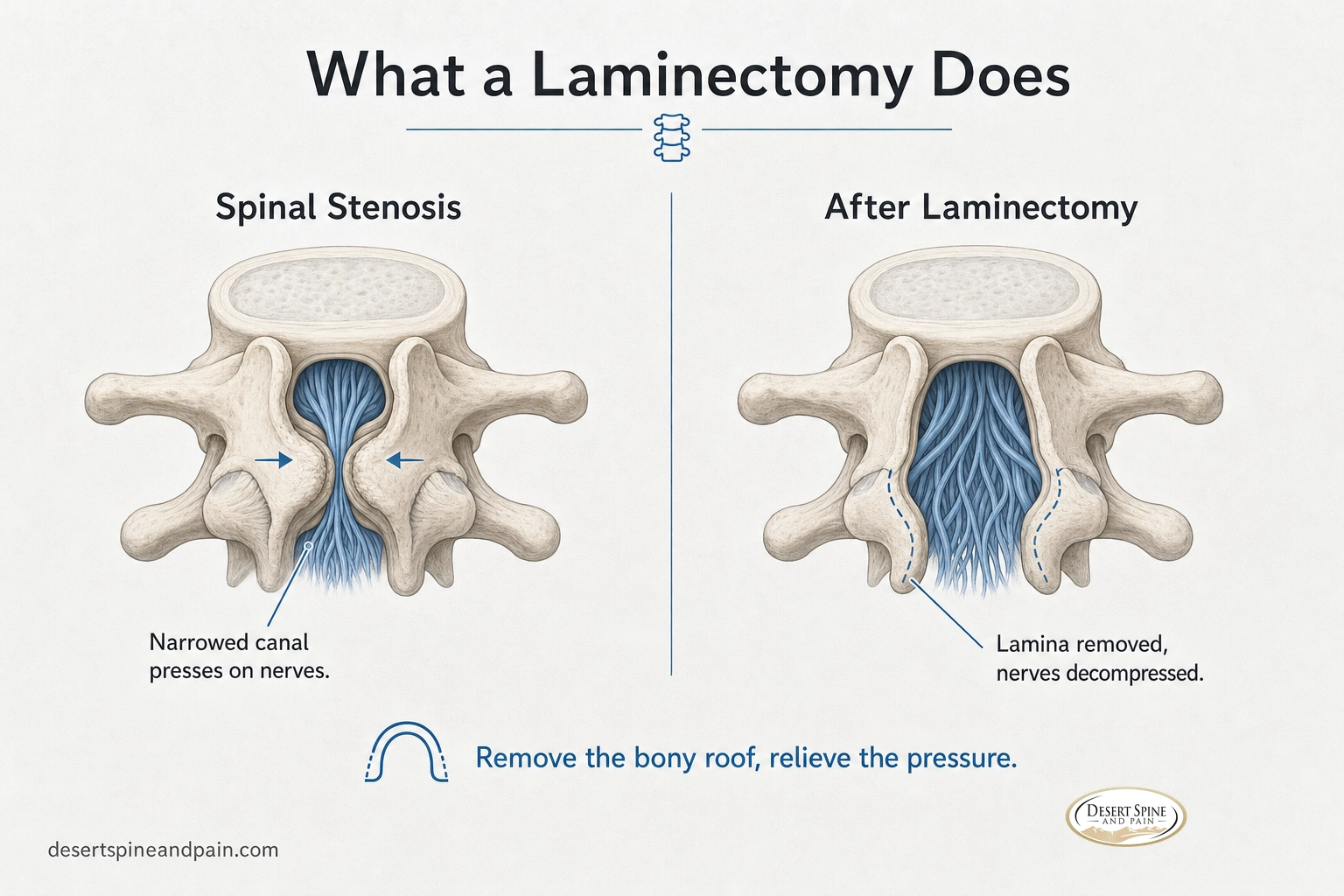
Each vertebra in your spine has a ring of bone at the back that forms a protective roof over the spinal canal, the tunnel that carries the spinal cord and nerve roots. That roof is the lamina. A laminectomy is the surgical removal of the lamina to open up that tunnel when it has become too tight.
A laminectomy removes the lamina, the arch of bone at the back of a vertebra, to widen a narrowed spinal canal and relieve pressure on the spinal cord and nerves. Because the goal is to decompress crowded nerves, it is often called a decompressive laminectomy, and it is the most common form of spinal decompression surgery.
Here is a simple way to picture it. Think of the spinal canal as a garden hose and the nerves as the water inside. When the walls of the hose thicken with age, or a bone spur or swollen ligament presses in, the flow gets pinched. A laminectomy does not touch the nerves themselves. It removes a section of the surrounding bone so the nerves have room again, the way widening the hose lets the water flow freely. The word comes straight from the anatomy: lamina (the bone) plus -ectomy (removal of).
A laminectomy can be done anywhere along the spine. In the lower back it is a lumbar laminectomy, in the neck a cervical laminectomy, and in the mid-back a thoracic laminectomy. The lumbar version is the most common by far. To understand how a laminectomy compares with the other decompression options a surgeon might consider, see our guide to laminectomy versus broader spinal decompression.
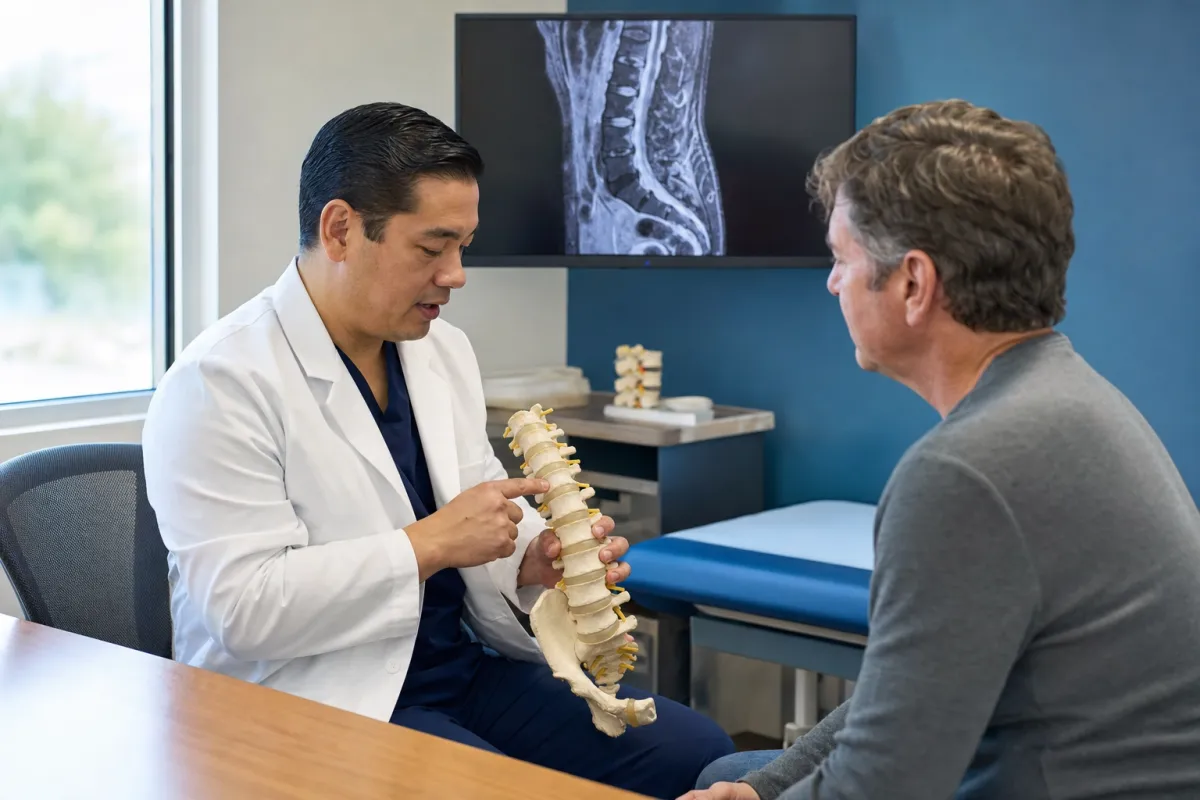
Learn about laminectomy at Desert Spine and PainSource: Baylor Medicine Spine Center, laminectomy overview
2Why a Laminectomy Is Done
A laminectomy is a decompression. It is done when something inside or around the spinal canal is pressing on the nerves and causing symptoms that have not settled with conservative care. By far the most common reason is spinal stenosis, a gradual narrowing of the canal that develops as the spine ages and bone, ligament, and disc thicken inward.
Stenosis typically produces a pattern called neurogenic claudication: leg pain, heaviness, or weakness that comes on with standing and walking and eases when you sit or lean forward. In the neck, canal narrowing can cause arm pain, numbness, clumsiness, or balance problems. Because this narrowing is so common with age, decompressive laminectomy is the most frequent reason spine surgery is performed in older adults.
Beyond age-related stenosis, a laminectomy may be recommended for other sources of pressure on the cord or nerves:
- Bone spurs (osteophytes) and thickened ligaments that crowd the canal.
- A herniated disc, when the surgeon needs to remove a small window of lamina to reach and remove the disc fragment.
- Spinal tumors inside or next to the canal that must be accessed and removed.
- Trauma or infection that has narrowed the canal or caused pressure.
Importantly, surgery is not the first step. A laminectomy is generally reserved for people whose imaging clearly shows compression that matches their symptoms, and who have not gotten lasting relief from time, activity changes, physical therapy, or injections. Our team starts with the least invasive option that can solve the problem, which is why we discuss conservative and non-invasive care before any operation is on the table.
See the spine conditions we treat
Source: Frontiers in Musculoskeletal Disorders, 2024
3How a Laminectomy Works, Step by Step
A laminectomy is done from the back, with the patient asleep under general anesthesia. The exact steps vary with the spine level and whether the surgeon uses an open or minimally invasive approach, but the sequence is consistent:
- Anesthesia and positioning. You are placed face down and fully asleep. The surgical area is numbed further and sterilized.
- Incision. A small incision is made over the affected vertebrae in the middle of the back or neck. Minimally invasive techniques use a smaller opening and tubular retractors that spread rather than cut the muscle.
- Exposure. The surgeon gently moves the back muscles aside to reach the lamina.
- Removing the lamina. Using fine instruments and a surgical drill, the surgeon removes part or all of the lamina, lifting the bony roof off the crowded canal.
- Decompression. Any additional sources of pressure, such as a bone spur, a thickened ligament, or a disc fragment, are trimmed away so the nerves have room.
- Checking and closing. The surgeon confirms the spinal cord and nerve roots have enough space, then closes the incision in layers.
At Desert Spine and Pain, our board-certified neurosurgeon and spine surgeon favors the least invasive approach that will fully decompress the nerve, removing exactly what is pinching it and preserving as much stabilizing bone and joint as possible. That precision is what keeps most laminectomies decompression-only, with no need for added hardware. For the operations that go through smaller incisions, see our overview of minimally invasive spine surgery.
Meet Dr. GreenwaldSource: Center for Orthopaedics, laminectomy FAQ
4Laminectomy vs. Laminotomy
The term most often confused with laminectomy is laminotomy, and the difference is right there in the ending. A laminectomy (-ectomy, removal) takes out the entire lamina. A laminotomy (-otomy, to cut or make an opening) removes only a part of it, creating a smaller window over a single nerve. Both relieve pressure; they differ in how much bone comes out and how broad the decompression is.
| Factor | Laminectomy | Laminotomy |
|---|---|---|
| How much lamina is removed | The whole bony arch | Only a portion of it |
| Size of the opening | Broad, opens the canal widely | A smaller, targeted window |
| Best for | Widespread narrowing (stenosis) at a level | Pressure over one nerve, or reaching a disc |
| Bone preserved | Less, the arch is taken | More stabilizing bone kept |
| Common goal | Decompress a crowded canal | Limited decompression or disc access |
Not true. A laminectomy removes only the lamina, a small arch at the back of the vertebra, not the vertebral body that bears your weight. And a laminectomy by itself does not fuse anything. Fusion is a separate step added only when the spine is unstable or would become unstable after decompression, which is the minority of cases. Confusing decompression with fusion leads people to expect a bigger operation and a longer recovery than most laminectomies actually involve.
These naming differences matter when you are reading your imaging report or surgical plan. For a closer look at the narrower procedure, see our comparison of laminotomy versus laminectomy, and if a herniated disc is your main issue, our guide to discectomy versus laminectomy explains which operation fits which problem.
Explore spinal decompression optionsSource: Center for Orthopaedics, laminectomy FAQ | Baylor Medicine

5The Main Types of Laminectomy
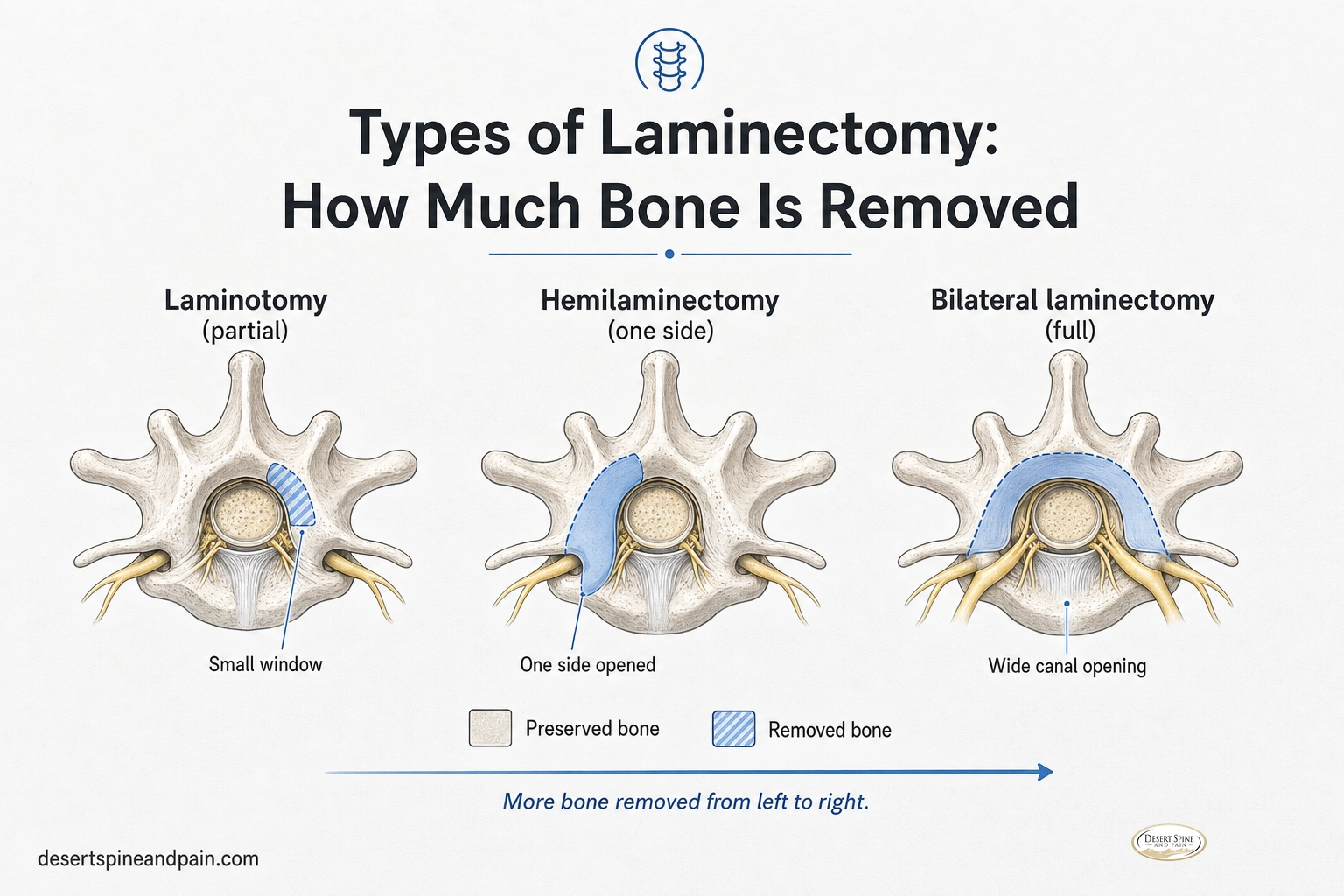
You will see several variations of the word, and they describe how much bone is removed and where. Here is what each one means in plain language:
- Decompressive (or decompression) laminectomy: the standard procedure, named for its purpose, relieving pressure on the nerves by removing the lamina.
- Partial laminectomy: only a portion of the lamina is removed rather than the full arch, preserving more bone. This overlaps closely with a laminotomy.
- Hemilaminectomy: the lamina is removed on only one side, when the compression is one-sided. Our comparison of hemilaminectomy versus laminectomy goes into the detail.
- Bilateral laminectomy: bone is removed on both sides of the canal, used when the narrowing crowds the nerves from both directions.
- Double laminectomy: an informal term that usually means a laminectomy performed at two spinal levels (two vertebrae) in the same operation.
- Cervical, thoracic, or lumbar laminectomy: the same procedure named for the region of the spine, the neck, mid-back, or lower back.
One practical note on the neck: a cervical laminectomy more often needs a fusion added, because removing bone there can affect stability. A lumbar laminectomy for stenosis is usually decompression-only. The right variation is chosen to remove exactly what is compressing the nerve while keeping the spine stable, never more bone than necessary.
Explore spine surgery at Desert Spine and Pain
Source: Center for Orthopaedics, laminectomy FAQ
6Recovery and What to Expect
Recovery from a laminectomy is usually more manageable than people expect, especially for a single-level lumbar decompression. Much of it depends on how many levels were treated, whether a fusion was added, your age, and your overall health, but the general timeline is well established.
A realistic week-by-week picture looks like this:
- Days 3 to 5: light activities and self-care, with short walks encouraged early.
- Weeks 2 to 4: physical therapy often begins if it is needed, and driving usually resumes once you are off narcotic pain medication, commonly around two to three weeks.
- Weeks 3 to 6: most people return to desk or low-demand work.
- Months 3 to 4 or longer: heavy labor and demanding physical jobs resume.
- Follow-up: visits are typically scheduled at two weeks, six weeks, three months, six months, and one year.
The single most important thing you can do is walk, a little and often, from the first days. It protects the result and lowers the risk of complications. For practical, surgeon-backed advice on the weeks after surgery, see our laminectomy recovery tips, and for the exact time in the operating room, our guide to how long laminectomy surgery takes.
Learn about stenosis surgery optionsSource: Center for Orthopaedics, laminectomy FAQ | Baylor Medicine
7Risks and Success Rates
A laminectomy is a common, well-studied operation, and for the right patient it reliably relieves the leg symptoms and walking limits of stenosis. Like any surgery, it carries risks, and understanding them is part of making a good decision.
Durability is good but not guaranteed, which is honest and worth knowing. The stated figure above comes from a four-year study in which success meant sustained improvement in at least two of three measured domains. Many patients do better than the average, especially when the diagnosis is precise and the decompression is matched exactly to the compression. The deeper outcome numbers, including long-term reoperation and how long relief tends to last, are covered in our laminectomy statistics and how many years a laminectomy lasts.
The main risks a surgeon discusses before a laminectomy include:
- Bleeding and infection, the general risks of any surgery.
- Dural tear (CSF leak), a small injury to the sac around the nerves, usually repaired during the operation.
- Nerve root injury, uncommon, but it can cause new weakness or numbness.
- Persistent or returning pain, if the compression recurs or was not the full source of symptoms.
- Instability, when removing bone leaves the segment less stable, which is the situation that may call for a fusion.
Pulling together the clinical picture, that stenosis is a broad, bony problem, that cervical levels are more prone to instability than lumbar ones, and that fusion is reserved for unstable segments, explains why a well-planned lumbar laminectomy so often needs no hardware at all. Removing only the bone that is pinching the nerve, and preserving the joints and the vertebral body, keeps the segment stable and avoids the longer recovery that comes with fusion. The surgical judgment of how much to remove, made before the first incision, is therefore the quiet driver of both a good result and an easier recovery. Calculation and interpretation original to Desert Spine and Pain.
Source: Frontiers in Musculoskeletal Disorders, 2024 | Center for Orthopaedics, laminectomy FAQ
8How to Know If a Laminectomy Is Right for You
A laminectomy tends to be the right operation when a few things line up: imaging shows clear narrowing or pressure in the spinal canal, that finding matches your symptoms (leg pain and trouble walking for lumbar stenosis, arm or balance problems for cervical), and conservative care has stopped giving relief. It is far less likely to help if the pictures and the pain do not point to the same place, which is exactly why a careful evaluation comes first.
The most valuable step before any spine surgery is confirming the diagnosis with a surgeon who can tell whether decompression alone will solve the problem. Dr. David L. Greenwald is a dual board-certified spine surgeon and neurosurgeon who takes the time to match the operation to the true source of pressure, and he reserves fusion for the cases that genuinely need it. Desert Spine and Pain in Phoenix works with out-of-network patients of every kind and partners closely with personal injury attorneys, offering 24/7 concierge response and documentation coordination for injured clients.
If you have been told you need a laminectomy, or you are simply trying to understand your options, a consultation or second opinion is the smartest next step. You can also weigh the cost side of the decision in our guide to laminectomy surgery cost.
Book a consultation: (602) 566-95009Related Spine Terms
- Spinal stenosis: narrowing of the spinal canal that pinches the nerves, the condition a laminectomy most often treats. See the spine conditions we treat.
- Laminotomy: removal of only part of the lamina, a more limited decompression. Compare laminotomy versus laminectomy.
- Discectomy: removal of herniated disc material pressing on a nerve, sometimes done together with a laminectomy. See discectomy versus laminectomy.
- Spinal fusion: joining two vertebrae to stabilize the spine, added to a decompression only when stability is a concern. Learn about spinal fusion.
- Foraminotomy: widening the small opening where a nerve exits the spine, another form of targeted decompression.
- Decompression surgery: the broad category of operations that relieve pressure on the spinal nerves. See decompression surgery statistics.
- Neurogenic claudication: the hallmark symptom of stenosis, leg pain and heaviness with walking that eases when you sit.
Frequently Asked Questions
What is a laminectomy?
What conditions does a laminectomy treat?
How long does it take to recover from a laminectomy?
Does a laminectomy require spinal fusion?
What is the difference between a laminectomy and a laminotomy?
Methodology & Sources
How we compiled this guide
Figures trace to Tier 1 primary and specialty sources. The lumbar stenosis prevalence (over 10% of older adults), the statement that decompressive laminectomy is the most common indication for spine surgery in older adults, and the four-year success figure (62.7% with sustained improvement in at least two of three domains) come from a 2024 analysis published in Frontiers in Musculoskeletal Disorders. Procedure length (about one to one and a half hours for a single level), hospital stay, the week-by-week recovery milestones, and the list of surgical risks come from the Center for Orthopaedics laminectomy reference. The anatomical definition of the lamina and same-day discharge detail come from the Baylor Medicine Spine Center. All statistics describe populations, not any individual patient, and timelines are typical ranges that vary with the number of levels treated, age, and overall health.
Primary sources referenced:
- Preoperative factors and four-year decompressive laminectomy success in symptomatic lumbar spinal stenosis. Frontiers in Musculoskeletal Disorders, 2024.
- Laminectomy FAQ (procedure, duration, recovery, risks). Center for Orthopaedics.
- Laminectomy overview (definition, anatomy, hospital stay). Baylor Medicine Spine Center.
This article is educational and is not individual medical advice. For guidance specific to your spine condition, consult a qualified spine surgeon. No outcome can be guaranteed.
Journalists and researchers may cite these statistics with attribution to Desert Spine and Pain and a link to this page. Please attribute the underlying figures to their original Tier 1 sources as listed above. For expert commentary on spine decompression surgery from a board-certified neurosurgeon and spine surgeon, contact Desert Spine and Pain at (602) 566-9500.