
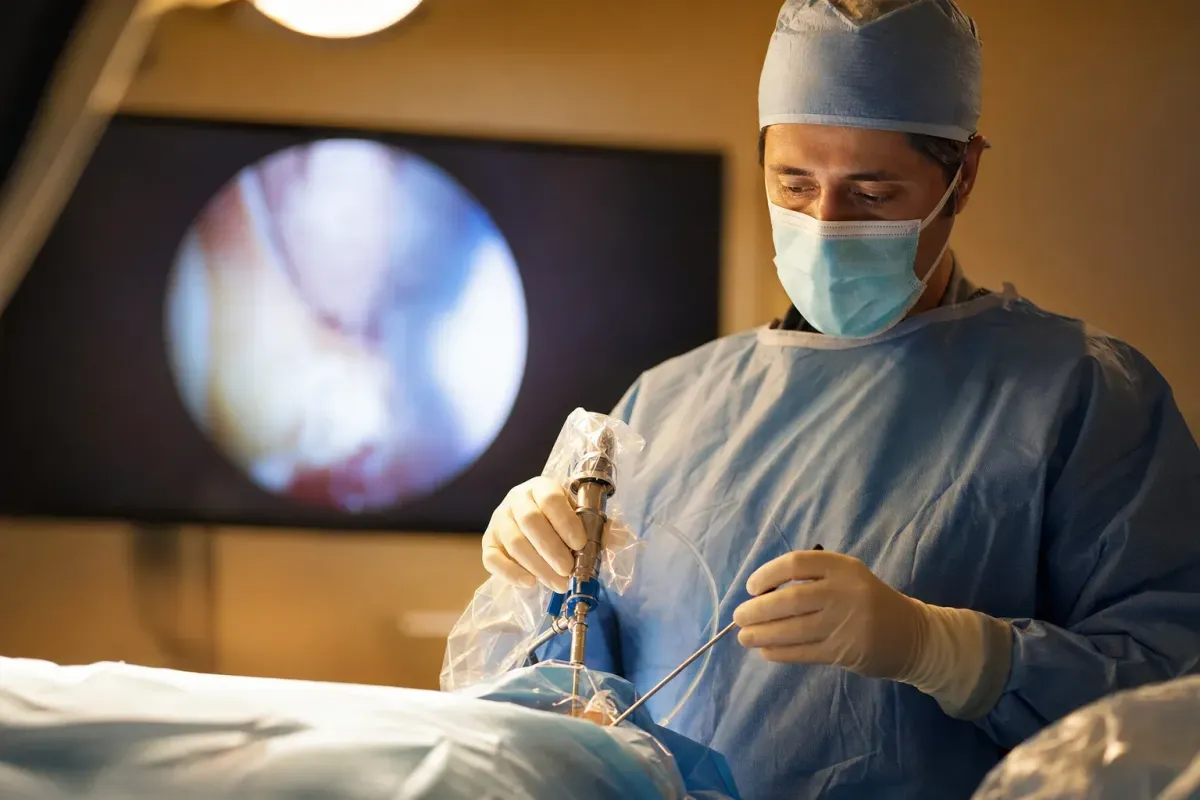
Decompression Surgery Statistics (2026): Success Rates by Technique
Spinal decompression is a family of procedures that relieve pressure on pinched nerves, with success rates of 71 to 90 percent and modern minimally invasive versions reaching excellent or good outcomes in 90 to 97 percent of patients. Increasingly, the data shows decompression alone matches more extensive fusion for many patients, at lower cost and with faster recovery.
- Spinal decompression success rates are generally 71 to 90 percent for relieving leg pain, back pain, and disability.
- Minimally invasive unilateral laminotomy with bilateral decompression reports excellent or good outcomes in about 90 to 97 percent of patients.
- In a two-level stenosis study, biportal endoscopic decompression achieved a 96.9 percent excellent-or-good rate with no postoperative complications.
- Endoscopic decompression matched minimally invasive fusion on clinical outcomes (90.6 versus 93.8 percent excellent or good), with shorter stays and lower cost.
- A systematic review found an overall complication rate of 18 to 20 percent, mostly minor, with dural tear at 3.6 to 9 percent.
- Insufficient decompression occurred in only about 3 percent of reported cases.
- Decompression is a family of techniques, so matching the right one to the patient is central to a good outcome.
What's in This Guide
1What Decompression Surgery Includes
Spinal decompression is not a single operation but a family of procedures that remove bone or soft tissue to reduce pressure on the spinal cord and nerve roots. The right one depends on where and how the nerves are compressed.
| Procedure | What It Does | Common Use |
|---|---|---|
| Laminectomy | Removes the lamina (bony roof) | Central stenosis |
| Laminotomy | Removes part of the lamina | Targeted, less bone removed |
| Foraminotomy | Widens the nerve exit opening | Foraminal stenosis |
| Facetectomy | Removes part of a facet joint | Lateral compression |
| Discectomy | Removes herniated disc material | Disc herniation |
| ULBD | Unilateral laminotomy, bilateral decompression | Minimally invasive stenosis |
The trend in decompression has been toward removing only what is necessary to free the nerves while preserving as much stabilizing bone and joint as possible. This tissue-sparing philosophy is why techniques like unilateral laminotomy with bilateral decompression (ULBD) have grown popular, and why decompression can often avoid the need for a fusion.
Our Phoenix practice, led by board-certified neurosurgeon and spine surgeon Dr. David L. Greenwald, MD, FACS, favors the least invasive effective decompression for each patient's specific pattern of nerve compression.
Explore decompression surgery in PhoenixSource: Peer-reviewed compilation, Spine Together
2Success Rates by Technique
Decompression is one of the more reliable spine operations, particularly for leg pain and walking difficulty caused by nerve compression. Success rates are consistently strong across techniques.
Reported success clusters in the 71 to 90 percent range, with laminectomy and modern minimally invasive techniques often at the higher end for well-selected stenosis patients. Notably, the rate of technically insufficient decompression is very low, around 3 percent, meaning the operation reliably achieves its mechanical goal of freeing the nerves. What varies more is whether the freed nerve was the true source of the patient's symptoms, which comes back to diagnosis.
Learn about laminectomySource: ULBD systematic review, PMC
3Minimally Invasive and Endoscopic Decompression
The biggest advance in decompression has been the shift toward minimally invasive and endoscopic techniques, which achieve the same nerve decompression through much smaller corridors.
Excellent or Good Outcomes by Minimally Invasive Decompression Technique
Excellent or good outcomes (modified MacNab). Sources: BS-UBE-ULBD study; LE-ULBD vs MIS-TLIF study.
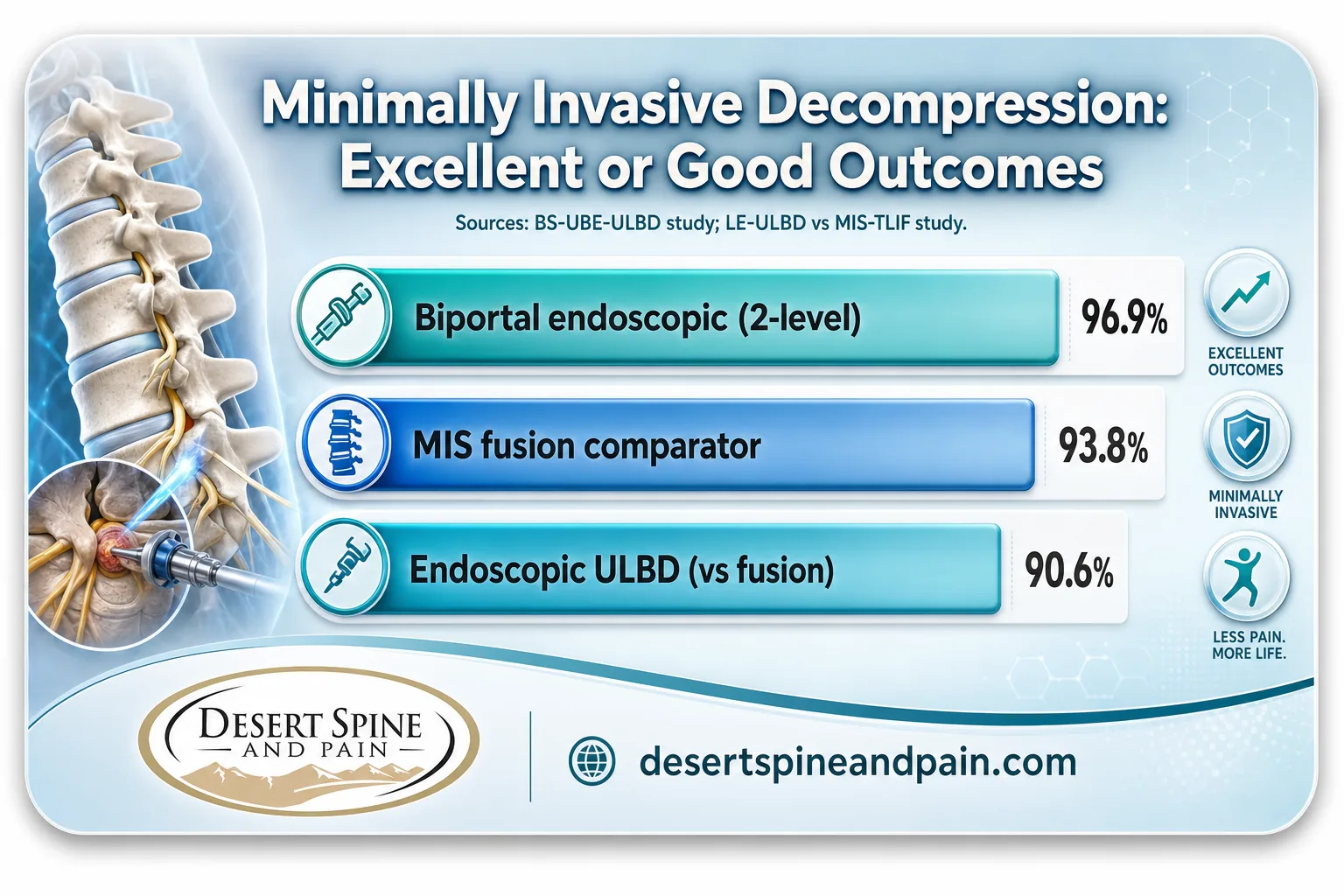
The endoscopic data is striking: excellent or good outcomes near 97 percent for two-level stenosis, with no postoperative complications in one series. When compared head to head with minimally invasive fusion, endoscopic decompression matched clinical outcomes while producing shorter recovery and lower cost. For suitable patients, this is decompression at its most refined.
See minimally invasive spine optionsSource: Biportal endoscopic decompression study, PMC | Endoscopic decompression vs MIS fusion, PMC
4Decompression vs Fusion
One of the most practical questions in spine surgery is whether a patient needs decompression alone or decompression plus a fusion. The evidence increasingly favors the simpler operation for many stenosis patients.
In head-to-head studies, endoscopic decompression matched minimally invasive fusion on pain, disability, and satisfaction for one-level stenosis with mild spondylolisthesis, while using less blood, shorter hospital time, and lower cost. This aligns with the broader randomized-trial evidence that fusion often adds burden without adding benefit for stable stenosis. Fusion remains the right choice when instability or deformity is present.
The decompression data says otherwise. For many stenosis patients, a targeted decompression matches a larger fusion on pain relief and function, while causing less blood loss, a shorter stay, and lower cost. Doing more is not doing better when the extra surgery does not address the actual problem. The skill lies in achieving complete nerve decompression through the least disruptive approach, not in performing the biggest operation.
Source: Endoscopic decompression vs MIS fusion comparison, PMC
5Complications and Safety
Decompression is generally a safe operation, and its complication profile is well documented, especially for the minimally invasive techniques.
The systematic review concluded that unilateral laminotomy with bilateral decompression has favorable short- and mid-term pain and functional outcomes with low recurrence and complication rates. Most complications are minor and manageable, with dural tear being the main technical risk. As with all spine surgery, complication rates are lower in experienced hands, and modern minimally invasive techniques further reduce tissue trauma.
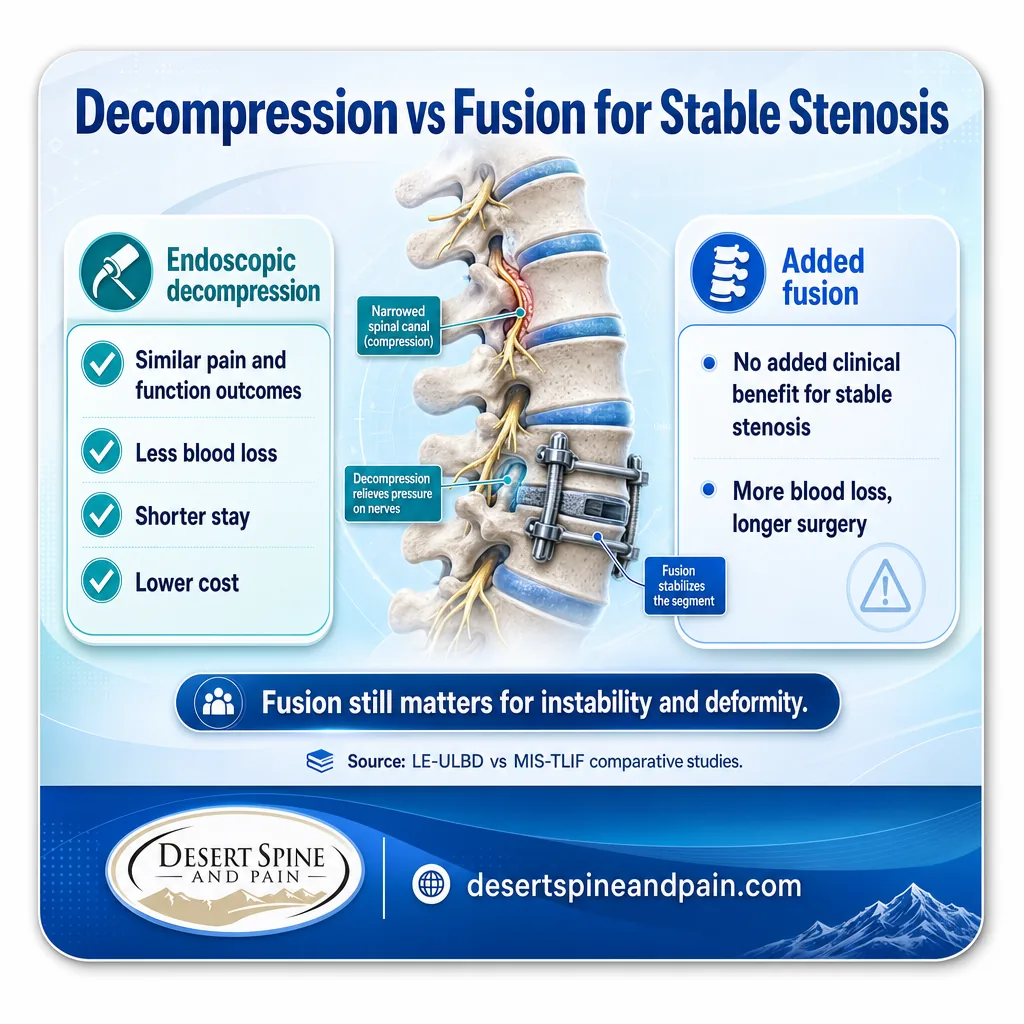
The decompression data points to a single principle: the goal is complete relief of nerve pressure with the least possible disruption to the spine. Endoscopic and minimally invasive techniques now match open surgery and even fusion on outcomes while reducing blood loss, hospital time, and cost. Achieving that balance, thorough decompression through a small, tissue-sparing corridor, is a technical skill that rewards experience and precise diagnosis. Interpretation original to Desert Spine and Pain.
Desert Spine and Pain works with out-of-network patients of every kind and partners closely with personal injury attorneys, offering 24/7 concierge response and documentation coordination for injured clients.
Review stenosis treatment optionsSource: ULBD systematic review of outcomes and complications, PMC
Summary Table: Decompression Statistics 2026
| Statistic | Figure | Source | Year |
|---|---|---|---|
| General decompression success rate | 71 to 90% | Peer-reviewed compilation | 2026 |
| Laminectomy decompression success | 85 to 90% | Decompressive surgery literature | 2025 |
| Biportal endoscopic ULBD, excellent/good (2-level) | 96.9% | BS-UBE-ULBD study | 2024 |
| Endoscopic ULBD excellent/good (vs fusion) | 90.6% | LE-ULBD vs MIS-TLIF study | 2021 |
| MIS fusion comparator excellent/good | 93.8% | LE-ULBD vs MIS-TLIF study | 2021 |
| Insufficient decompression rate | ~3% | ULBD systematic review | 2023 |
| Overall complication rate (ULBD) | 18 to 20% | ULBD systematic review | 2023 |
| Dural tear rate (ULBD) | 3.6 to 9% | ULBD systematic review | 2023 |
| Hematoma rate (ULBD) | 0 to 4% | ULBD systematic review | 2023 |
| VAS improvement (ULBD) | 4.2-7.5 to 1.4-3.0 | ULBD systematic review | 2023 |
| Decompression vs fusion clinical outcome | No significant difference | LE-ULBD vs MIS-TLIF study | 2021 |
| Endoscopic decompression cost vs fusion | Lower | LE-ULBD vs MIS-TLIF study | 2021 |
| Recovery / return to activity | 4 to 6 weeks | Peer-reviewed compilation | 2026 |
Frequently Asked Questions
What is the success rate of spinal decompression surgery?
What types of spinal decompression surgery are there?
Is minimally invasive decompression as effective as open surgery?
What are the risks of decompression surgery?
Is decompression better than fusion for stenosis?
Methodology & Sources
How we compiled these statistics
Every figure traces to a Tier 1 primary source: systematic reviews, comparative cohort studies, and randomized data. Success and complication ranges reflect differences in technique, diagnosis, follow-up length, and how outcomes are defined. Decompression covers a family of procedures, so figures are reported by technique where possible. All statistics describe populations, not any individual patient.
Primary sources referenced:
- Unilateral laminotomy with bilateral spinal canal decompression: systematic review of outcomes and complications, PMC
- Bilateral synchronous UBE for unilateral laminotomy and bilateral decompression for two-level lumbar stenosis, PMC
- Lumbar endoscopic unilateral laminotomy bilateral decompression versus minimally invasive TLIF for one-level stenosis with spondylolisthesis, PMC
- Preoperative factors and four-year decompressive laminectomy success in lumbar stenosis, Frontiers in Musculoskeletal Disorders
- Peer-reviewed success and recovery compilation, Spine Together
This article is educational and is not individual medical advice. For guidance specific to your spine condition, consult a qualified spine surgeon. No outcome can be guaranteed.
Journalists and researchers may cite these statistics with attribution to Desert Spine and Pain and a link to this page. Please attribute the underlying figures to their original Tier 1 sources as listed above. For expert commentary on decompression surgery data from a board-certified neurosurgeon and spine surgeon, contact Desert Spine and Pain at (602) 566-9500.