

Hemilaminectomy vs. Laminectomy: What's the Difference?
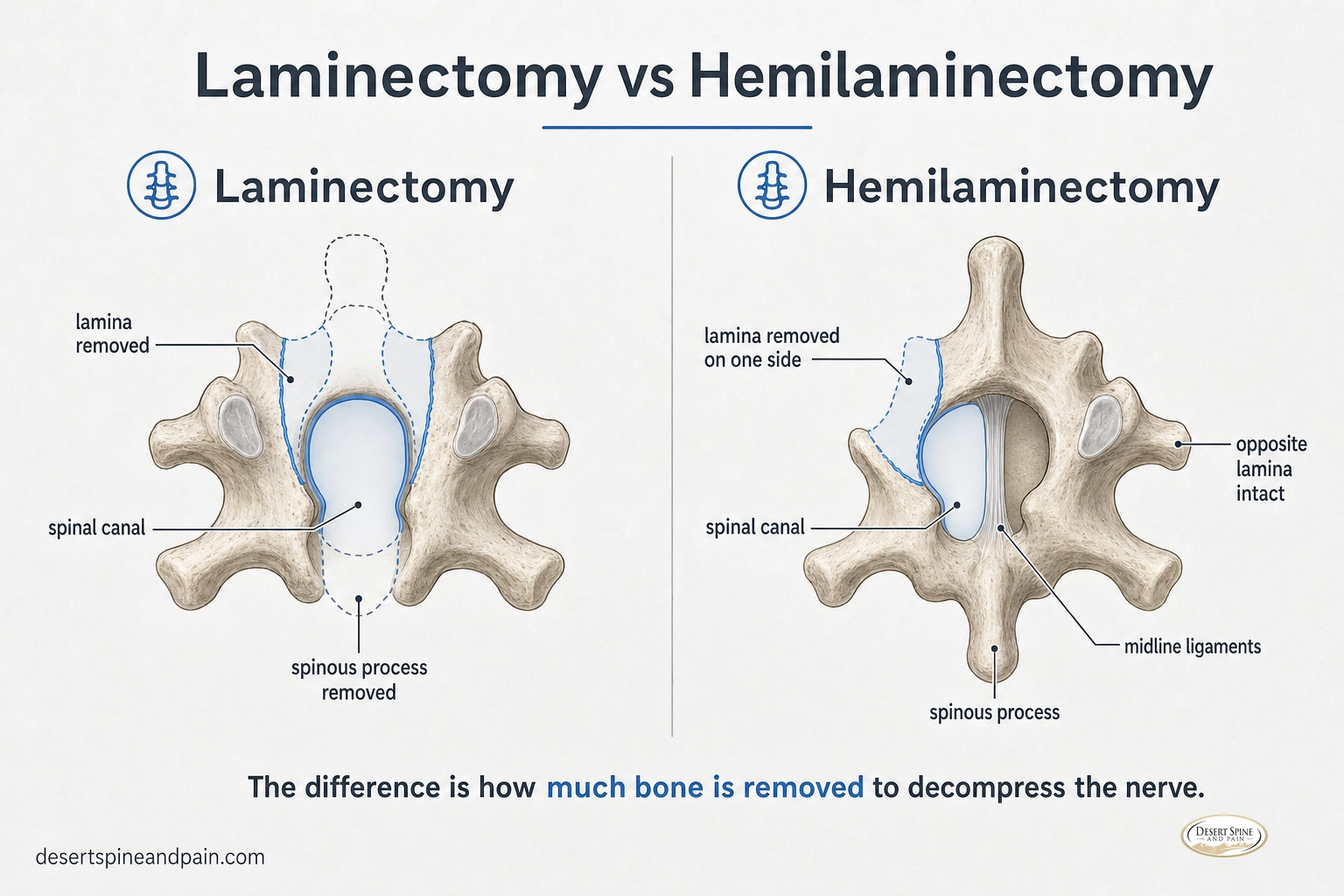
A hemilaminectomy and a laminectomy both relieve pressure on compressed spinal nerves by removing bone from the back of a vertebra. The difference is how much. A laminectomy removes the full lamina, the bony roof of the spinal canal, usually on both sides plus the spinous process. A hemilaminectomy removes only the lamina on the side where the nerve is pinched and leaves the midline bone and ligaments intact.
If a surgeon has recommended a decompression for your back or neck, you have probably seen both of these words and wondered whether one is a bigger deal than the other. They are not two names for the same surgery, and they are not competing brands. They are points on a spectrum of how much bone a surgeon removes to free a trapped nerve. That choice matters, because lumbar spinal stenosis alone affects roughly 11 percent of older adults in the United States and drives about 600,000 surgical decompressions every year, according to a 2022 review in JAMA. Understanding the difference helps you ask better questions and understand your own operative plan.
Key Takeaways
- Same goal, different amount of bone. Both operations decompress a pinched nerve. A laminectomy removes the full lamina (often both sides plus the spinous process); a hemilaminectomy removes only one side.
- Hemilaminectomy preserves midline stability. By sparing the spinous process, the midline ligaments, and the opposite lamina, it keeps more of the spine's natural support, which is linked to less post-operative deformity.
- Laminectomy gives a wider view. Removing the whole arch exposes the entire canal, which can be the better choice for compression on both sides or across several levels, or for larger tumors.
- Hemilaminectomy is often the smaller, faster-recovery option and lends itself to minimally invasive, muscle-sparing surgery.
- The decision is individual. Where the compression sits, how severe it is, how many levels are involved, and your spine's existing stability all steer the choice.

What's in This Guide
How Each Procedure Works
Picture a single vertebra from behind. The spinal cord and nerve roots run through a tunnel in the middle called the spinal canal. The roof of that tunnel is formed by two flat plates of bone, the laminae (one on the left, one on the right), that meet at a central bony ridge you can feel down the middle of your back, the spinous process. When something crowds the canal, a bulging disc, a bone spur, thickened ligament, or the narrowing called spinal stenosis, the nerves get squeezed and you feel pain, numbness, or weakness.
A laminectomy lifts off the roof. The surgeon removes the full lamina, typically on both sides, along with the spinous process, which opens the canal widely and takes pressure off the nerves. Yale Medicine describes it as removing the lamina to enlarge the canal, which is why it is also called open decompression. It gives the surgeon a direct, panoramic view of the whole canal at that level.
A hemilaminectomy opens only half the roof. "Hemi" means half, so the surgeon removes the lamina on just the side where the nerve is compressed and leaves the spinous process, the midline ligaments, and the opposite lamina in place. Think of it as taking out one roofing panel to reach the problem rather than removing the entire roof and the central beam. Because it stays on one side, a hemilaminectomy is well suited to minimally invasive, muscle-sparing surgery through a small incision.
Both belong to the same family of decompression operations, which also includes a laminotomy, a smaller window cut in the lamina, and a laminoplasty, which hinges the bone open instead of removing it. If you are new to the whole category, our overview of what a laminectomy is is a good starting point.
Source: Yale Medicine | StatPearls (NCBI Bookshelf)
Hemilaminectomy vs. Laminectomy: Side by Side
The two operations differ in scope, not in purpose. This table lays out where they diverge in practice.
| Factor | Hemilaminectomy | Laminectomy |
|---|---|---|
| Bone removed | Lamina on one side only | Full lamina, usually both sides, plus the spinous process |
| Midline structures | Spinous process and ligaments preserved | Spinous process and midline ligaments removed |
| Exposure of the canal | One side, targeted | Wide, both sides of the whole level |
| Effect on stability | Preserves more natural support | Larger bone removal, higher chance of needing fusion |
| Best fit | One-sided compression, single or limited levels | Two-sided or multi-level compression, larger tumors |
| Minimally invasive option | Well suited to tubular, muscle-sparing technique | Possible, but wide exposure often favors open surgery |
| Typical recovery | Generally shorter early recovery | Can be longer, longer still if fused |
In short, a hemilaminectomy is the more conservative, tissue-sparing operation, and a laminectomy is the more complete, wider-access operation. One is not inherently better than the other. The correct answer is whichever one matches the shape of your problem.
How Much Bone Comes Out, and Why Stability Matters
The spinous process and the ligaments that attach to it are not just padding. They are part of what holds your spine in alignment and resists it tipping forward. Remove them and you widen the canal, but you also give up some of that built-in support. That is the central trade-off between these two operations.
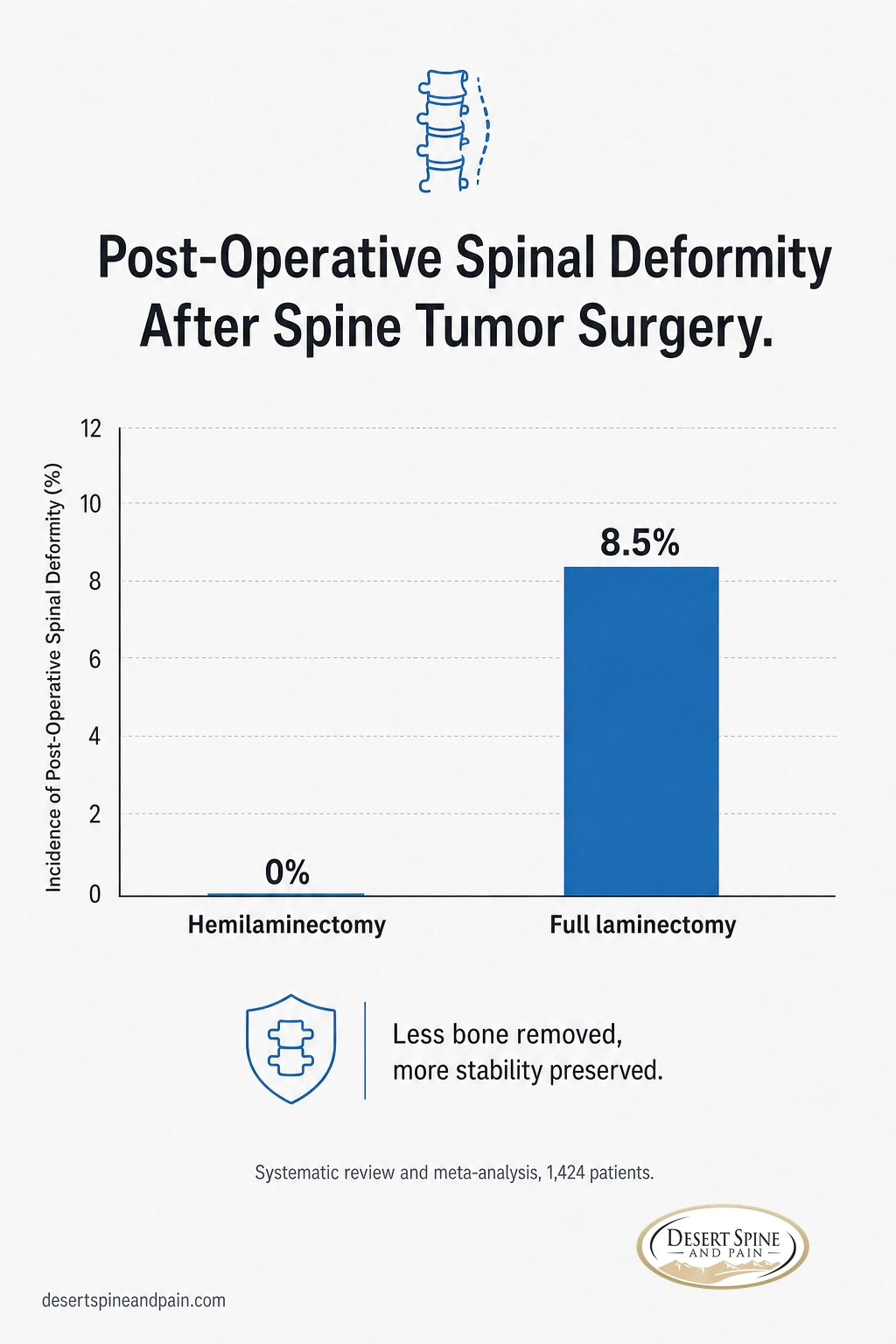
The difference shows up in the research. A systematic review and meta-analysis of 13 studies and 1,424 patients undergoing spinal tumor surgery compared unilateral hemilaminectomy with full laminectomy. Post-operative spinal deformity occurred in none of the 302 hemilaminectomy patients, versus about 8.5 percent of the 295 laminectomy patients, a statistically significant difference favoring the smaller operation. The same analysis found shorter operative times, less blood loss, and shorter hospital stays with hemilaminectomy.
The fusion myth
A common fear is that a laminectomy automatically means a spinal fusion with rods and screws. That is not true. Many laminectomies are done without fusion. A surgeon adds fusion only when removing bone and ligament would leave the spine unstable, such as when a facet joint also has to be removed or when there is pre-existing slippage. A hemilaminectomy, by sparing the midline, less often reaches that threshold. Removing more bone than the problem requires is not an advantage, which is exactly why surgeons remove as little as the decompression allows.
Keep the numbers above in context. That deformity comparison comes from tumor surgery, where the operations can be more extensive, and most of the supporting studies are small and retrospective. The takeaway is directional and sound: less bone removed, generally more stability preserved.
Source: Annals of Palliative Medicine systematic review and meta-analysis

When a Surgeon Chooses One Over the Other
The choice is driven by the anatomy of your specific problem, confirmed on an MRI or CT scan. A few patterns guide the decision.
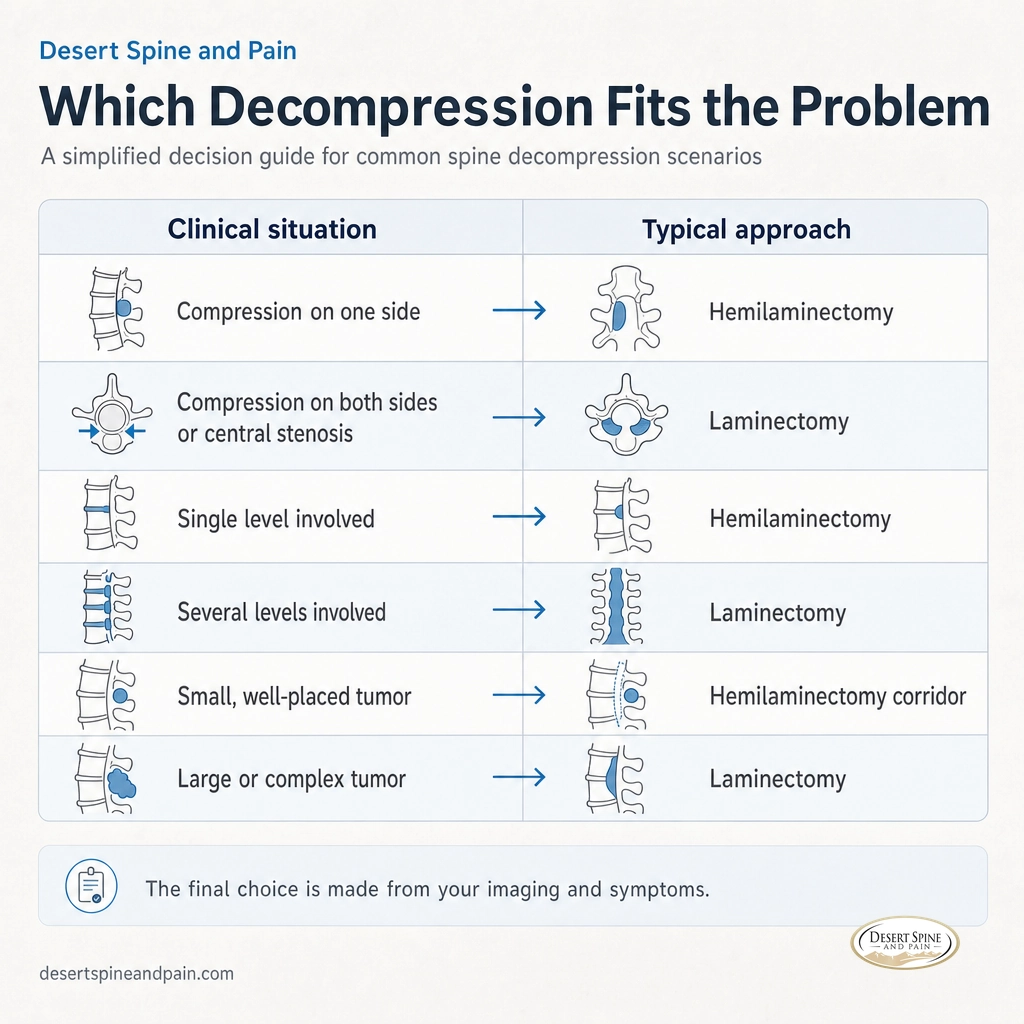
Where the compression sits. If a nerve is pinched on one side (classic one-sided sciatica from a disc or a bone spur), a hemilaminectomy can reach it directly without disturbing the healthy side. If the canal is squeezed from both sides, which is common in central spinal stenosis, a laminectomy that opens both sides is often the more reliable decompression.
How many levels are involved. A single pinched level is a natural candidate for a targeted hemilaminectomy. Several adjacent narrowed levels may be handled more completely with laminectomy.
What else is going on. For spinal tumors, surgeons weigh the size and position of the mass. Smaller, well-placed tumors can often be removed through the narrower hemilaminectomy corridor, while larger or more complex tumors may need the full bilateral exposure of a laminectomy, which lets the surgeon see the entire canal and both neural foramina. The same logic applies to removing a disc fragment versus a wide swath of thickened ligament.
Whichever decompression is chosen, surgery is usually reserved for people whose leg or back symptoms have not settled with non-surgical care. The landmark SPORT trial found that patients who had surgery for lumbar spinal stenosis kept substantially greater pain relief and functional improvement than those managed without surgery through four years of follow-up, which is why a careful diagnosis and an experienced surgeon matter so much. Dr. David L. Greenwald, a dual board-certified spine surgeon and neurosurgeon, tailors the decompression to each patient rather than applying one default operation.
Source: JAMA, Diagnosis and Management of Lumbar Spinal Stenosis (2022) | SPORT four-year outcomes (Spine, 2010)
Recovery and Results: What to Expect
Because a hemilaminectomy removes less bone and can be done through a smaller, muscle-sparing approach, it tends to involve a shorter hospital stay and a faster early recovery. Many single-level decompressions are now same-day or short-stay procedures, with light walking encouraged almost immediately and a gradual return to normal activity over the following weeks. A laminectomy, especially across multiple levels or combined with a fusion, generally asks for a longer recovery runway.
That said, the honest picture is that high-quality head-to-head data is limited. Some comparative series show a clear hospital-stay advantage for hemilaminectomy, while at least one retrospective review found no significant difference in length of stay between the two for tumor surgery. Your real recovery depends on your diagnosis, the number of levels treated, your general health, and how closely you follow your rehab plan. Our laminectomy recovery tips and the question of how long the results of a laminectomy last go deeper on what to expect after either operation. A small number of patients develop ongoing symptoms known as post-laminectomy syndrome, which is worth understanding before surgery.
Source: Annals of Palliative Medicine meta-analysis | The Optimal Surgical Approach to Intradural Spinal Tumors
How to Decide Which Is Right for You
You do not have to choose between a hemilaminectomy and a laminectomy on your own. That is the surgeon's call, made from your imaging and your symptoms. Your job is to make sure the recommendation is the right fit. A few practical steps help.
- Get the diagnosis pinned down. A decompression only helps if the compression is clearly identified on imaging and matches your symptoms. Insist on seeing your MRI or CT with the surgeon.
- Ask how much bone is coming out, and why. A good surgeon can explain in plain terms why your problem calls for one side or both, and one level or several.
- Ask about stability and fusion. Find out whether your spine will still be stable after decompression, and whether a fusion is planned. If it is, ask what makes it necessary.
- Ask whether a minimally invasive approach is an option. For one-sided problems, a tubular hemilaminectomy may spare muscle and speed recovery.
- Consider a second opinion for a major operation. It is reasonable to confirm the plan with an experienced spine specialist before any multi-level or fusion surgery.
At Desert Spine and Pain's decompression program, the operation is matched to the problem, with the goal of removing exactly as much bone as the decompression needs and no more. If you are weighing a laminectomy or hemilaminectomy, a consultation is the fastest way to get a clear, individualized answer.
Explore laminectomy and decompression surgery
Frequently Asked Questions
Is a hemilaminectomy the same as a laminectomy?
Is a hemilaminectomy safer than a laminectomy?
Which has a faster recovery, a hemilaminectomy or a laminectomy?
Does a laminectomy always require a spinal fusion?
Can a hemilaminectomy be done minimally invasively?
Related Spine Terms
- Laminectomy: removal of the full lamina to open the spinal canal and decompress the nerves.
- Laminotomy: a smaller window cut within the lamina rather than removing it entirely.
- Laminoplasty: hinging the lamina open to enlarge the canal while keeping the bone, used mainly in the neck.
- Discectomy: removal of herniated disc material, often paired with a small bone opening.
- Facetectomy: removal of part or all of a facet joint, which can affect spinal stability.
- Spinal stenosis: narrowing of the spinal canal that crowds the nerves, the most common reason for a decompression.
- Spinous process: the central bony ridge of a vertebra, preserved in a hemilaminectomy and removed in a laminectomy.
Methodology and Sources
This guide explains the difference between a hemilaminectomy and a laminectomy using current clinical literature and standard spinal anatomy. Procedure definitions follow Yale Medicine and the StatPearls reference on laminectomy. Comparative outcomes (spinal deformity, operative time, blood loss, hospital stay) are drawn from a systematic review and meta-analysis of unilateral hemilaminectomy versus total laminectomy for intraspinal tumors; these figures come from tumor surgery and from mostly small, retrospective studies, so they are presented as directional. Epidemiology of lumbar spinal stenosis and surgical volume come from the 2022 JAMA review. Evidence that decompression surgery outperforms non-operative care for lumbar stenosis is from the four-year results of the Spine Patient Outcomes Research Trial (SPORT). This article is for general education and is not a substitute for a personal evaluation by a qualified spine surgeon.
Sources: Yale Medicine, Laminectomy | StatPearls, Laminectomy (NCBI Bookshelf) | Annals of Palliative Medicine, Unilateral Hemilaminectomy for Intraspinal Tumor Resection: Systematic Review and Meta-Analysis | JAMA, Diagnosis and Management of Lumbar Spinal Stenosis (Katz et al., 2022) | Spine, SPORT Four-Year Results for Lumbar Spinal Stenosis (Weinstein et al., 2010) | The Optimal Surgical Approach to Intradural Spinal Tumors: Laminectomy or Hemilaminectomy?
Book a consultation with Desert Spine and Pain