

Laminectomy Statistics (2026): Success Rates, Reoperation, and Stenosis Outcomes
Laminectomy is the most common operation for lumbar spinal stenosis in older adults, and for the right patient it works well: pooled data shows durable relief of leg symptoms and claudication, with about two-thirds maintaining long-term improvement. The key is matching the operation to the true source of pain, since back-dominant symptoms respond less predictably than leg-dominant ones.
- Laminectomy success for pure lumbar stenosis was about 86.7 percent at 6 months, with roughly two-thirds maintaining long-term improvement.
- A 4-year study found 63 percent achieved sustained surgical success across symptom, function, and satisfaction domains.
- A systematic review with at least 5 years of follow-up found a pooled reoperation rate of 14 percent.
- In a 500-patient series, reoperation was 14.4 percent over 3.4 years (about 4.6 percent per year), and the lifetime fusion risk was just 8 percent.
- Patients with back-dominant pain had a reoperation risk over six times higher than those without postoperative back pain.
- Outcomes are best for leg symptoms and neurogenic claudication, more variable when back pain predominates.
- Decompression alone is often enough for stenosis without instability, so most patients never need a fusion.
What's in This Guide
1What Laminectomy Treats and How Common It Is
A laminectomy removes part of the vertebral bone (the lamina) to create more space in the spinal canal and relieve pressure on compressed nerves. It is the standard operation for lumbar spinal stenosis, a narrowing of the canal that most often affects older adults.
Because stenosis becomes more common with age, and the population is aging, laminectomy volume and its associated costs have risen substantially. Mean hospital charges more than doubled over one decade of tracking, which makes appropriate patient selection all the more important.
Our Phoenix practice, led by board-certified neurosurgeon and spine surgeon Dr. David L. Greenwald, MD, FACS, uses decompression to relieve stenosis while preserving stability wherever possible, reserving fusion for cases that truly require it.
Explore laminectomy options in PhoenixSource: Frontiers in Musculoskeletal Disorders, 2024 | 500-patient laminectomy series, PMC
2Success Rates by Stenosis Type
Laminectomy success depends heavily on the type of stenosis and which symptoms dominate. A classic prospective study broke this down clearly, and the pattern still guides practice.
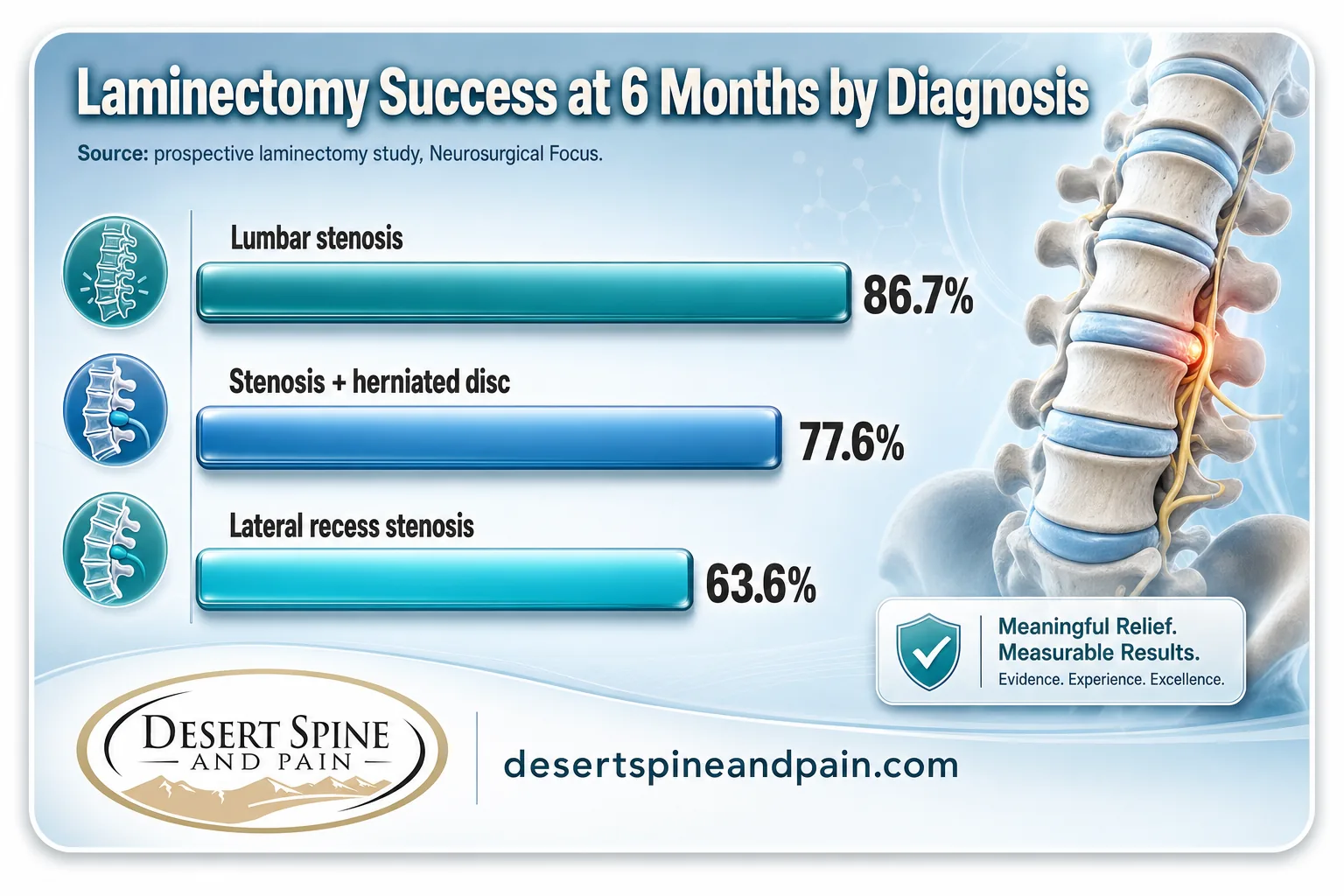
The takeaway is that laminectomy works best when the problem is clear-cut central stenosis causing leg symptoms and difficulty walking. Success is somewhat lower for mixed or lateral recess pathology. This is why an accurate diagnosis of exactly what is compressing which nerve, and which symptoms it explains, is so important before surgery.
Learn about stenosis surgery optionsSource: Prospective laminectomy study, Neurosurgical Focus
3Long-Term Durability
A fair concern with any decompression is whether the relief lasts as degeneration continues. The long-term data is reassuring for well-selected patients.
The systematic review of studies with at least five years of follow-up concluded that patients had significantly more satisfaction and less pain and disability compared with before surgery, and were more physically active. In practical terms, the improvement patients feel early tends to hold up over years, which is exactly what someone weighing surgery wants to know.
Meet Dr. GreenwaldSource: Laminectomy long-term outcomes meta-analysis, PMC 2022
4Reoperation and Fusion Rates
Two questions patients often ask are how likely they are to need another operation, and whether they will eventually need a fusion. The data gives clear, reassuring answers.
The 8 percent lifetime fusion figure is worth emphasizing. It counters a common fear that a laminectomy inevitably leads to a bigger fusion operation later. For most patients with stenosis and no significant instability, decompression alone is durable, and fusion is reserved for the minority with instability or deformity.
For most patients, this does not happen. In a 500-patient series, only about 8 percent needed a fusion over their lifetime after a first-time laminectomy. Modern decompression techniques aim to relieve nerve pressure while preserving as much stabilizing bone and joint as possible. Whether fusion is needed is an anatomical decision, not an inevitability, and an experienced surgeon decompresses without over-destabilizing the spine.
Source: 500-patient laminectomy series, PMC | Laminectomy meta-analysis, PubMed 2022
5What Predicts a Good Outcome
Perhaps the most useful laminectomy statistics are those that predict who will do well. The research points clearly to the importance of which symptoms dominate.
The finding that patients with predominant back pain had a sixfold higher reoperation risk is a powerful selection signal. Laminectomy reliably relieves nerve compression, but it is not primarily a back-pain operation. When back pain dominates, the underlying cause may be something decompression alone cannot fix, which is exactly the distinction a careful evaluation is meant to catch.

The sixfold reoperation gap between back-dominant and leg-dominant patients shows that laminectomy success is largely decided before surgery, by correctly identifying whether a patient's pain is the kind decompression can fix. Choosing the right operation for the right symptom, and declining surgery when it would not help, is where diagnostic expertise and dual spine-and-neurosurgery training translate directly into better statistics. Interpretation original to Desert Spine and Pain.
Desert Spine and Pain works with out-of-network patients of every kind and partners closely with personal injury attorneys, offering 24/7 concierge response and documentation coordination for injured clients.
See conservative care options firstSource: 500-patient laminectomy series, PMC | Frontiers in Musculoskeletal Disorders, 2024
Summary Table: Laminectomy Statistics 2026
| Statistic | Figure | Source | Year |
|---|---|---|---|
| Older adults affected by lumbar stenosis | 10%+ | Frontiers Musculoskel. Disorders | 2024 |
| Laminectomy discharges per 100,000 adults | ~34 | HCUP NIS via PMC | 2015 |
| Success at 6 months, pure stenosis | 86.7% | Neurosurgical Focus | 1998 |
| Success at 6 months, stenosis + herniated disc | 77.6% | Neurosurgical Focus | 1998 |
| Success at 6 months, lateral recess stenosis | 63.6% | Neurosurgical Focus | 1998 |
| Sustained 4-year success | 63% | Frontiers Musculoskel. Disorders | 2024 |
| Long-term improvement maintained | ~2/3 | Neurosurgical Focus | 1998 |
| Pooled reoperation rate (5+ yr) | 14% | Systematic review/meta-analysis | 2022 |
| Reoperation over 3.4 years (500 patients) | 14.4% | PMC series | 2015 |
| Annualized reoperation rate | 4.6% | PMC series | 2015 |
| Lifetime fusion risk after first laminectomy | 8% | PMC series | 2015 |
| Reoperation rate range (literature) | 0 to 21% | Turner et al. via Neurosurg Focus | 1998 |
| Reoperation risk, back-dominant pain | 6x higher | PMC series | 2015 |
| Veterans without functional gain at 12 mo | ~50% | Frontiers Musculoskel. Disorders | 2024 |
Frequently Asked Questions
What is the success rate of a lumbar laminectomy?
What is the reoperation rate after laminectomy?
Will I need a fusion after a laminectomy?
How long does laminectomy relief last?
What predicts a good laminectomy outcome?
Methodology & Sources
How we compiled these statistics
Every figure traces to a Tier 1 primary source: systematic reviews and meta-analyses, prospective studies, large cohort series, and government-linked databases. Success and reoperation ranges reflect differences in stenosis type, follow-up length, and how outcomes are defined. Some foundational figures come from older long-term studies, which are noted by year; they remain widely cited and are corroborated by recent data. All statistics describe populations, not any individual patient.
Primary sources referenced:
- Long-term outcomes of laminectomy in lumbar spinal stenosis: systematic review and meta-analysis (12 studies, 5+ year follow-up), 2022
- Clinical and surgical outcomes after lumbar laminectomy: analysis of 500 patients, PMC
- Preoperative factors and four-year decompressive laminectomy success in symptomatic lumbar spinal stenosis, Frontiers in Musculoskeletal Disorders, 2024
- Long-term follow-up review of patients who underwent laminectomy for lumbar stenosis (prospective study), Neurosurgical Focus
- Healthcare Cost and Utilization Project (HCUP) Nationwide Inpatient Sample, via PMC
This article is educational and is not individual medical advice. For guidance specific to your spine condition, consult a qualified spine surgeon. No outcome can be guaranteed.
Journalists and researchers may cite these statistics with attribution to Desert Spine and Pain and a link to this page. Please attribute the underlying figures to their original Tier 1 sources as listed above. For expert commentary on laminectomy data from a board-certified neurosurgeon and spine surgeon, contact Desert Spine and Pain at (602) 566-9500.