

How Much Does Laminectomy Surgery Cost? A 2026 Price Breakdown
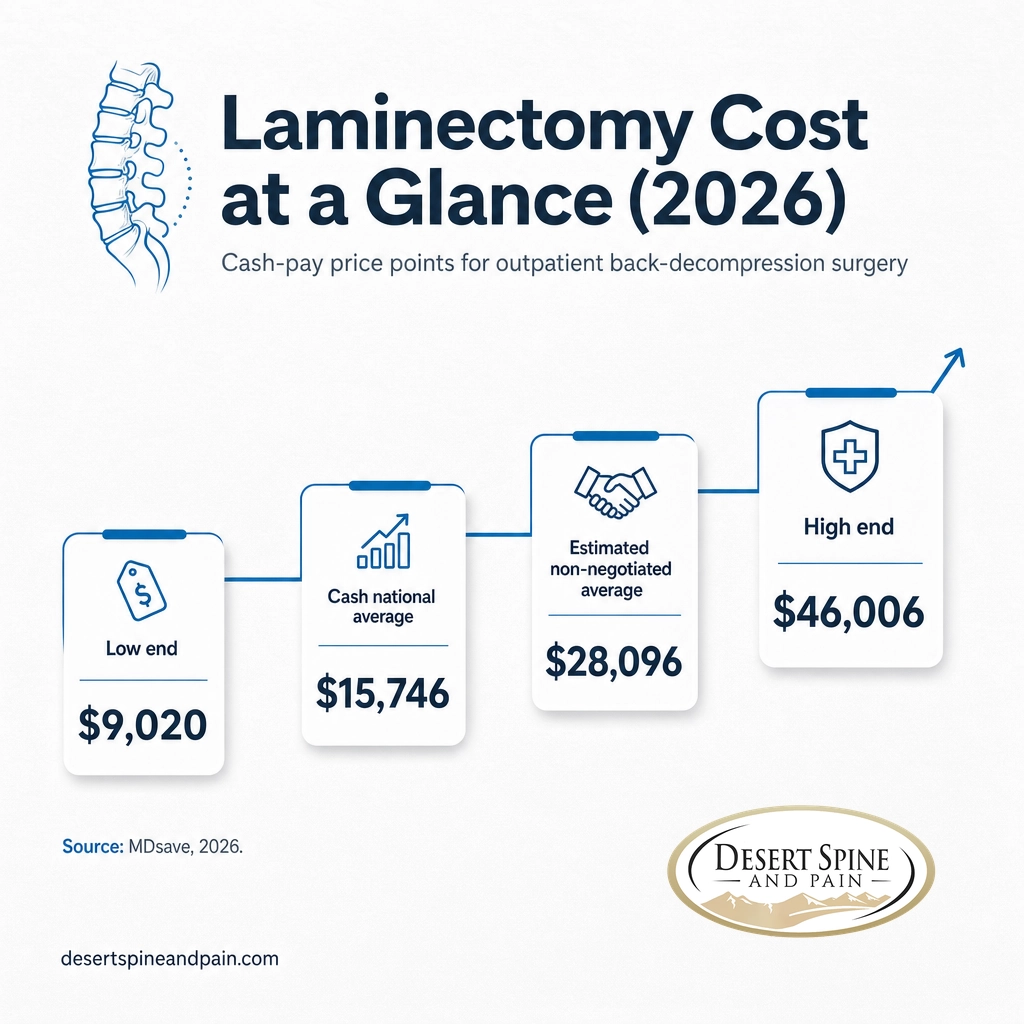
A laminectomy in the United States typically costs between $9,000 and $46,000, with a cash-pay national average near $15,700 for an outpatient procedure, according to the MDsave medical marketplace. The wide range is not random: it tracks how many spinal levels are treated, whether the surgery is outpatient or inpatient, whether a spinal fusion is added, and your region. With insurance, you never pay the full sticker price, your share is capped by your plan's annual out-of-pocket maximum.
| Price point | Cash-pay cost | What it reflects |
|---|---|---|
| Low end | ~$9,020 | Single-level outpatient decompression, cash price |
| Cash national average (outpatient) | ~$15,746 | MDsave prepaid cash price, decompression only |
| Cash national average (inpatient) | ~$15,017 | Overnight hospital stay included |
| Estimated non-negotiated average | ~$28,096 | Typical sticker price before cash or insurance discounts |
| High end | ~$46,006 | Multi-level or complex outpatient case |
Figures are national cash-pay ranges from MDsave for the back surgery (laminectomy, laminotomy, discectomy) category. This guide covers a decompression laminectomy for the spine. Adding a spinal fusion, which is a separate decision, raises the total substantially, as explained below.
- Cash-pay laminectomy runs about $9,020 to $46,006, averaging roughly $15,746 outpatient and $15,017 inpatient on MDsave, with an estimated non-negotiated average near $28,096.
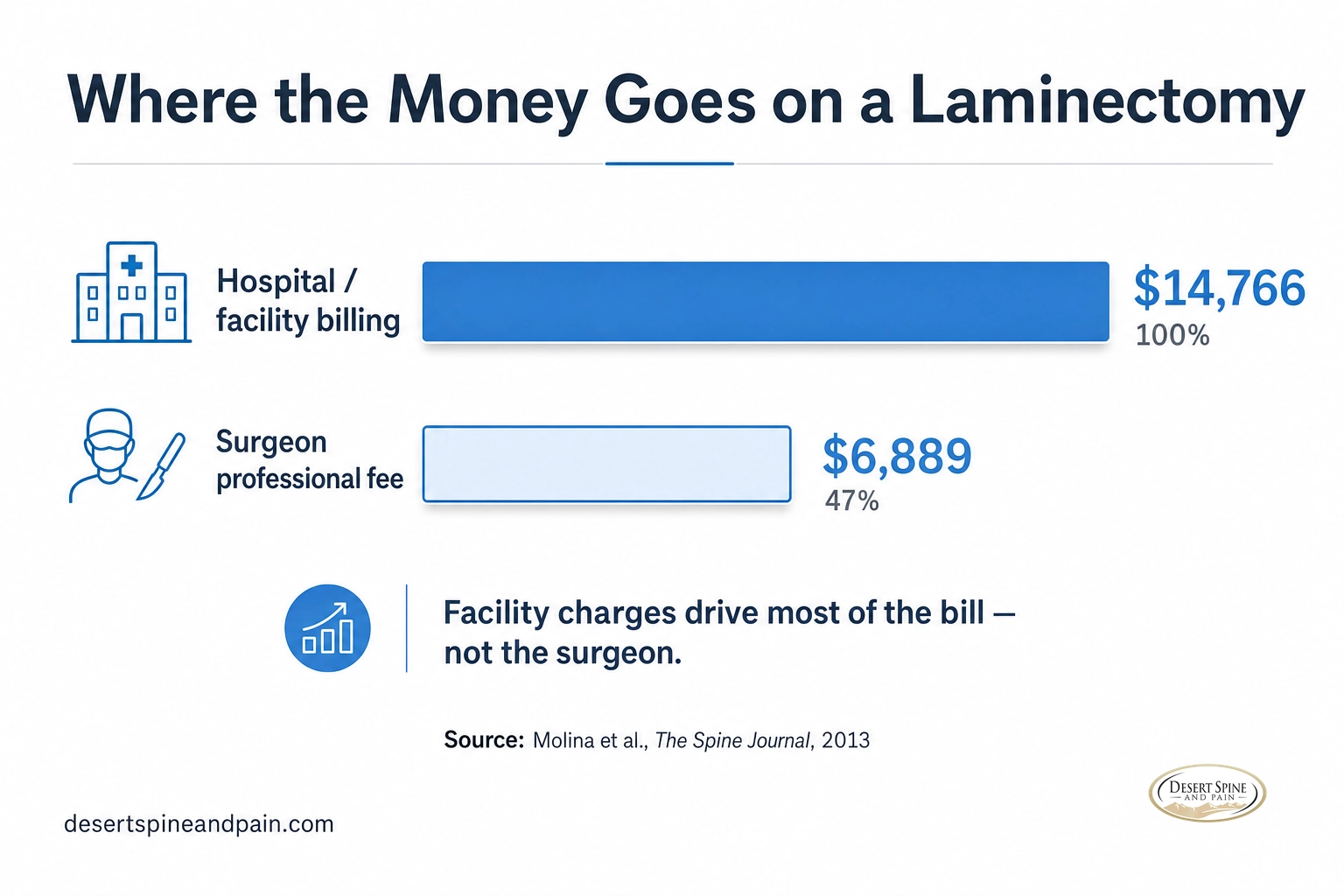
- The facility fee is the largest single piece of the bill. Hospital charges average about $14,766 versus roughly $6,889 for the surgeon's professional fee.
- Outpatient surgery centers cost less than a hospital inpatient stay because they avoid overnight room-and-board charges.
- Adding a spinal fusion roughly doubles to triples the cost, from about $11,405 for decompression alone to about $29,438 with lumbar fusion (2013 inflation-adjusted means).
- Region matters. The West, including Phoenix, averages about 23% more than the Northeast for lumbar laminectomy and discectomy.
- With insurance you pay a deductible plus coinsurance up to your plan's out-of-pocket maximum, capped at $10,600 (individual) for a 2026 Marketplace plan, not the sticker price.

What's in This Guide
- What a Laminectomy Costs in 2026
- What Factors Affect the Cost?
- Where the Money Goes: Hospital vs. Surgeon Fees
- Hidden Costs to Watch For
- Insurance and Medicare Coverage
- Cost in Phoenix and the West vs. National Averages
- Is a Laminectomy Worth the Cost?
- How to Get an Accurate Quote
- Summary Pricing Table
- Frequently Asked Questions
What a Laminectomy Costs in 2026
A laminectomy removes part or all of the lamina, the bony roof of a vertebra, to relieve pressure on the spinal cord or nerves. It is one of the most common decompression surgeries for spinal stenosis and related conditions. On the cost ladder of spine procedures it sits in the middle: more than an injection, less than a multi-level instrumented fusion.
The clearest real-world pricing comes from cash-pay data, where providers list upfront prepaid prices. On the MDsave marketplace, an outpatient back surgery in the laminectomy, laminotomy, and discectomy category has a national average cash price of about $15,746, within a full range of roughly $9,020 to $46,006. MDsave also lists an estimated non-negotiated national average near $28,096, which is closer to what an uninsured patient might see on an itemized hospital bill before any discount. An inpatient version of the same surgery averages about $15,017 in cash, with an estimated national average of roughly $33,239.
Those numbers describe a decompression laminectomy on its own. They do not automatically include a spinal fusion, the pre-operative imaging and consultation, or the physical therapy that follows. Each of those is covered in the sections below, because for many patients the add-ons matter as much as the headline price. For the broader picture of how spine procedures compare, see our companion report on what spine surgery costs across procedure types.
Source: MDsave outpatient back-surgery cash pricing | MDsave inpatient back-surgery cash pricing
Learn about laminectomy decompression at our Phoenix practiceWhat Factors Affect the Cost?
The wide price range comes down to a handful of specific, predictable variables. Understanding them is the difference between a surprise invoice and a number you can plan around.
Number of spinal levels treated
A laminectomy is billed by the level. Decompressing a single level is the most economical case and sits toward the low end of the range. When stenosis affects two, three, or more adjacent levels, each additional level adds surgical time, implants if used, and billed charges, pushing the total toward the upper end.
Outpatient versus inpatient setting
Setting is one of the largest swing factors. A straightforward single-level decompression can often be performed in an ambulatory surgery center and the patient goes home the same day, which avoids an overnight hospital room-and-board charge. A more complex or multi-level case, or a patient with other medical needs, may require an inpatient stay that adds facility cost. Minimally invasive technique, when a patient is a candidate, supports the lower-cost outpatient path.
Whether a spinal fusion is added
This is the single biggest decision for your bill. If the spine remains stable after the bone is removed, a decompression alone may be enough. If the surgeon also needs to fuse the segment for stability, the cost roughly doubles to triples. A National Inpatient Sample analysis published in Neurosurgery found 2013 mean costs of about $11,405 for lumbar laminectomy or discectomy versus about $29,438 for lumbar fusion, in inflation-adjusted dollars.
Mean Cost: Laminectomy Alone vs. With Lumbar Fusion (2013, inflation-adjusted)
Source: Zygourakis et al., Neurosurgery (2017), National Inpatient Sample 2001–2013. Adding a fusion is the largest cost driver.Region and insurance status
Where you have surgery changes the price. The same Neurosurgery analysis found the West about 23% more expensive than the Northeast for lumbar laminectomy and discectomy. Finally, whether you are in network, out of network, or uninsured can affect what you actually pay more than any clinical factor. Out-of-network care can be the right choice for access to a specific surgeon, but it requires understanding your plan's reimbursement in advance.

Explore our spinal decompression surgery options
Where the Money Goes: Hospital vs. Surgeon Fees
Patients are often surprised to learn that the surgeon's fee is a small part of a laminectomy bill. The facility is the large majority. A peer-reviewed cohort cost analysis of noninstrumented lumbar laminectomy, published in The Spine Journal, measured this split directly.
In that study, average hospital billing, excluding the surgeon, was about $14,766, while the surgeon's average professional billing was about $6,889. The gap in what was actually collected was even wider: hospitals collected roughly 92% of billed charges, while surgeons collected about 28%. In other words, the hospital or surgery center, not the physician, is where most of your laminectomy dollars go, which is exactly why the outpatient-versus-inpatient choice moves the total so much.
Who Bills What on a Laminectomy
Source: Molina et al., The Spine Journal (2013). The facility, not the surgeon, drives the bill.
Source: Molina et al., cohort cost analysis of lumbar laminectomy, The Spine Journal (2013)

Hidden Costs to Watch For
The surgical quote is only part of the picture. These are the add-ons that catch patients off guard, and the ones worth asking about before you schedule.
Not usually. A single procedure quote may exclude the pre-operative MRI, anesthesia, the facility fee, post-surgical physical therapy, and any fusion hardware if a fusion is added. And an out-of-network procedure can change your math more than any clinical detail. Always ask whether a number is all-inclusive and what specifically is left out before you commit.
- Imaging and consultation. A diagnostic MRI and the surgical consultation that confirm you need a laminectomy are billed before the surgery and often separately.
- Anesthesia. The anesthesiologist bills independently of the surgeon and the facility.
- Facility fee. A hospital inpatient stay adds the largest facility charge; an outpatient surgery center adds a smaller one; this is the single biggest controllable variable.
- Added fusion and hardware. If the segment must be fused, implants and the longer operation can double or triple the base cost.
- Physical therapy and recovery. Rehabilitation visits after surgery are a real, recurring cost. Our laminectomy recovery guide covers what that phase typically involves.
- Deductible and out-of-network status. If your deductible is not met, you may pay the full allowed amount first. Out-of-network care changes reimbursement and should be clarified up front.
Source: Molina et al., The Spine Journal (2013), hospital vs. professional fee split
Review conservative, non-invasive options firstInsurance and Medicare Coverage
A laminectomy for a documented condition such as spinal stenosis is a standard, covered procedure under Medicare and almost all commercial plans when it is medically necessary. Most insurers want to see that conservative care, physical therapy, injections, and time, has been tried first, and many require prior authorization before surgery. Once that is in place, you do not pay the sticker price.
Instead, you pay your deductible, then coinsurance (often around 20% in network), until you reach your plan's annual out-of-pocket maximum. After that cap, an in-network plan pays 100% of covered costs for the rest of the plan year. For a 2026 Marketplace plan, federal rules cap that out-of-pocket maximum at $10,600 for an individual and $21,200 for a family, and employer plans use similar limits. This is why two patients with identical $30,000 surgical bills can owe very different amounts, their deductibles, coinsurance, and remaining out-of-pocket balances differ.
The practical takeaway: if your laminectomy is medically necessary and you stay in network, your realistic cost is your remaining deductible plus coinsurance up to that cap, not the $15,000 to $30,000 sticker figures. The two steps that most affect your bill are confirming the surgeon and facility are in your network and getting prior authorization completed before the date.
Source: HealthCare.gov, out-of-pocket maximum limit
Cost in Phoenix and the West vs. National Averages
National averages are a starting point, but geography shifts the number. The Neurosurgery National Inpatient Sample analysis found that, after adjusting for patient and hospital factors, the West was about 23% more expensive than the Northeast for lumbar laminectomy and discectomy. Phoenix sits in that higher-cost Western region, so Arizona patients should expect figures at or above the national mean rather than below it.
That regional premium is one more reason to get a specific, written estimate for your own case rather than relying on a national average. A local practice can tell you where your procedure would be performed and how that setting affects the total. For how surgery volumes and outcomes look overall, see our laminectomy statistics report and the broader spinal decompression surgery data.
Source: Zygourakis et al., Neurosurgery (2017), regional cost variation
Is a Laminectomy Worth the Cost?
For the right candidate, a laminectomy addresses the mechanical source of nerve compression that medication and injections can only mask. The honest way to weigh the price is against the running cost of living with untreated stenosis: ongoing pain management, repeated imaging, lost work, and declining function. A one-time surgical cost spread across years of restored mobility reads very differently than the sticker price alone.
The cost comparison with fusion is also central to value. Because a decompression alone averages far less than a fusion, and because the best evidence shows a laminectomy without fusion carries lower complication and reoperation rates for many degenerative cases, confirming whether you genuinely need a fusion protects both your recovery and your wallet. That determination is a clinical judgment, not a sales decision, and a surgeon who performs the full range of procedures is positioned to make it objectively.
Combining two verifiable figures shows what the fusion question is worth in dollars. Using the Neurosurgery National Inpatient Sample means, a lumbar laminectomy or discectomy averaged about $11,405 while a lumbar fusion averaged about $29,438 in 2013 inflation-adjusted dollars, a difference of roughly $18,000 for a single episode of care. For a patient whose spine is stable after decompression, choosing the procedure the anatomy actually requires, rather than defaulting to fusion, can mean a materially smaller bill and a shorter recovery. Calculation and interpretation original to Desert Spine and Pain, based on Zygourakis et al., Neurosurgery (2017). This is general information, not financial or medical advice.
Source: Zygourakis et al., Neurosurgery (2017) | Molina et al., The Spine Journal (2013)
Meet Dr. David L. Greenwald, MD, FAANS, FACSHow to Get an Accurate Quote
A trustworthy estimate is specific to your spine, your plan, and your setting. Here is what to prepare and what to ask so the number you are quoted is the number you pay.
- Your diagnosis and which spinal levels are involved (cervical, thoracic, or lumbar).
- Your most recent MRI or imaging report.
- Your insurance card, deductible status, and whether the provider is in or out of network.
- A record of the conservative care you have already tried.
- Is this quote all-inclusive (surgeon fee, facility fee, anesthesia, and imaging)?
- Will the surgery be outpatient at a surgery center or inpatient at a hospital, and how does that change the price?
- Is a fusion planned, and if so, why, and what does it add to the cost?
- How many levels are you planning to decompress?
- What is my estimated out-of-pocket amount after insurance, including out-of-network reimbursement if applicable?
At Desert Spine and Pain, a Phoenix practice led by board-certified surgeon Dr. David L. Greenwald, who is both a spine surgeon and a neurosurgeon, the team verifies your benefits, explains costs up front, and assists out-of-network patients and those referred by personal injury attorneys with the paperwork. The philosophy is least-invasive-effective care first, so you are only steered toward a laminectomy, and a fusion only if it is truly needed, when the clinical picture supports it. For a plain-language overview of the procedure itself, see what a laminectomy is and how it works.
Request a cost estimate: (602) 566-9500Laminectomy Cost: Summary Pricing Table (2026)
| Cost variable | Figure | Source |
|---|---|---|
| Cash-pay range (outpatient) | $9,020–$46,006 | MDsave, 2026 |
| Cash national average (outpatient) | ~$15,746 | MDsave, 2026 |
| Cash national average (inpatient) | ~$15,017 | MDsave, 2026 |
| Estimated non-negotiated average (outpatient) | ~$28,096 | MDsave, 2026 |
| Estimated non-negotiated average (inpatient) | ~$33,239 | MDsave, 2026 |
| Hospital billing (lumbar laminectomy) | ~$14,766 | Molina et al., The Spine Journal, 2013 |
| Surgeon professional fee | ~$6,889 | Molina et al., The Spine Journal, 2013 |
| Mean cost, laminectomy / discectomy (2013) | ~$11,405 | Zygourakis et al., Neurosurgery, 2017 |
| Mean cost, lumbar fusion (2013) | ~$29,438 | Zygourakis et al., Neurosurgery, 2017 |
| Western regional premium vs. Northeast | ~23% higher | Zygourakis et al., Neurosurgery, 2017 |
| Out-of-pocket max, individual (2026) | $10,600 | HealthCare.gov, 2026 |
| Out-of-pocket max, family (2026) | $21,200 | HealthCare.gov, 2026 |
Frequently Asked Questions
How much does a laminectomy cost?
Does insurance cover a laminectomy?
Why is a laminectomy cheaper as an outpatient procedure?
How much does adding a spinal fusion to a laminectomy cost?
What hidden costs come with a laminectomy?
Methodology & Sources
How we compiled this guide
Cash-pay pricing reflects live listings on the MDsave medical marketplace for the back surgery (laminectomy, laminotomy, discectomy) category, captured in 2026, covering both the outpatient procedure (national average cash price about $15,746, range $9,020 to $46,006, estimated non-negotiated average about $28,096) and the inpatient procedure (cash average about $15,017, estimated non-negotiated average about $33,239). Hospital-versus-surgeon fee figures come from a peer-reviewed cohort cost analysis of noninstrumented lumbar laminectomy published in The Spine Journal (Molina et al., 2013), which reported average hospital billing of about $14,766 and average surgeon billing of about $6,889. National trend and regional figures come from a National Inpatient Sample analysis published in Neurosurgery (Zygourakis et al., 2017), which reported 2013 inflation-adjusted mean costs of about $11,405 for lumbar laminectomy or discectomy and about $29,438 for lumbar fusion, and a Western cost premium of about 23% over the Northeast. Insurance out-of-pocket maximums are the 2026 federal Marketplace limits published by HealthCare.gov. Prices are national figures and are not a quote; actual cost depends on region, provider, setting, number of levels, whether a fusion is added, and insurance. This article is general information and not medical or financial advice.
- MDsave, Back Surgery (Laminectomy, Laminotomy, Discectomy), outpatient and inpatient procedure pricing (2026)
- Molina CA, et al. A cohort cost analysis of lumbar laminectomy, The Spine Journal, 2013
- Zygourakis CC, et al. Geographic and hospital variation in cost of lumbar laminectomy and lumbar fusion, Neurosurgery, 2017
- HealthCare.gov, out-of-pocket maximum limit (2026 Marketplace limits)
You are welcome to cite these figures with attribution to the original primary sources named above (MDsave, The Spine Journal, Neurosurgery, and HealthCare.gov). When referencing the Desert Spine and Pain analysis of the fusion-decision cost difference, please attribute the calculation to Desert Spine and Pain. This article is general information and not medical or financial advice.