
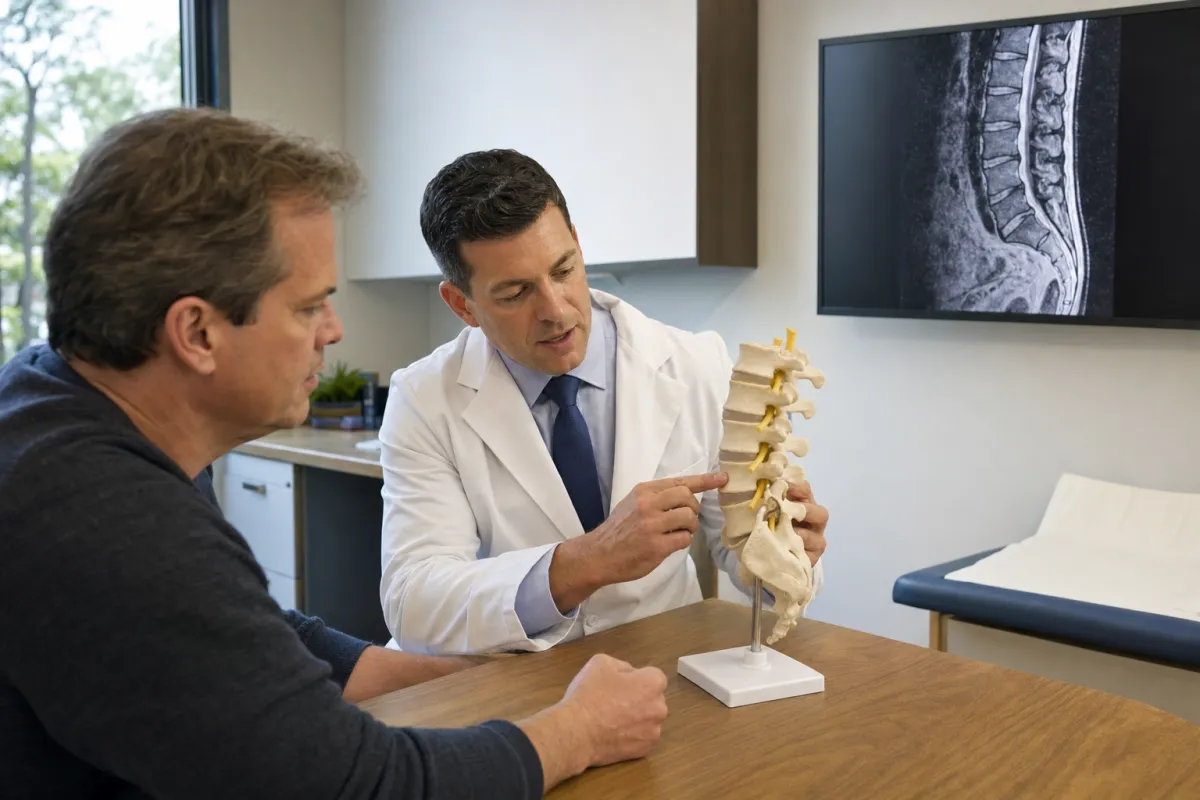
Discectomy vs. Laminectomy: How the Two Spine Surgeries Differ
The simplest way to tell these two spine surgeries apart is by what they remove: a discectomy takes out herniated disc material pressing on a nerve, while a laminectomy removes bone (the lamina) to open up a narrowed spinal canal. That difference is not academic. A discectomy is the usual answer for a herniated disc, and a laminectomy is the usual answer for spinal stenosis, so choosing correctly depends entirely on an accurate diagnosis of what is actually compressing the nerve. Matching the operation to the true source of pain is the single biggest driver of a good result.
- Different targets: discectomy removes disc material; laminectomy removes bone (the lamina) to widen the canal.
- Different problems: discectomy is typically for a herniated disc; laminectomy is typically for spinal stenosis.
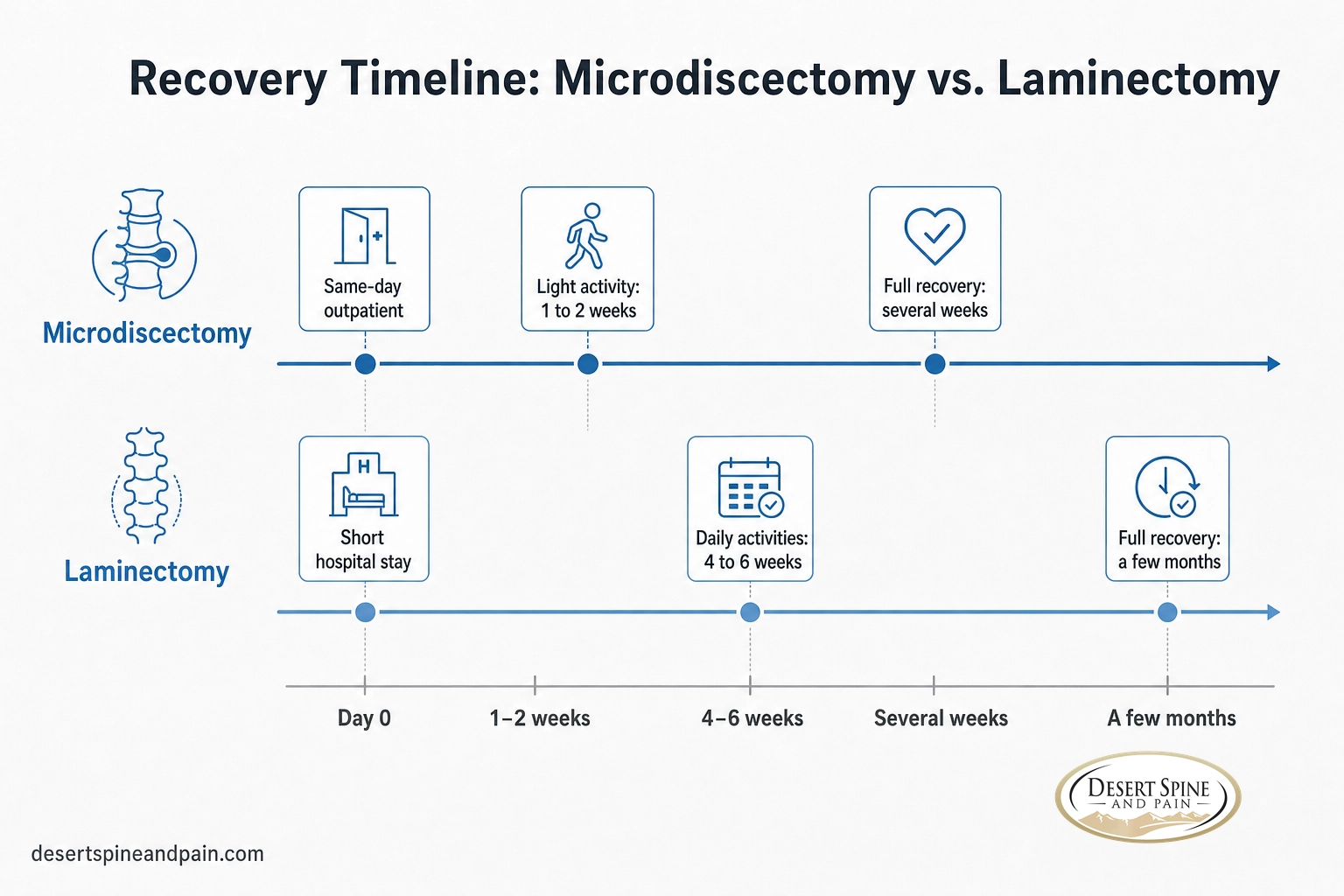
- Different recovery: microdiscectomy often means light activity in 1 to 2 weeks; laminectomy usually takes about 4 to 6 weeks to resume daily activities.
- Early revision is modestly higher after discectomy (2.75% vs 1.18% at 3 months), mostly from recurrent herniation.
- Long-term, revision and final fusion rates are similar between the two (about 9.7% revision and 11 to 12% fusion).
- They are not either-or: surgeons often remove a little lamina to reach a disc, combining both in one operation.
- The deciding factor is what is compressing the nerve, confirmed on imaging and matched to your symptoms, not which surgery sounds bigger.

What's in This Guide
- Discectomy vs. Laminectomy at a Glance
- Understanding Discectomy
- Understanding Laminectomy
- What Each One Treats
- What Is Actually Removed
- Recovery and Hospital Stay
- Success and Durability
- Revision and Reoperation Rates
- Side-by-Side Comparison Table
- Who a Discectomy Fits
- Who a Laminectomy Fits
- The Verdict
- Frequently Asked Questions
Discectomy vs. Laminectomy at a Glance
- Removes herniated disc material pressing on a nerve
- Most common for a herniated or ruptured disc with sciatica or arm pain
- Microdiscectomy is minimally invasive and often same-day outpatient
- Light activity typically in 1 to 2 weeks
- Main long-term risk: recurrent herniation at the same level
- Removes the lamina (bone) to widen a narrowed spinal canal
- Most common for spinal stenosis with leg pain and trouble walking
- More bone work, often a short inpatient stay
- Daily activities typically in 4 to 6 weeks
- Main long-term question: whether stability is preserved (fusion rarely needed)
1Understanding Discectomy
A discectomy removes the portion of a spinal disc that has herniated, or ruptured, and is pressing on a nearby nerve root. Discs are the soft cushions between the vertebrae. When the tough outer ring tears, the softer inner material can push out and pinch a nerve, producing the shooting leg pain of sciatica, or arm pain and numbness when the herniation is in the neck. The surgeon removes only the fragment causing trouble and preserves the healthy part of the disc.
Most discectomies today are done as a microdiscectomy, a minimally invasive version performed through a small incision using a microscope or endoscope and tubular retractors. Because it spares muscle and bone, the operation is often done as a same-day outpatient procedure, and many patients walk out the same afternoon.
Who it fits: a patient with a confirmed herniated disc whose imaging matches their symptoms, especially leg-dominant or arm-dominant pain that has not settled with time, medication, physical therapy, or injections. Genuine trade-offs: it is the smaller operation with faster recovery, but it does not address bony narrowing, and the same disc can herniate again, which is the most common reason for a second operation. For a deeper look at those numbers, see our microdiscectomy recovery and reherniation rates.
Explore discectomy options in PhoenixSource: Hospital for Special Surgery, microdiscectomy overview
2Understanding Laminectomy
A laminectomy removes part or all of the lamina, the arch-shaped piece of bone at the back of each vertebra, to create more room inside the spinal canal and relieve pressure on the nerves. It is the standard operation for lumbar spinal stenosis, a narrowing of the canal that most often affects older adults and causes leg pain, heaviness, and difficulty walking any distance, a pattern called neurogenic claudication. When only a small section of lamina is removed over one nerve, the procedure is called a laminotomy.
Because stenosis develops as the spine ages and bone, ligament, and disc thicken into the canal, the problem is bony and broad rather than a single soft fragment. Decompressive laminectomy is in fact the most common spine operation performed in older adults.
Who it fits: a patient with canal narrowing confirmed on MRI whose leg symptoms and walking limits match that narrowing. Genuine trade-offs: it reliably opens the canal and relieves claudication, but it is more bone work than a discectomy, recovery is a little longer, and a small number of patients with instability may also need a fusion. Our board-certified neurosurgeon and spine surgeon decompresses while preserving as much stabilizing bone and joint as possible, reserving fusion for cases that truly require it. The detailed outcome data is in our guide to laminectomy outcomes in detail.
Explore laminectomy options in PhoenixSource: Frontiers in Musculoskeletal Disorders, 2024
3What Each One Treats
This is where the two operations separate most clearly. They are tools for different problems, and the mismatch between them is exactly what a careful evaluation is meant to catch.
Discectomy is for a herniated disc: a discrete fragment of disc material pressing on a single nerve root, usually producing pain that travels down one leg or one arm. Laminectomy is for spinal stenosis: a generalized narrowing of the canal from bone and ligament that squeezes the nerves more diffusely, usually producing leg symptoms that worsen with standing and walking and ease when you sit or lean forward.
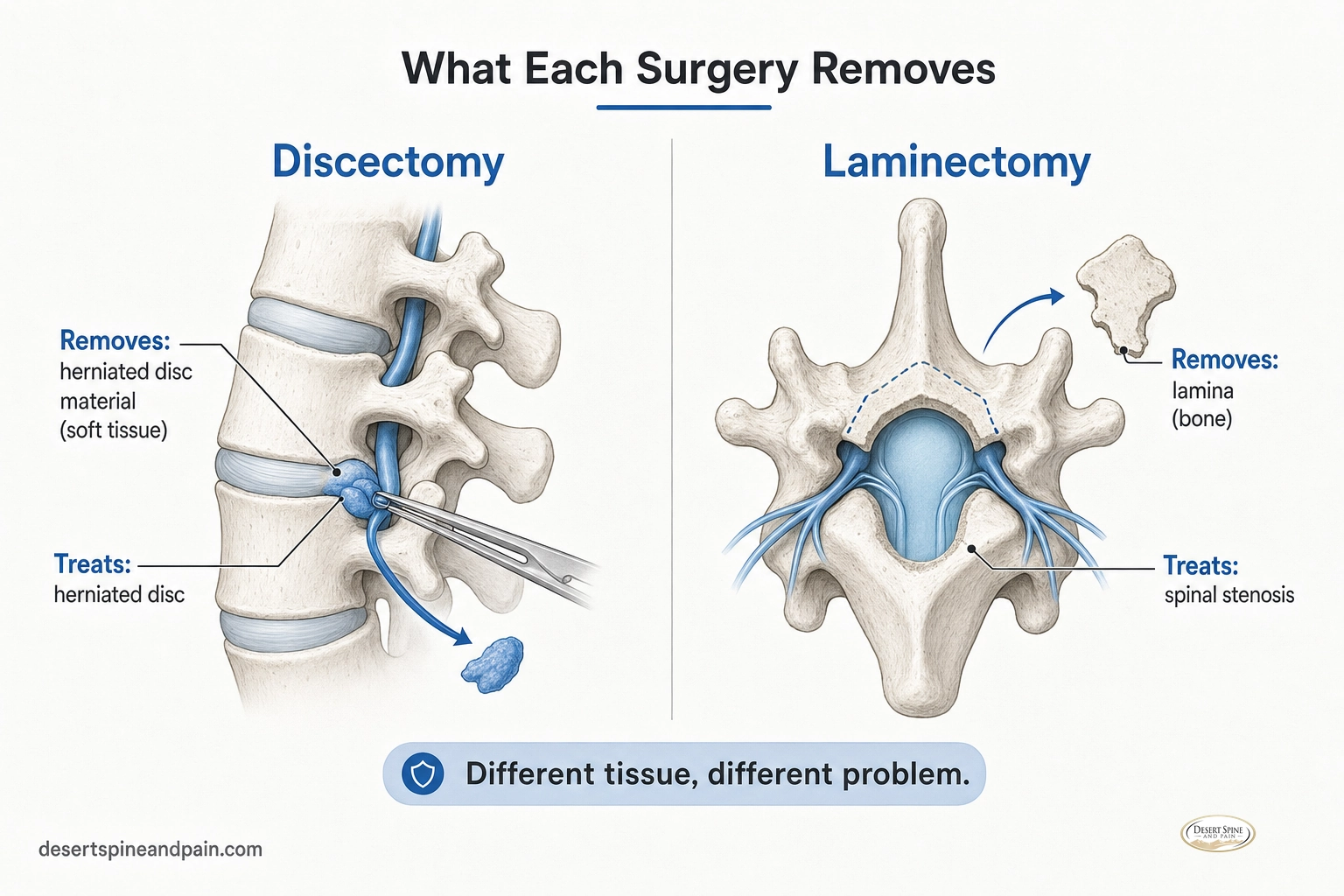
They are not. One removes soft disc tissue and the other removes bone, and they treat different conditions. Confusing them matters, because doing a pure decompression when the real problem is a contained disc fragment, or removing a disc when the real problem is bony stenosis, leaves the true source of pain untreated. In large series, patients whose main pain was not the kind the operation was designed to fix had markedly worse results. The operation has to match the diagnosis.
Source: Comparative microdiscectomy and laminectomy overview, Center for Orthopaedics
4What Is Actually Removed
The names describe the anatomy. A discectomy (from the disc) removes disc material. A laminectomy (from the lamina) removes bone. In practice the line can blur, because reaching a herniated disc sometimes requires taking a small window of lamina first, so a discectomy may include a limited laminotomy. The difference that matters is the main target and how much tissue is removed.
This is also why the two are not rivals so much as neighbors on a spectrum of decompression. A surgeon's job is to remove exactly what is pinching the nerve and no more, preserving the structures that keep the spine stable. When stenosis and a disc herniation compress the same nerve together, a combined decompression treats both in one sitting.
Learn about minimally invasive microdiscectomySource: Center for Orthopaedics, microdiscectomy vs. laminectomy
5Recovery and Hospital Stay
Recovery is one of the most practical differences, and it mostly follows from how much tissue each operation disturbs.
Because a microdiscectomy spares muscle and bone, most patients go home the same day and ease back into routine quickly, while heavier lifting is held off for several weeks. A laminectomy for stenosis involves more bone removal and often an older patient, so a short hospital stay is more common and the activity ramp is a little slower. Both timelines stretch when more than one level is treated or a fusion is added, and both depend on age and overall health. For most patients, driving resumes once they are off narcotic pain medication, roughly two to four weeks out.
Hospital cost tends to track these same factors. A stenosis operation that involves more bone work and a short admission generally runs somewhat higher than an outpatient microdiscectomy, though the real number for any individual depends heavily on the number of levels, comorbidities, and whether a fusion is involved. Those are questions to settle with your surgeon and insurer, not to estimate from an average.
Meet Dr. GreenwaldSource: Center for Orthopaedics, recovery comparison | Hospital for Special Surgery

6Success and Durability
Both operations relieve nerve compression well when the diagnosis is right. The research is strongest when you look at each in its own lane.
For laminectomy, pooled long-term data shows durable relief of leg symptoms and walking ability, which is exactly what stenosis patients want to know. For microdiscectomy, the operation is highly effective at relieving the leg pain of a herniated disc, and the main durability question is recurrent herniation rather than failure of the original decompression. In other words, each procedure succeeds at its own job, so the honest comparison is not which number is bigger but which problem you actually have.
Learn about stenosis surgery optionsSource: Prospective laminectomy study, Neurosurgical Focus | Lumbar microdiscectomy complications meta-analysis, PubMed 2015
7Revision and Reoperation Rates
The cleanest head-to-head data comes from a large population-based cohort that followed 16,048 patients who had a first lumbar discectomy or laminectomy, tracking who needed another operation.
Revision Rate Within 3 Months: Discectomy vs. Laminectomy
The pattern is consistent and reassuring. Discectomy carries a modestly higher early revision risk, 2.75 percent versus 1.18 percent within three months and 3.38 versus 2.57 percent at one year, driven mostly by recurrent disc herniation at the same level. But from one year onward the two converge to about 9.7 percent each, and the lifetime likelihood of eventually needing a fusion is similar for both. A separate small study of cauda equina syndrome likewise found complication and revision rates comparable between a minimally invasive discectomy and an open laminectomy with discectomy.
Combining the three-month and long-term figures from the 16,048-patient cohort shows that almost all of the discectomy-versus-laminectomy revision difference happens early and then disappears. The early gap reflects recurrent herniation, a known and specific risk of removing a disc fragment, while the late convergence shows that neither operation is inherently more durable once that early window passes. For a patient weighing the two, that means the choice should be driven by the diagnosis and recovery profile, not by a fear that one procedure fails more often over time. Calculation and interpretation original to Desert Spine and Pain.
Source: Revision rates after lumbar discectomy vs. laminectomy, BMJ Open 2018 | Minimally invasive discectomy vs. open laminectomy for cauda equina, PMC 2022
Side-by-Side Comparison Table
| Factor | Discectomy (Microdiscectomy) | Laminectomy | Best fit for |
|---|---|---|---|
| What is removed | Herniated disc fragment (soft tissue) | Lamina, the vertebral bone arch | Matches the problem |
| Condition treated | Herniated or ruptured disc | Spinal stenosis | Depends on diagnosis |
| Typical symptom | Leg or arm pain (radiculopathy, sciatica) | Leg pain and trouble walking (claudication) | Depends on diagnosis |
| Invasiveness | Minimally invasive, muscle and bone sparing | More bone removal | Discectomy smaller |
| Hospital stay | Often same-day outpatient | More often a short inpatient stay | Discectomy |
| Return to light activity | About 1 to 2 weeks | About 4 to 6 weeks | Discectomy |
| Early revision (3 months) | 2.75% | 1.18% | Laminectomy |
| Long-term revision (1 year on) | 9.75% | 9.69% | Comparable |
| Final fusion rate | 11.25% | 12.08% | Comparable |
| Main long-term risk | Recurrent herniation at same level | Instability (fusion rarely needed) | Depends on anatomy |
8Who a Discectomy Fits
A discectomy, almost always a microdiscectomy today, tends to be the right operation when:
- Imaging shows a herniated disc pressing on a nerve root, and that nerve explains your pain.
- Your pain is leg-dominant or arm-dominant (sciatica or a radiating arm pain) rather than mostly central back or neck pain.
- Conservative care, such as time, medication, physical therapy, or an epidural steroid injection, has not given lasting relief.
- You want the smallest, fastest-recovery operation that will fix the problem, and you do not have significant bony stenosis at that level.
- You understand and accept the main trade-off: a small chance the same disc herniates again.
9Who a Laminectomy Fits
A laminectomy tends to be the right operation when:
- Imaging shows spinal stenosis, a narrowing of the canal from bone and ligament, that matches your symptoms.
- Your legs feel heavy, painful, or weak when you stand and walk, and better when you sit or lean forward (neurogenic claudication).
- The compression is diffuse and bony, not a single soft disc fragment a discectomy could remove.
- Conservative care has stopped working and your walking distance and quality of life are limited.
- Your spine is stable, so decompression alone is expected to suffice, with fusion reserved for the minority who have instability or deformity.
Desert Spine and Pain works with out-of-network patients of every kind and partners closely with personal injury attorneys, offering 24/7 concierge response and documentation coordination for injured clients.
Explore spine surgery at Desert Spine and Pain10The Verdict
Discectomy versus laminectomy is not a contest between a better and a worse surgery. They remove different tissue to treat different problems, so the real question is which one your spine actually needs. If a herniated disc is pinching a nerve, a microdiscectomy is usually the smaller, faster-recovery answer. If a narrowed canal from stenosis is squeezing the nerves, a laminectomy is usually the answer. The research backs this up: each works well in its own lane, early revision is slightly higher after discectomy but the two converge long-term, and fusion is uncommon after either.
The decision that matters most happens before surgery, when a surgeon confirms exactly what is compressing which nerve and whether it explains your symptoms. That is where dual spine and neurosurgery training and an unhurried evaluation translate directly into a better result. If you have been told you need back surgery and are unsure which operation is right, or you just want to understand your options, a consultation or second opinion is the best next step. You can also compare the full outcome data in our discectomy success and revision data and decompression surgery statistics.
Book a consultation: (602) 566-9500Frequently Asked Questions
What is the difference between a discectomy and a laminectomy?
Which is more serious, a discectomy or a laminectomy?
What is the recovery time for a discectomy versus a laminectomy?
Is the revision or reoperation rate higher for discectomy or laminectomy?
Can you have a discectomy and a laminectomy at the same time?
Methodology & Sources
How we compiled this comparison
Figures trace to Tier 1 primary sources: a population-based cohort study, systematic reviews and meta-analyses, a prospective outcome study, and hospital and specialty references. Revision and fusion figures come from a 16,048-patient cohort (Kao et al., BMJ Open 2018) using Taiwan's National Health Insurance Research Database with up to five years of follow-up. Microdiscectomy reoperation ranges come from a 2015 systematic review and meta-analysis of lumbar microdiscectomy complications. Laminectomy success for stenosis comes from a prospective study published in Neurosurgical Focus, corroborated by a 2024 analysis in Frontiers in Musculoskeletal Disorders. Recovery timelines reflect specialty references from the Center for Orthopaedics and the Hospital for Special Surgery. Some foundational studies are older and are noted; they remain widely cited and are consistent with recent data. All statistics describe populations, not any individual patient.
Primary sources referenced:
- Kao F-C et al. Short-term and long-term revision rates after lumbar spine discectomy versus laminectomy: a population-based cohort study. BMJ Open, 2018.
- Lumbar microdiscectomy complication rates: a systematic review and meta-analysis. PubMed, 2015.
- Long-term follow-up of patients who underwent laminectomy for lumbar stenosis (prospective study). Neurosurgical Focus.
- Preoperative factors and four-year decompressive laminectomy success in symptomatic lumbar spinal stenosis. Frontiers in Musculoskeletal Disorders, 2024.
- Minimally invasive discectomy versus open laminectomy and discectomy for cauda equina syndrome. PMC, 2022.
- Center for Orthopaedics and Hospital for Special Surgery procedure and recovery references.
This article is educational and is not individual medical advice. For guidance specific to your spine condition, consult a qualified spine surgeon. No outcome can be guaranteed.
Journalists and researchers may cite these statistics with attribution to Desert Spine and Pain and a link to this page. Please attribute the underlying figures to their original Tier 1 sources as listed above. For expert commentary on spine decompression surgery from a board-certified neurosurgeon and spine surgeon, contact Desert Spine and Pain at (602) 566-9500.