

How Long Does Laminectomy Surgery Take?
How long does a laminectomy take? Most laminectomies take about 1 to 3 hours, from the first incision to the final stitch. A single-level decompression sits at the shorter end; treating several levels, or adding a spinal fusion, moves it toward or past the longer end. Expect more total time in the operating room than that, because anesthesia, positioning, and waking up are added on either side of the operation.
If a laminectomy has been recommended, one of the first practical questions is how long you will be in surgery. The honest answer is a range, not a single number, because "a laminectomy" covers everything from a quick one-level decompression to a multilevel operation combined with a fusion. This guide breaks the timing into the parts that actually matter: the operation itself, your whole day at the hospital, the handful of factors that lengthen the surgery, and the recovery timeline that follows. Knowing the difference keeps your expectations realistic and helps you ask your surgeon the right questions.
- A standard laminectomy usually takes about 1 to 3 hours of operating time.
- A single-level decompression is closer to one hour; multilevel cases run longer.
- Your total time in the operating room is longer than the operation, because it includes anesthesia and positioning.
- Adding a spinal fusion lengthens both the surgery and the recovery.
- Minimally invasive technique generally means less blood loss and a shorter hospital stay, with broadly similar operating times.
- Many single-level cases go home the same day; others stay 1 to 2 days.
- Recovery is separate from surgery length: roughly 4 to 6 weeks for a decompression alone, up to about 6 months with a fusion.

What's in This Guide
- The Short Answer: How Long a Laminectomy Takes
- Operation Time vs. Your Whole Day at the Hospital
- What Happens During the Surgery, Step by Step
- 4 Things That Change How Long Your Laminectomy Takes
- Why a Laminectomy With Fusion Takes Longer
- Recovery Timeline: Separate From Surgery Length
- Is a Laminectomy Major Surgery?
- How to Get Started
- Common Questions
- Sources
The Short Answer: How Long a Laminectomy Takes
A laminectomy removes part or all of the lamina, the bony arch at the back of a vertebra, to take pressure off the spinal cord or nerves. The operation to do that is not especially long. Both the National Library of Medicine and major academic centers put a standard laminectomy at about one to three hours, and note it can run longer when it is part of a more complex procedure.
That range is the best general answer, but it is a starting point rather than a promise. The real length of your operation depends on what your spine needs, which is why the sections below walk through the factors that move the number up or down. The one thing to anchor on: for most people, the decompression part of the day is measured in a small number of hours, not in all-day terms.
Source: MedlinePlus laminectomy surgical guide (U.S. National Library of Medicine) | Cleveland Clinic laminectomy overview
Operation Time vs. Your Whole Day at the Hospital
The one to three hours is the operation. Your day is longer, and it helps to separate the two so nothing comes as a surprise. The operating-room clock starts well before the first incision and keeps running after the last stitch.

A typical surgical day looks like this:
- Arrival and preparation. You usually arrive a couple of hours early, change, meet the anesthesia team, and have an IV placed. Most people are asked not to eat or drink for several hours beforehand.
- Anesthesia and positioning. A laminectomy is done under general anesthesia, so you are fully asleep. The team then positions you face-down and preps the surgical site. This adds time in the operating room before the surgery itself begins.
- The operation. This is the one-to-three-hour window where the actual decompression happens.
- The recovery room. Afterward you move to a recovery area while the anesthetic wears off and the team monitors you and manages pain.
- Home or a hospital room. Many single-level cases go home the same day. Others stay one to two days, and a fusion or other health factors can extend that.
So when you hear "a few hours," that is the surgery. Budget most of a day for the full visit, and ask your surgeon's office for the specific arrival time and expected discharge plan for your case.
Source: MedlinePlus laminectomy surgical guide
What Happens During the Surgery, Step by Step
Understanding the steps makes the timing make sense. Each stage takes real minutes, and the more that has to be done, the longer the clock runs. Here is the sequence in plain terms.
- Anesthesia. You are placed under general anesthesia and will not feel or remember the surgery.
- The incision. The surgeon makes an incision over the midline of the back (or neck, for a cervical laminectomy) at the level being treated.
- Reaching the spine. Skin, muscle, and ligament are moved aside to expose the bony arch. A surgical microscope is often used for a close, precise view.
- Removing the lamina. Part or all of the lamina is removed to open up the space and relieve pressure on the spinal cord or nerves. This is the decompression, and it is the core of the operation.
- Clearing the pressure. The surgeon may also remove bone spurs, a thickened ligament, or small disc fragments that are crowding the nerves.
- Optional fusion. If the segment needs added stability, a spinal fusion with hardware and a bone graft is done at the same sitting. This step is what most often extends the surgery.
- Closing up. The muscles and soft tissues are returned to place and the skin is stitched closed.
A decompression that involves one level and no fusion moves through these steps quickly. A case with several levels, a difficult re-operation, or an added fusion naturally takes longer because there is more surgery to perform at steps four through six.
Source: MedlinePlus step-by-step laminectomy description | Cleveland Clinic procedure details
4 Things That Change How Long Your Laminectomy Takes
If two people both have "a laminectomy," their surgery times can still differ by hours. Four factors explain most of that difference.
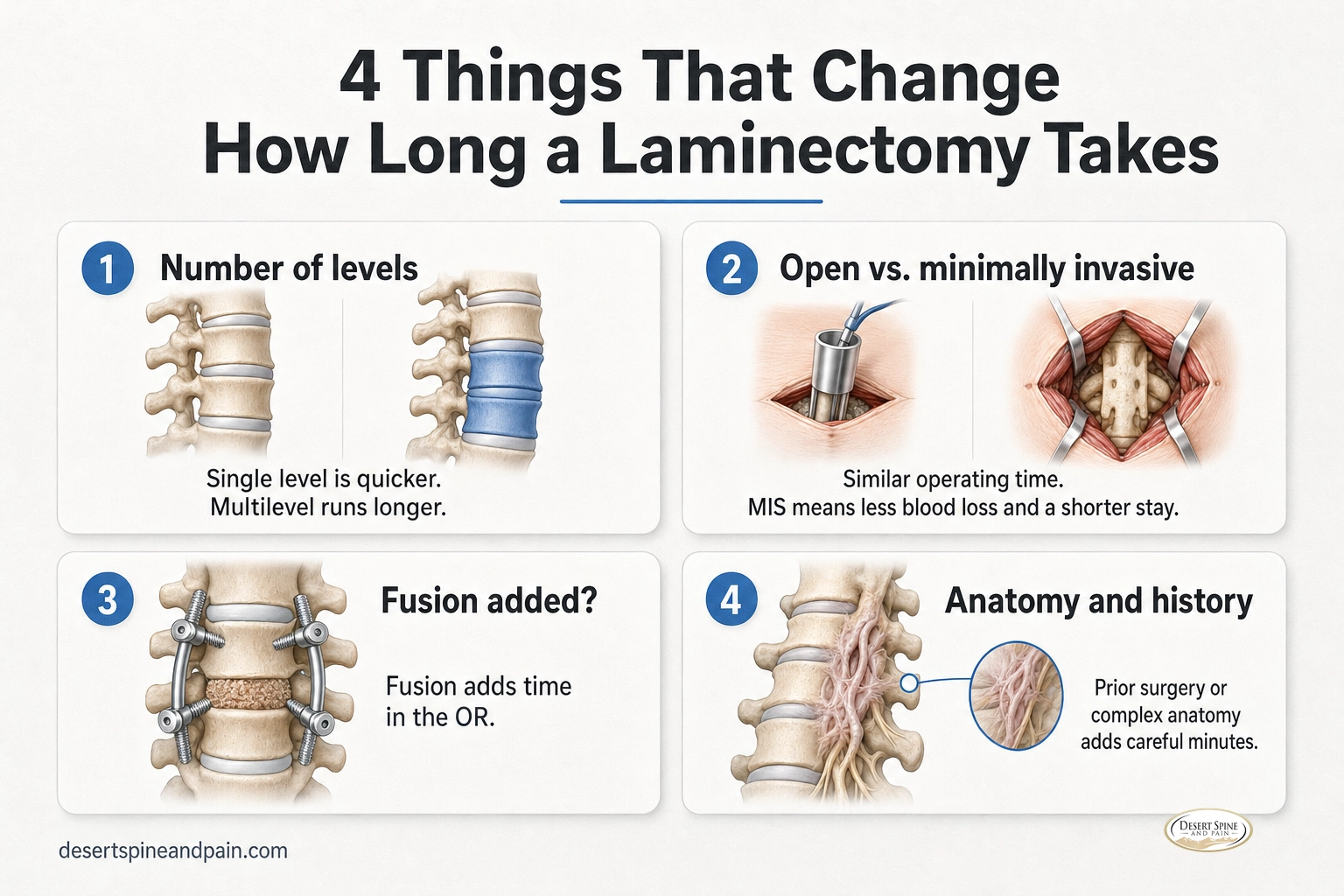
| Factor | Shorter surgery | Longer surgery |
|---|---|---|
| Number of levels | Single level decompressed | Two, three, or more levels decompressed |
| Surgical approach | Focused, well-planned exposure | Wider exposure or a difficult working space |
| Fusion added? | Decompression only | Laminectomy plus fusion with hardware and graft |
| Your anatomy and history | First-time surgery, straightforward anatomy | Scar tissue from prior surgery, complex anatomy |
Number of levels
This is the single biggest driver. Decompressing one level is relatively quick; each additional level adds its own incision work, bone removal, and nerve protection, so a multilevel case runs toward the longer end of the range.
Open vs. minimally invasive
A minimally invasive laminectomy works through a smaller opening using tubular retractors and a microscope, while an open laminectomy uses a larger exposure. A 2016 systematic review and meta-analysis comparing the two approaches for lumbar stenosis found broadly similar operating times, with the minimally invasive approach associated with less blood loss and a shorter hospital stay. In other words, the approach affects your recovery and your day more than it dramatically changes the hours in the operating room.
Source: Systematic review and meta-analysis of minimally invasive vs. open laminectomy for lumbar stenosis, Spine (2016) | Desert Spine and Pain minimally invasive spine surgery
Whether a fusion is added
Adding a spinal fusion is the most common reason a laminectomy runs long. Placing hardware and a bone graft is extra surgery on top of the decompression, so it extends both the operation and the recovery that follows.
Your anatomy and surgical history
Scar tissue from a previous spine surgery, unusual anatomy, or a very narrowed canal can all add careful minutes, because the surgeon works more slowly to protect the nerves and the spinal cord.
Myth: "A longer surgery means a worse surgery." Not true. A multilevel decompression or a decompression with fusion takes longer only because there is more to do, not because something is going wrong. What matters is that the operation is thorough, safe, and matched to what your spine actually needs, not how quickly the clock runs.
The common thread across all four factors is that careful, well-planned surgery is worth the time it takes. Outcomes in spine surgery track closely with how precisely the operation is performed, which is why the experience of the surgeon doing it matters as much as the minutes on the clock.

Why a Laminectomy With Fusion Takes Longer
It is worth separating the two operations people often blur together. A laminectomy by itself removes bone to relieve pressure. A fusion permanently joins two or more vertebrae with hardware and a bone graft to add stability. When both are done at the same sitting, called a decompression and fusion, the fusion portion adds real time in the operating room.
The bigger difference, though, is on the back end. A decompression alone is a relatively quick healer, while a fusion has to solidify over months before the segment is fully solid.
If your surgeon has recommended a fusion along with your laminectomy, it is reasonable to ask why the stability is needed, whether a decompression alone could work, and how the added fusion changes your specific timeline. If the question is whether you even need surgery, our guide to what a laminectomy is and when it is used is a good next read.
Source: Cleveland Clinic laminectomy recovery guidance | Desert Spine and Pain lumbar fusion
Recovery Timeline: Separate From Surgery Length
A short surgery does not mean an instant recovery, and this is where many people get the timing confused. The operation is measured in hours; healing is measured in weeks to months. Two things happen at different speeds: the incision and soft tissues settle in the first weeks, while a fusion, if you had one, continues to solidify for months.
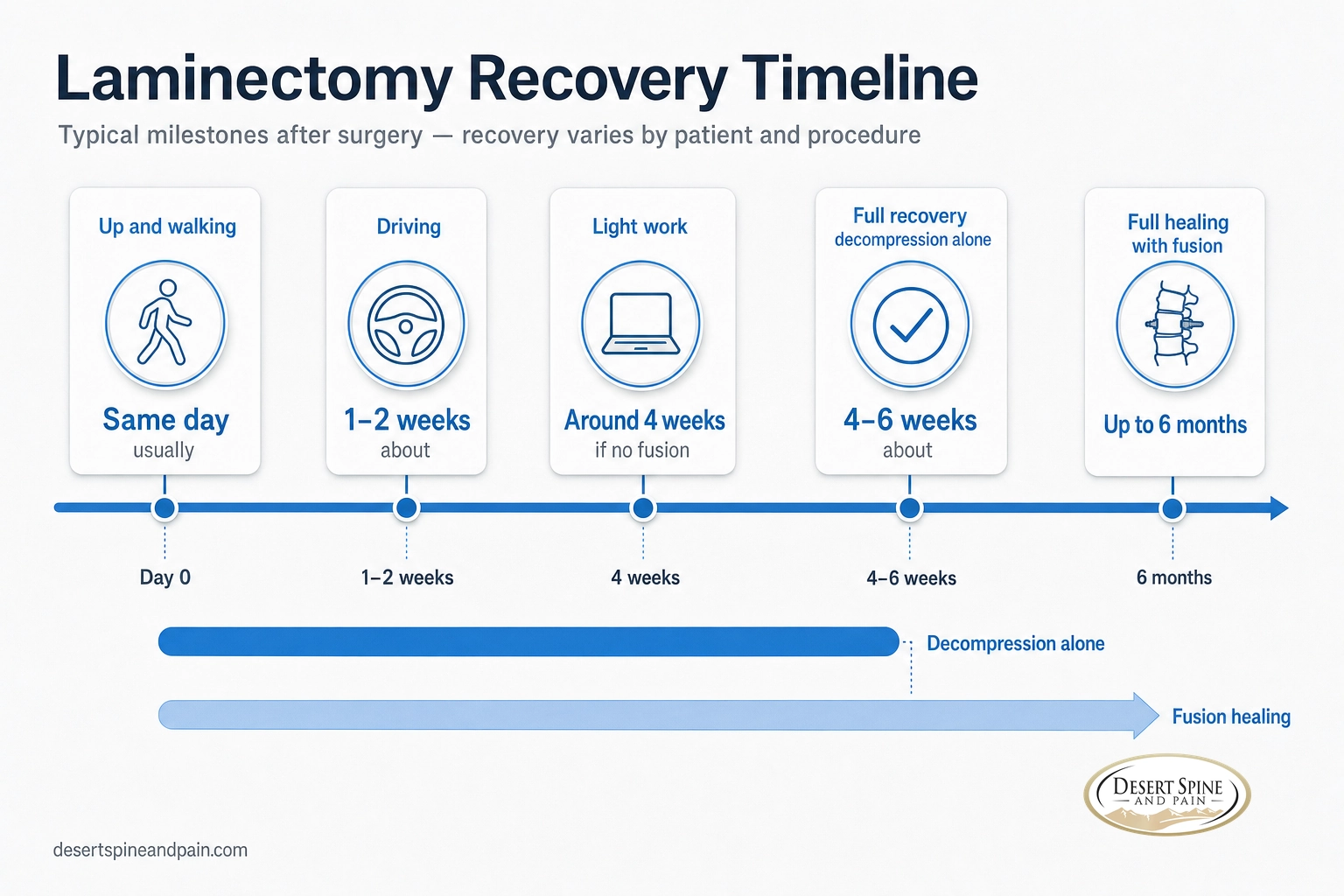
| Milestone | Typical timing |
|---|---|
| Up and walking | Usually the same day, once anesthesia wears off (unless a fusion was done) |
| Driving again | About 1 to 2 weeks for most people |
| Back to light, non-strenuous work | Around 4 weeks if no fusion was performed |
| Full recovery, decompression alone | About 4 to 6 weeks after a minimally invasive laminectomy |
| Full healing with fusion | Up to about 6 months |
These are general ranges, not individual predictions. Your age, overall health, whether you smoke, how many levels were treated, and whether you had a fusion all shape the real timeline. For practical ways to help your recovery along, see our laminectomy recovery tips, and if you are wondering about the pain side of healing, our guide to what pain to expect after a laminectomy covers it honestly.
Source: Cleveland Clinic recovery timeline | MedlinePlus recovery notes
Is a Laminectomy Major Surgery?
Patients often ask whether a one-to-three-hour operation really counts as major surgery. The fair answer is that it is a real operation performed under general anesthesia on the spine, so it deserves respect and careful preparation, but a straightforward single-level decompression is also one of the more routine, well-established spine procedures, and many people go home the same day.
Where a laminectomy sits on the spectrum depends almost entirely on the factors above. A single-level minimally invasive decompression is on the lighter end. A multilevel laminectomy with a fusion is a bigger operation with a longer recovery. The time it takes is one honest signal of where your particular surgery falls, which is exactly why a specific, in-person estimate from your surgeon is worth more than any general range. For a side-by-side on how a laminectomy compares with a related operation, our discectomy vs. laminectomy comparison is a useful next step.
How to Get Started
If a laminectomy is on the table, the most useful next step is a focused evaluation that confirms how many levels are involved, whether a fusion is truly needed, and which approach fits your spine. That is also the moment your surgeon can turn the general "1 to 3 hours" into a real estimate for you, and it is the right time to ask about alternatives and to get a second opinion before any spine surgery.
Desert Spine and Pain is a Phoenix, Arizona practice led by Dr. David L. Greenwald, MD, FACS, who is board certified as both a spine surgeon and a neurosurgeon. The practice draws patients from across the Greater Phoenix area and beyond for spine care, and it always starts with the least invasive effective option, escalating to surgery only when it is genuinely the best path. You can read more about Dr. Greenwald's background and training before you decide.
Learn about laminectomy at Desert Spine and Pain
Explore minimally invasive spine surgery
Book a consultation or second opinion
Common Questions About Laminectomy Surgery Time
How long does a laminectomy take?
Why is the operating room time longer than the surgery itself?
Does a laminectomy with fusion take longer?
Will I stay in the hospital after a laminectomy?
How soon will I know the exact length of my surgery?
Sources
Sources and Methodology
This guide summarizes established clinical references and peer-reviewed data on laminectomy surgery duration, approach, and recovery. Surgery-time and recovery figures are general ranges drawn from national health libraries, academic medical centers, and a peer-reviewed comparison of surgical approaches. They are presented as general reference, not as individual predictions. This is educational information, not medical advice. Decisions about surgery should be made with a qualified spine surgeon after an in-person evaluation.