

Laminectomy Recovery: Timeline, Tips, and What to Expect
The short answer: Most people recover from a minimally invasive laminectomy in about four to six weeks, and up to six months if a spinal fusion was added. You will walk within the first day, return to driving in roughly one to four weeks, and go back to desk work in about two to four weeks. The golden rule while you heal is simple: avoid bending, lifting, and twisting, walk a little more each day, and call your surgeon if pain worsens or you develop new weakness or numbness.
A laminectomy removes a small section of bone, the lamina, to take pressure off a crowded spinal nerve, which is why the leg pain, sciatica, or heaviness that led you to surgery is often better the day it is done. Recovery after that is mostly about protecting a healing spine and gradually rebuilding activity on a predictable schedule. The good news is that a laminectomy, especially a minimally invasive one, is one of the faster spine surgeries to bounce back from. This guide walks you through exactly what to expect: the first few days, the week-by-week timeline, the do's and don'ts that keep your recovery on track, the habits that help you heal faster, and the specific warning signs that mean something needs a closer look.
- Full recovery takes about four to six weeks after a minimally invasive laminectomy, and up to six months if a spinal fusion was performed at the same time.
- You will start short walks within the first 24 hours; most people drive again in roughly one to four weeks and return to desk work in about two to four weeks.
- The central restriction is to avoid bending, lifting, and twisting, and to limit sitting or standing to about 30 minutes at a stretch, until your surgeon clears you.
- Walking daily, controlling pain on schedule, preventing constipation, not smoking, and completing physical therapy are the habits that speed recovery.
- Pain that worsens instead of improving, or new weakness, saddle numbness, or loss of bladder or bowel control, is not normal and needs prompt or emergency care.

What's in This Guide
What to Expect in the First Few Days
Many laminectomies are now done as same-day or short-stay surgery, so a good share of the early recovery happens at home. In the first hours after surgery you will feel some soreness at the incision and a deep, bruised ache in the muscles beside the spine, which is normal and usually well controlled with medication. If the procedure relieved a pinched nerve, you may notice right away that the old leg pain is already gone or dramatically reduced, even while the back itself feels tender.
The most important thing that happens in this window is that you get up and move. Walking is encouraged within the first 24 hours after a spinal decompression like a laminectomy, because lying in bed for long stretches slows healing and raises the risk of blood clots. The walks are short and frequent, not marathons: a lap around the room or the hallway, a little more than the time before. For a sense of how the procedure itself works and why early movement is safe, see our overview of what a laminectomy is and how it works, and if you are curious about the operation itself, how long laminectomy surgery takes.
Source: Cleveland Clinic: Laminectomy Surgery for Back Pain | Kaiser Permanente: Lumbar Laminectomy, What to Expect at Home
The Laminectomy Recovery Timeline, Week by Week
Recovery follows a recognizable arc. Discomfort is highest early and then declines steadily, while your activity slowly expands. Knowing the schedule helps you tell an ordinary bump in the road from a real problem.
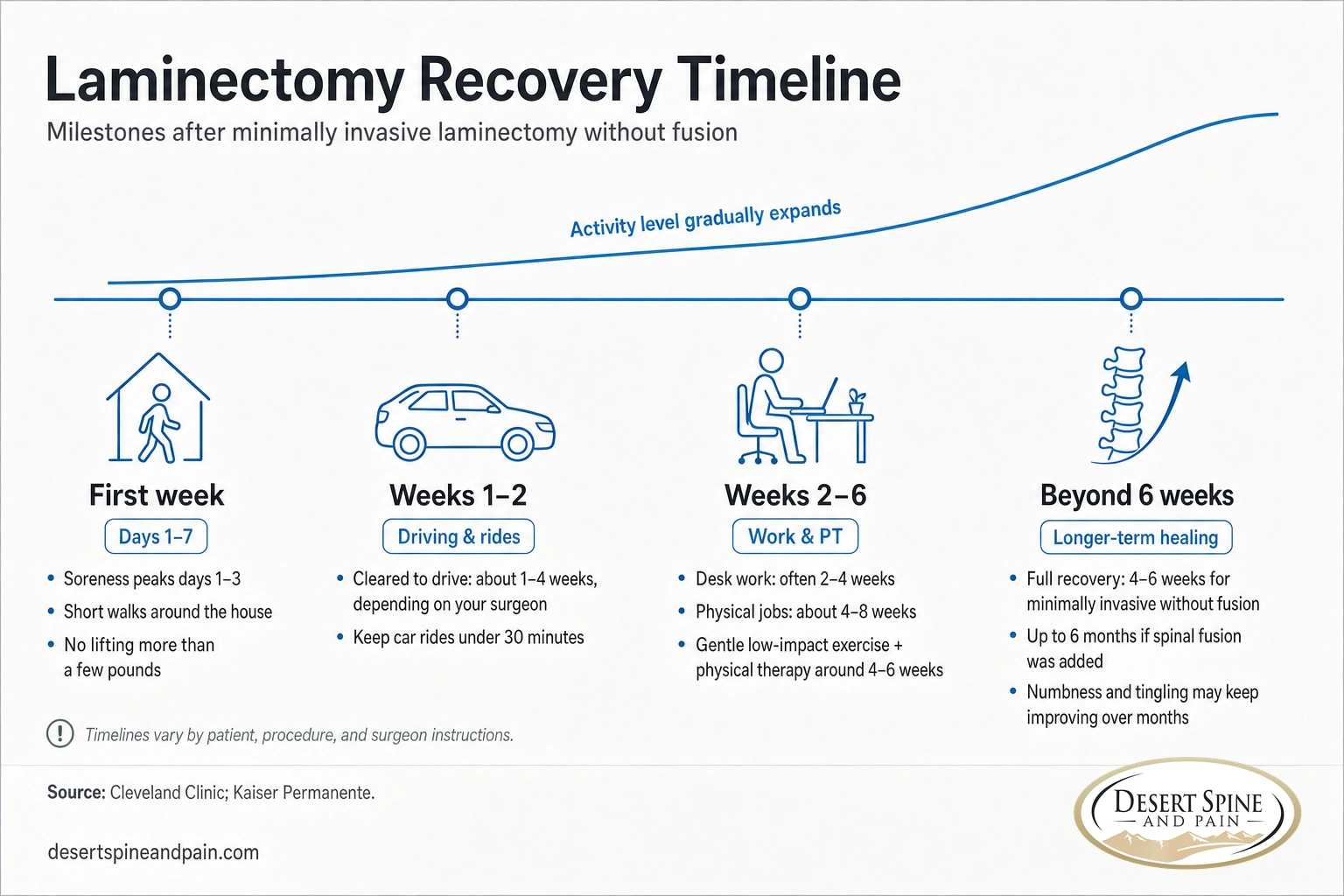
The first week
This is when soreness peaks, usually in the first two to three days, then begins to ease. Activity is mostly walking around the house, and you will not be lifting anything heavier than a few pounds. Take your pain medication on the schedule your team sets rather than waiting for pain to spike, and change position roughly every 30 minutes instead of sitting or standing in one spot. If you want a realistic picture of how much discomfort to expect, our guide to how much pain is normal after a laminectomy breaks it down.
Weeks one to two
Soreness is noticeably better. According to the Cleveland Clinic, most people feel well enough to drive within one to two weeks, though many surgeons and patient-education guides advise waiting two to four weeks, especially while you are still on strong pain medication. Keep car rides under about 30 minutes for the first few weeks, and stop to stand and stretch on longer trips.
Weeks two to six
This is the main return-to-life window. Desk and other non-strenuous work typically resumes around two to four weeks, while physically demanding jobs often need four to eight weeks off. Gentle, low-impact exercise is usually cleared around four to six weeks, often alongside physical therapy. For a minimally invasive laminectomy without fusion, most people are fully recovered by the end of this window.
Beyond six weeks
Two things stretch longer. First, if a spinal fusion was added to stabilize the segment, complete healing can take up to six months because bone has to fuse. Second, nerve recovery is slow by nature: a nerve compressed for months can take weeks to months to fully settle, so residual numbness or tingling can keep improving well after the incision has healed. That slow fade is expected, not a sign the surgery failed. If you are weighing the long-term picture, see how long a laminectomy lasts.
Return-to-activity milestones after a minimally invasive laminectomy (no fusion)
General guidance for a laminectomy without spinal fusion; your surgeon's instructions take priority. Sources: Cleveland Clinic; Kaiser Permanente.Source: Cleveland Clinic: Laminectomy | Kaiser Permanente: Lumbar Laminectomy at Home
Recovery Do's and Don'ts: The Rules That Protect Your Spine
Almost every post-laminectomy restriction comes down to one idea: give the incision, muscles, and (if applicable) the fusion time to heal before you load the spine. The movements that put a healing spine at risk are bending, lifting, and twisting, often shortened to the BLT rule.
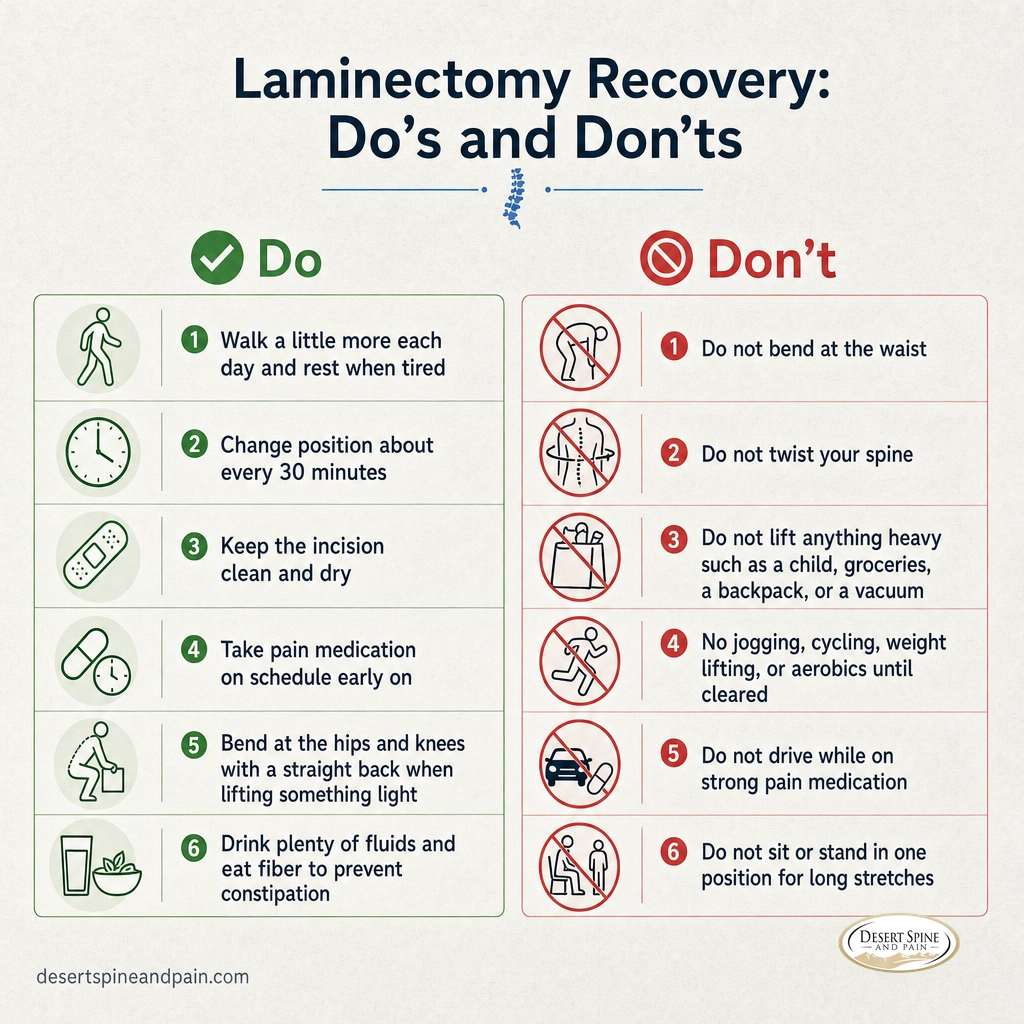
Avoid bending, lifting, and twisting (BLT) while you heal. Do not bend at the waist, twist your spine, or lift anything heavy, such as a child, a full grocery bag, a heavy backpack, or a vacuum. Skip strenuous activity like jogging, cycling, weight lifting, and aerobics until your surgeon approves. These limits usually apply for at least the first few weeks, and your surgeon may extend them, particularly if a fusion was done. When you do need to pick something light up, bend at the hips and knees and keep your back straight rather than bending from the spine.
The things you should actively do are just as important:
- Do walk every day, a little more than the day before, resting when you are tired.
- Do change position about every 30 minutes instead of sitting or standing for long stretches.
- Do keep the incision clean and dry, and follow your surgeon's instructions on showering and dressing changes.
- Do take pain medication on schedule early on so you stay ahead of the pain and can keep moving.
- Don't drive until you are cleared and off strong pain medication, and keep early car rides short.
- Don't return to heavy chores, lifting, or demanding work until your surgeon signs off, even if you feel good.
Source: Kaiser Permanente: Lumbar Laminectomy, What to Expect at Home | Cleveland Clinic: Laminectomy

How to Recover Faster After a Laminectomy
Recovery is not entirely in your hands, but a surprising amount of it is. The habits below are the difference between a smooth four-to-six-week recovery and a longer, more frustrating one, and none of them are complicated.
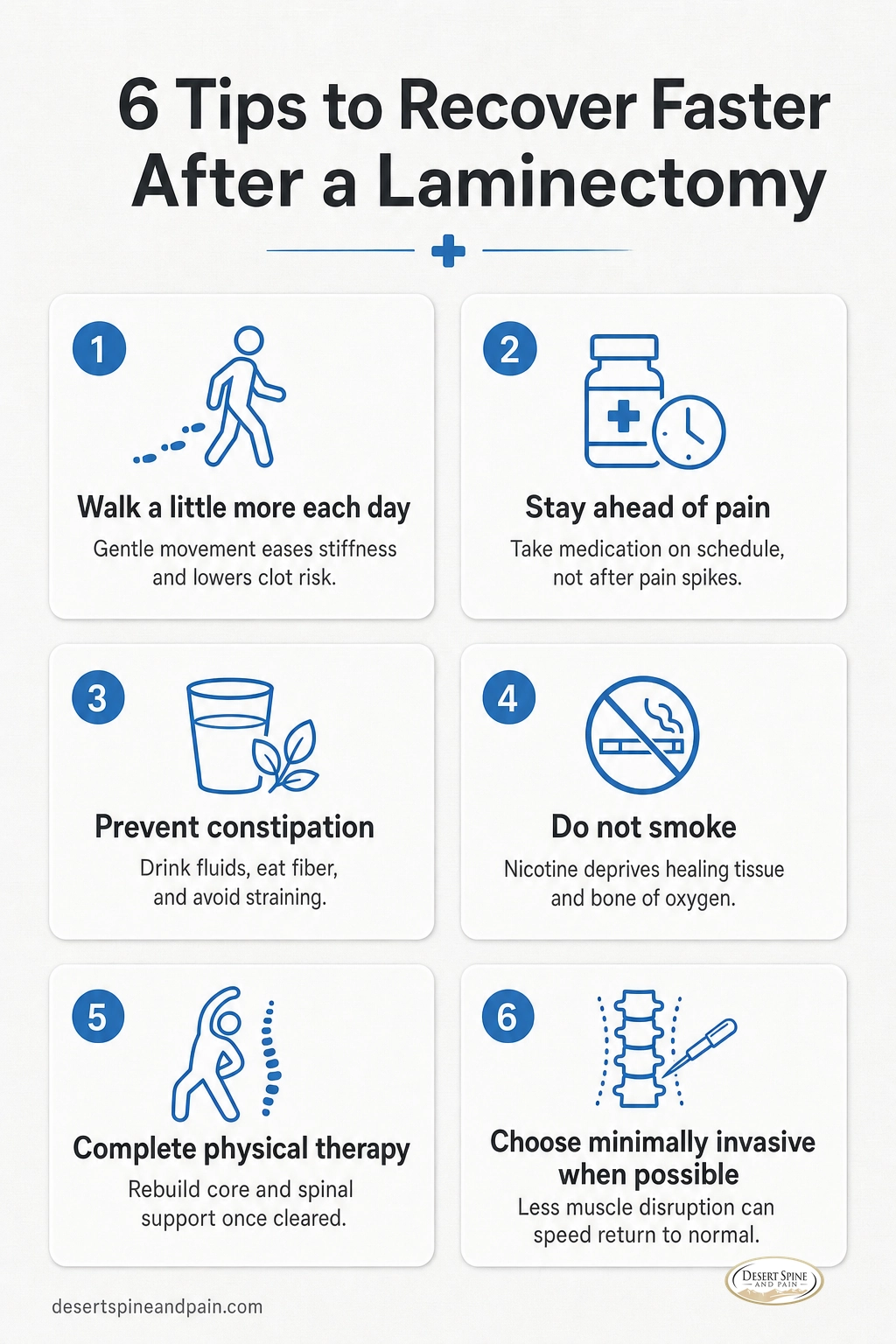
Walk a little more each day
Walking is the most underrated recovery tool there is. Frequent short walks ease stiffness, improve circulation, and lower the risk of complications like blood clots, and they beat prolonged bed rest every time. You are not trying to get fit, just to keep moving, starting with a short loop and adding a little distance daily.
Stay ahead of pain, and ahead of constipation
Take pain medication on the schedule your team recommends rather than waiting for pain to become severe, which usually means needing less of it overall. Pain medications, especially opioids, commonly cause constipation, so drink plenty of fluids, eat fiber, and ask about a daily fiber supplement or a mild laxative. Straining on the toilet is exactly the kind of pressure a healing spine does not need.
Do not smoke
Nicotine narrows blood vessels and starves healing tissue and bone of oxygen, which slows recovery and, if you had a fusion, can interfere with the bone fusing at all. Not smoking is one of the most powerful things you can do for a clean recovery.
Complete your physical therapy
Once your surgeon clears it, a guided physical therapy program, coordinated through trusted referral partners, rebuilds the core and spinal muscles that protect your back long term. Physical therapy at Desert Spine and Pain is arranged by referral to vetted rehabilitation partners rather than performed in the office, and finishing the full program is strongly linked to better, more durable outcomes. For a sibling procedure's rehab arc, compare our microdiscectomy recovery timeline.
If specific pain lingers as you rebuild activity, it can usually be addressed. Image-guided epidural steroid injections and other interventional options can calm an irritated nerve during recovery. A small share of patients develop ongoing pain known as post-laminectomy syndrome, which is a recognized, treatable problem rather than a dead end.
Source: Kaiser Permanente: Lumbar Laminectomy at Home | Weinstein et al., SPORT: Surgical versus Nonsurgical Therapy for Lumbar Spinal Stenosis, NEJM (2008)
Warning Signs: When to Call Your Surgeon
The vast majority of recoveries are uneventful. But knowing which symptoms fall outside the normal pattern is the most important thing to take from this guide, because a few of them are genuine emergencies.
Seek emergency care right away for any new or worsening weakness in a leg or foot, numbness around the groin, buttocks, or inner thighs (saddle numbness), or any new loss of bladder or bowel control. Call 911 if you pass out, have sudden chest pain with shortness of breath, or cannot move a leg at all. These are uncommon, but they are time-sensitive and should not be watched at home.
Call your surgeon promptly, though not necessarily as an emergency, for:
- Pain that is steadily getting worse after the first few days instead of improving.
- Severe pain that your prescribed medication does not control.
- Redness, increasing swelling, warmth, drainage, or pus at the incision, or a fever, which can point to infection.
- An incision that opens or loose stitches.
- Leg pain that had resolved and then returns.
- No bowel movement for a couple of days, or a recovery that is not progressing as expected.
Source: Kaiser Permanente: when to call your doctor | American Association of Neurological Surgeons: Lumbar Spinal Stenosis
Setting Up the Smoothest Recovery
Two decisions shape your recovery more than almost anything that happens afterward, and both are made before the first incision. The first is choosing the least invasive effective approach, because a minimally invasive decompression spreads rather than cuts the muscle, which consistently means less tissue trauma, less pain, and a faster return to normal. The second is making sure the procedure is the right one for your specific anatomy, so the nerve is fully freed and nothing is left to cause lingering trouble. If you are still comparing procedures, our breakdown of a discectomy versus a laminectomy is a good place to start, and our guide to laminectomy surgery cost covers the financial side.
Desert Spine and Pain is a Phoenix, Arizona practice led by Dr. David L. Greenwald, MD, FACS, a board-certified surgeon who is both a spine surgeon and a neurosurgeon, and it draws patients from across the Greater Phoenix area and beyond. Care always starts with the least invasive effective option and moves to surgery only when it is genuinely the best path, which is the philosophy that keeps recovery as light as it can be. If surgery has been recommended and you want to understand your options, or if your recovery is not going the way you expected, a focused consultation or second opinion is the right next step.
Learn about laminectomy at Desert Spine and Pain
Explore options for persistent or post-surgical pain
Book a consultation or second opinion
Common Questions About Laminectomy Recovery
How long does it take to recover from a laminectomy?
What are the restrictions after a laminectomy?
How long after a laminectomy can I drive?
How long after a laminectomy can you bend over?
What helps you recover faster after a laminectomy?
Sources and Methodology
Sources and Methodology
This guide summarizes established clinical references and patient-education guidance on recovery after a laminectomy. Recovery timeframes reflect typical, not guaranteed, outcomes and vary with technique, whether a fusion was done, the number of levels treated, and your overall health. Where sources differ (for example on when it is safe to drive), we present the range and cite each source. This is educational information, not medical advice. Decisions about your care should be made with a qualified spine specialist after an in-person evaluation, and your surgeon's post-operative instructions always take priority.
- Cleveland Clinic: Laminectomy Surgery for Back Pain (recovery timeline, driving, return to work, bending and twisting)
- Kaiser Permanente: Lumbar Laminectomy, What to Expect at Home (driving, car rides, lifting, work, constipation, warning signs)
- American Association of Neurological Surgeons: Lumbar Spinal Stenosis
- Weinstein et al. (2008): Surgical versus Nonsurgical Therapy for Lumbar Spinal Stenosis, SPORT, New England Journal of Medicine