

Laminotomy vs. Laminectomy: Key Differences Explained
Laminotomy and laminectomy are the same idea at two different sizes: both remove bone from the lamina, the arch at the back of a vertebra, to relieve pressure on pinched spinal nerves, but a laminotomy removes only a small window while a laminectomy removes the whole arch. That one difference drives everything that follows. A laminotomy is the more targeted, bone-sparing operation that tends to protect spinal stability, and a laminectomy is the wider, more complete decompression used when narrowing is severe or spans several levels. Choosing correctly is less about which operation is bigger and more about exactly how much room your nerves actually need.
- Same goal, different size: both remove lamina bone to decompress nerves; a laminotomy takes a small window, a laminectomy takes the entire lamina.
- Laminotomy preserves more: it spares most of the bone and the stabilizing facet joints, lowering the risk of post-surgery instability.
- Laminectomy decompresses more broadly: the standard choice for severe or multilevel spinal stenosis where a window is not enough.
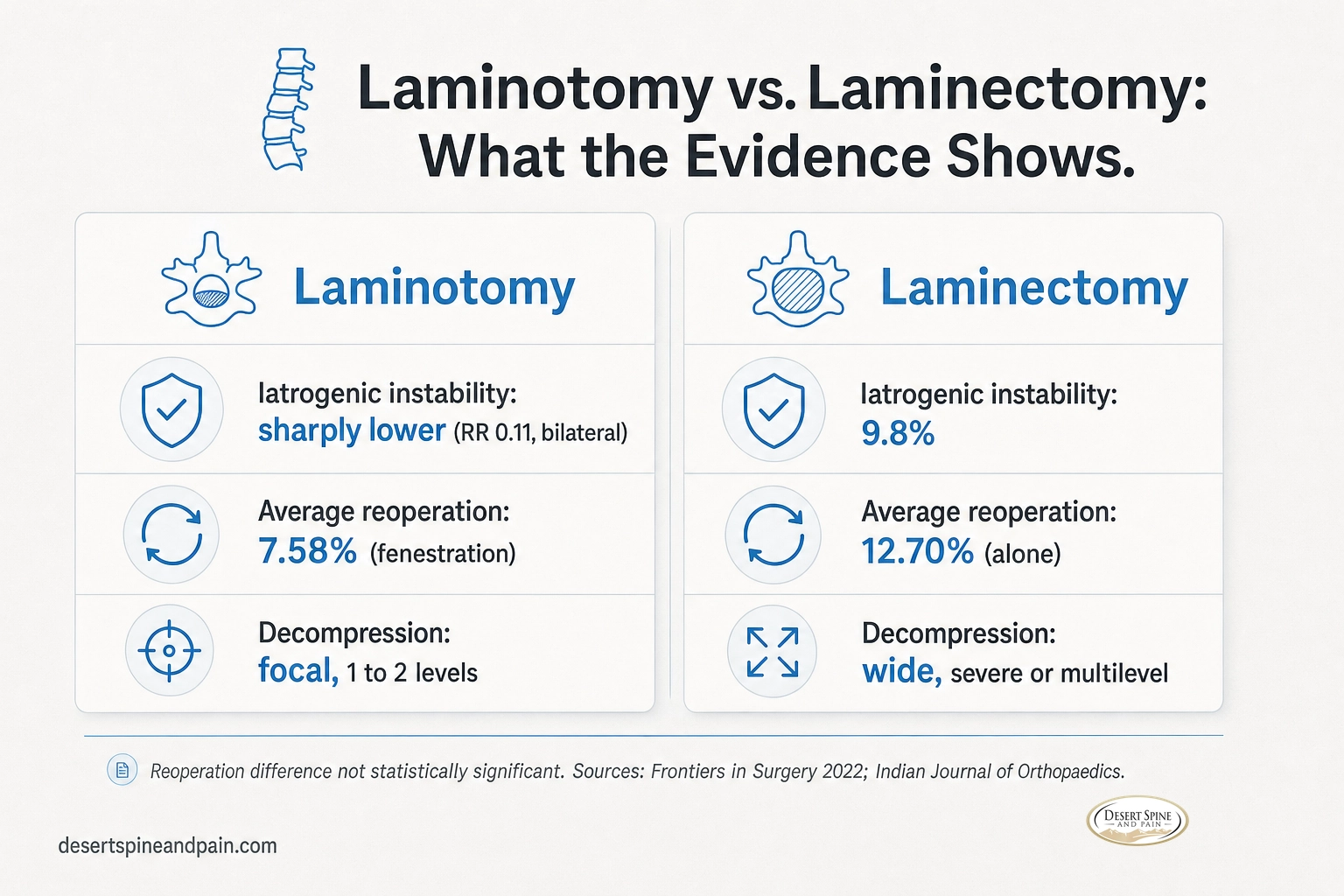
- Stability data: iatrogenic instability affected about 9.8% of laminectomy patients; bilateral laminotomy cut that risk sharply (RR 0.11).
- Function is similar: high-quality trials show comparable relief of leg pain and disability, with bilateral laminotomy modestly favored on recovery.
- Reoperation is comparable: bone-sparing decompression trended lower (7.58% vs 12.70%), a difference that was not statistically significant.
- The deciding factor is how much and how widely the canal is narrowed, confirmed on MRI, not which operation sounds more thorough.

What's in This Guide
- Laminotomy vs. Laminectomy at a Glance
- Understanding Laminotomy
- Understanding Laminectomy
- What Each One Treats
- How Much Bone Comes Out
- Spinal Stability: The Real Trade-off
- Recovery and Hospital Stay
- Outcomes and Reoperation
- Side-by-Side Comparison Table
- Who a Laminotomy Fits
- Who a Laminectomy Fits
- The Verdict
- Frequently Asked Questions
Laminotomy vs. Laminectomy at a Glance
- Removes a small window of the lamina over the affected nerve
- Best for focal, one- or two-level narrowing or a localized pinch
- Preserves most bone and the facet joints, protecting stability
- Well suited to minimally invasive and endoscopic approaches
- Trade-off: a narrower working window may not clear severe stenosis
- Removes the entire lamina at one or more levels
- Standard for severe or multilevel spinal stenosis
- Gives the surgeon the widest, most complete decompression
- More bone removed, so a small minority may need a fusion
- Trade-off: more bone work and a modestly higher instability risk
1Understanding Laminotomy
A laminotomy removes only a small section of the lamina, the bony arch at the back of a vertebra, to create a window that takes pressure off a specific nerve. Think of the lamina as part of the roof over the spinal canal. In a laminotomy, the surgeon opens a small skylight in that roof rather than taking the whole roof off. Through that window, a surgeon can also trim the thickened ligament or a bulging disc fragment that is crowding the nerve, while leaving the surrounding bone and the facet joints, the small joints that link one vertebra to the next, in place.
Because the opening is small and targeted, a laminotomy is naturally suited to minimally invasive and endoscopic techniques. Working through a small incision with tubular retractors or an endoscope spares muscle, limits blood loss, and often shortens the hospital stay. When a laminotomy is used to open the canal on both sides from a single approach, it is sometimes called a unilateral laminotomy for bilateral decompression. A closely related, even smaller technique is a hemilaminectomy, which removes one side of the lamina.
Who it fits: a patient whose narrowing is focal, affecting one or two levels or one nerve root, where a precise window is enough to relieve the pressure. Genuine trade-offs: it is the smaller, more stability-friendly operation, but the narrower working window can make it harder to fully decompress a canal that is severely or diffusely narrowed, and in those cases a surgeon may need to convert to a wider removal.
Explore minimally invasive spine surgery in PhoenixSource: NCBI StatPearls, posterior spinal decompression techniques
2Understanding Laminectomy
A laminectomy removes the entire lamina at one or more vertebrae, taking the whole back wall of the canal off to give the nerves the most room possible. It is the long-established standard operation for lumbar spinal stenosis, a narrowing of the spinal canal that most often affects older adults as bone, ligament, and disc thicken inward over time. The classic symptom is neurogenic claudication: leg pain, heaviness, or weakness that builds while standing and walking and eases when you sit or lean forward.
Because stenosis is usually a broad, bony problem rather than a single soft fragment, a full laminectomy gives the surgeon an unobstructed view and the room to clear pressure across the whole segment. The cost of that thoroughness is that more bone comes out, which is why a small number of patients, especially those who already have some slippage or instability, may also need a fusion to keep the segment stable. For a fuller primer on the procedure itself, see our guide to what a laminectomy is and how it works.
Who it fits: a patient with severe or multilevel canal narrowing confirmed on MRI whose symptoms match that narrowing. Genuine trade-offs: it reliably and completely opens the canal, but it is more bone work than a laminotomy, and removing the full arch modestly raises the chance of instability down the line. Our board-certified neurosurgeon and spine surgeon decompresses while preserving as much stabilizing bone and joint as the anatomy safely allows, reserving fusion for cases that truly require it.
Learn about laminectomy at Desert Spine and PainSource: Frontiers in Musculoskeletal Disorders, 2024
3What Each One Treats
Both operations treat the same core problem, a pinched nerve from a narrowed canal, so unlike discectomy versus laminectomy, this is not a case of two different diagnoses. It is a question of scale. The surgeon matches the size of the decompression to the size of the problem.
A laminotomy fits focal narrowing: one or two levels, or a single nerve root crowded by a bulging disc, a thickened ligament, or a bone spur. The pressure is localized, so a window is enough. A laminectomy fits broader narrowing: severe central stenosis, narrowing across several levels, or anatomy where a surgeon needs full access to clear the canal completely. When the narrowing is extensive, a series of small windows would leave too much compression behind.
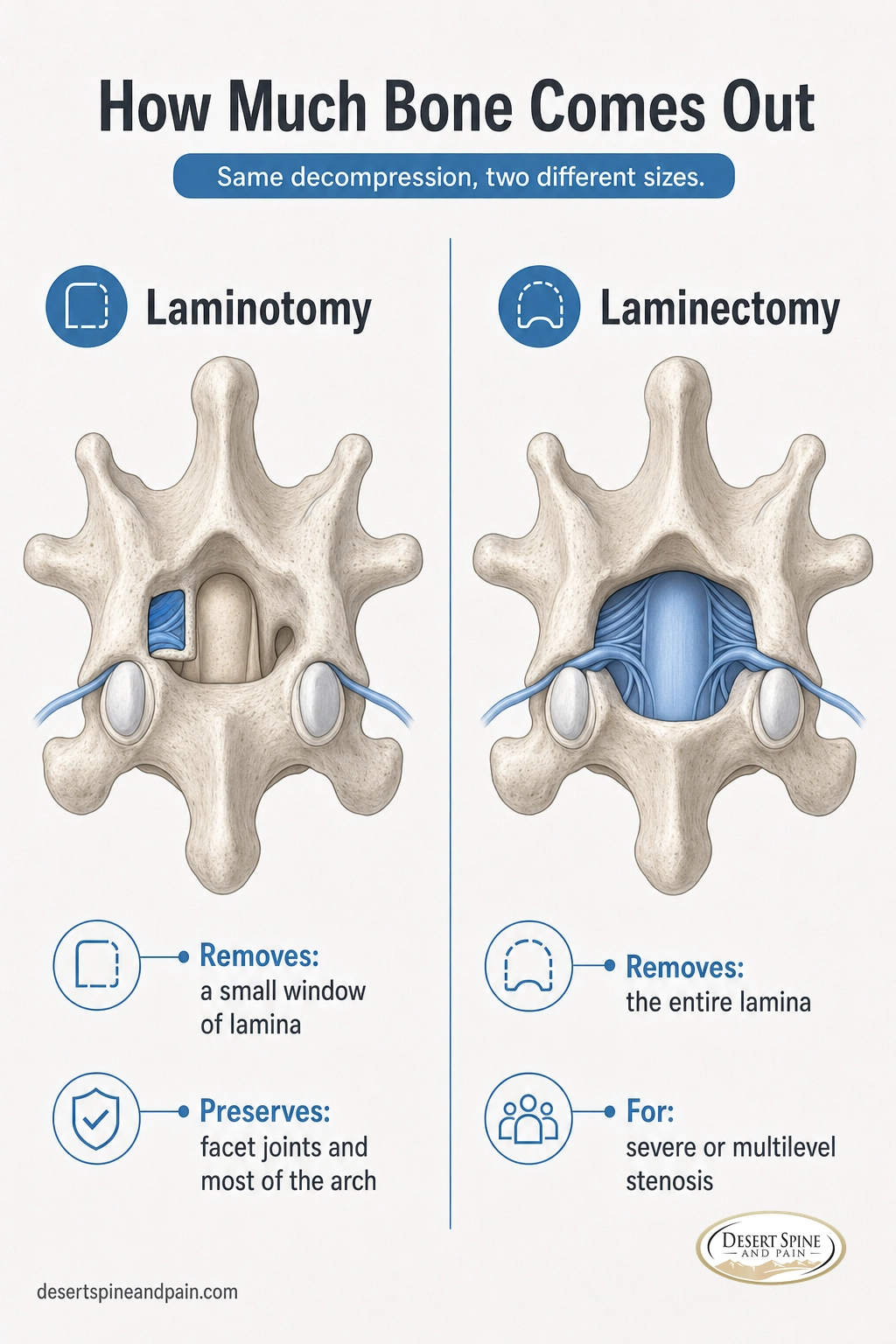
More bone removal is not automatically better. Taking out more lamina than the problem requires does not improve nerve relief, and it removes stabilizing structures the spine relies on. In a focal pinch, a precise laminotomy can relieve the nerve just as completely as a laminectomy while protecting stability. The goal is to remove exactly enough bone to decompress the nerve and no more, which is why matching the operation to the pattern of narrowing matters more than choosing the larger procedure.
Source: NCBI StatPearls, posterior spinal decompression
4How Much Bone Comes Out
The names describe the difference exactly. The suffix -otomy means to cut into or make an opening, so a laminotomy makes an opening in the lamina. The suffix -ectomy means to remove, so a laminectomy removes the lamina. One opens a window; the other takes the arch.
In real surgery the two live on a spectrum of decompression rather than in separate boxes. A surgeon may start with a laminotomy and extend it if more room is needed, or perform laminotomies on both sides to decompress widely while leaving the central bone and the spinous process in place. The practical question is never just the name of the operation. It is how much bone has to come out to free the nerve, and how much can be safely left to keep the spine stable. For the full menu of techniques, from the smallest window to a complete decompression, see our overview of spinal decompression surgery.
Compare decompression surgery optionsSource: Cochrane systematic review of posterior decompression techniques
5Spinal Stability: The Real Trade-off
The single most important difference between these two operations is what they leave behind. The more lamina and facet joint a surgeon removes, the more the spine can loosen over time, a problem called iatrogenic instability, which sometimes shows up as a vertebra slipping forward (spondylolisthesis) and can lead to a second operation or a fusion. This is where the bone-sparing nature of a laminotomy earns its keep.
In that 2022 systematic review and meta-analysis of 14 trials and 1,106 participants, bilateral laminotomy was associated with markedly lower iatrogenic instability than conventional laminectomy, along with a modestly better disability score (mean difference -2.94, 95% CI -4.12 to -1.76). Importantly, laminotomy did not cost the patient anything measurable on the practical surgical metrics: operative time and blood loss were not significantly different between the techniques. The authors concluded that bilateral laminotomy has advantages in functional recovery and postoperative stability, while noting that more rigorous long-term trials are still needed.
Reading the comparative evidence together, the clearest and most consistent signal is not pain relief or recovery speed, where the two operations are broadly similar, but preserved stability. A laminotomy cuts the instability risk seen after laminectomy without lengthening surgery or increasing blood loss, which means the bone-sparing approach is close to a free upgrade whenever the narrowing is focal enough to allow it. The honest limit is coverage: a window cannot safely clear a severely or diffusely stenotic canal. So the surgical judgment reduces to a single question, how widely does the canal need to be opened, and the answer, read off the MRI, decides whether the stability advantage of a laminotomy is actually available. Calculation and interpretation original to Desert Spine and Pain.
Source: Zhang et al., Frontiers in Surgery, 2022

6Recovery and Hospital Stay
Recovery tracks how much tissue each operation disturbs. A laminotomy removes less bone and, done through a minimally invasive approach, spares more muscle, so it is generally the smaller operation with a shorter hospital stay and a somewhat quicker return to light activity. A laminectomy, particularly across several levels, involves more bone work and often an older patient, so the ramp back to full activity tends to be a little slower.
For both operations, most people resume daily activities within several weeks and continue improving over a few months, with heavier lifting held back longest. Both timelines stretch when more levels are treated or a fusion is added, and both depend on age and overall health. Driving typically resumes once a patient is off narcotic pain medication. Rather than fixating on a precise day count, which varies widely by person, it is more useful to know that the bone-sparing operation is usually the faster of the two and that steady, graded activity, guided by your surgeon, drives the result. Our laminectomy recovery guidance covers the week-by-week ramp in more detail.
Physical therapy after spine surgery is an important part of recovery, and Desert Spine and Pain coordinates referrals to trusted therapists as part of your care plan.
Meet Dr. GreenwaldSource: NCBI StatPearls, posterior spinal decompression
7Outcomes and Reoperation
When the right operation is matched to the right anatomy, both relieve nerve compression well. The highest-quality head-to-head evidence comes from a Cochrane systematic review that pooled 10 randomized controlled trials and 733 participants comparing unilateral laminotomy, bilateral laminotomy, and split-spinous laminotomy against conventional laminectomy.
The Cochrane reviewers found that the newer bone-sparing techniques and conventional laminectomy had broadly similar effects on functional disability and leg pain, based on low to very low quality evidence. The one statistically favorable signal was for bilateral laminotomy on patient-perceived recovery. Instability was numerically lower with the laminotomy techniques, but the overall incidence was low and the review stopped short of calling the difference definitive. Its honest conclusion is the one worth carrying into a consultation: the techniques are broadly comparable, high-quality long-term data is still limited, and good trials are needed.
Reoperation, the real-world durability question, follows the same pattern. In a review of 29,680 patients across 23 studies, fenestration-type bone-sparing decompression had an average reoperation rate of 7.58 percent versus 12.70 percent for laminectomy alone, a difference the authors reported as not statistically significant. The most common reasons for a second operation after either procedure are recurrent narrowing at the same level and new narrowing at an adjacent level.
Average Reoperation Rate: Bone-Sparing Decompression vs. Laminectomy Alone
Read carefully, the trend favors preserving bone, but the overlap in the data is real, and the difference did not reach statistical significance. That is exactly why the choice should not be made on reoperation percentages alone. It should be made on whether a window can actually clear your narrowing, with the stability advantage of a laminotomy taken where the anatomy allows it. For the broader outcome picture, see our laminectomy statistics and success data.
Explore lumbar stenosis surgery
Source: Cochrane Database of Systematic Reviews, posterior decompression techniques | Reoperation rates after lumbar stenosis surgery, Indian Journal of Orthopaedics
Side-by-Side Comparison Table
| Factor | Laminotomy | Laminectomy | Edge |
|---|---|---|---|
| Bone removed | A small window of the lamina | The entire lamina | Depends on narrowing |
| Best for | Focal, 1 to 2 level narrowing | Severe or multilevel stenosis | Depends on anatomy |
| Decompression breadth | Targeted window | Wide, complete | Laminectomy |
| Preserves facet joints | Yes, largely | Less | Laminotomy |
| Iatrogenic instability | Lower (RR 0.11 bilateral) | About 9.8% | Laminotomy |
| Minimally invasive fit | Excellent | Possible, less natural | Laminotomy |
| Operative time & blood loss | No significant difference | No significant difference | Comparable |
| Function & leg-pain relief | Comparable, recovery modestly favored | Comparable | Comparable |
| Average reoperation | 7.58% (fenestration) | 12.70% (alone) | Not significant |
| May need a fusion | Rarely | Occasionally (if unstable) | Laminotomy |
8Who a Laminotomy Fits
A laminotomy tends to be the right operation when:
- Imaging shows focal narrowing, at one or two levels or around a single nerve root, that a targeted window can reach.
- Your symptoms point to a specific pinched nerve rather than diffuse, severe central stenosis.
- Preserving spinal stability is a priority, for instance if your spine is otherwise sound and you want to protect the facet joints.
- You are a good candidate for a minimally invasive or endoscopic approach and want the smallest operation that will do the job.
- Conservative care such as time, medication, physical therapy, or an injection has not given lasting relief.
If you have not yet exhausted non-surgical options, those are usually the right first step before any decompression.
See conservative care options first9Who a Laminectomy Fits
A laminectomy tends to be the right operation when:
- Imaging shows severe or multilevel spinal stenosis, a broad bony narrowing that a small window cannot fully relieve.
- Your legs feel heavy, painful, or weak when you stand and walk, and better when you sit or lean forward (neurogenic claudication).
- The compression is diffuse and central, so the surgeon needs full access to clear the canal completely.
- Conservative care has stopped working and your walking distance and quality of life are limited.
- Any slippage or instability can be addressed in the same setting, with fusion reserved for the minority who genuinely need it.
Desert Spine and Pain works with out-of-network patients of every kind and partners closely with personal injury attorneys, offering 24/7 concierge response and documentation coordination for injured clients. If you are weighing a fuller decompression against a bone-sparing option, our comparison of a laminoplasty versus a laminectomy covers another stability-preserving alternative for the neck.
Explore spine surgery at Desert Spine and Pain10The Verdict
Laminotomy versus laminectomy is not a contest between a better and a worse surgery. They are the same decompression at two scales, and the right one is the smallest operation that fully relieves your nerves. If your narrowing is focal, a laminotomy opens a precise window, protects the stabilizing bone and joints, and lends itself to a minimally invasive approach. If your narrowing is severe or spans several levels, a laminectomy removes the full arch to clear the canal completely. The research is consistent: both relieve leg pain and disability well, recovery and reoperation are broadly comparable, and the clearest measurable edge for the bone-sparing approach is preserved stability, available whenever the anatomy allows it.
The decision that matters most happens before surgery, when a surgeon reads your MRI and decides exactly how much of the canal has to be opened. That is where dual spine and neurosurgery training and an unhurried evaluation translate directly into a better, more conservative operation. If you have been told you need a laminectomy and want to know whether a smaller, stability-sparing laminotomy could do the job, or you just want to understand your options, a consultation or second opinion is the best next step. You can also compare a related pair in our guide to discectomy versus laminectomy.
Book a consultation: (602) 566-9500Frequently Asked Questions
What is the difference between a laminotomy and a laminectomy?
Is a laminotomy safer than a laminectomy?
Which lasts longer, a laminotomy or a laminectomy?
What is the recovery time for a laminotomy versus a laminectomy?
Can a laminotomy be done minimally invasively?
Methodology & Sources
How we compiled this comparison
Figures trace to Tier 1 primary sources: a Cochrane systematic review, a systematic review and meta-analysis, a large multi-study reoperation analysis, and clinical reference material. The head-to-head function, recovery, and instability comparisons come from the Cochrane Database of Systematic Reviews (Overdevest et al.), which pooled 10 randomized controlled trials and 733 participants, and from a 2022 systematic review and meta-analysis in Frontiers in Surgery (Zhang et al.) of 14 trials and 1,106 participants, which reported the 9.8 percent laminectomy instability rate, the bilateral-laminotomy instability relative risk of 0.11, the disability-score mean difference of -2.94, and no significant difference in operative time or blood loss. Reoperation figures (7.58 percent for fenestration versus 12.70 percent for laminectomy alone, across 29,680 patients in 23 studies) come from a review in the Indian Journal of Orthopaedics; the authors reported the difference as not statistically significant. The lumbar spinal stenosis prevalence figure comes from a 2024 analysis in Frontiers in Musculoskeletal Disorders. Procedure definitions and decompression-technique descriptions draw on NCBI StatPearls. Where the underlying evidence is graded low quality or lacks long-term follow-up, we have said so. All statistics describe populations, not any individual patient.
Primary sources referenced:
- Overdevest GM et al. Effectiveness of posterior decompression techniques compared with conventional laminectomy for lumbar stenosis. Cochrane Database of Systematic Reviews (CD010036).
- Zhang Y et al. Comparison of posterior decompression techniques and conventional laminectomy for lumbar spinal stenosis: a systematic review and meta-analysis. Frontiers in Surgery, 2022.
- Reoperation rates after surgery for lumbar spinal canal stenosis (23 studies, 29,680 patients). Indian Journal of Orthopaedics.
- Preoperative factors and decompressive laminectomy outcomes in symptomatic lumbar spinal stenosis. Frontiers in Musculoskeletal Disorders, 2024.
- Posterior spinal decompression techniques. NCBI StatPearls.
This article is educational and is not individual medical advice. For guidance specific to your spine condition, consult a qualified spine surgeon. No outcome can be guaranteed.
Journalists and researchers may cite these statistics with attribution to Desert Spine and Pain and a link to this page. Please attribute the underlying figures to their original Tier 1 sources as listed above. For expert commentary on spine decompression surgery from a board-certified neurosurgeon and spine surgeon, contact Desert Spine and Pain at (602) 566-9500.