

How Long Does a Laminectomy Last? Long-Term Outcomes
A laminectomy does not come with an expiration date, and for most people the relief lasts for years. Long-term studies show that the improvement in pain and walking holds up well past the five-year mark, with roughly two-thirds of patients keeping their gains. The catch is that surgery relieves the pressure on your nerves, it does not stop your spine from aging, so across 8 to 10 years about one in five patients eventually needs a second operation. The good news: most of those revisions happen in the first couple of years, so a result that holds early tends to keep holding.
- Years, not months. For the right patient, a laminectomy relieves leg symptoms and claudication durably, with benefit maintained at 5 or more years of follow-up.
- About 1 in 5 need a redo within 8 years. The largest randomized trial found an 18 percent reoperation rate at 8 years for lumbar spinal stenosis.
- Most revisions are early. 42 percent of all eventual reoperations happen within 2 years and 84 percent within 6, so a result that holds past the early years is a good sign.
- It wears out because the spine keeps aging. Recurrent stenosis, a slipping vertebra, or wear at the next level, not a failure of the surgery itself, is what brings symptoms back.
- Leg pain outlasts back pain. Leg-dominant symptoms respond best; back-dominant pain is less predictable and carries a higher chance of needing revision.
- Who operates matters. Removing only what is needed and preserving stability protects how long the decompression lasts.

What's in This Guide
- The Short Answer: How Many Years a Laminectomy Lasts
- A Laminectomy Relieves Pressure, It Does Not Stop Aging
- The Laminectomy Timeline, Year by Year
- What the Long-Term Studies Actually Show
- What Determines How Long Your Laminectomy Lasts
- If Your Symptoms Come Back: Recurrence and Revision
- Protecting Your Results for the Long Term
- Laminectomy Outcomes Timeline: The Evidence at a Glance
- Frequently Asked Questions
- Methodology & Sources
The Short Answer: How Many Years a Laminectomy Lasts
If you are weighing decompression surgery, the honest answer is that a well-done laminectomy usually lasts many years, and for a large share of patients it lasts the rest of their life without a second procedure. Surgeons and researchers do not quote a single number of years, because a laminectomy does not fail like a worn-out part. It fades only if the degenerative changes that caused your stenosis in the first place catch back up with you.
The best long-term data come from patients treated for lumbar spinal stenosis, the most common reason a laminectomy is performed. A systematic review of studies with at least five years of follow-up found that, on average, patients still had less pain, less disability, and higher satisfaction than before surgery. A separate long-term review found that improvement was maintained in roughly two-thirds of patients across follow-up ranging from one to eleven years.
The flip side of durability is the reoperation rate, which is the clearest signal of how long a decompression holds. The largest, highest-quality source is the Spine Patient Outcomes Research Trial (SPORT), a landmark study funded by the National Institutes of Health. In its stenosis group, 18 percent of surgical patients had a second spine operation within 8 years. In plain terms: four out of five patients did not.
Source: Gerling et al., Spine (2016), SPORT 8-year reoperation subanalysis | Long-term follow-up review, lumbar stenosis laminectomy (1998)
For the full dataset behind these numbers, see our deeper roundup of laminectomy success and reoperation statistics.
A Laminectomy Relieves Pressure, It Does Not Stop Aging
To understand how long your result will last, it helps to understand what a laminectomy actually does. The lamina is the bony roof over the back of the spinal canal. In spinal stenosis, that canal narrows, usually from thickened ligament, bone spurs, and bulging discs, and the crowded nerves trigger leg pain, numbness, and the classic heaviness that builds when you walk. A laminectomy removes that roof and the offending tissue to give the nerves room again. If you want the full procedure explainer, start with what a laminectomy is and how it works.
Here is the key point for durability: decompression fixes the crowding, but it does nothing to the arthritis, disc wear, and ligament changes that created the crowding. Those processes keep going. That is why a laminectomy that works beautifully at year one can slowly lose ground at year eight, not because the operation came undone, but because the spine kept doing what aging spines do.
Myth: "A laminectomy is permanent, so I am fixed for life." Not quite. The decompression itself is permanent, the removed bone does not grow back into the exact same roof. But stenosis can slowly rebuild at the same level, a vertebra can begin to slip, or the segment next door can wear down. A laminectomy buys relief and years of better function, it does not freeze your spine in time. Treating it as a reset button, rather than a well-earned repair, sets up the wrong expectations.
Source: Sajadi et al., Asian Journal of Neurosurgery (2022), long-term outcomes systematic review
The Laminectomy Timeline, Year by Year
Rather than one number, think of durability as a timeline. Here is what the evidence shows at each stage after surgery.
The First 6 to 12 Weeks: Healing
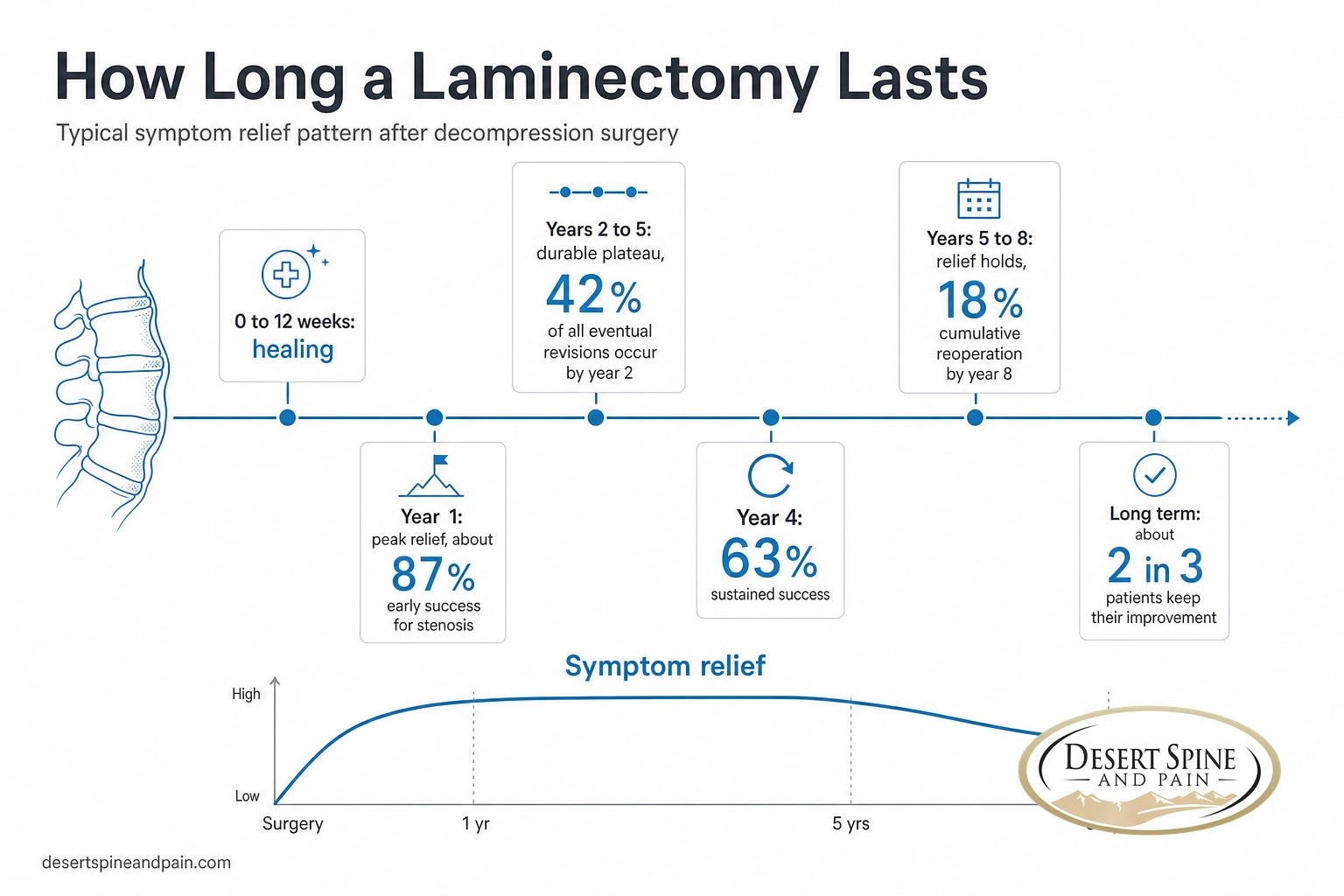
Leg symptoms often ease quickly once the nerves are decompressed, and many patients notice the walking-related leg pain improve within days. The incision and soft tissues need six to twelve weeks to heal, and activity is built back up gradually. This window is about recovery, not durability, but it sets the baseline. For practical guidance, see our laminectomy recovery tips and what to expect for pain after a laminectomy.
The First Year: Peak Relief
This is where most of the benefit shows up and settles in. Early success rates for pure stenosis are high, around the mid-to-high 80 percent range in the first six months, and the one-year mark is generally where surgeons judge whether the operation achieved its goal. Importantly, long-term studies find that whatever improvement you have at one year tends to be what you keep, the result does not usually drift much after that point if it is going to hold.
Years 2 to 5: The Durable Plateau
If your result is going to need early revision, this is usually when it happens. In the SPORT trial, 42 percent of all eventual reoperations occurred within two years and 70 percent within four. The upside is that patients who sail through this window are statistically in good shape. A four-year study of decompression for symptomatic stenosis found 63 percent achieved sustained success, and most failures showed up in the first twelve months rather than appearing out of nowhere later.
When Reoperations Happen (share of all eventual reoperations), SPORT 8-year data
Most revisions are early. A laminectomy that holds past the first several years tends to keep holding. Source: Gerling et al., Spine (2016).Years 5 to 10: Where the Reoperation Curve Lives
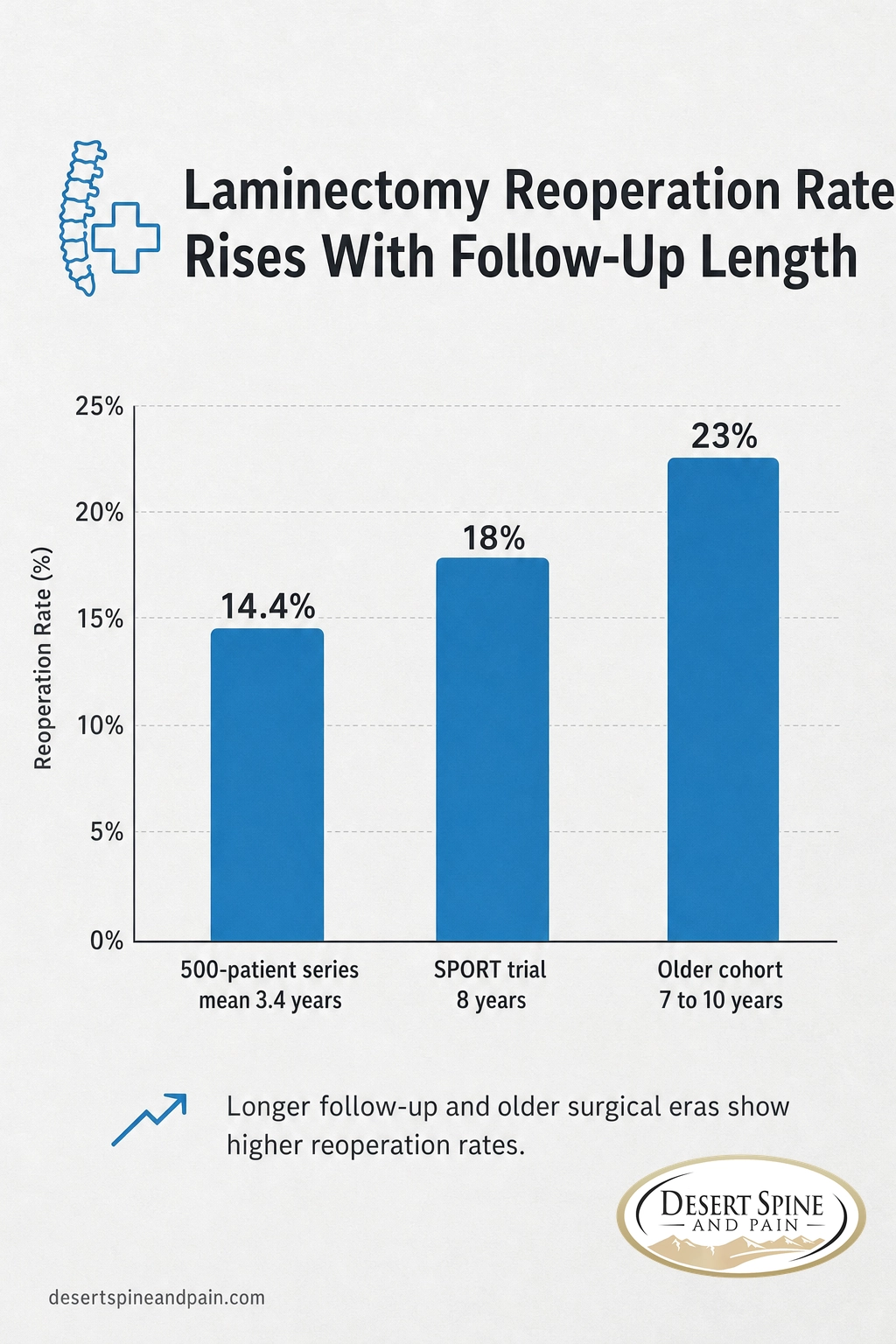
By this stage, the cumulative reoperation rate reaches the figures that define "how long it lasts." SPORT reported 18 percent at eight years for stenosis. Older long-term cohorts that followed patients for 7 to 10 years reported higher reoperation rates, up to 23 percent, but those patients were operated on in the 1980s with less refined techniques, and even then three-quarters remained satisfied with their surgery. A large 500-patient series found a 14.4 percent reoperation rate over an average of 3.4 years, which works out to roughly a 4.6 percent chance per year.
Beyond 10 Years: The Long View
Fewer studies follow patients past a decade, but the pattern is consistent: the majority keep meaningful improvement, a minority need further surgery, and the deciding factor is almost always ongoing degeneration rather than the original decompression failing. A laminectomy done well in a carefully selected patient is best thought of as a durable, years-to-decades repair.
Source: Gerling et al., Spine (2016) | Katz et al., Spine (1996), 7-to-10-year outcomes | Bydon et al., Surgical Neurology International (2015), 500-patient series
Learn about laminectomy and decompression surgeryWhat the Long-Term Studies Actually Show
Three bodies of evidence tell the durability story, and it is worth knowing what each one found rather than trusting a single headline.
The SPORT trial (long-term benefit). SPORT followed 654 stenosis patients for eight years. In the randomized group, surgery clearly outperformed non-surgical care through four years, after which the two groups converged, partly because many patients assigned to non-surgical care eventually chose surgery. In the observational group, the surgical advantage stayed stable from year five to year eight. The takeaway is nuanced: surgery delivers faster, larger relief, and that relief is durable, though some patients improve with conservative care given enough time.
The 2022 systematic review (durability of relief). Pooling twelve studies that each followed patients at least five years, researchers found patients had significantly greater satisfaction and significantly less pain and disability than before surgery, with meaningful gains in walking ability for neurogenic claudication. The authors graded the evidence as low quality, a reminder that long-term spine data are imperfect, but the direction is consistent and favorable.
The reoperation studies (the ceiling on longevity). Across modern series, roughly 14 to 18 percent of patients need a second operation within 8 years, climbing toward 20-plus percent in older, longer-followed cohorts. Whether a redo is counted as a "failure" depends on perspective: for many patients, a decade of relief followed by a tune-up is a good outcome, not a bad one.
Source: Lurie et al., Spine (2015), SPORT 8-year stenosis outcomes | Sajadi et al., Asian Journal of Neurosurgery (2022)

What Determines How Long Your Laminectomy Lasts
Population averages are a starting point, but your own result depends on specific, knowable factors. These are the ones that move the needle most.
Leg pain versus back pain. Decompression is a nerve operation, so it works best on nerve symptoms: leg pain, numbness, and neurogenic claudication. Back-dominant pain is a different problem and responds less reliably. In the 500-patient series, patients whose primary complaint was back pain rather than leg pain had a reoperation risk more than six times higher. Matching the operation to the true source of pain is the single biggest predictor of a lasting result.
Stability of the segment. If a vertebra is already slipping (spondylolisthesis) or the spine is unstable, decompression alone may not hold, which is why a fusion is sometimes added. Adding a fusion is not a free upgrade, though: in the 500-patient series, nearly half of the patients who needed a reoperation had already had a fusion. Fusion is reserved for genuine instability, not used as routine insurance.
How much is removed. Taking out only what is needed to free the nerves, while preserving the facet joints and as much bone as possible, protects the segment's stability and its longevity. This is where surgeon experience and technique, including minimally invasive approaches, directly affect how many years you get.
Your spine's overall health. Multi-level degeneration, smoking, and poor bone quality all push the odds toward earlier recurrence. The disease process does not stop at the operated level.
Source: Bydon et al., Surgical Neurology International (2015)
If Your Symptoms Come Back: Recurrence and Revision
A return of leg pain or claudication years after a laminectomy does not mean the surgery was wasted, and it rarely means you are out of options. The first job is to find out why, because the cause determines the fix.
Common reasons symptoms return include recurrent stenosis at the same level, a new or progressing slip (spondylolisthesis), a fresh disc herniation, or adjacent segment degeneration, where the level above or below the original surgery wears down. A smaller group develops persistent pain even after a technically successful operation, sometimes called post-laminectomy syndrome, which is managed differently from a straightforward recurrence.
The point is that "my laminectomy stopped working" is a symptom, not a diagnosis. Up-to-date imaging and an exam by a spine surgeon separate a simple recurrence (often treatable with another decompression or a targeted procedure) from a stability problem (which may call for fusion). Because the stakes of a second spine operation are higher than the first, this is a situation where a careful second opinion is worth the time.
Get a second opinion on your spine: (602) 566-9500Protecting Your Results for the Long Term
You cannot halt the aging of your spine, but you can slow the things that drive recurrence and give your decompression the best chance to last.
Keep the core and back strong. Muscle support offloads the spine. A structured program, often started with guided rehabilitation, is one of the most protective habits you can build.
Manage weight and stay active. Extra load accelerates disc and joint wear. Regular low-impact movement, especially walking once you are cleared, keeps the segment healthy.
Do not smoke. Smoking impairs disc nutrition and bone healing and is linked to worse spine outcomes. If you quit nothing else before surgery, quit this.
Lift and move smart. Good lifting mechanics and posture reduce repetitive strain on the operated and neighboring levels.
Choose your surgeon carefully. How much bone is removed and how well stability is preserved are decided in the operating room. An experienced spine surgeon who favors the least-invasive effective approach is protecting your result for years to come.
At Desert Spine and Pain in Phoenix, these decisions are made by Dr. David L. Greenwald, MD, FACS, who is board certified as both a spine surgeon and a neurosurgeon, a dual background that is uncommon and that matters when the goal is a durable, nerve-safe decompression. The practice's philosophy is the least invasive effective treatment first, which is also the approach most associated with long-lasting results.
Explore spine surgery options at Desert Spine and PainLaminectomy Outcomes Timeline: The Evidence at a Glance
| Time Point | What Typically Happens | Key Figure | Source |
|---|---|---|---|
| 0 to 6 weeks | Nerve pressure relieved; leg pain and claudication often ease early; soft tissue healing | Walking tolerance improves | Bydon 2015 |
| 6 to 12 weeks | Incision healed; gradual return to normal activity | Most resume daily activity | Bydon 2015 |
| 3 to 6 months | Near-peak improvement for leg-dominant symptoms | ~87% early success (pure stenosis) | Javid 1998 |
| 1 year | Benefit established; what you have now tends to be what you keep | Improvement maintained at 1 year | Lurie 2015 |
| 2 years | Earliest revisions cluster here | 42% of all eventual reoperations have occurred | Gerling 2016 |
| 4 years | Surgery still outperforms non-surgical care (randomized group) | 63% sustained success; 70% of reoperations done | Frontiers 2024; Gerling 2016 |
| 5 years | Durable relief confirmed across pooled studies | Lasting pain and disability improvement (12 studies, 5+ yr) | Sajadi 2022 |
| 5 to 8 years | Observational-cohort benefit stable; randomized outcomes converge | Advantage stable (observational cohort) | Lurie 2015 |
| 6 years | Nearly all eventual revisions have happened | 84% of reoperations done | Gerling 2016 |
| 8 years | Cumulative reoperation for stenosis | 18% reoperation rate | Gerling 2016 |
| 7 to 10 years (older cohort) | High long-term satisfaction despite some decline and revision | 75% satisfied; 23% reoperation | Katz 1996 |
| ~3.4 years (mean, large series) | Reoperation for degenerative progression | 14.4%; ~4.6% per year | Bydon 2015 |
| Lifetime (first laminectomy) | Risk of later needing a fusion | ~8% | Bydon 2015 |
| Any time (back-dominant pain) | Higher likelihood of needing revision | 6.1x higher reoperation risk | Bydon 2015 |
| Decompression + fusion cases | Fusion reserved for instability; does not remove revision risk | ~44% of reoperated patients had had a fusion | Bydon 2015 |
| Long-term (overall) | Majority keep meaningful improvement | ~2 in 3 maintain improvement | Javid 1998 |
Source: Gerling et al., Spine (2016) | Lurie et al., Spine (2015) | Sajadi et al. (2022) | Katz et al., Spine (1996) | Bydon et al. (2015) | Frontiers in Musculoskeletal Disorders (2024)
Frequently Asked Questions
How many years does a laminectomy last?
What is the reoperation rate after a laminectomy?
Why would my symptoms come back after a successful laminectomy?
Does leg pain or back pain respond better to a laminectomy?
Will I need a spinal fusion after my laminectomy?
What can I do to make my laminectomy last longer?
Methodology & Sources
How we compiled this
Every figure in this article traces to a Tier 1 primary source: randomized trials, systematic reviews and meta-analyses, prospective studies, and large cohort series. Reoperation and success ranges reflect real differences in stenosis type, follow-up length, surgical era, and how each study defines an outcome. Some foundational figures come from older long-term studies, noted by year; they remain widely cited and are corroborated by recent data. All statistics describe populations, not any individual patient, and no number predicts your personal result.
Primary sources referenced:
- Gerling MC, et al. Risk factors for reoperation in patients treated surgically for lumbar stenosis: a subanalysis of the 8-year SPORT data. Spine, 2016. PubMed
- Lurie JD, et al. Long-term outcomes of lumbar spinal stenosis: eight-year results of the SPORT trial. Spine, 2015. DOI
- Sajadi, et al. Long-term outcomes of laminectomy in lumbar spinal stenosis: a systematic review and meta-analysis. Asian Journal of Neurosurgery, 2022. DOI
- Katz JN, et al. Seven- to 10-year outcome of decompressive surgery for degenerative lumbar spinal stenosis. Spine, 1996. PubMed
- Bydon M, et al. Clinical and surgical outcomes after lumbar laminectomy: an analysis of 500 patients. Surgical Neurology International, 2015. Full text
- Long-term follow-up review of patients who underwent laminectomy for lumbar stenosis (prospective study), 1998. PubMed
- Preoperative factors and four-year decompressive laminectomy success in symptomatic lumbar spinal stenosis. Frontiers in Musculoskeletal Disorders, 2024. Article
This article is educational and is not individual medical advice. For guidance specific to your spine condition, consult a qualified spine surgeon. No surgical outcome can be guaranteed.