
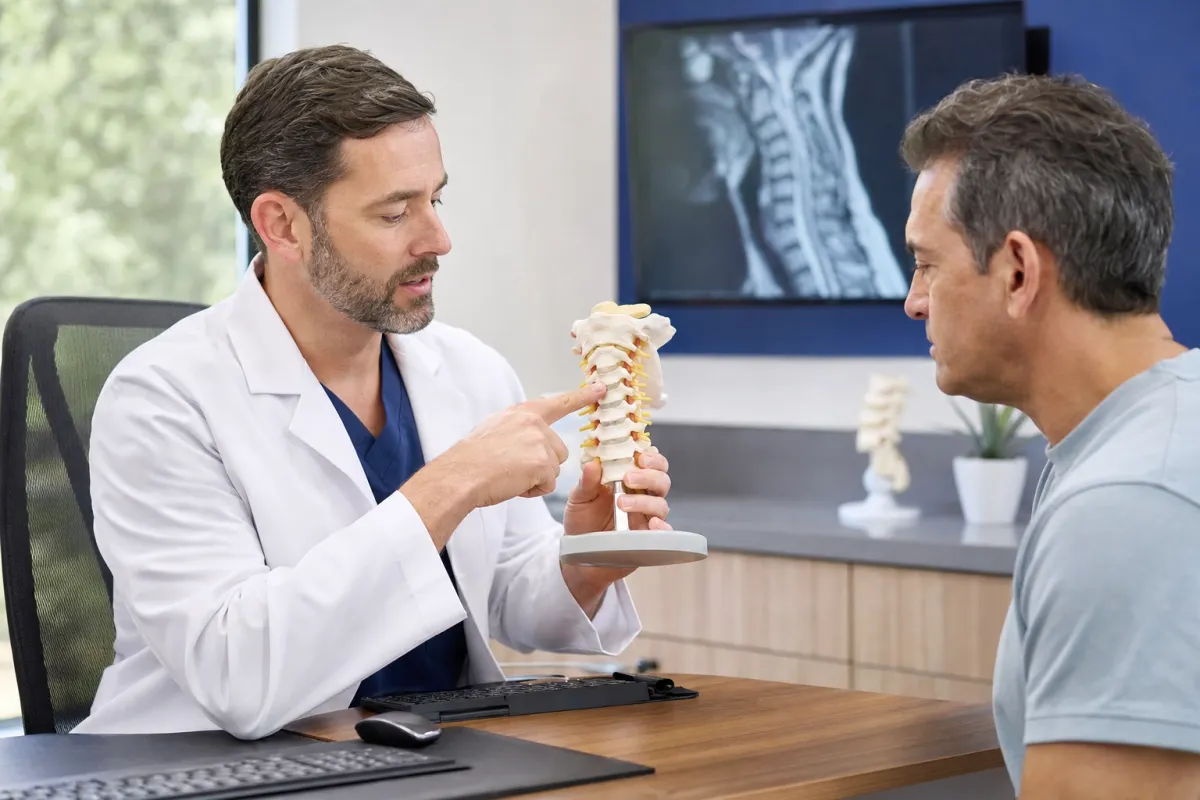
Surgery for Spinal Myelopathy: What to Know
Spinal myelopathy surgery is a decompression operation that relieves pressure on a squeezed spinal cord, most often in the neck, to stop the condition from getting worse and protect nerve function. Myelopathy is different from ordinary back or neck pain: it is a problem of the spinal cord itself, the main cable carrying signals between your brain and body, and once it is being crushed it rarely recovers on its own. That is why surgery is usually recommended once myelopathy becomes moderate or severe. This guide explains in plain language what the operation does, why timing matters so much, the anterior and posterior approaches a surgeon chooses between, and what recovery and results actually look like.
- What it is: surgery to decompress the spinal cord, taking pressure off the cord (and nearby nerves) so it stops being damaged. Most myelopathy is in the neck (cervical).
- Why it is done: myelopathy is usually slowly progressive and rarely improves with non-surgical care, which cannot relieve the actual compression.
- The real goal: to stop the damage from worsening and prevent permanent disability, not just to relieve pain.
- The approaches: from the front (anterior) with ACDF or corpectomy, or from the back (posterior) with laminectomy, laminoplasty, or decompression and fusion.
- Outcomes: the majority of patients improve or at least stay the same, with better results when surgery happens earlier in the disease.
- Recovery: about 1 to 3 nights in the hospital, with the fastest gains in the first 3 to 6 months.
- The deciding factor is an accurate diagnosis confirming the cord is compressed, matched to your symptoms, and the right approach chosen by an experienced spine surgeon.

What's in This Guide
- What Spinal Myelopathy Surgery Is
- Why Surgery Is Needed: Myelopathy Does Not Fix Itself
- How the Surgery Works, Step by Step
- The Surgical Approaches: Anterior vs. Posterior
- Myelopathy vs. Radiculopathy (and the "Lumbar Myelopathy" Mix-Up)
- Recovery and What to Expect
- Risks, Success Rates, and Outcomes
- How to Know If Surgery Is Right for You
- Related Spine Terms
- Frequently Asked Questions
1What Spinal Myelopathy Surgery Is
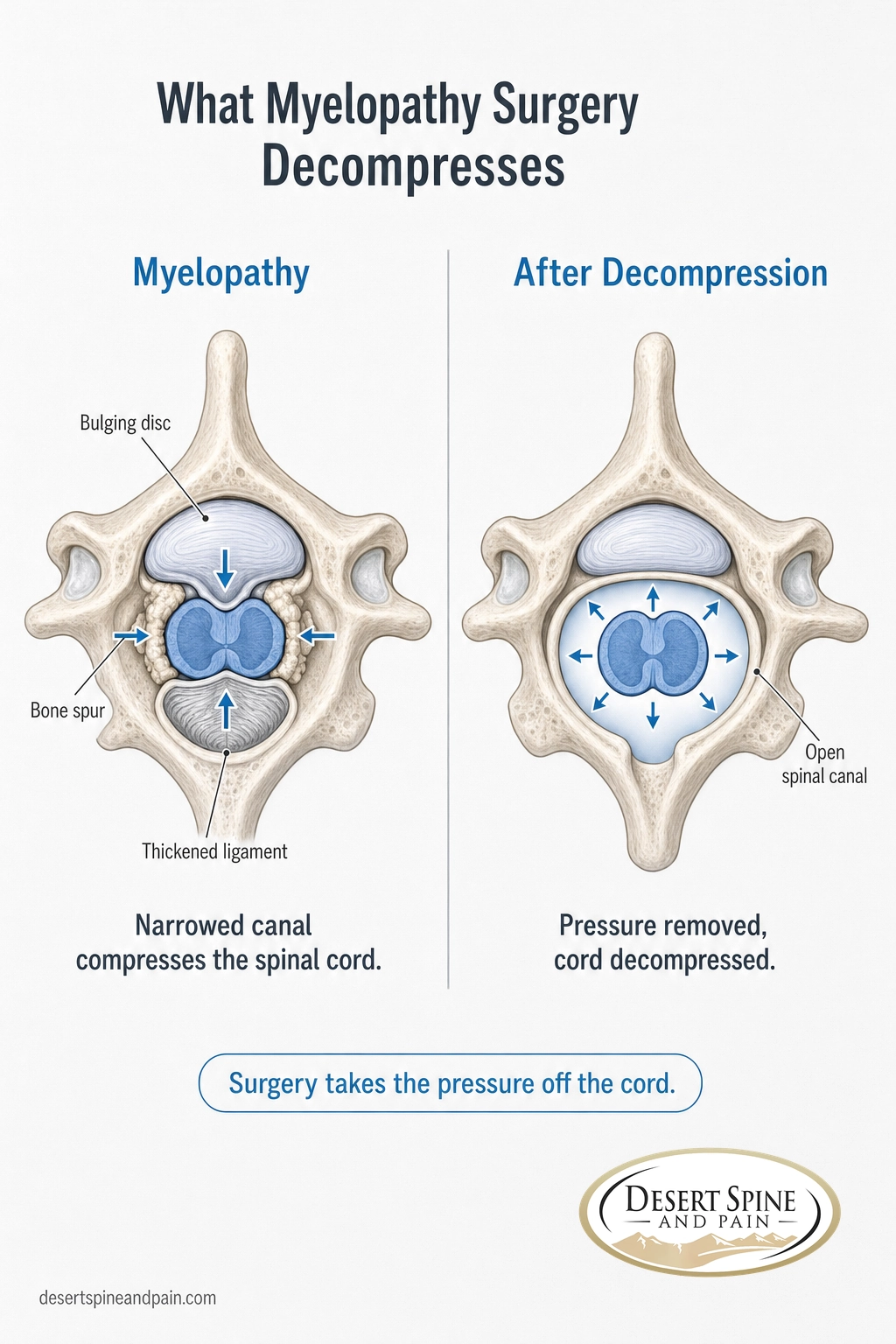
Myelopathy is a set of symptoms caused by compression of the spinal cord. The cord runs through a bony tunnel called the spinal canal, and when that canal narrows, from age-related wear, a herniated disc, bone spurs, thickened ligaments, a tumor, or trauma, the cord gets squeezed. That pressure disrupts the signals traveling between your brain and the rest of your body, which is why myelopathy shows up as clumsy hands, an unsteady walk, numbness, weakness, or, in severe cases, trouble with bladder control. Spinal myelopathy surgery is the operation that removes whatever is pressing on the cord so it has room again.
It is a decompression operation: the surgeon removes the bone, disc, or ligament crowding the spinal cord so the cord is no longer under pressure. Because the cord itself cannot be repaired, the aim is to relieve the compression and give the nerves the best chance to recover or, at minimum, stop losing ground.
By far the most common place for myelopathy is the neck, where it is called cervical myelopathy, and the most common type is degenerative cervical myelopathy (also known as cervical spondylotic myelopathy), which develops gradually as the neck ages. It can also occur in the mid-back (thoracic myelopathy), though that is much rarer. If you want the condition itself explained in full before the surgery, start with our guide to what cervical myelopathy is.
Explore spinal decompression surgerySource: Cleveland Clinic, myelopathy overview | Mayfield Clinic, cervical myelopathy
2Why Surgery Is Needed: Myelopathy Does Not Fix Itself
This is the part that changes how people think about the decision. Myelopathy is not a muscle strain that will ease with rest. Clinically, it tends to be slowly progressive and rarely improves with non-surgical treatment, often following a stepwise course where symptoms stay stable for a while and then drop to a new, worse level. Therapy, anti-inflammatories, and injections can take the edge off the symptoms, but none of them decompress the cord. The pressure is still there.
Because the cord cannot be surgically repaired and nerve damage can become permanent, the window for the best result is while the compression is relatively new. That is the core reason moderate to severe myelopathy is treated surgically rather than waited out. At Desert Spine and Pain, we still begin with the least invasive path that can genuinely solve the problem, which is why we talk through conservative and non-invasive care for mild or early cases, but we do not let true myelopathy drift once the cord is clearly being compressed.
Waiting is the single most common mistake with myelopathy. Surgery for myelopathy is not primarily about relieving pain, it is about protecting the spinal cord from permanent injury. The longer the cord is compressed, the less likely it is to fully recover, and some deficits become fixed. "Bad enough" can mean damage that no operation can undo. The better question is whether the cord is being compressed now, not how severe the symptoms have become.
Source: OrthoBullets, cervical myelopathy clinical reference | Cleveland Clinic
3How the Surgery Works, Step by Step
Every myelopathy operation shares the same purpose, decompression, even though the exact route differs. The patient is fully asleep under general anesthesia, and the surgeon works through either the front or the back of the neck (or occasionally both) to reach the compressed level of the cord. The sequence is consistent:
- Anesthesia and positioning. You are placed and secured for either a front-of-neck or back-of-neck approach and put fully to sleep.
- Access. The surgeon makes a precise incision and gently moves tissue aside to reach the spine, using the smallest opening the case allows.
- Removing what is compressing the cord. The disc, bone spur, thickened ligament, or a section of vertebra pressing on the cord is carefully removed.
- Decompression check. The surgeon confirms the spinal cord and nerve roots now have adequate room.
- Stabilizing if needed. When removing bone or a disc leaves the spine unstable, a fusion (bone graft, cage, plates, or screws) or a motion-preserving implant is added so the segment stays sound.
- Closing. The incision is closed in layers.
Not every myelopathy surgery includes a fusion, but many neck operations do, because decompressing the cervical cord often means removing structures that also provide stability. Whether hardware is needed is one of the central judgments a surgeon makes before the operation. Dr. David L. Greenwald is a dual board-certified spine surgeon and neurosurgeon who favors the least invasive approach that will fully decompress the cord while preserving as much healthy, stabilizing anatomy as possible. For the operations done through smaller openings, see our overview of minimally invasive spine surgery.
Meet Dr. Greenwald, brain and spine surgeonSource: Mayfield Clinic, cervical myelopathy surgery
4The Surgical Approaches: Anterior vs. Posterior
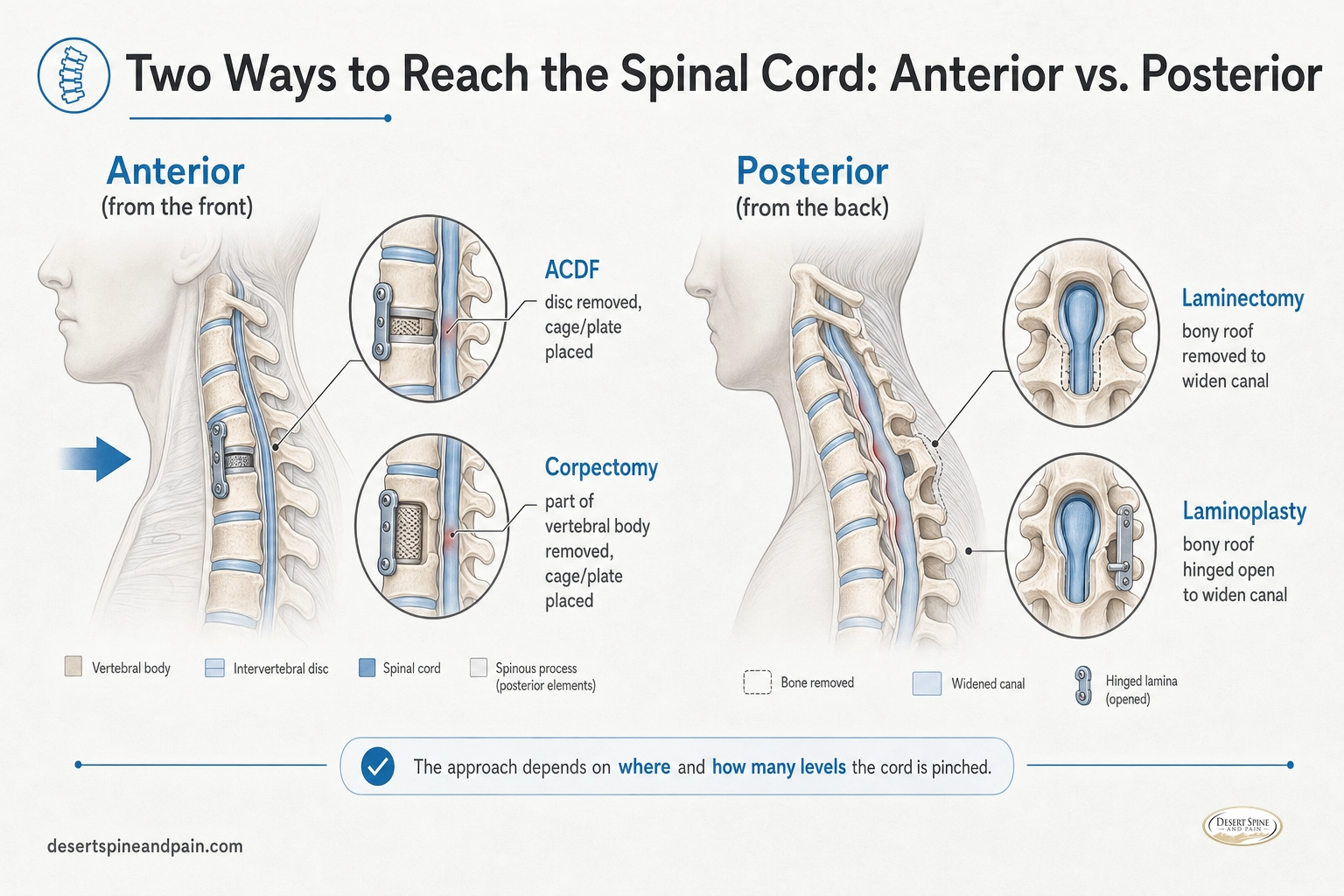
There is no single "myelopathy surgery." The right operation depends on where the cord is being pinched, over how many levels, and the shape and alignment of your spine. Broadly, a surgeon decompresses from the front (anterior) or the back (posterior), and sometimes both. Here is how the main options compare.
| Operation | Approach | What it does | Typically used when |
|---|---|---|---|
| ACDF (anterior cervical discectomy and fusion) | Front | Removes the damaged disc, spurs, and ligament, then fuses the level with a graft or cage and a plate | Compression from one or two disc levels; the mainstay for most limited disease |
| Corpectomy and fusion (ACCF) | Front | Removes part of a vertebral body plus discs, bridged by a cage or strut graft | Pressure behind the vertebral body or across multiple adjacent levels |
| Disc replacement | Front | Replaces a diseased disc with an artificial one, preserving motion instead of fusing | Select single or two-level cases where motion preservation is suitable |
| Laminectomy and fusion | Back | Removes the lamina (the bony roof) to open the canal, with screws and rods to stabilize | Multilevel compression, often in a neck that is not fixed in a forward bend |
| Laminoplasty | Back | Hinges the lamina open and holds it with a small plate to widen the canal, without a full fusion | Multilevel compression when preserving neck motion is a priority |
A few plain-language rules of thumb a surgeon weighs: anterior ACDF is the go-to for one or two-level disease, while a corpectomy handles pressure sitting behind the vertebral body itself. From the back, laminoplasty widens the canal while keeping motion, and its results are considered comparable to multilevel anterior decompression and fusion. A standalone laminectomy without fusion is used cautiously in the neck because removing the bony roof can let the spine drift into a forward curve over time. If the neck is already fixed in a forward bend, a purely posterior decompression is generally avoided. The detail matters, which is why these calls belong to an experienced cervical spine surgeon. You can read more about the specific procedures in our explainers on what ACDF stands for, corpectomy surgery, laminectomy, and the comparison of laminoplasty versus laminectomy.
For the money decision between fusing and keeping motion, our treatment pages cover ACDF, corpectomy, cervical fusion, and cervical disc replacement in detail.
Learn about minimally invasive spine surgerySource: OrthoBullets, cervical myelopathy clinical reference | Froedtert & the Medical College of Wisconsin

5Myelopathy vs. Radiculopathy (and the "Lumbar Myelopathy" Mix-Up)
The term most often confused with myelopathy is radiculopathy, and the difference drives the whole treatment plan. Myelopathy is compression of the spinal cord itself. Radiculopathy is compression of a single nerve root as it branches off the cord, which produces the classic shooting pain, tingling, or weakness down one arm or leg. The two can happen together, but they are not the same problem, and myelopathy is the more serious one because it affects the central cord.
The spinal cord ends near the top of the lumbar spine (around the first lumbar vertebra). Below that point there is no cord to compress, only a bundle of nerve roots called the cauda equina. So pressure in the lower back causes radiculopathy or, in emergencies, cauda equina syndrome, not true myelopathy. When people say "lumbar myelopathy," the issue is almost always nerve-root compression or stenosis, which is why getting the diagnosis right before any surgery is so important.
This distinction decides which operation, if any, is appropriate. For a closer look, see our comparisons of myelopathy versus radiculopathy and myelopathy versus stenosis.
Source: Cleveland Clinic, myelopathy | OrthoBullets
6Recovery and What to Expect
Recovery depends on how many levels were treated, whether a fusion was added, your age, and, most of all, how long the cord was compressed before surgery. The general shape of it, though, is well established.
A realistic picture: after a short hospital stay, outpatient rehabilitation is commonly a handful of visits over six to eight weeks, often with gait and balance retraining if walking was affected. Symptoms improve gradually rather than overnight, and some numbness can take months to settle or may not fully resolve, particularly if the cord was compressed for a long time before surgery. The honest message is that surgery reliably stops the slide and gives real functional gains for most people, but it is protecting and recovering a cord, not resetting it. For related recovery questions, our guide on cervical stenosis surgery covers overlapping ground, since stenosis is the usual cause.
Learn about cervical stenosis surgerySource: Froedtert & the Medical College of Wisconsin | Mayfield Clinic
7Risks, Success Rates, and Outcomes
Spinal cord decompression is a common, well-studied operation, and for the right patient it reliably halts the decline and improves function. Like any surgery it carries risks, and understanding them is part of a good decision.
Clinically, patients usually show a significant improvement in their myelopathy score by one year after surgery, even in severe cases, when the decompression is done well. The main risks a surgeon discusses beforehand include:
- Bleeding and infection, the general risks of any surgery.
- Dural tear (CSF leak), a small injury to the sac around the cord, usually repaired during the operation.
- Nerve injury, uncommon, but it can cause new weakness or numbness.
- C5 palsy, a usually temporary weakness of the shoulder that can follow cervical decompression.
- Failure of the bones to fuse (pseudoarthrosis), more likely across multiple levels than a single level.
- Hardware issues or epidural hematoma, both uncommon.
| Complication | Reported rate |
|---|---|
| C5 palsy after surgery for cervical compression myelopathy | About 4.6% |
| Pseudoarthrosis (non-fusion), single-level fusion | About 12% |
| Pseudoarthrosis (non-fusion), multilevel fusion | About 30% |
| Epidural hematoma | About 1 in 1,000 |
Put the clinical picture together, that myelopathy rarely improves without decompression, that outcomes are best with shorter symptom duration and less pre-op disability, and that the cord cannot be repaired once damaged, and one practical truth stands out: with myelopathy, when you operate often matters as much as how. The surgical skill of choosing the right approach and decompressing fully is essential, but it works on the cord it is given. Acting while the compression is relatively new is the quiet driver of the best results. Interpretation original to Desert Spine and Pain.
Source: OrthoBullets, cervical myelopathy clinical reference | Froedtert & the Medical College of Wisconsin
8How to Know If Surgery Is Right for You
Surgery tends to be the right call when a few things line up: imaging clearly shows the spinal cord is being compressed, that finding matches your symptoms (clumsy hands, an unsteady walk, arm numbness or weakness), and the myelopathy is moderate or progressing. Very mild or borderline cases are sometimes watched closely first. The pivotal step before any operation is confirming the diagnosis with a surgeon who can tell exactly where the cord is pinched and which approach will decompress it with the least disruption.
Dr. David L. Greenwald is a dual board-certified spine surgeon and neurosurgeon who takes the time to match the operation to the true source of compression and reserves fusion for the segments that genuinely need it. Desert Spine and Pain in Phoenix works with out-of-network patients of every kind and partners closely with personal injury attorneys, offering 24/7 concierge response and documentation coordination for injured clients. If you have been told you may need surgery for myelopathy, or you just want to understand your options, a consultation or second opinion is the smartest next step. If a car crash, fall, or workplace injury is behind your symptoms, our explainer on how cervical myelopathy can become dangerous underscores why it is worth acting sooner rather than later.
Book a consultation: (602) 566-9500Related Spine Terms
- Cervical myelopathy: compression of the spinal cord in the neck, the most common form of myelopathy. See what cervical myelopathy is.
- Radiculopathy: compression of a single nerve root, not the cord. Compare myelopathy versus radiculopathy.
- Spinal stenosis: narrowing of the spinal canal, the usual cause of degenerative myelopathy. See myelopathy versus stenosis.
- ACDF: anterior cervical discectomy and fusion, the most common anterior decompression. See what ACDF stands for.
- Corpectomy: removal of part of a vertebral body to decompress the cord. See corpectomy surgery.
- Laminectomy: removal of the lamina to open the canal from behind. See what a laminectomy is.
- Laminoplasty: hinging the lamina open to widen the canal while preserving motion. Compare laminoplasty versus laminectomy.
- Spinal fusion: joining vertebrae to stabilize the spine, often added after decompression. Learn about cervical fusion.
Frequently Asked Questions
What is spinal myelopathy surgery?
Can spinal myelopathy be treated without surgery?
Will surgery reverse my symptoms or just stop them from getting worse?
What are the risks of spinal myelopathy surgery?
How long does recovery from myelopathy surgery take?
Methodology & Sources
How we compiled this guide
Figures and clinical statements trace to specialty and Tier 1 clinical sources. The definition of myelopathy as spinal cord compression, the list of causes, the fact that degenerative cervical myelopathy is the most common type, the over-40 age pattern, and that non-surgical care does not decompress the cord come from the Cleveland Clinic myelopathy reference. The surgical approaches (ACDF, anterior corpectomy and fusion, posterior laminectomy and fusion, laminoplasty) and the message that surgery for moderate-to-severe myelopathy aims to prevent further cord damage come from the Mayfield Clinic cervical myelopathy guide. The clinical course (slowly progressive, rarely improves with non-operative care, stepwise deterioration), surgical indications by approach, the significant one-year improvement in myelopathy scores, the C5 palsy rate (about 4.6%), pseudoarthrosis rates (about 12% single-level, 30% multilevel), and the epidural hematoma rate (about 1 in 1,000) come from the OrthoBullets cervical myelopathy clinical reference. The hospital stay (one to three nights), the rehabilitation schedule, the timing of improvement (most rapid in the first three to six months), and the statement that the majority of patients improve or stay the same come from Froedtert and the Medical College of Wisconsin spine care. All statistics describe populations, not any individual patient, and timelines are typical ranges that vary with the number of levels treated, age, and how long the cord was compressed.
Primary sources referenced:
- Myelopathy (definition, causes, types, age pattern, treatment goals). Cleveland Clinic.
- Cervical myelopathy surgery (approaches, goals, recovery). Mayfield Clinic.
- Cervical myelopathy (natural history, surgical indications, outcomes, complication rates). OrthoBullets.
- Cervical myelopathy (recovery timeline, hospital stay, prognosis). Froedtert and the Medical College of Wisconsin.
This article is educational and is not individual medical advice. For guidance specific to your spine condition, consult a qualified spine surgeon. No outcome can be guaranteed.
Journalists and researchers may cite these statistics with attribution to Desert Spine and Pain and a link to this page. Please attribute the underlying figures to their original clinical sources as listed above. For expert commentary on spinal cord decompression surgery from a board-certified neurosurgeon and spine surgeon, contact Desert Spine and Pain at (602) 566-9500.