
Laminoplasty vs. Laminectomy: Comparing Cervical Spine Options
If a surgeon has told you that pressure on your spinal cord needs to be relieved from the back of your neck, you are likely choosing between two operations that sound similar but work very differently: laminoplasty and laminectomy. Both open the crowded spinal canal and both can halt the progression of cervical spondylotic myelopathy, the most common cause of spinal cord dysfunction in adults over 55. Where they part ways is what happens to the bone and the motion of your neck afterward, and that single difference drives most of the trade-offs in alignment, stability, and recovery that this guide walks through.
Key Takeaways
- Same goal, different method. A laminectomy removes the lamina to decompress the cord. A laminoplasty cuts and hinges the lamina open, widening the canal while keeping the bone.
- Motion vs. fusion. Laminoplasty preserves neck motion and usually avoids a fusion. A cervical laminectomy is frequently paired with fusion to prevent forward collapse of the spine.
- Neurological results are comparable. Multiple systematic reviews find similar recovery of cord function between the two, so the decision hinges on alignment, stability, pain, and age, not on one being clearly stronger.
- Each carries a signature risk. Laminoplasty can leave residual neck pain or incomplete decompression. Laminectomy alone risks postlaminectomy kyphosis, reported in roughly 6 to 46 percent of older series, which is why fusion is often added.
- Surgeon judgment decides the outcome. The data do not crown a winner. The right operation is the one matched to your specific spine by an experienced surgeon.

What's in This Guide
- Laminoplasty vs. Laminectomy at a Glance
- Understanding Laminoplasty
- Understanding Laminectomy
- Decompression of the Spinal Cord
- Motion, Alignment, and Stability
- Complications and the Role of Surgical Skill
- Recovery and Long-Term Outlook
- Master Comparison Table
- Who Should Choose Laminoplasty
- Who Should Choose Laminectomy
- Final Verdict
- Frequently Asked Questions
Laminoplasty vs. Laminectomy at a Glance
Laminoplasty
- Cuts and hinges the lamina open, keeping the bone in place
- Widens the canal across multiple levels in one motion
- Usually avoids a fusion, preserving neck movement
- Best suited to a neck that still holds a normal forward curve
- Signature risks: residual axial neck pain, possible incomplete decompression
Laminectomy
- Removes the lamina entirely to free the spinal cord
- Offers a direct, complete decompression and access for deformity correction
- Frequently combined with fusion for stability in the cervical spine
- Best suited to instability, deformity, or significant neck pain
- Signature risks: postlaminectomy kyphosis if done alone, loss of motion when fused
Both operations are performed from the back of the neck (a posterior approach) and both aim to give a compressed spinal cord room to breathe. A laminectomy removes the bony roof of the canal, while a laminoplasty reconstructs that roof in a larger position. Everything that follows, from how the neck moves afterward to whether you need hardware, flows from that one structural choice.
Understanding Laminoplasty
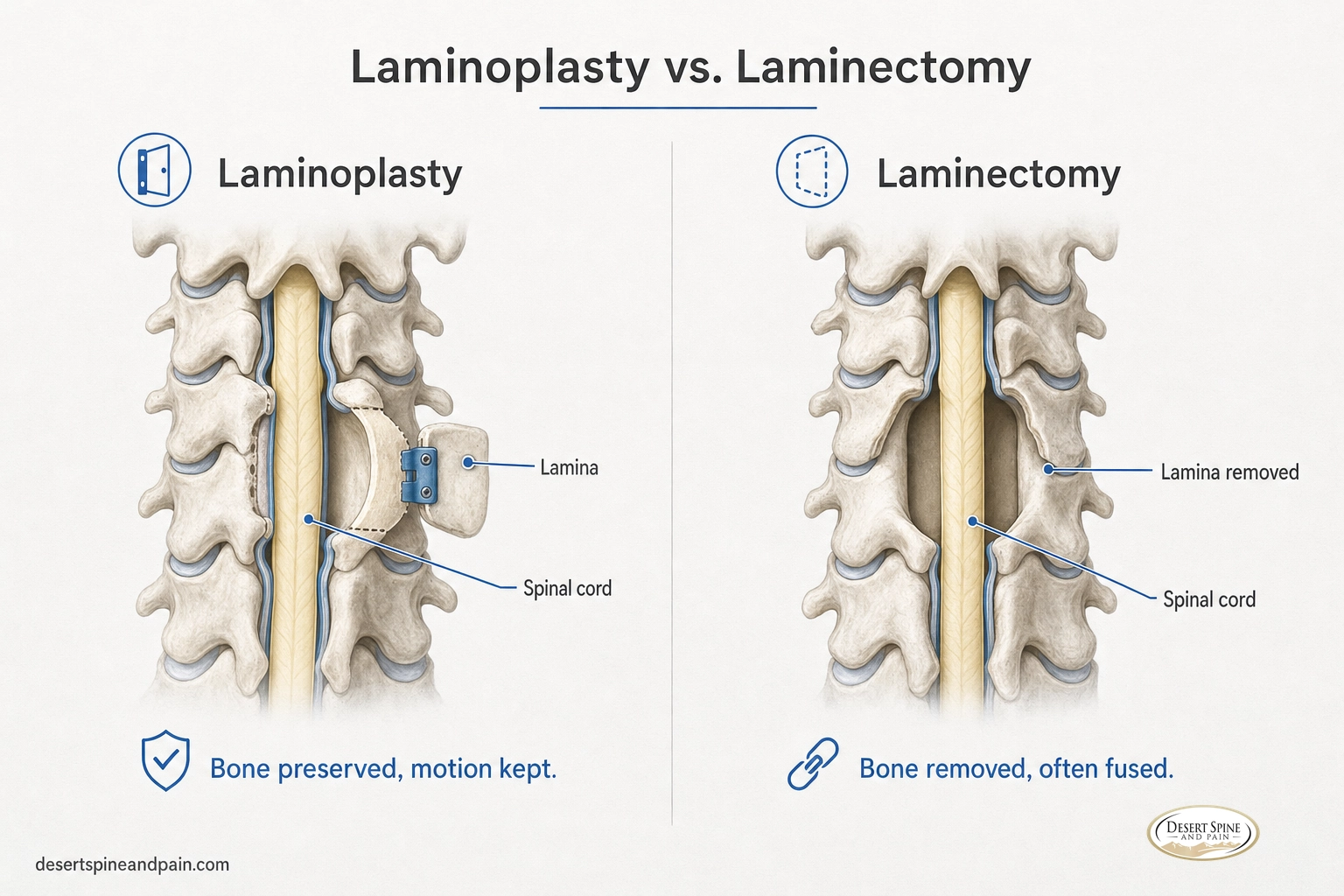
Laminoplasty was developed in Japan specifically to decompress the cervical spinal cord over several levels without sacrificing the stabilizing bone and ligaments at the back of the neck. Instead of taking the lamina out, the surgeon makes a complete cut on one side and a partial cut on the other, then swings the lamina open like a door on a hinge. Small plates, spacers, or sutures hold it in the widened position. The canal is enlarged, the cord decompresses and drifts backward away from the pressure, and the posterior bony arch stays intact.
Because the bone is preserved, laminoplasty does not usually require a fusion. That is its defining advantage: the neck keeps much of its natural motion, and the spine is not locked into a fixed position. For a patient with multilevel compression from cervical spondylotic myelopathy whose neck is still well aligned, this is a compelling option. It is also efficient, allowing the surgeon to address three, four, or more levels in a single, continuous decompression.
Who it fits and where it falls short. Laminoplasty works best when the neck still holds its normal forward curve, called lordosis. If the spine has already drifted into a forward bend, the cord may not fall back far enough to decompress fully, and the procedure can disappoint. The two documented drawbacks are honest ones: some patients develop or keep axial neck pain afterward, and in a spine with poor alignment the decompression can be incomplete. These are limitations of fit, not failures of the operation, which is exactly why the evaluation beforehand matters so much.
Laminoplasty preserves motion in a way that overlaps with the goals of motion-preserving spine surgery, a philosophy Desert Spine and Pain applies across cervical procedures whenever a patient's anatomy allows it.
Source: Laminoplasty versus laminectomy for multi-level cervical spondylotic myelopathy, systematic review | Frontiers in Surgery meta-analysis, 2022
Understanding Laminectomy
A laminectomy is the older and more direct of the two operations. The surgeon removes the lamina, and often the spinous process and parts of the facet joints, to uncover the spinal canal and lift pressure off the cord and nerve roots. It is a versatile, complete decompression and remains a workhorse of spine surgery for stenosis, tumors, and trauma. When only a small window of bone is removed rather than the full lamina, the procedure is called a laminotomy, a more limited opening.
In the lumbar spine, a laminectomy is frequently performed on its own. The cervical spine is different. Removing the posterior bony elements across several neck levels can leave the spine unable to resist the forward pull of the head, and over time the neck can collapse into a forward bend. This is postlaminectomy kyphosis, and it is the single biggest reason a cervical laminectomy is so often paired with a fusion.
When fusion is added, rods and screws lock the decompressed levels together so the spine stays aligned. This buys stability and the ability to correct an existing deformity, at the cost of the motion in those segments. For many patients with instability or a neck that is already bending forward, that trade is worth it. The combined operation is a cervical decompression followed by instrumented stabilization, and it is one of the most reliable ways to both relieve the cord and fix alignment in one setting.
Learn about cervical fusion at Desert Spine and Pain
Source: Surgical Neurology International, posterior fusion with cervical laminectomy
Decompression of the Spinal Cord
The first question any decompression must answer is simple: does it take the pressure off? Here the two operations are closely matched. Laminectomy achieves decompression by removing the bone outright, giving the surgeon a direct and complete view of the cord. Laminoplasty achieves it indirectly, by enlarging the canal so the cord can drift backward into the new space. Both work, and systematic reviews comparing them in multilevel cervical myelopathy find comparable recovery of neurological function.
The caveat is alignment. Laminoplasty relies on the cord actually moving backward once the canal is opened, and that only happens if the neck still has a forward curve. In a kyphotic neck, the cord stays draped forward over the vertebral bodies and the indirect decompression can fall short. A laminectomy removes bone regardless of curve, so it can decompress a poorly aligned spine, and when combined with fusion it can straighten that alignment at the same time. For a well-aligned neck, laminoplasty matches laminectomy on decompression while sparing the fusion. For a malaligned neck, laminectomy with fusion holds the advantage.
Winner: Tie for a well-aligned spine; laminectomy with fusion for a kyphotic or unstable one. Both decompress the cord effectively. The deciding factor is your cervical alignment, not the raw decompressive power of either technique.
This is also where the diagnosis itself matters. The symptoms of cord compression, called cervical myelopathy, can overlap with simpler nerve pinches, and getting the diagnosis and the levels right is half the battle.
Source: Laminoplasty versus laminectomy for multi-level cervical spondylotic myelopathy, systematic review
Motion, Alignment, and Stability
This is the criterion where the two operations separate most sharply. Laminoplasty is motion-preserving by design. It keeps the posterior bony arch, so the fused-in stiffness of a fusion is avoided and the neck retains a meaningful range of movement. For a younger or active patient, or anyone who wants to keep turning their head freely, that is a genuine benefit.
Laminectomy alone preserves motion too, but at the risk of the forward collapse described earlier. Adding fusion removes that risk by stabilizing the spine, and it is the only one of these options that can actively correct an existing deformity. The price is motion: the fused segments no longer move, and locking several levels can place added stress on the discs above and below over the years.
How often does the feared kyphosis actually occur when the procedures are compared head to head in well-selected patients? Less than the older ranges suggest. A systematic review of multilevel cervical myelopathy surgery found postoperative kyphosis in a minority of patients in both groups, and modestly lower after laminoplasty.
Postoperative Cervical Kyphosis: Laminoplasty vs. Laminectomy (multilevel CSM systematic review)
The same review found no significant difference in overall surgical complications between the two approaches. In other words, when the patient is well chosen and the surgery is well executed, the alignment risk of modern decompression is far lower than the historical 6 to 46 percent figure for laminectomy performed alone. Technique and patient selection close most of the gap.
Winner: Laminoplasty for preserving motion; laminectomy with fusion for correcting or guaranteeing alignment. If keeping neck movement is the priority and the spine is well aligned, laminoplasty leads. If the neck is unstable or already bending forward, only fusion can lock in the correction.
Source: Laminoplasty versus laminectomy for multi-level cervical spondylotic myelopathy, systematic review
Complications and the Role of Surgical Skill
Both operations share the risk profile of posterior cervical surgery: infection, bleeding, dural tears, and nerve injury. The complication most specific to this region is C5 palsy, a weakness of the shoulder that can appear days after surgery when the C5 nerve root is stretched as the decompressed cord shifts backward. It is usually temporary, and most patients recover shoulder strength over weeks to months.
Across pooled data from systematic reviews, C5 palsy occurs in roughly 5 to 8 percent of posterior cervical procedures. Several meta-analyses report it somewhat less often after laminoplasty than after laminectomy with fusion, likely because the gentler, hinged opening shifts the cord less abruptly. Permanent C5 palsy is uncommon regardless of technique.
One matched comparison illustrates how close the two really are: the laminectomy and fusion group recorded complications in about 9 percent of patients with a 2 percent formal revision rate, while the laminoplasty group recorded about 13 percent complications with a 5 percent revision rate. The numbers are small and the groups were not identical, which is the honest reality of this literature. No high-quality study crowns a clear winner.
That is precisely why the surgeon matters more than the label on the operation. Choosing the right procedure, selecting the correct levels, judging the alignment, and executing a clean decompression are what separate a good outcome from a poor one. This is cord-level surgery in the neck, and it rewards experience. At Desert Spine and Pain, these operations are performed by a dual board-certified brain and spine surgeon who evaluates each spine individually.
Meet Dr. David L. Greenwald, brain and spine surgeon

Source: Frontiers in Surgery meta-analysis, 2022 | C5 palsy incidence and recovery, systematic review and meta-analysis
Recovery and Long-Term Outlook
Early recovery is broadly similar. Both are posterior cervical operations with a hospital stay typically measured in a few days, a period of neck soreness, and a gradual return to activity over weeks. Some comparative work suggests laminoplasty can mean a shorter operating time and shorter stay, since no hardware fusion is constructed, but the difference is modest and varies by patient and surgeon.
The long-term picture is where the structural choice pays off or costs. Because laminoplasty keeps the neck mobile, it avoids the added stress that a fusion can place on neighboring discs over the years. A fusion, on the other hand, delivers durable stability and a corrected alignment that does not drift. Five-year follow-up data describe laminoplasty as an effective, durable alternative to laminectomy in multilevel disease, with fewer late complications in some series. Neither operation is a cure for the underlying arthritis of the spine, and both aim primarily to stop the progression of myelopathy and relieve symptoms rather than to restore a youthful neck.
A myth worth retiring: "decompression surgery means I will lose my neck motion." That is true of a fusion, not of decompression itself. Laminoplasty is specifically designed to relieve cord pressure while keeping the neck mobile, and even laminectomy without fusion preserves movement in selected patients. Losing motion is a feature of the fusion, not an unavoidable cost of taking pressure off the cord. The right operation is chosen to match your alignment, not to default everyone into a stiff neck.
Source: Laminoplasty versus laminectomy for multi-level cervical spondylotic myelopathy, systematic review
Master Comparison Table
| Criterion | Laminoplasty | Laminectomy (often with fusion) | Edge |
|---|---|---|---|
| How it decompresses | Hinges lamina open, widens canal | Removes lamina directly | Tie |
| Neurological recovery | Comparable | Comparable | Tie |
| Neck motion | Preserved | Lost at fused levels | Laminoplasty |
| Fusion / hardware | Usually none | Frequently required | Laminoplasty |
| Corrects deformity | No | Yes, with fusion | Laminectomy + fusion |
| Works in a kyphotic neck | Limited | Yes | Laminectomy + fusion |
| Postoperative kyphosis | 4.44% | 6.34% (far higher if done alone) | Laminoplasty |
| C5 palsy | Somewhat lower | Somewhat higher | Laminoplasty |
| Adjacent-segment stress | Lower | Higher after fusion | Laminoplasty |
| Instability present | Not ideal | Preferred | Laminectomy + fusion |
Who Should Choose Laminoplasty
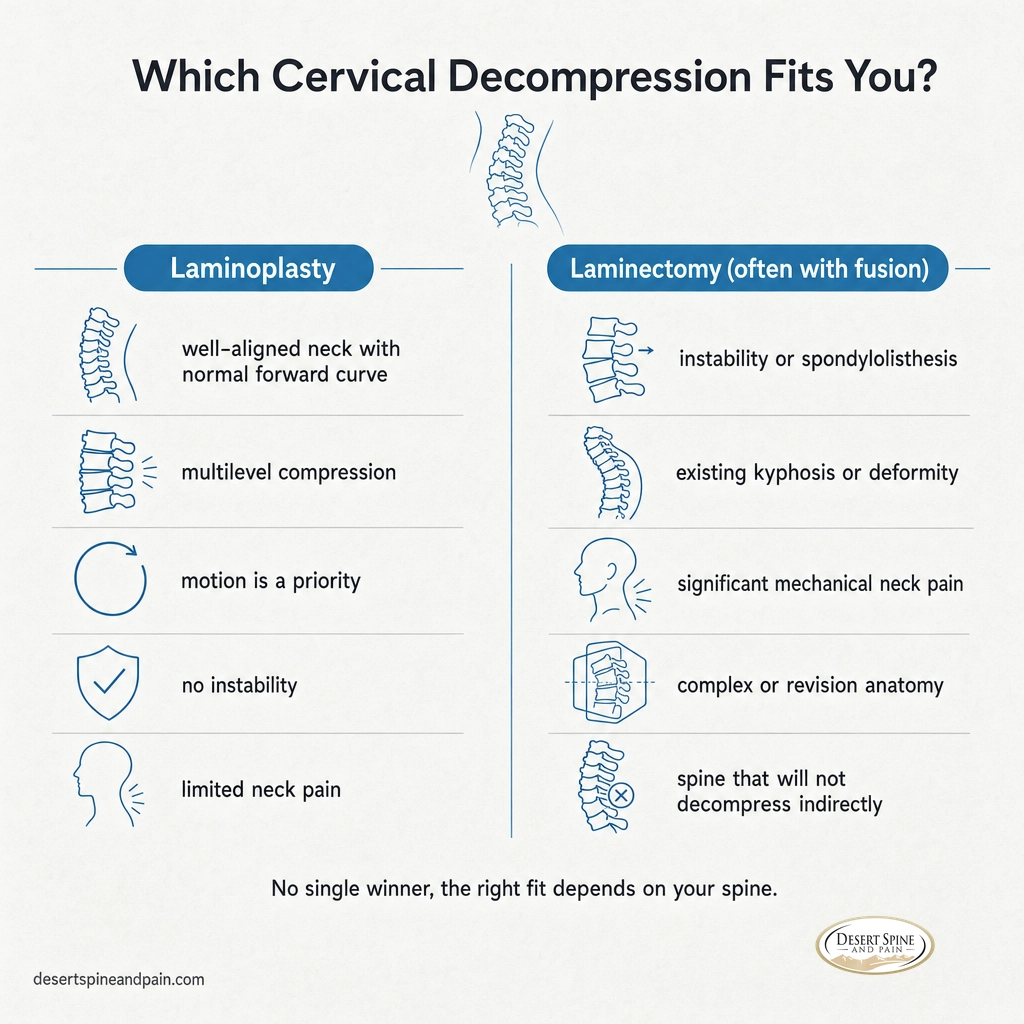
- Multilevel compression with preserved alignment. Your neck still holds a normal forward curve, so the cord can drift back once the canal is opened.
- Motion is a priority. You are younger or active and want to keep turning and bending your neck freely.
- No significant instability. Imaging shows the spine is stable and does not need a deformity corrected.
- Limited axial neck pain. Your dominant problem is cord compression, not grinding, mechanical neck pain.
- You want to avoid hardware. Keeping fusion off the table means less long-term stress on neighboring discs.
Who Should Choose Laminectomy
- Instability or spondylolisthesis. The spine cannot safely give up its posterior bone without stabilization, so fusion is the safer route.
- Existing kyphosis or deformity. A neck already bending forward needs the correction that only fusion can lock in.
- Significant mechanical neck pain. Fusing the painful, arthritic segments can address pain that a motion-preserving operation leaves behind.
- Complex or revision anatomy. Tumors, trauma, or prior surgery may demand the complete, direct access a laminectomy provides.
- A spine that will not decompress indirectly. When the cord cannot fall back into an opened canal, direct bone removal is the dependable answer.
Final Verdict
There is no trophy to hand out here, and any article that declares one operation the clear champion is overselling the evidence. The best systematic reviews put laminoplasty and laminectomy with fusion neck and neck on the measure that matters most, recovery of spinal cord function. What differs is the trade-off each one asks you to accept. Laminoplasty offers decompression with motion preserved and no fusion, and it shines in a well-aligned neck. Laminectomy, usually with fusion, offers a complete decompression plus the power to stabilize and straighten a spine, and it is the safer choice when alignment or stability is in question.
That makes this a decision about your spine, not about the operations in the abstract. Your alignment, the number of levels involved, your neck pain, and your goals point clearly toward one path once an experienced surgeon has read your imaging alongside your symptoms. Because the stakes are high and the two options are genuinely close, this is one of the most valuable situations in which to seek a careful evaluation or a second opinion before committing.
Book a consultation with Desert Spine and Pain
Frequently Asked Questions
Is laminoplasty better than laminectomy?
What is the difference between laminoplasty and laminectomy?
Does laminectomy always require fusion?
What is C5 palsy and how common is it after these surgeries?
How do I know which cervical decompression is right for me?
Methodology and Sources
This comparison draws on peer-reviewed systematic reviews and meta-analyses of cervical laminoplasty and laminectomy for cervical spondylotic myelopathy, including a systematic review of laminoplasty versus laminectomy for multilevel disease (reporting postoperative kyphosis of 4.44 percent after laminoplasty and 6.34 percent after laminectomy, with no significant difference in overall surgical complications), a 2022 Frontiers in Surgery meta-analysis, pooled systematic-review data on C5 palsy incidence and recovery, and epidemiology from the American Academy of Family Physicians on cervical spondylotic myelopathy as the leading cause of spinal cord dysfunction in adults over 55. Figures are drawn directly from these primary sources. Older complication ranges (such as 6 to 46 percent postlaminectomy kyphosis after laminectomy alone) are presented as historical context, and the evidence overall shows no clearly superior procedure, which is why individual surgical evaluation is emphasized throughout. This article is educational and is not a substitute for a personal consultation with a qualified spine surgeon.
Sources
- Laminoplasty versus laminectomy for multi-level cervical spondylotic myelopathy: a systematic review of the literature
- Comparison of Laminoplasty vs. Laminectomy for Cervical Spondylotic Myelopathy: a systematic review and meta-analysis, Frontiers in Surgery, 2022
- Incidence of C5 Palsy and Recovery Rate After Cervical Spine Surgery: a systematic review and meta-analysis
- Is posterior fusion necessary with laminectomy in the cervical spine? Surgical Neurology International
- Cervical Spondylotic Myelopathy: A Common Cause of Spinal Cord Dysfunction in Older Persons, American Academy of Family Physicians