
Myelopathy vs. Radiculopathy: What's the Difference?
The quickest way to keep these two straight: myelopathy is a problem with the spinal cord itself, and radiculopathy is a problem with a single nerve root branching off it. Both are usually caused by the same wear-and-tear changes in the spine, but they produce very different symptoms, carry very different levels of urgency, and are treated in very different ways. Getting the distinction right is what separates a painful but self-limiting pinched nerve from a progressive cord problem that can cause lasting damage if it is ignored.
Quick definition. Myelopathy is compression or dysfunction of the spinal cord, the central nerve highway inside your spine. Radiculopathy is compression or irritation of one nerve root as it exits the spine. Think of it as the difference between squeezing the whole cable and pinching a single wire coming out of it.
- Myelopathy = the spinal cord. Symptoms are often on both sides and whole-body: unsteady walking, clumsy hands, numbness, and sometimes bladder or bowel changes.
- Radiculopathy = one nerve root. Symptoms follow one nerve, usually down a single arm or leg, as pain, tingling, numbness, or weakness. Sciatica is lumbar radiculopathy.
- Urgency differs. Myelopathy tends to be progressive and may need timely surgery to halt it; most radiculopathy improves with conservative care.
- They can overlap. Spinal stenosis can compress the cord and a nerve root at once, a combination called myeloradiculopathy.
- The exam decides. Reflex patterns and specific clinical signs, confirmed on MRI, tell a surgeon which one you have, and you can have features of both.
What's in This Guide
What Is Myelopathy?
Myelopathy is any condition that compresses or injures the spinal cord, the thick bundle of nerves that carries signals between your brain and the rest of your body. Because every message to your arms, legs, bladder, and bowel passes through the cord, pressure on it can affect function anywhere below the level of the problem. It most often develops in the neck, where it is called cervical myelopathy, but it can also occur in the mid-back (thoracic myelopathy).
The most common form is degenerative cervical myelopathy, sometimes called cervical spondylotic myelopathy. Here, the slow arthritis of aging, bulging discs, thickened ligaments, bone spurs, and a narrowing spinal canal gradually squeeze the cord over years. This is the same family of changes that causes spinal stenosis, which is why the two conditions so often travel together.
Myelopathy is far more common than most people realize. Degenerative cervical myelopathy is estimated to affect about 2 percent of adults worldwide, and it is widely regarded as the most common cause of spinal cord dysfunction in adults, a problem that grows as the population ages.
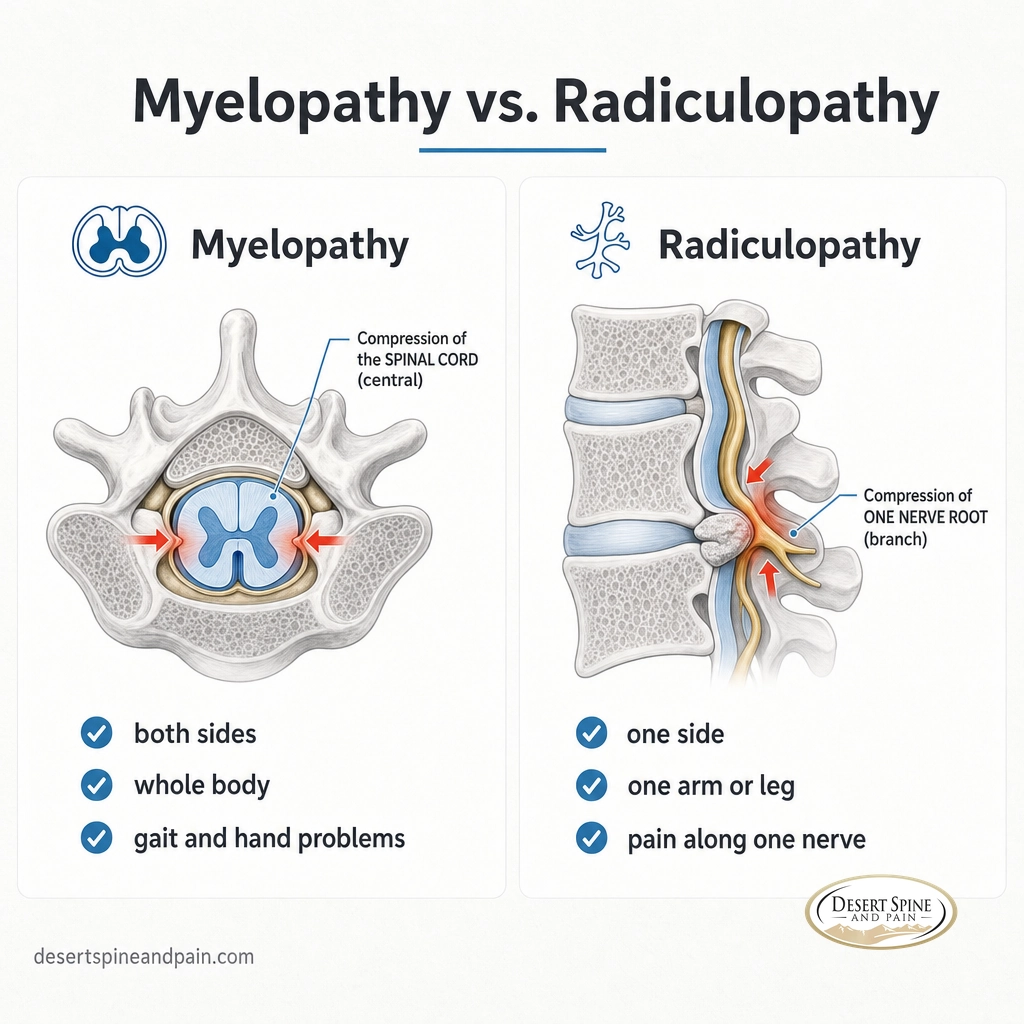
Because the cord is a central structure, myelopathy symptoms are usually spread across the body and affect both sides: a stiff or unsteady walk, loss of fine hand control, numbness in the hands, and, in more advanced cases, changes in bladder or bowel control. The symptoms are frequently painless or less pain-driven than a pinched nerve, which is one reason early myelopathy can be missed.
Source: Myelopathy.org (Key Facts)
What Is Radiculopathy?
Radiculopathy is the compression or irritation of a single nerve root at the point where it branches off the spinal cord and exits between the vertebrae. Instead of affecting the whole cord, it affects one specific wire, so the symptoms travel along the exact territory that one nerve serves. That is why radiculopathy pain and tingling run in a line: down one arm from the neck (cervical radiculopathy), or down one leg from the lower back. Sciatica is the everyday name for lumbar radiculopathy affecting the sciatic nerve.
The usual culprits are a herniated disc pressing on the root, or the bone spurs and disc-space narrowing of spondylosis closing down the opening the nerve passes through. In cervical radiculopathy, spondylosis, disc protrusion, or both account for nearly 70 percent of cases. Herniated discs tend to drive radiculopathy in younger patients, while degenerative narrowing becomes the more common cause with age.
For a deeper look at how often nerve-root compression happens and which roots are involved, see our roundup of radiculopathy statistics. If you want to understand which nerve root maps to which symptom, our guide to which vertebrae affect which nerves breaks it down level by level.
Source: American Family Physician: Cervical Radiculopathy | AAOS OrthoInfo: Cervical Radiculopathy
Myelopathy vs. Radiculopathy: Side by Side
The two conditions share causes but differ in almost every way that matters to a patient. This table lays the distinctions out at a glance.
| Feature | Myelopathy | Radiculopathy |
|---|---|---|
| What is compressed | The spinal cord (central nervous system) | A single nerve root exiting the spine |
| Where symptoms appear | Whole-body, often both sides, below the level of compression | Along one nerve's path, usually one arm or one leg |
| Typical symptoms | Unsteady gait, clumsy hands, numbness, bladder or bowel changes | Shooting pain, tingling, numbness, or weakness in a specific limb |
| Pain pattern | Often painless or vague; function problems dominate | Pain is usually prominent and follows a nerve line |
| Reflexes | Overactive (hyperreflexia), with signs like Hoffmann's or Babinski | Reduced or absent in the affected nerve's area |
| Course | Tends to be progressive; damage can become permanent | Often self-limiting; most improve over weeks to months |
| Usual first-line treatment | Specialist evaluation; surgery often needed to halt progression | Conservative care first; surgery only if it fails |
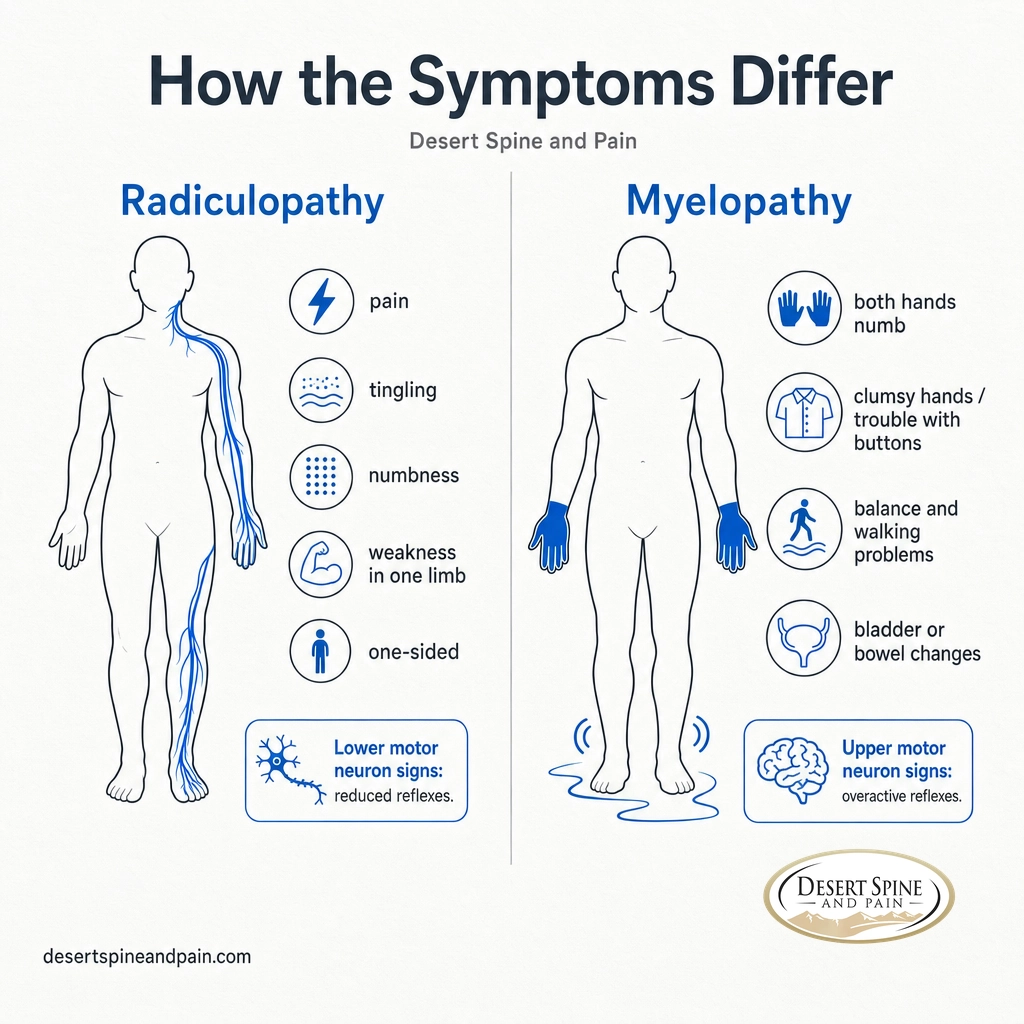
The single most useful idea in this table is the reflex pattern. Myelopathy, because it involves the cord, produces upper motor neuron signs such as overactive reflexes and spasticity. Radiculopathy, because it involves a peripheral root, produces lower motor neuron signs such as reduced reflexes and localized weakness. A spine specialist can often tell the two apart at the exam table before any imaging.
Symptoms: How to Tell Them Apart
If you are trying to make sense of your own symptoms, three questions get you most of the way there: Where are the symptoms? Which side? And what kind of problem is it, pain or function?
Radiculopathy feels like one angry nerve
Radiculopathy usually announces itself with pain. It is sharp, burning, or electric, and it travels in a line: from the neck into the shoulder, arm, and specific fingers, or from the lower back into the buttock, leg, and foot. Tingling, numbness, and weakness follow that same single pathway. It is typically on one side. Many people can trace the symptom down their arm or leg with a finger, which is a strong clue that one nerve root is involved.
Myelopathy feels like the body is not responding
Myelopathy is sneakier. Instead of one loud nerve, it quietly degrades function across the body. The classic early clues are in the hands and the gait: buttons and zippers get harder, handwriting deteriorates, people drop things, and walking starts to feel stiff, heavy, or unbalanced. Numbness tends to affect both hands. There may be little or no pain, which is exactly why patients and even clinicians can underestimate it. Because the spinal cord sits above the nerve roots, cord compression can affect everything downstream at once.
These patterns can blur, and some people genuinely feel both at once. That overlap is the whole reason a careful clinical exam matters more than self-diagnosis, and it is why a myelopathy that hides behind arm pain is one of the most important things a spine surgeon is trained to catch early.

Red Flags and When It Becomes Urgent
Most spine symptoms are not emergencies, and most radiculopathy settles down on its own. The danger is treating every neck or back problem as the same thing, because the signs of cord involvement are precisely the ones people tend to brush off.
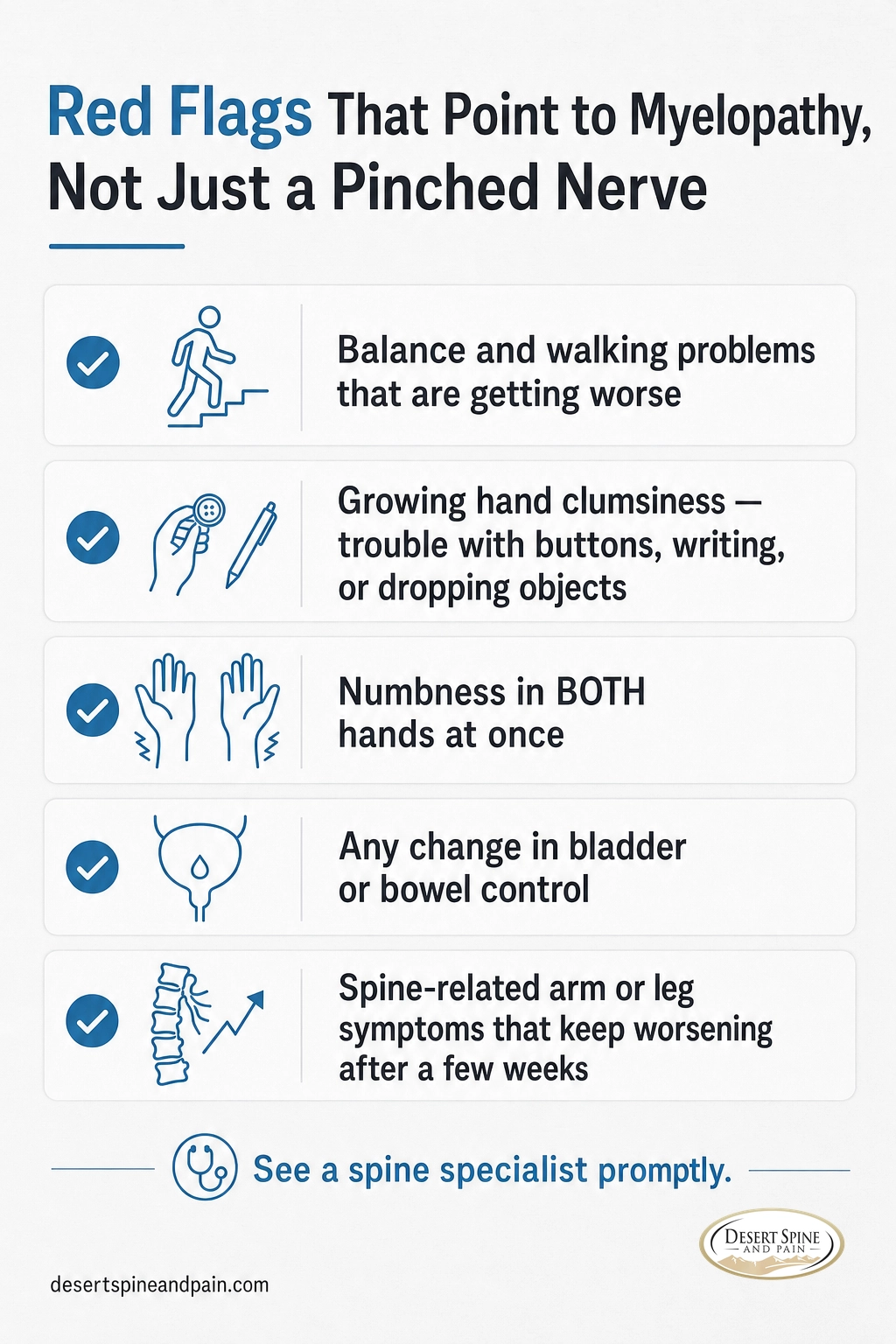
Myth: "A pinched nerve is a pinched nerve, it will just go away." Not always. Radiculopathy often does improve on its own, but the same spine changes can also be squeezing the spinal cord. Progressive balance trouble, worsening hand clumsiness, numbness in both hands, or any change in bladder or bowel control are not features of a simple pinched nerve. They point toward myelopathy and deserve prompt evaluation, because cord damage that is allowed to advance may not fully recover.
Get evaluated promptly if you notice any of the following:
- Increasing difficulty with balance or a stumbling, unsteady walk
- Growing clumsiness in the hands, trouble with buttons, writing, or dropping objects
- Numbness or pins-and-needles in both hands at once
- Any new change in bladder or bowel control
- Arm or leg symptoms from the spine that keep getting worse rather than better after a few weeks
None of this is cause for panic. It is a reason to be seen by a spine specialist who can sort out which problem you actually have. Early myelopathy that is caught and treated tends to do far better than myelopathy that has been advancing for years.
Get Your Symptoms EvaluatedCan You Have Both at Once?
Yes, and it is common. When the same degenerative changes narrow the central spinal canal and crowd the side openings where nerve roots exit, you can get cord compression and root compression together. Doctors call this myeloradiculopathy. A person might have the electric arm pain and finger tingling of a pinched nerve layered on top of the unsteady walk and clumsy hands of cord compression.
Cervical spinal stenosis is the usual setting for this overlap, and advanced degenerative disc disease often sits underneath it. When both are present, the myelopathy component usually drives the treatment decision, because protecting the cord takes priority.
How Each Is Diagnosed
Diagnosis starts with the story and the physical exam, not the scanner. A spine specialist checks strength, sensation, and reflexes, looking for the pattern described above: reduced reflexes and localized weakness point toward a nerve root, while overactive reflexes and signs like Hoffmann's or a positive Babinski point toward the cord.
Imaging then confirms the picture. MRI is the key test for both conditions, because it shows the soft tissues: a herniated disc pressing a nerve root, or the spinal cord being flattened by stenosis. X-rays and CT add detail on bone spurs and alignment. When it is unclear whether a nerve root truly explains the symptoms, electromyography and nerve conduction studies (EMG and NCS) can localize the problem and separate radiculopathy from other nerve conditions. Knowing which spinal level controls which function lets the surgeon match the scan to the symptom.
One important caveat applies to imaging: findings are common even in people with no symptoms. Nearly half of middle-aged and older adults have worn discs and pinched nerves on imaging that cause no pain at all. That is exactly why the exam and the symptom pattern, not the scan alone, decide the diagnosis.
Source: AAOS OrthoInfo: Cervical Radiculopathy
How Each Is Treated
This is where the two conditions diverge most, and where getting the diagnosis right changes everything.
Radiculopathy: conservative care first
For most radiculopathy, the least invasive path is also the most effective one. The large majority of patients improve without surgery using a combination of activity modification, physical therapy, anti-inflammatory medication, and, when needed, targeted epidural or nerve-root steroid injections to calm the inflamed root. In one well-known cohort, a focused non-surgical program succeeded in 92 percent of patients. Surgery for radiculopathy is reserved for cases that do not respond to a fair trial of conservative care, or where there is significant, worsening weakness.
Explore Non-Surgical Pain TreatmentSource: American Family Physician: Cervical Radiculopathy
Myelopathy: protect the cord
Myelopathy is a different calculation. Because it tends to progress and because advanced cord damage may not reverse, the goal is to relieve pressure on the cord before function is lost. Mild, stable cases can sometimes be watched closely, but for moderate or progressive myelopathy, surgical decompression is the mainstay. Procedures such as a laminectomy or other decompression, often paired with stabilization, create room for the cord and aim to stop the decline. Modern minimally invasive spine surgery can accomplish this through smaller incisions in appropriate cases.
Learn About Decompression SurgeryThe right answer depends on the right diagnosis. A pinched nerve and a compressed cord can start with similar-sounding neck or arm complaints, yet one is usually best left to heal with conservative care and the other may be a race against progressive damage. That is why a precise evaluation by a surgeon who treats both, every day, is worth more than any single test. Dr. David L. Greenwald is a dual board-certified spine surgeon and neurosurgeon, which means both the nerve-root problem and the spinal-cord problem are squarely within his expertise.
Frequently Asked Questions
What is the difference between myelopathy and radiculopathy?
Which is more serious, myelopathy or radiculopathy?
Can you have myelopathy and radiculopathy at the same time?
How common is each condition?
When should I see a doctor for these symptoms?
Methodology and Sources
How we built this comparison
This guide compares two distinct clinical conditions, myelopathy (spinal cord compression) and radiculopathy (nerve root compression), using definitions, symptom patterns, and epidemiology from established medical references. Incidence and prevalence figures are drawn from peer-reviewed and professional-society sources and are cited at the point of use. Clinical descriptions are general education, not individualized medical advice. Symptoms vary from person to person, imaging findings are common even without symptoms, and only a qualified evaluation can establish a diagnosis.
- Myelopathy.org, Key Facts on degenerative cervical myelopathy (prevalence of about 2 percent of adults; most common cause of spinal cord dysfunction; Global Burden of Disease 2016 comparison)
- American Family Physician (2010): Cervical Radiculopathy, citing Radhakrishnan et al., Brain (1994) and Saal et al., Spine (1996) (annual incidence about 83 per 100,000; roughly 70 percent of cases from spondylosis or disc; 92 percent non-surgical success)
- AAOS OrthoInfo: Cervical Radiculopathy (Pinched Nerve) (causes, diagnosis, asymptomatic imaging findings, conservative treatment)