
What Is Cervical Myelopathy? Symptoms, Prognosis, and Treatment
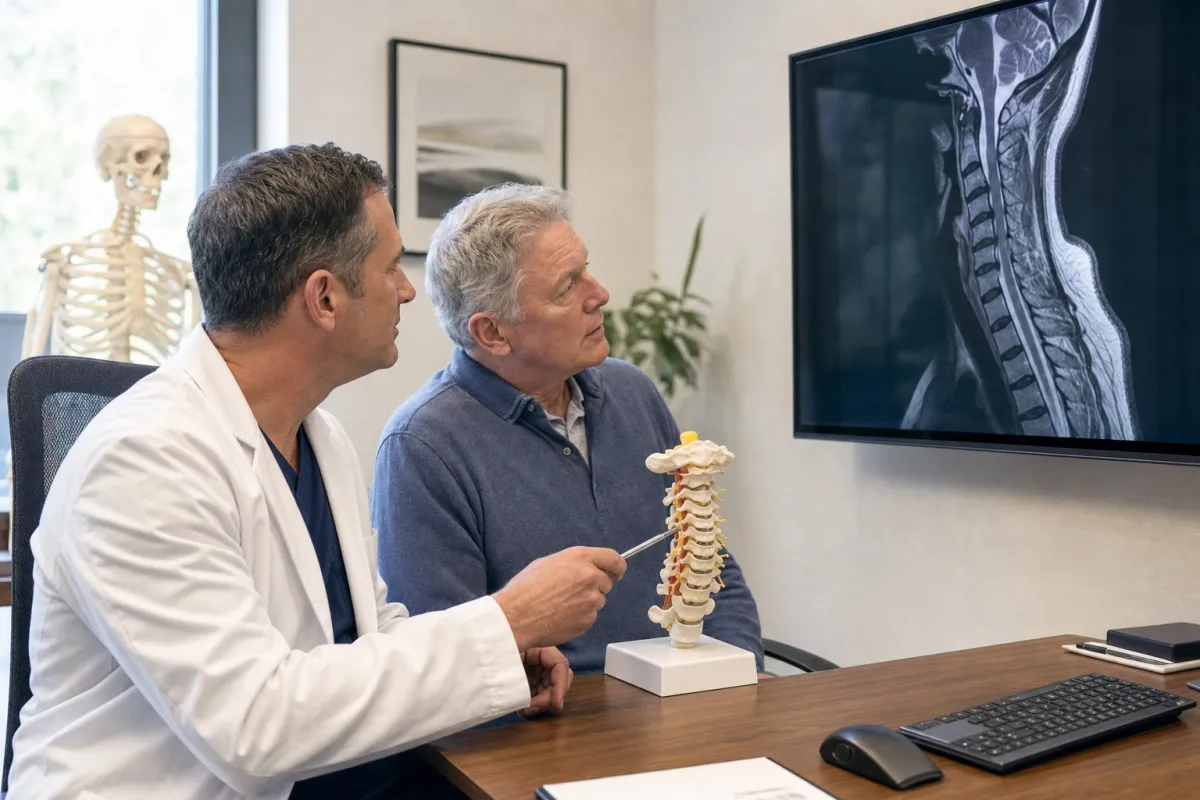
Cervical myelopathy, in plain terms: Cervical myelopathy is a condition in which the spinal cord in the neck is squeezed, usually by age-related wear in the spine. Because that cord carries signals to the arms, trunk, and legs, the pressure can cause hand clumsiness, balance and walking problems, and numbness. It tends to progress gradually and often needs surgery to stop it.
If a doctor has used the word "myelopathy," or if you have been losing dexterity in your hands and feeling unsteady on your feet without an obvious reason, it is natural to want a clear explanation before anything else. The term breaks down simply: "myelo" means spinal cord and "pathy" means disease, so myelopathy is any problem affecting the spinal cord. Cervical myelopathy is that problem located in the neck, where wear in the spine presses on the cord. This guide explains what the condition is, why it affects both the hands and the legs, how it differs from the more familiar pinched nerve, how it is diagnosed, what the outlook looks like treated and untreated, and what treatment involves.
- Cervical myelopathy is compression of the spinal cord in the neck, most often from age-related degeneration (the degenerative form is called cervical spondylotic myelopathy, or CSM).
- Because the compressed cord carries signals to the whole body below the neck, it affects the legs and balance as well as the hands, which sets it apart from a simple pinched nerve.
- It is the most common cause of spinal cord dysfunction in adults, and it usually appears after age 55 and develops slowly.
- MRI is required to confirm it, but the amount of compression on a scan does not match the severity of symptoms, so the exam and the history matter just as much.
- Untreated, a large share of patients deteriorate over time; surgery is the main way to halt progression, and most patients with disability improve or stabilize after decompression.

What's in This Guide
How Cervical Myelopathy Develops
The cervical spine is the seven vertebrae of the neck, and running through the center of them is the spinal cord, the main cable of nerves that connects the brain to the rest of the body. Myelopathy happens when the space around that cord narrows enough to press on it. In most adults this is a slow, degenerative process rather than a sudden injury.
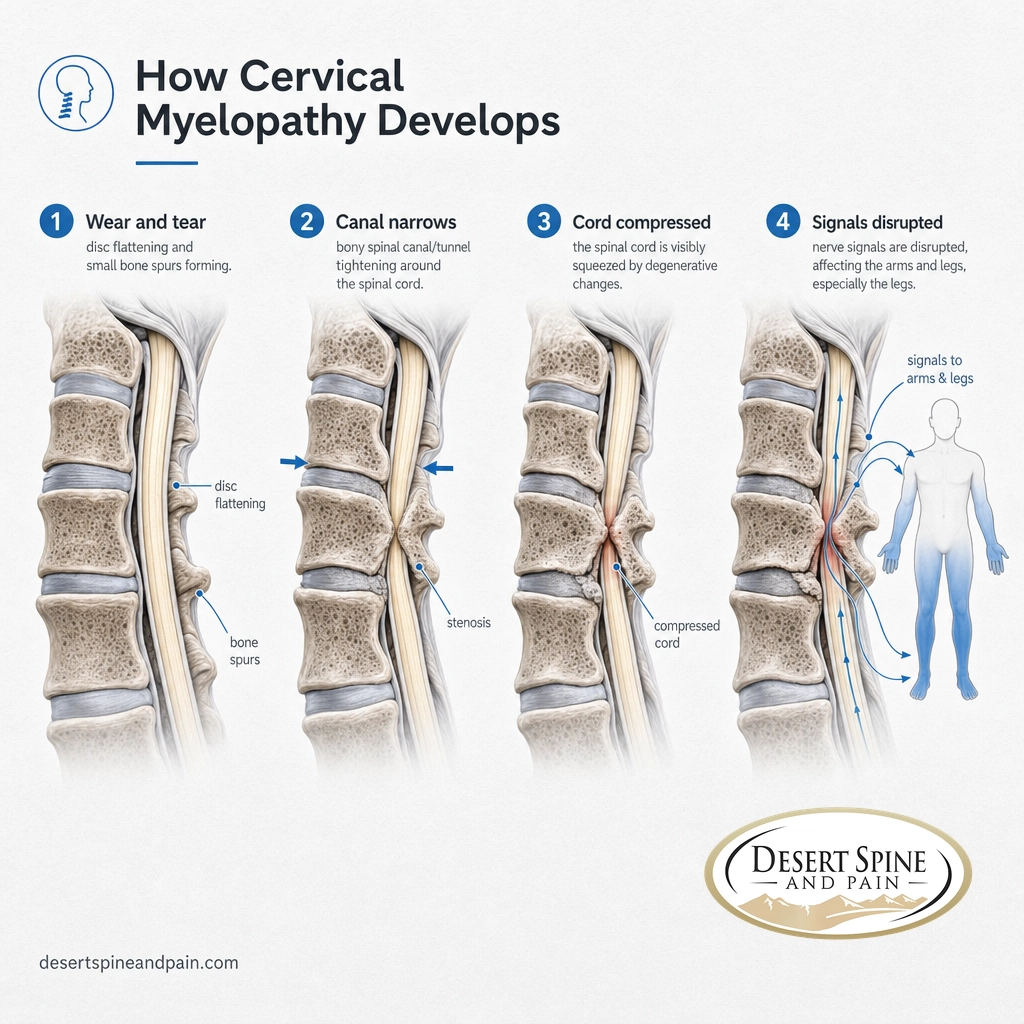
Here is the sequence in plain English:
- Wear and tear accumulates. With age, the discs that cushion the vertebrae dry out and flatten, the bones can form spurs (osteophytes), and the ligaments can thicken or harden. Any of these can grow into the space the cord needs.
- The canal narrows. As those changes build up, the bony tunnel that holds the spinal cord gets tighter. This narrowing is called cervical spinal stenosis.
- The cord gets compressed. When the narrowing is severe enough, it presses directly on the spinal cord. Movement of the neck can pinch it further with each bend.
- Signals get disrupted. The pressure interferes with the nerve pathways passing through the cord, and over time it can injure the cord tissue itself. That is the point at which stenosis becomes myelopathy.
This is also the answer to a question many patients ask: why does a neck problem affect my legs? The long nerve tracts that carry movement and sensation signals to the legs all pass through the spinal cord in the neck on their way down. When the cord is squeezed high up in the neck, everything below that point can be affected, which is why cervical myelopathy so often shows up as stiff, heavy legs and an unsteady walk rather than, or in addition to, neck symptoms.
Source: American Academy of Family Physicians: Cervical Spondylotic Myelopathy | Desert Spine and Pain cervical stenosis surgery overview
Cervical Myelopathy vs. Cervical Radiculopathy
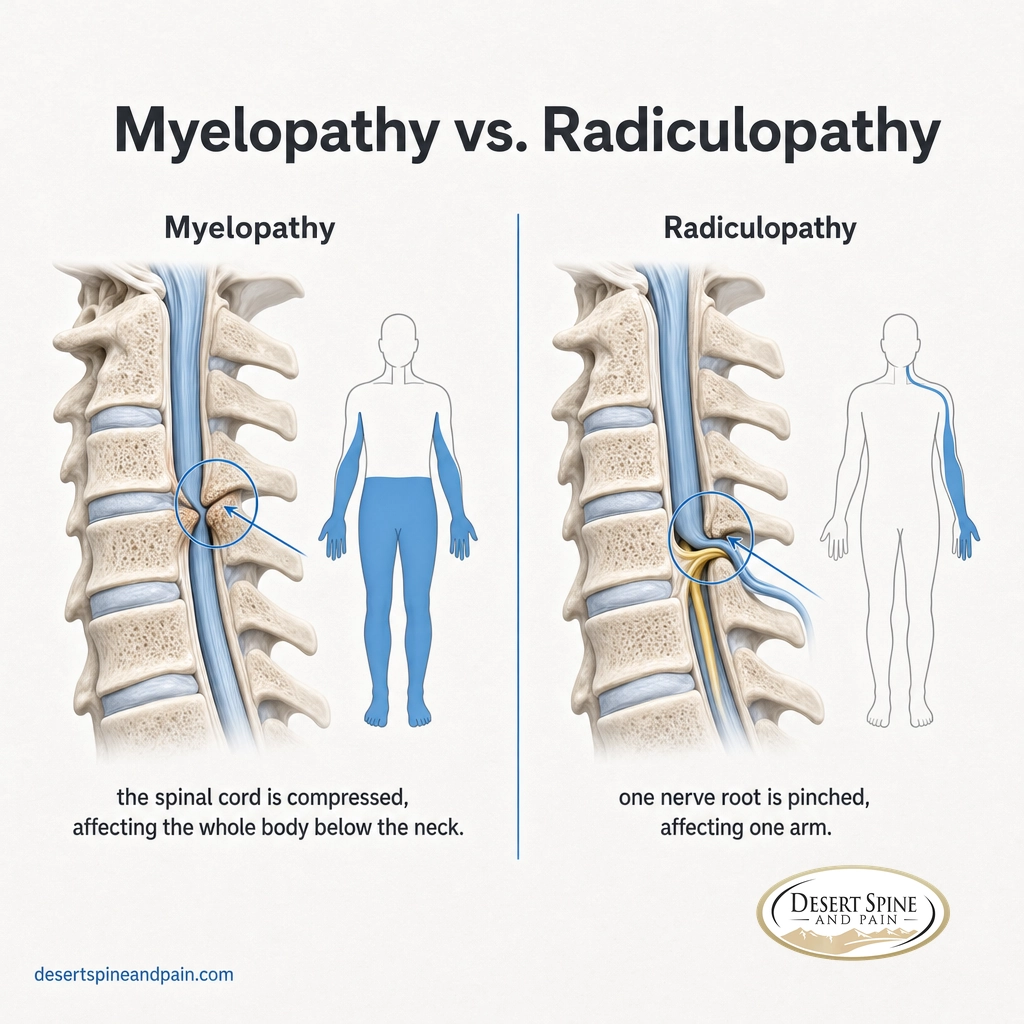
The single most common point of confusion is the difference between myelopathy and radiculopathy. They sound similar and can even occur together, but they are different problems with different patterns, and the distinction changes how urgent the situation is.
| Feature | Cervical Myelopathy | Cervical Radiculopathy |
|---|---|---|
| What is compressed | The spinal cord itself | A single nerve root as it exits the spine |
| Where symptoms show up | Both sides and below the neck: hands, trunk, and legs | Along the path of one nerve, usually one arm |
| Typical complaints | Hand clumsiness, imbalance, stiff or heavy legs, trouble walking | Sharp pain, numbness, or weakness running down one arm |
| Pain | Often minimal, especially early; the problem is function, not pain | Pain is usually the leading symptom |
| Nerve signal type | Upper motor neuron signs (overactive reflexes, stiffness) | Lower motor neuron signs (dampened reflexes, localized weakness) |
A useful way to picture it: radiculopathy is like pinching one wire coming out of a cable, so one specific arm circuit misbehaves. Myelopathy is pressure on the main cable itself, so anything served by the lines below the squeeze can be affected. That is why myelopathy tends to be the more serious of the two and why its subtle, painless early signs deserve attention.
Myth: "No neck pain means my spine is fine." Cervical myelopathy is often painless in its early stages. Many patients have little or no neck pain and instead notice clumsy hands or a change in how they walk. Waiting for pain before getting checked can let the condition progress silently.
Source: Myelopathy.org: Symptoms of degenerative cervical myelopathy | which doctor to see for cervical radiculopathy
Symptoms and Early Warning Signs
Because cervical myelopathy develops slowly and is often painless at first, its early symptoms are easy to dismiss as normal aging or a minor injury. The most telling early changes involve the hands and the way a person walks. Watching for them, and for whether they are getting worse, is more important than any single symptom on its own.
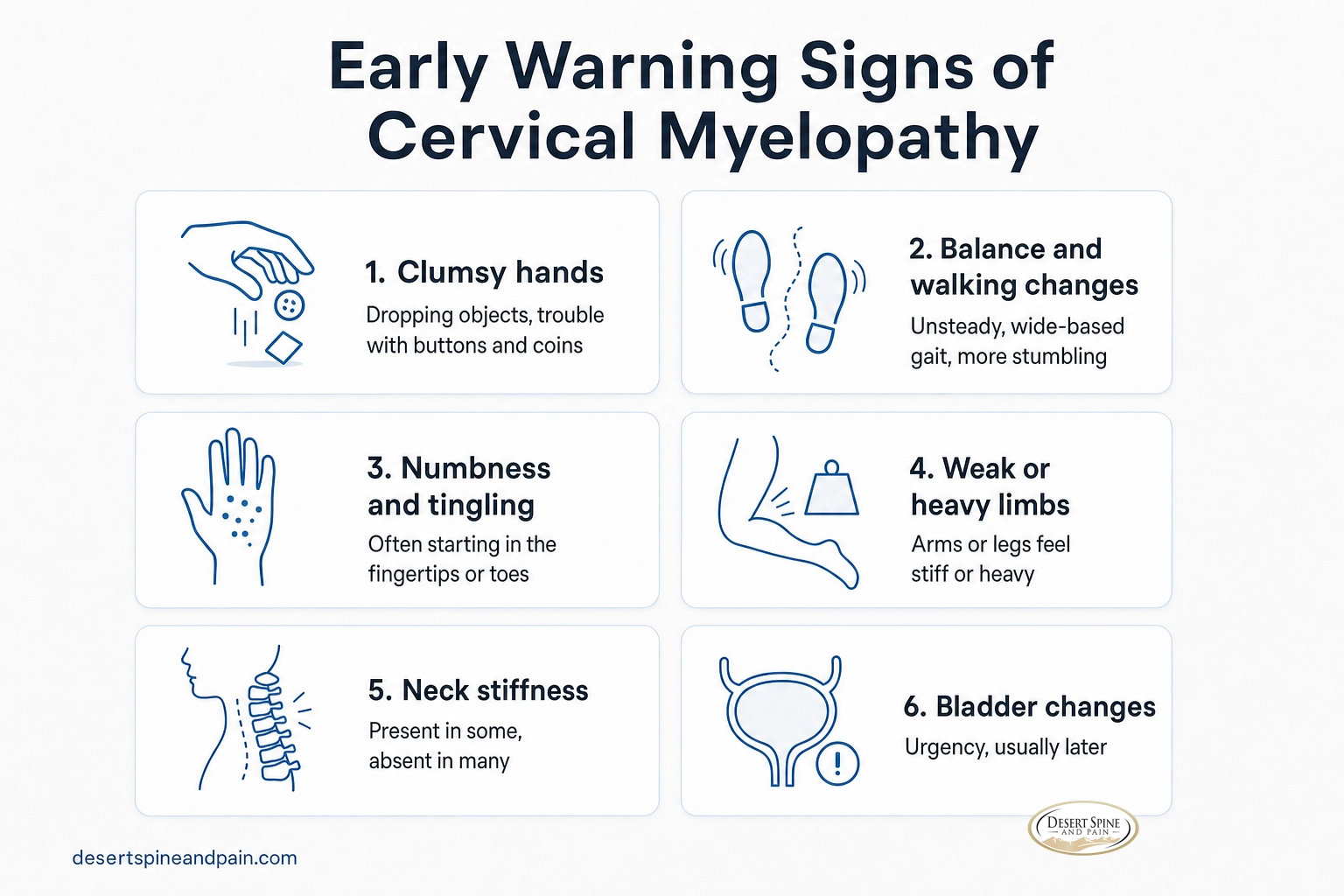
- Hand clumsiness and loss of dexterity. Dropping objects, trouble with buttons, zippers, or coins, and messier handwriting are classic early clues that the cord is affected.
- Balance and walking changes. An unsteady, wide-based, or stiff walk, more stumbling, or needing to hold a wall or railing are common and can lead to falls.
- Numbness and tingling. Pins-and-needles or numbness, often starting in the fingertips or toes, is frequent.
- Weakness or heaviness. Arms or legs can feel weak, stiff, or heavy, and reflexes often become overactive.
- Neck stiffness. Some patients have neck stiffness or pain, but many do not, which is part of why the condition is missed.
- Bladder changes. Urinary urgency or other bladder changes can appear, usually later rather than first, and warrant prompt evaluation.
These symptoms often come on so gradually that patients cannot name a start date. The practical rule is to take the whole pattern together, the hands plus the walking plus the sensation changes, and to watch for progression over weeks and months rather than waiting for one dramatic symptom.
Source: Myelopathy.org: Symptoms of DCM
What Causes It and Who Gets It
By far the most common cause is ordinary, age-related degeneration of the cervical spine, the same wear that produces arthritis, bone spurs, and disc changes elsewhere in the body. When degeneration is the driver, the condition is specifically called cervical spondylotic myelopathy (CSM), and it is the usual form in older adults. Less common causes include a large herniated disc, ossification of a spinal ligament, and injury, tumor, or inflammatory disease.
Degenerative cervical myelopathy is now recognized as the most common cause of spinal cord dysfunction in adults. According to Myelopathy.org, drawing on Global Burden of Disease data, it is more than 500 times more common than acute traumatic spinal cord injury, yet it receives a tiny fraction of the research attention, which is part of why awareness among patients is still low.
Age is the biggest risk factor, because degeneration accumulates over decades. That said, wear-and-tear changes on a scan are extremely common with age and do not by themselves mean a person has myelopathy. The condition is defined by the combination of cord compression and the symptoms and exam findings that come from it, not by imaging alone.
Source: Myelopathy.org: Key Facts on degenerative cervical myelopathy | American Academy of Family Physicians: Cervical Spondylotic Myelopathy

How Cervical Myelopathy Is Diagnosed
Diagnosis rests on three parts working together: the history of symptoms, a focused neurological exam, and imaging. No single piece is enough on its own.
- History. The pattern matters more than any one symptom: gradual hand clumsiness, balance and gait changes, and numbness, usually without a clear starting point.
- Neurological exam. A physician checks strength, sensation, and reflexes and looks for specific cord-compression signs. Overactive reflexes, a positive Hoffmann sign, and a Lhermitte sign (an electric sensation down the spine when the neck bends) can all point to myelopathy.
- MRI. An MRI is required to confirm the diagnosis and in most cases shows the cord being compressed. X-rays and CT scans show the bones but not the cord itself, so they support planning rather than make the diagnosis.
Why the scan and the symptoms can disagree: The amount of compression visible on an MRI does not reliably predict how severe a person's symptoms are. Two people with similar-looking scans can function very differently. This is exactly why an experienced spine specialist weighs the exam and the history alongside the images, rather than treating the picture alone.
Doctors often grade severity with the modified Japanese Orthopaedic Association (mJOA) scale, which scores hand and leg function, sensation, and bladder control into mild, moderate, or severe categories. That grade helps guide how urgently to act and whether surgery is recommended.
Source: Myelopathy.org: Diagnosis of degenerative cervical myelopathy
Prognosis: What Happens Treated vs. Untreated
The outlook for cervical myelopathy depends heavily on whether, and when, it is treated. The condition itself is not usually fatal, so the honest answer to "how long can you live with cervical myelopathy" is that it does not typically shorten life expectancy on its own. The real stakes are function and independence: left to progress, it can cause lasting disability in the hands and legs.
Longstanding natural-history data, summarized by the American Academy of Family Physicians, describe a condition that is hard to predict for any one person but that frequently worsens over time when left untreated.
Course of untreated cervical spondylotic myelopathy (classic natural-history data)
Approximate distribution of untreated outcomes from classic natural-history studies. The individual course cannot be predicted. Source: American Academy of Family Physicians (2000), summarizing earlier natural-history data.Surgery to decompress the cord changes that picture substantially. The goal is not to turn back the clock but to stop the slide and allow the cord a chance to recover what it can. Reported outcomes after surgery are encouraging for most patients.
Reported outcomes after surgery for patients with myelopathy-related disability
Reported outcomes for patients with disability from degenerative cervical myelopathy after decompression surgery. Source: Myelopathy.org treatment overview.Two themes run through the data. First, timing matters: because surgery is mainly about halting progression, catching myelopathy earlier generally means protecting more function. Second, the condition rarely improves on its own, so a "wait and see" approach carries real risk once symptoms are more than mild. This is why specialists take progressive myelopathy seriously rather than treating it as ordinary neck arthritis.
Source: American Academy of Family Physicians: Cervical Spondylotic Myelopathy | Myelopathy.org: Treatment of DCM
Treatment Options
Treatment is guided by how severe the myelopathy is and whether it is progressing. International guidance uses the mJOA severity grade to help make that call.
Monitoring and non-surgical care for mild cases
For mild, stable myelopathy, some patients are monitored closely, and physical therapy can help with neck and limb pain, strength, and comfort. It is important to be clear about what conservative care does and does not do: therapy can ease symptoms, but it is not expected to cure myelopathy or reverse cord compression, and it is generally not relied on once the condition is moderate or severe. At Desert Spine and Pain, physical therapy is coordinated through trusted referral rather than performed in-house, as part of a least-invasive-first philosophy.
Surgery for moderate, severe, or progressing myelopathy
When myelopathy is moderate, severe, or clearly worsening, surgery is generally recommended because it is the only known way to halt progression. The common goal of every approach is decompression: taking the pressure off the spinal cord, and stabilizing the spine when needed. Depending on where the compression sits and the shape of the spine, that may be done from the front of the neck, the back, or both. No single technique is best for everyone; the right choice depends on the compression pattern, alignment, and the surgeon's judgment. Related procedures include cervical stenosis surgery, laminectomy, cervical corpectomy, and cervical fusion.
As with any spinal cord surgery, there are real risks, and outcomes track closely with how carefully the operation is planned and performed. This is surgery where the hands doing it matter. Dr. David L. Greenwald, MD, FAANS, FACS is dual board certified as both a spine surgeon and a neurosurgeon, and that training is built around exactly this kind of delicate cord decompression.
Source: Myelopathy.org: Treatment of degenerative cervical myelopathy
How to Get Started
If you recognize the pattern in yourself or a family member, or a doctor has mentioned myelopathy, the most useful next step is a focused evaluation that brings the symptoms, the neurological exam, and an MRI together. That is what separates ordinary age-related neck changes from a cord problem that needs action, and it is the right moment to ask about the full range of options and to seek a second opinion before any major neck surgery.
Desert Spine and Pain is a Phoenix, Arizona practice led by Dr. David L. Greenwald, MD, FAANS, FACS, drawing patients from across the Greater Phoenix area and beyond for complex spine care. Evaluation starts with understanding your symptoms and imaging, and care is matched to how advanced the condition actually is.
Book a consultation or second opinion
Explore spine conditions we treat
Learn about cervical stenosis surgery
Common Questions About Cervical Myelopathy
Is cervical myelopathy serious?
What is the difference between cervical myelopathy and cervical radiculopathy?
Can cervical myelopathy go away on its own or be cured without surgery?
Why does cervical myelopathy affect the legs?
How long can you live with cervical myelopathy?
Related Spine Terms
- Cervical spinal stenosis: narrowing of the spinal canal in the neck, the usual precursor to degenerative myelopathy.
- Cervical radiculopathy: compression of a single nerve root, which causes arm pain rather than cord-wide dysfunction.
- Cervical spondylotic myelopathy (CSM): the degenerative, age-related form of cervical myelopathy, the most common type.
- Cervical corpectomy: removing a vertebral body to decompress the cord, one option when compression sits behind the bone.
- Laminectomy: decompression from the back of the spine by removing the bony arch over the cord.
- Cervical fusion: joining neck vertebrae into one solid unit to stabilize the spine after decompression.
- Hoffmann sign: a reflex finding on examination that can indicate spinal cord involvement in the neck.
Sources
Sources and Methodology
This guide summarizes established clinical references and reputable patient-education data on cervical myelopathy and degenerative cervical myelopathy. Natural-history percentages are drawn from classic studies as summarized by the American Academy of Family Physicians and are presented as general reference, not as individual predictions; surgical outcome figures are reported ranges, not guarantees. It is educational information, not medical advice. Decisions about diagnosis and surgery should be made with a qualified spine surgeon after an in-person evaluation.