

Cervical Myelopathy Complications: Can It Be Life-Threatening?
Can cervical myelopathy be life-threatening? The short answer: Cervical myelopathy is almost never directly fatal. Most people do not die from it. It is, however, a serious and usually progressive condition, and in specific situations it can threaten life indirectly, mainly through sudden spinal cord injury after minor trauma or complications of severe disability. Timely diagnosis and treatment lower these risks.
If you have searched how cervical myelopathy can cause death, you are almost certainly worried, either for yourself or for someone you love. Here is the honest, reassuring version first: cervical myelopathy, the dysfunction that happens when the spinal cord in the neck is compressed, is very rarely a direct cause of death. What makes it genuinely serious is different. It tends to worsen over time, the nerve damage it causes can become permanent, and a tightly compressed cord leaves little margin for a bad fall or a car accident. This guide explains, in plain language, the real ways cervical myelopathy can become dangerous, the warning signs that call for prompt care, and why acting early changes the outlook so much.
- Cervical myelopathy is rarely a direct cause of death. The risk to life is almost always indirect.
- The most important danger is a sudden, severe spinal cord injury after a minor fall or collision, because a narrowed neck canal has little room to spare.
- Very high or severe cord involvement can affect the breathing muscles, which is why high cervical cord problems are treated seriously.
- Advanced, disabling myelopathy raises the risk of pneumonia, blood clots, pressure injuries, and infections that drive premature mortality.
- Untreated myelopathy tends to progress, and nerve damage can be permanent, so the aim is to intervene before it is.
- A 2023 study found life expectancy in degenerative cervical myelopathy is reduced but can be restored with timely treatment.
- Red flags that need urgent care: rapidly worsening weakness or balance, loss of bladder or bowel control, or new symptoms after a fall or crash.

What's in This Guide
Can Cervical Myelopathy Be Life-Threatening?
For the vast majority of people, cervical myelopathy is not a condition that will directly end their life. It does not work like a fast, fatal illness. It is a mechanical problem: wear-and-tear changes, bone spurs, a bulging disc, or a thickened ligament gradually narrow the canal that houses the spinal cord in your neck, and the squeezed cord stops signaling normally. The result is clumsy hands, an unsteady walk, numbness, and weakness. Those symptoms are disruptive, but they are not, by themselves, lethal.
It helps to know how common the underlying changes are. Compression of the cervical cord shows up on MRI far more often than symptoms do, which is one reason a scan finding alone rarely means you are in danger.
Symptomatic degenerative cervical myelopathy is less common than those imaging changes, but it is still the leading cause of spinal cord dysfunction in older adults in North America, so it is far from rare.
So where does the word "death" come from in searches like this one? It comes from the serious, indirect consequences that can follow if the condition is severe or left to progress. Long-term data make the point without overstating it.
What the long-term research shows: A 2023 study in Acta Neurochirurgica followed 349 people treated surgically for degenerative cervical myelopathy for a median of 15.3 years. Their survival was lower than expected for their age and sex (135 deaths observed, against roughly 115 expected), and worse survival was linked to greater disability at the time of treatment. The authors' conclusion is the hopeful headline: life expectancy in cervical myelopathy is currently reduced, but it can be restored with timely treatment. In plain terms, the risk tracks with how much disability the condition is allowed to cause, and early care is what protects against it.
Source: Cleveland Clinic: Myelopathy | Davies et al., Acta Neurochirurgica (2023): life expectancy in degenerative cervical myelopathy
How Cervical Myelopathy Can Become Dangerous
The honest way to answer "how does cervical myelopathy cause death" is to separate the condition itself from the events it can set up. Cervical myelopathy rarely harms through the slow compression alone. The real dangers are a handful of indirect pathways, and understanding them is exactly what helps you avoid them.
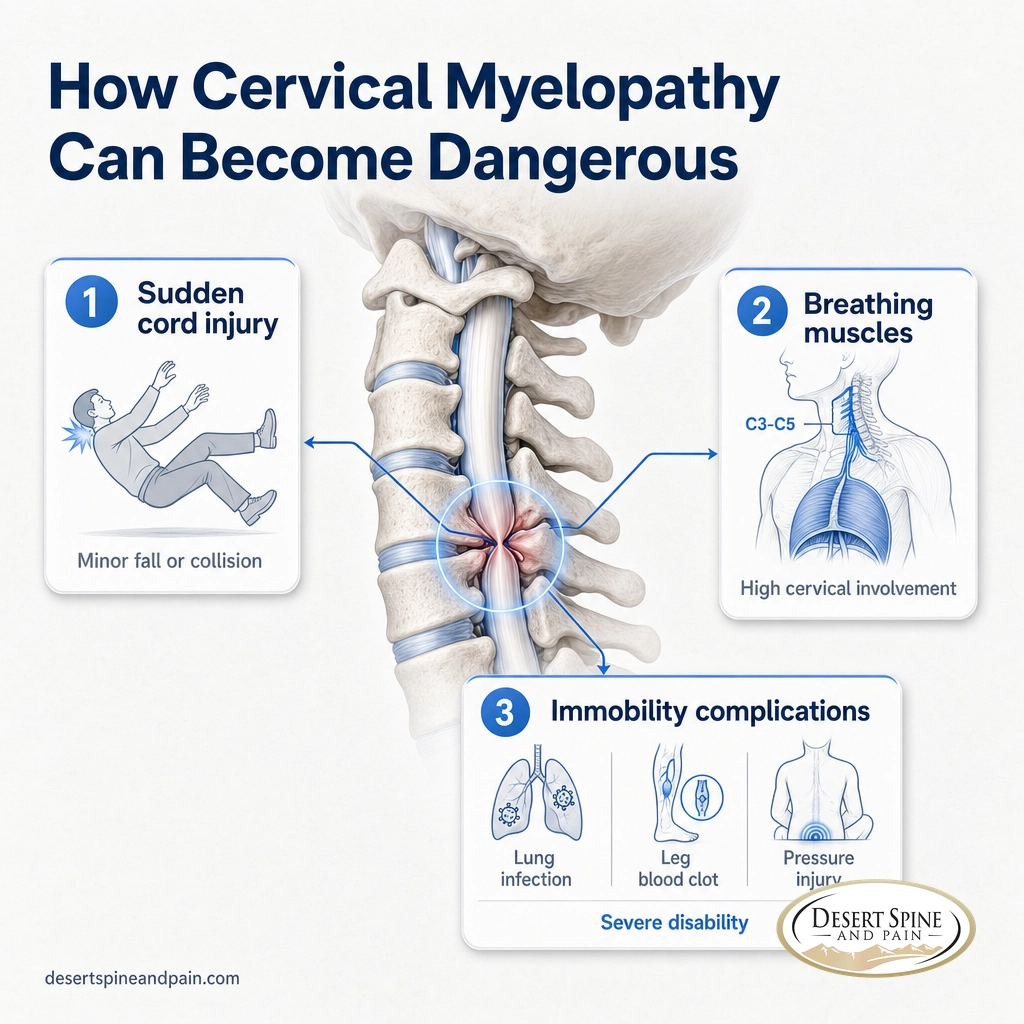
1. A sudden, severe cord injury from a minor fall or collision
This is the one that matters most. When the spinal canal is already narrowed and the cord is compressed, there is very little space to absorb a jolt. A relatively minor event, a trip and fall, a rear-end car accident, a sharp backward bend of the neck, can bruise or crush the vulnerable cord in an instant. The classic result is central cord syndrome, where weakness is worse in the arms than the legs and can range from clumsy hands to near-complete paralysis. It happens most often in older adults who already have the kind of neck arthritis that causes myelopathy, frequently after a simple ground-level fall.
2. Breathing problems from very high or severe cord involvement
The diaphragm, the main muscle that drives breathing, is controlled by the phrenic nerve, which arises from the upper neck levels (roughly C3 to C5). When a cord injury or very high, severe compression affects this region, it can weaken the breathing muscles and, in the most serious cases, cause respiratory insufficiency. This is uncommon in slowly progressive degenerative myelopathy and is far more relevant to acute high cervical injury, but it is the anatomic reason doctors treat high cervical cord problems with real urgency.
3. Complications of severe disability and immobility
When myelopathy is allowed to advance to significant weakness or paralysis, the body becomes vulnerable in the ways any immobilized body does. Reduced mobility raises the risk of blood clots in the legs that can travel to the lungs, chest infections and pneumonia, pressure injuries that can become infected, and urinary tract infections. These complications, not the cord compression itself, are what the long-term survival data point to as the drivers of premature death in the most severely affected patients.
Myth: "It is just neck arthritis, so there is nothing to worry about." Cervical myelopathy begins as ordinary-looking wear and tear, which is exactly why it is so easy to dismiss or write off as normal aging. But myelopathy means the spinal cord itself is affected, not just a stiff neck. Treating it like simple arthritis is how people miss the window to protect the cord before damage becomes permanent.
Source: StatPearls: Central Cord Syndrome | NICE: high cervical spinal cord injury and the phrenic nerve
What Happens If Cervical Myelopathy Is Left Untreated
Most of the long-term risk in cervical myelopathy comes down to one thing: whether it is allowed to progress. Left alone, myelopathy tends to get worse over time, and the nerve damage it causes can become permanent. That is the heart of why clinicians urge people not to wait and see indefinitely.
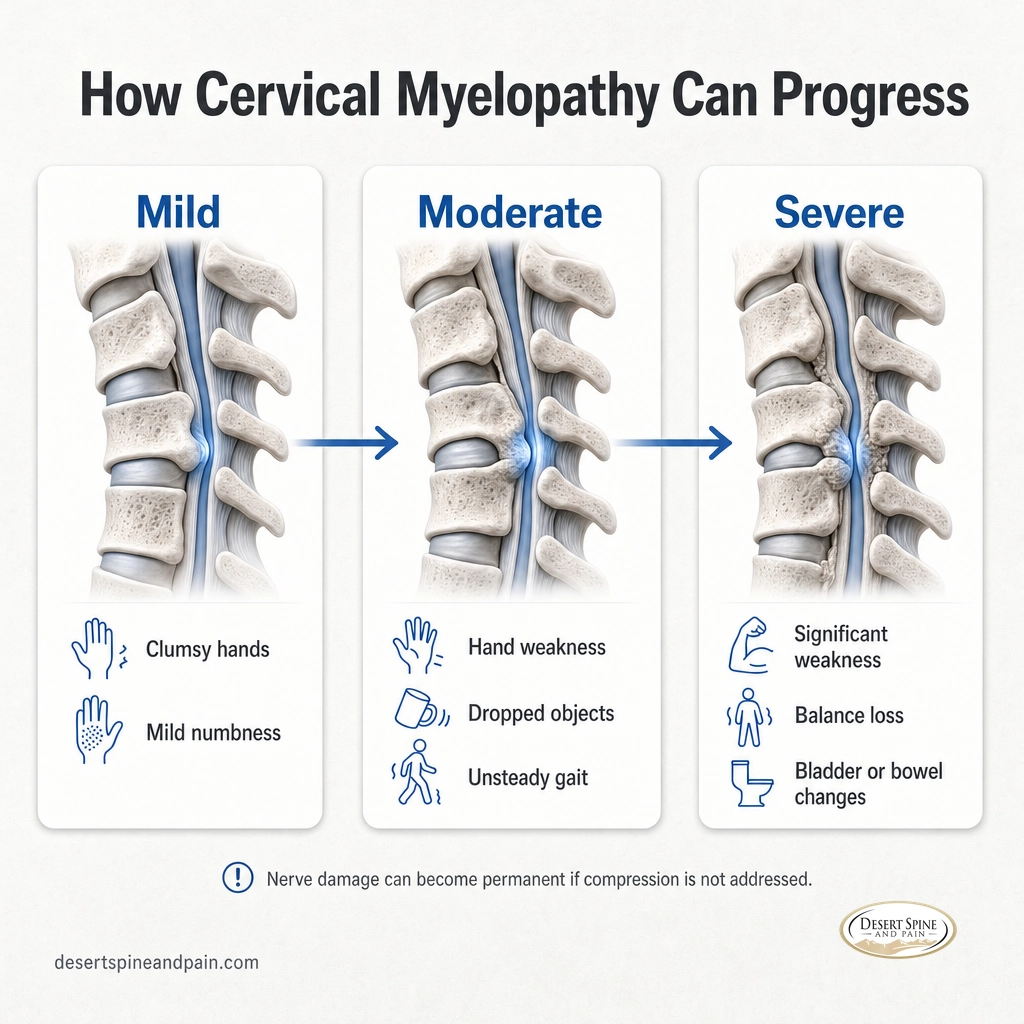
Cleveland Clinic puts it plainly: left untreated, myelopathy may get worse over time, and because you cannot reverse nerve damage, complications may be permanent. The outcomes it lists for untreated or advanced disease include severe pain, permanent nerve damage, loss of coordination and balance, loss of bladder or bowel control, and, in severe cases, paralysis. The same source notes that myelopathy complications may affect both life expectancy and quality of life.
Progression is not always steady. Many people have long stable stretches punctuated by step-downs in function. The problem is that each step-down can leave a permanent deficit, and the longer significant symptoms go unaddressed, the less likely a full recovery becomes. That is why duration of symptoms is one of the factors clinicians weigh when they talk about prognosis, and why "let's keep watching it" has limits once the cord is clearly affected.
The takeaway is not panic. It is that "watchful waiting" is a decision that should be made with a spine specialist, with a clear plan for what would trigger treatment, rather than by default.
Source: Cleveland Clinic: Myelopathy complications and progression | American Academy of Family Physicians: Cervical Spondylotic Myelopathy

Warning Signs That Need Prompt Medical Attention
Most cervical myelopathy moves slowly and is not an emergency. What you want to recognize are the signals that it may be worsening or that the cord may have been acutely injured. If you notice any of the following, treat it as a reason to be seen quickly rather than to wait.
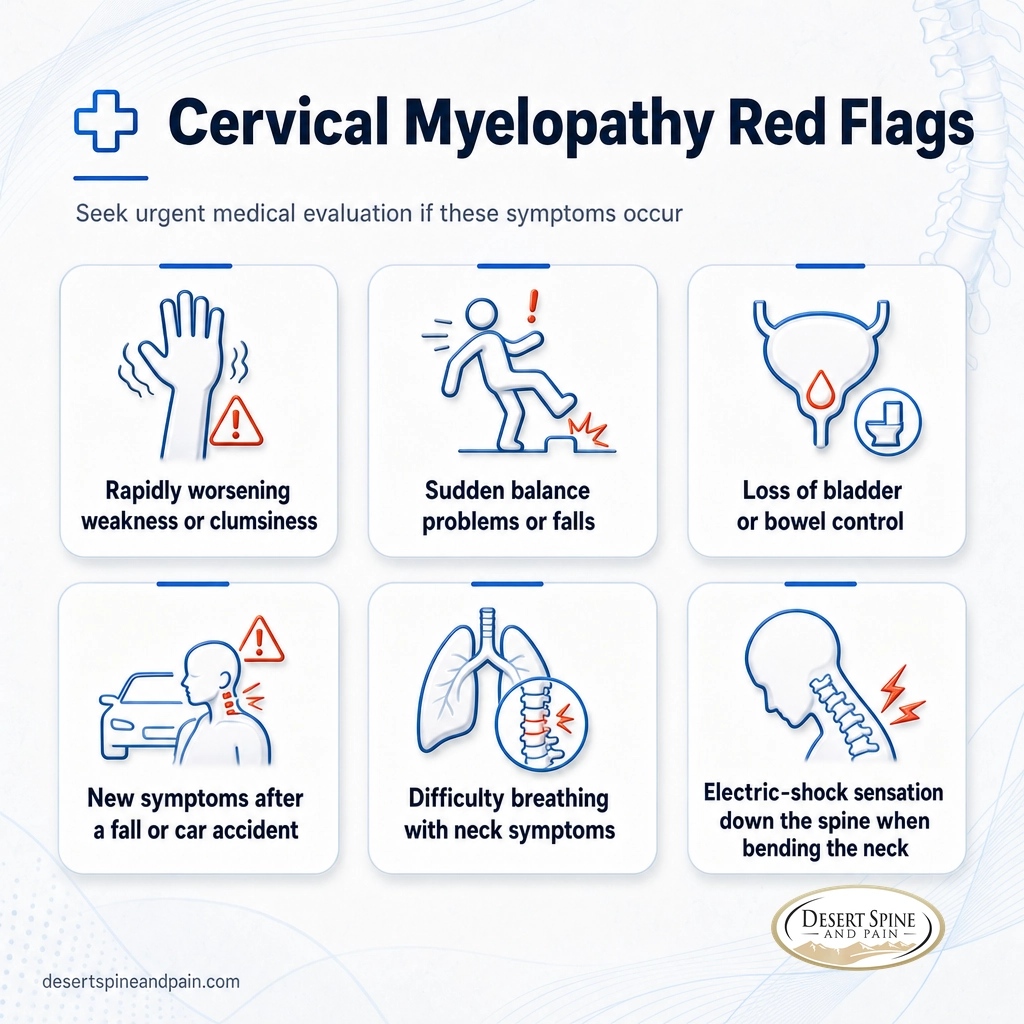
- Rapidly worsening weakness or clumsiness in your hands or legs over days or a few weeks, rather than a slow drift over months.
- New or worsening balance problems and falls. A sudden change in how steady you are on your feet is a meaningful signal, not just "getting older."
- Loss of bladder or bowel control, or new trouble starting or holding urine. This points to more advanced cord involvement and needs prompt assessment.
- Symptoms that appear or worsen after a fall, a car accident, or a sharp bend of the neck. In a neck that already has compression, even minor trauma can injure the cord. This warrants same-day care.
- Any difficulty breathing alongside neck symptoms, which, while uncommon, should be treated as an emergency.
- Spreading numbness or an electric-shock sensation down the spine when you bend your neck forward.
None of these means the worst has happened. They mean the situation deserves a professional eye soon, so that a reversible problem gets caught while it is still reversible. If symptoms are severe or came on suddenly after an injury, go to an emergency department rather than waiting for an appointment.
Source: Cleveland Clinic: when to contact a provider about myelopathy | American Academy of Family Physicians: recognizing cervical myelopathy
The Good News: Timely Treatment Changes the Outlook
The reason this condition is frightening to read about is also the reason it is so treatable: the damage comes from pressure on the cord, and relieving that pressure can stop the damage from advancing. The goal of treatment is rarely to reverse what is already lost. It is to protect what you still have and halt progression, which is exactly where timely care pays off.
What treatment usually looks like: For mild myelopathy, a spine specialist may recommend close monitoring alongside non-surgical care to manage symptoms. When the cord is clearly compressed and symptoms are progressing, decompression surgery, which creates more room for the cord and may involve an ACDF, a laminectomy, or a fusion, is often recommended to stop the condition in its tracks. The right choice depends on where the compression sits, how many levels are involved, and your overall health. This is where a careful evaluation, and often a second opinion, is worth the time.
The long-term data reinforce the message. The reduced life expectancy seen in cervical myelopathy is tied to disability, and the same research concludes it can be restored with timely treatment. In other words, the outcome is not fixed at diagnosis. It is heavily influenced by whether the cord is protected before damage becomes permanent. That is a hopeful, actionable finding, and it is the single best argument for getting a clear answer rather than living with uncertainty.
Decompressing the cervical spinal cord is delicate work, and outcomes track closely with how well the surgery is planned and performed. Desert Spine and Pain is a Phoenix, Arizona practice led by Dr. David L. Greenwald, MD, FACS, who is board certified as both a spine surgeon and a neurosurgeon, dual training built around exactly this kind of cord decompression. Care always starts with the least invasive effective option and moves to surgery only when it is genuinely the best path. If you want to understand your own neck first, our overview of what cervical myelopathy is and how it is diagnosed is a helpful starting point.
Explore cervical decompression surgery
See the spinal conditions we treat
Book a consultation or second opinion
Source: Davies et al., Acta Neurochirurgica (2023) | American Academy of Family Physicians: treatment and prognosis in cervical myelopathy
Common Questions About Cervical Myelopathy and Life Expectancy
Can you die from cervical myelopathy?
How does cervical myelopathy become life-threatening?
What happens if cervical myelopathy is left untreated?
Is cervical myelopathy a medical emergency?
Does surgery for cervical myelopathy improve survival?
Sources and Methodology
Sources and Methodology
This guide summarizes established clinical references and peer-reviewed data on cervical myelopathy, its complications, and its long-term outcomes. Mechanisms by which the condition can become dangerous are described qualitatively from clinical sources; prevalence and survival figures are cited to their original studies. It is educational information, not medical advice, and it cannot predict any individual's risk. Decisions about evaluation and treatment should be made with a qualified spine specialist after an in-person assessment.
- Cleveland Clinic: Myelopathy (complications, progression, when to seek care)
- American Academy of Family Physicians: Cervical Spondylotic Myelopathy
- Davies et al., Acta Neurochirurgica (2023): Life expectancy in degenerative cervical myelopathy is reduced but can be restored with timely treatment
- Smith et al., Global Spine Journal (2021): prevalence of cervical cord compression and degenerative cervical myelopathy on MRI
- StatPearls: Central Cord Syndrome
- NICE: high cervical spinal cord injury, the phrenic nerve, and breathing
- Matsumoto et al., Journal of Bone & Joint Surgery Br (1998): MRI of cervical discs in asymptomatic subjects