
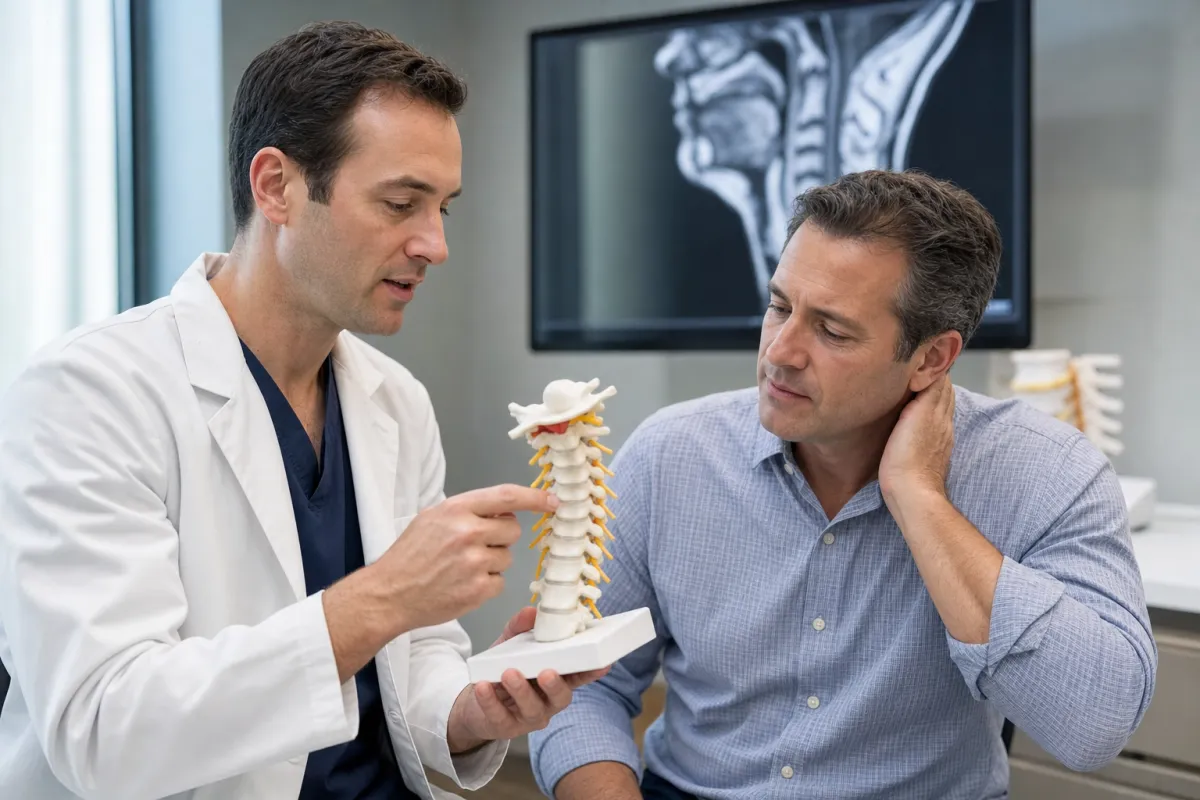
What Is ACDF? Anterior Cervical Discectomy and Fusion Explained
ACDF, in plain terms: ACDF stands for Anterior Cervical Discectomy and Fusion. It is a neck surgery that removes a worn or herniated disc through a small incision at the front of the neck, then joins the two vertebrae above and below so they heal into one solid bone. It relieves pressure on pinched nerves or the spinal cord in the neck.
If a doctor, an imaging report, or a surgical consent form has used the term ACDF, the acronym alone can feel intimidating. It is actually a plain description of exactly what the operation does. ACDF stands for Anterior Cervical Discectomy and Fusion, one of the most common and most studied neck surgeries performed today. This guide breaks down what each part of the name means, how the surgery works step by step, the conditions it treats, how it compares to a cervical disc replacement, what recovery looks like, and the success and fusion rates you can reasonably expect.
- ACDF stands for Anterior Cervical Discectomy and Fusion: a front-of-the-neck approach to remove a disc and fuse the segment.
- It is done to take pressure off a pinched nerve (radiculopathy) or the spinal cord (myelopathy) in the neck, usually from a herniated or degenerated disc.
- The surgeon removes the disc and any bone spurs, places a spacer or cage with bone graft, and secures it with a small plate and screws so the vertebrae fuse.
- Single-level ACDF fuses successfully in about 94 to 97 percent of cases, one of the highest union rates in spine surgery.
- Most single-level patients go home the same day or after one night, return to light activity in two to six weeks, and reach full fusion over six to twelve months.

What's in This Guide
What Does ACDF Stand For?
Each letter describes one piece of the operation, and reading them in order tells you almost everything about what happens:
- Anterior means the surgeon reaches the spine from the front of the neck, not the back. This matters because the front approach slips between the muscles and windpipe rather than cutting through the thick muscles at the back of the neck, which tends to mean less pain and a smoother recovery.
- Cervical refers to the cervical spine, the seven vertebrae (C1 through C7) that make up the neck. ACDF is specifically a neck procedure, distinct from fusions done in the lower back.
- Discectomy means removal of a disc. The surgeon takes out the cushioning disc that sits between two vertebrae when it has herniated, collapsed, or formed bone spurs that press on nearby nerves.
- Fusion means joining two bones into one. After the disc is removed, the gap is filled and the two vertebrae are encouraged to grow together into a single solid segment, which stabilizes the area and keeps pressure off the nerves for good.
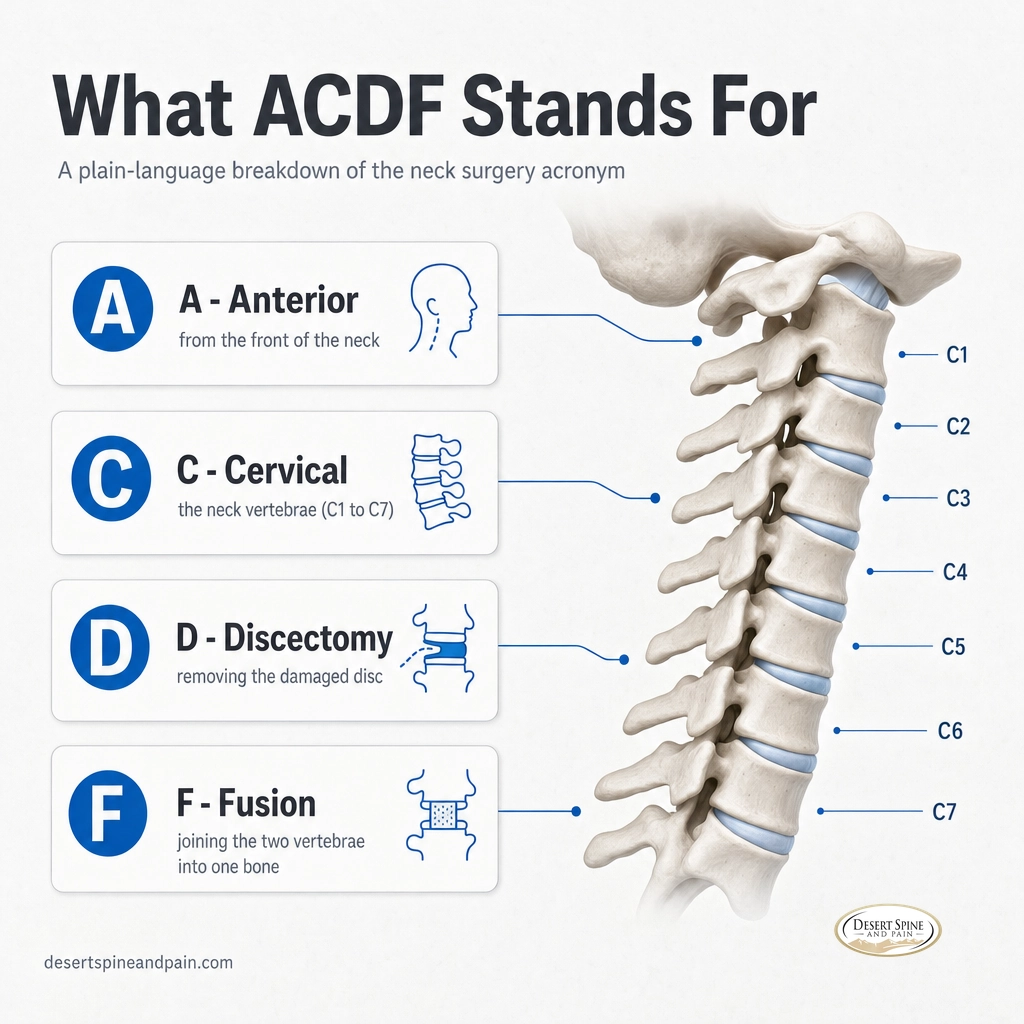
Put together, Anterior Cervical Discectomy and Fusion means: come in from the front of the neck, remove the problem disc, and fuse the two vertebrae so the segment is stable. The name is a description, not a code.
How ACDF Surgery Works, Step by Step
ACDF is performed under general anesthesia at an accredited surgical facility. A helpful way to picture it: the disc is a worn-out shock absorber between two blocks of bone, and the operation swaps that failed cushion for a stable, permanent bridge. The sequence usually looks like this:
- 1. A small front-of-neck incision. The surgeon makes a short incision, often in a natural skin crease, on the front of the neck and gently moves the windpipe, food pipe, and muscles aside rather than cutting through them.
- 2. Removing the disc (the discectomy). The damaged disc is taken out, along with any bone spurs or fragments pressing on the spinal cord or nerve roots. This step is what relieves the pinching.
- 3. Decompressing the nerves. With the disc gone, the surgeon can see and free the compressed nerve or spinal cord, which is the real goal of the operation.
- 4. Placing a spacer or cage. A spacer or cage packed with bone graft is set into the empty disc space to restore the normal height between the vertebrae and act as a scaffold for new bone to grow.
- 5. Securing with a plate and screws. A small titanium plate and screws hold everything steady while the bone heals, so the two vertebrae can fuse into one.
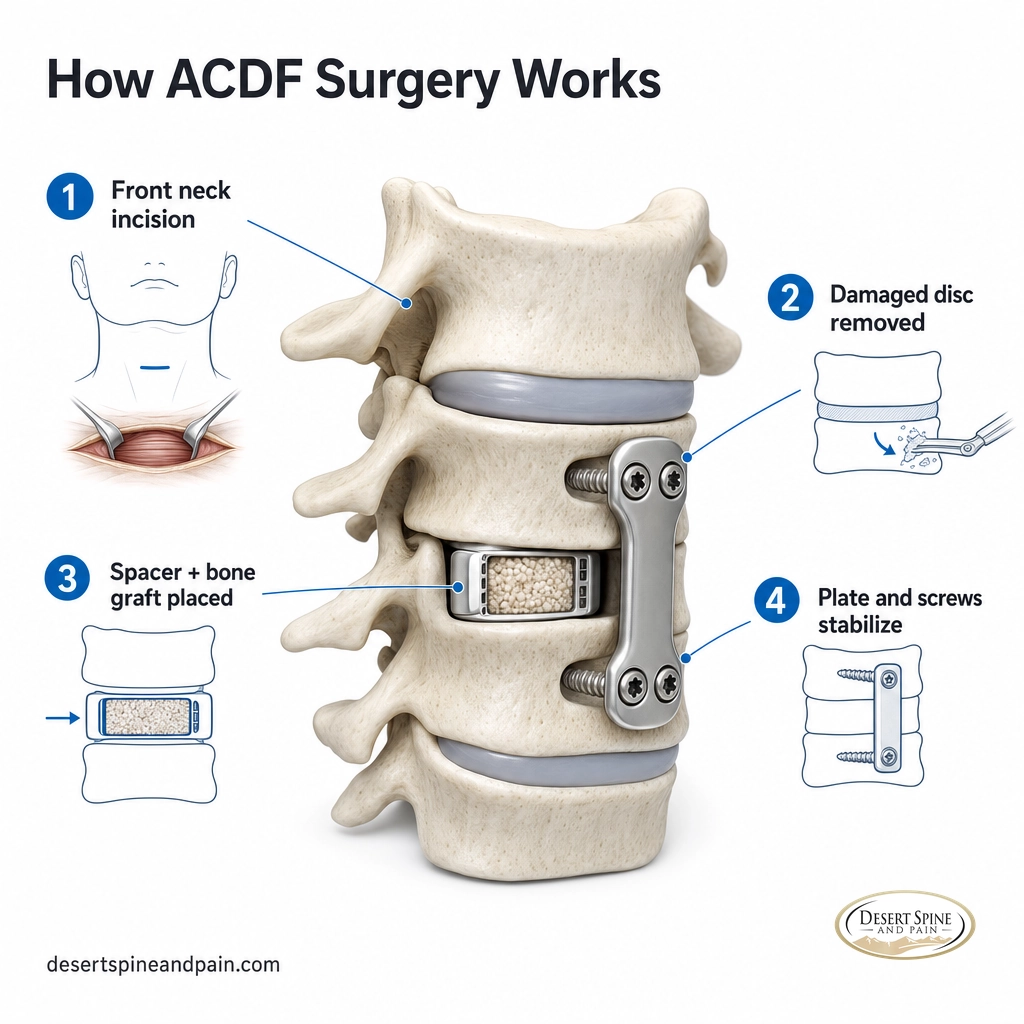
Over the following months, the bone graft and the two vertebrae grow together into a single solid piece. That biological fusion, not the metal plate, is what makes the result permanent. The plate is just a brace that holds the segment still while nature does the welding.
Source: Journal of Spine Surgery: outcomes of anterior cervical discectomy and fusion
ACDF vs. Cervical Disc Replacement
The term most often confused with ACDF is cervical disc replacement, also called cervical artificial disc replacement. Both start the same way, by removing the problem disc through the front of the neck. The difference is what goes in afterward. ACDF fuses the segment so it no longer moves. A cervical disc replacement inserts an artificial disc that preserves motion at that level.
| Feature | ACDF (Fusion) | Cervical Disc Replacement |
|---|---|---|
| What is placed | A spacer or cage with bone graft, plus a plate and screws | A mobile artificial disc implant |
| Motion at that level | Eliminated; the segment becomes one solid bone | Preserved; the implant allows the segment to keep bending |
| Best suited for | Degeneration, instability, bone spurs, or multiple affected levels | Younger patients with a healthy segment and mainly disc-related nerve compression |
| Healing | Relies on a bone fusion forming over months | No fusion needed; the implant is stable once placed |
| Track record | Decades of data and very high fusion success | Newer, with strong results in carefully selected patients |
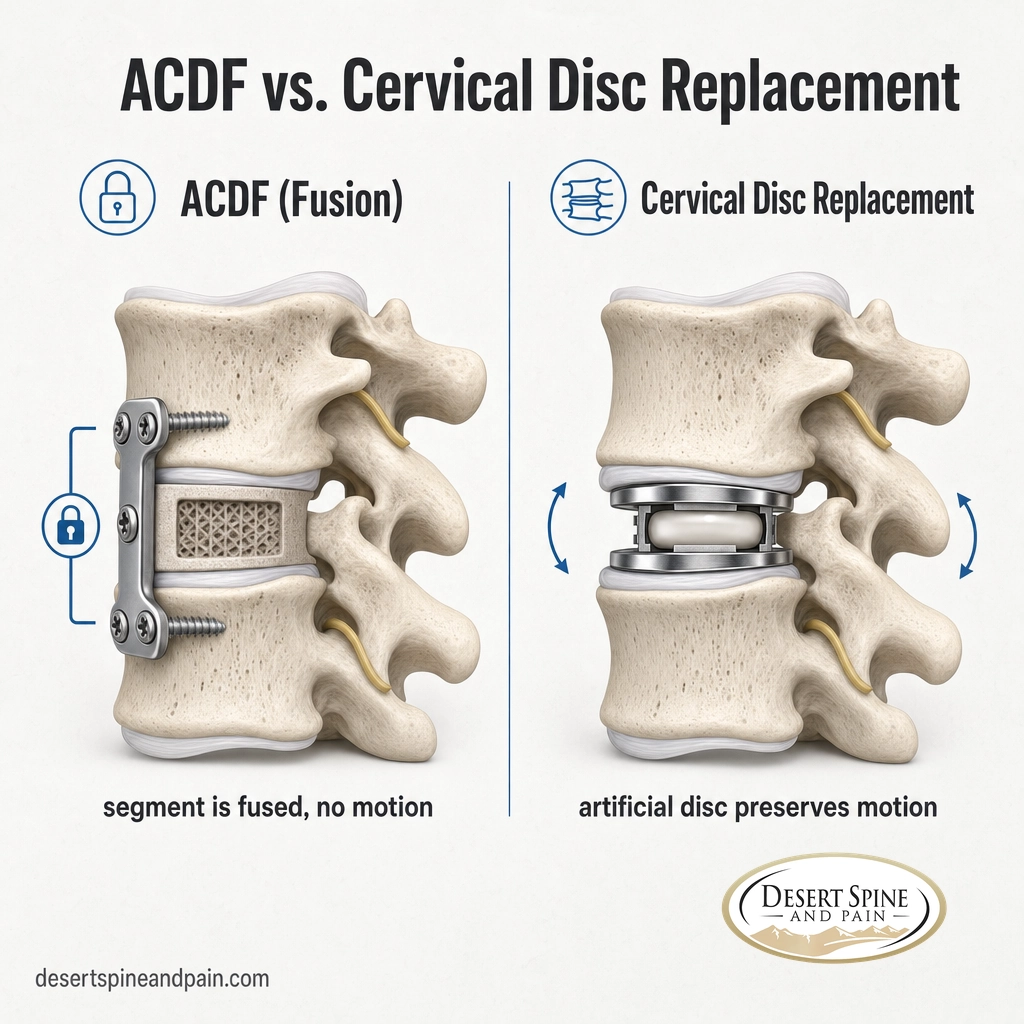
Neither option is universally better. A fusion is the more proven, more versatile choice and is often the only safe option when there is instability, significant bone spurring, or more than one bad level. A disc replacement can be a better fit for a younger patient with an otherwise healthy segment who wants to keep natural motion. The right answer comes from your specific anatomy and diagnosis, which is why this is a conversation to have with a surgeon who performs both. Desert Spine and Pain also offers an anterior cervical discectomy with disc replacement for appropriate candidates.
Myth: "A neck fusion will make my neck stiff and immobile." This is the fear that stops many people from getting care they need. In reality, a single-level ACDF locks only one of the many moving segments in your neck. The rest of the cervical spine keeps moving, and most patients retain close to their normal overall range of motion while losing the pain. A stiff, painful neck before surgery often moves better afterward once the nerve pressure is gone.
Conditions ACDF Treats
ACDF is not a first-line treatment. It is considered when nerve or spinal-cord compression in the neck is causing real symptoms and conservative options have not worked. The common reasons a surgeon recommends it include:
- Herniated cervical disc. When the soft inner core of a disc pushes out and presses on a nerve root or the spinal cord, learn more about a herniated disk from the Mayo Clinic.
- Cervical radiculopathy. A pinched nerve root in the neck that sends pain, numbness, tingling, or weakness down into the shoulder, arm, or hand.
- Cervical myelopathy. Compression of the spinal cord itself, which can cause clumsy hands, balance problems, and trouble with fine movements. This is often the most time-sensitive reason to operate.
- Cervical spondylosis and stenosis. Age-related wear that produces bone spurs and narrows the space around the cord and nerves.
- Degenerative disc disease. A collapsed, worn disc that no longer cushions the segment and generates chronic neck or nerve pain.
The hallmark that often points toward ACDF is arm or hand symptoms, not just neck pain, because those usually mean a specific nerve is being compressed. You can see the full range of neck and spine problems the practice evaluates on the conditions overview, and the non-surgical steps that typically come first under conservative spine care.
Source: Mayo Clinic: Herniated disk | Journal of Spine Surgery: ACDF outcomes
Success and Fusion Rates
ACDF has one of the strongest track records in spine surgery, which is a big part of why it remains so common. Two numbers matter most: the fusion rate (how often the bone actually heals into one) and the clinical success rate (how often symptoms improve).
Clinical success tracks closely with fusion. For a well-selected patient with clear nerve compression, single-level ACDF reliably relieves arm pain and radiculopathy, and that is the result most patients care about most. The main variable is how many levels are being fused. Fusing one level is far more predictable than fusing three or four, because every additional joint is one more place that has to knit together.
Non-union (pseudarthrosis) risk rises with the number of levels fused
Reported pseudarthrosis (failure to fully fuse) by number of levels, from a review cited in the Journal of Spine Surgery (Jiang et al.). Single-level fusion, by contrast, succeeds about 94 to 97 percent of the time.The practical takeaway: single-level ACDF is highly reliable, and multilevel fusions, while still successful for most people, carry a higher chance that one level does not fully heal and may need attention. That is a key reason an experienced surgeon spends time confirming exactly which level or levels are responsible for your symptoms before operating.
Source: Journal of Spine Surgery: multilevel ACDF outcomes | Surgical Neurology International: ACDF complication review
ACDF Recovery Timeline
Recovery from a single-level ACDF is usually more comfortable than people expect, largely because the front approach spares the neck muscles. Everyone heals differently, and multilevel surgery takes longer, but a typical single-level path looks like this:
| Timeframe | What to expect |
|---|---|
| Day of surgery | Many single-level patients go home the same day or after one overnight stay. Some mild sore throat or difficulty swallowing is common at first. |
| Weeks 2 to 6 | A gradual return to light daily activities. Heavy lifting, straining, and strenuous exercise are still off-limits while the fusion starts to form. |
| Months 2 to 3 | Most normal activities resume. Nerve symptoms like arm pain have typically improved well by this point. |
| Months 6 to 12 | The bone fusion solidifies and most patients reach full recovery. This is when surgeons generally consider the healing complete. |
Your surgeon will give you specific activity, driving, and return-to-work guidance based on your job and how many levels were treated. Desk workers often return sooner than those in physically demanding roles.
Risks and Side Effects
ACDF is a safe, routine operation for most patients, but like any surgery it has risks worth understanding honestly:
- Temporary difficulty swallowing or hoarseness. This is the most common side effect, because the food pipe and voice-box nerves sit near the surgical path. It is usually mild and resolves within weeks.
- Non-union (pseudarthrosis). The bone does not fully fuse. Uncommon at a single level, more likely with multiple levels, and sometimes needs a follow-up procedure.
- Infection or bleeding. Low risk with modern technique, but possible with any surgery.
- Nerve or spinal-cord injury. Rare, and the whole point of careful decompression and intraoperative monitoring is to avoid it.
- Adjacent-segment stress. Over the long term, the levels next to a fusion carry a little more load and can wear faster in some patients.
The best way to keep risk low is candidate selection and surgical experience. Fusing the correct level, confirming the diagnosis, and matching the operation to the patient are what separate a good outcome from a repeat surgery. That is also why a second opinion before any neck surgery is never wasted.
Source: Surgical Neurology International: ACDF complication review
How to Get Started
If ACDF has been mentioned for your neck, the most valuable next step is a focused evaluation that connects your imaging to your actual symptoms and confirms whether surgery is truly the right move, and if so, at exactly which level. A thorough consult reviews your history, your exam, and your scans together, and it is the right moment to ask about motion-preserving alternatives and to get a second opinion before committing to an operation.
Desert Spine and Pain is a Phoenix, Arizona practice led by Dr. David L. Greenwald, MD, FACS, a board-certified surgeon who is both a spine surgeon and a neurosurgeon. Care always starts with the least invasive effective option and moves toward a procedure like ACDF only when it is genuinely the best path. Out-of-network patients are welcome, and no referral is required.
Learn more about ACDF surgery at Desert Spine and Pain
Explore non-surgical spine care options first
Book a consultation or second opinion
Common Questions About ACDF
What does ACDF stand for?
Is ACDF a major surgery?
How long does ACDF recovery take?
What is the success rate of ACDF?
What is the difference between ACDF and cervical disc replacement?
Related Spine Terms
- Discectomy: removal of a damaged disc; the "D" in ACDF and a procedure in its own right when no fusion is needed.
- Cervical fusion: joining two or more neck vertebrae into one solid bone, which is the "F" in ACDF.
- Radiculopathy: a pinched nerve root causing pain, numbness, or weakness down an arm; a leading reason for ACDF.
- Myelopathy: compression of the spinal cord itself, often the most time-sensitive reason to consider neck surgery.
- Pseudarthrosis: a fusion that fails to fully heal into one bone, more common with multilevel fusions.
- Anterior approach: reaching the spine from the front of the neck, which spares the back muscles.
- Microdiscectomy: a minimally invasive disc removal used mainly in the lower back, different from a neck fusion.
Sources
Sources and Methodology
This guide summarizes established clinical references and peer-reviewed data on anterior cervical discectomy and fusion. Fusion and non-union figures are drawn from published spine-surgery literature and are presented as general reference, not individual predictions. It is educational information, not medical advice. Decisions about diagnosis and treatment should be made with a qualified spine specialist after an in-person evaluation.