

Myelopathy vs. Spinal Stenosis: What's the Difference?
Quick answer: Spinal stenosis is a narrowing of the spaces inside your spine. Myelopathy is a loss of spinal cord function caused by pressure on the cord. One describes a structure on a scan; the other describes how your body is working. Stenosis in the neck or mid-back can cause myelopathy, but the two words are not interchangeable.
If a doctor or an imaging report has used both "spinal stenosis" and "myelopathy" to describe your spine, it is easy to assume they mean the same thing. They don't. Understanding the difference changes what your symptoms mean, how urgent they are, and whether non-surgical care is a reasonable first step or whether the clock is working against you.
- Stenosis is a narrowing; myelopathy is nerve damage. Stenosis is a structural change you can see on an MRI. Myelopathy is a neurological problem, a decline in how the spinal cord functions.
- Stenosis can cause myelopathy, but not always. When narrowing in the neck or mid-back squeezes the spinal cord, myelopathy can follow. Many people have stenosis with no cord compression at all.
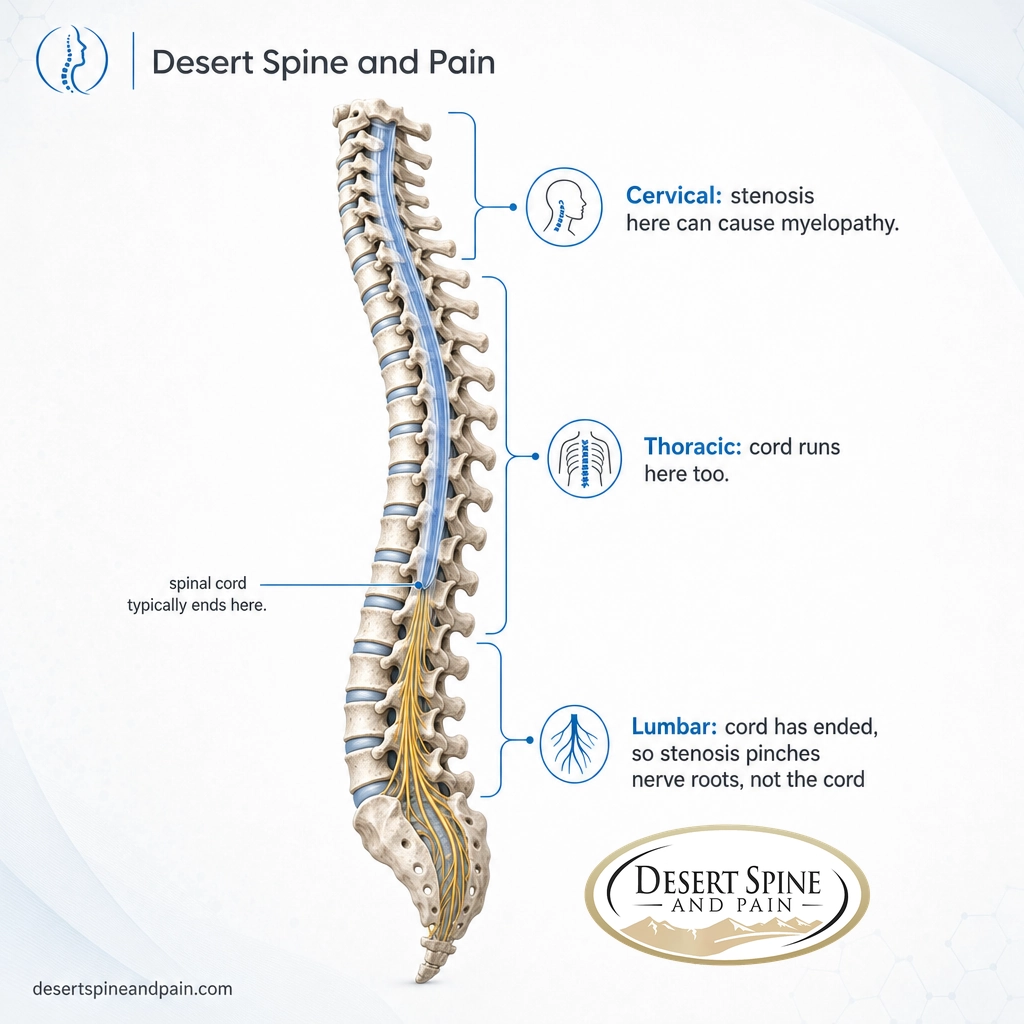
- Location is everything. Lower-back (lumbar) stenosis rarely causes myelopathy because the spinal cord ends above the lumbar spine. There, stenosis pinches nerve roots instead.
- Their symptoms feel different. Stenosis often brings aching, cramping, and pain that eases when you sit or lean forward. Myelopathy brings clumsiness, balance trouble, and loss of fine hand control.
- They are treated differently. Stenosis without cord compression is often managed without surgery. Progressive myelopathy usually needs timely decompression to protect the cord.

What's in This Guide
The Core Difference in One Minute
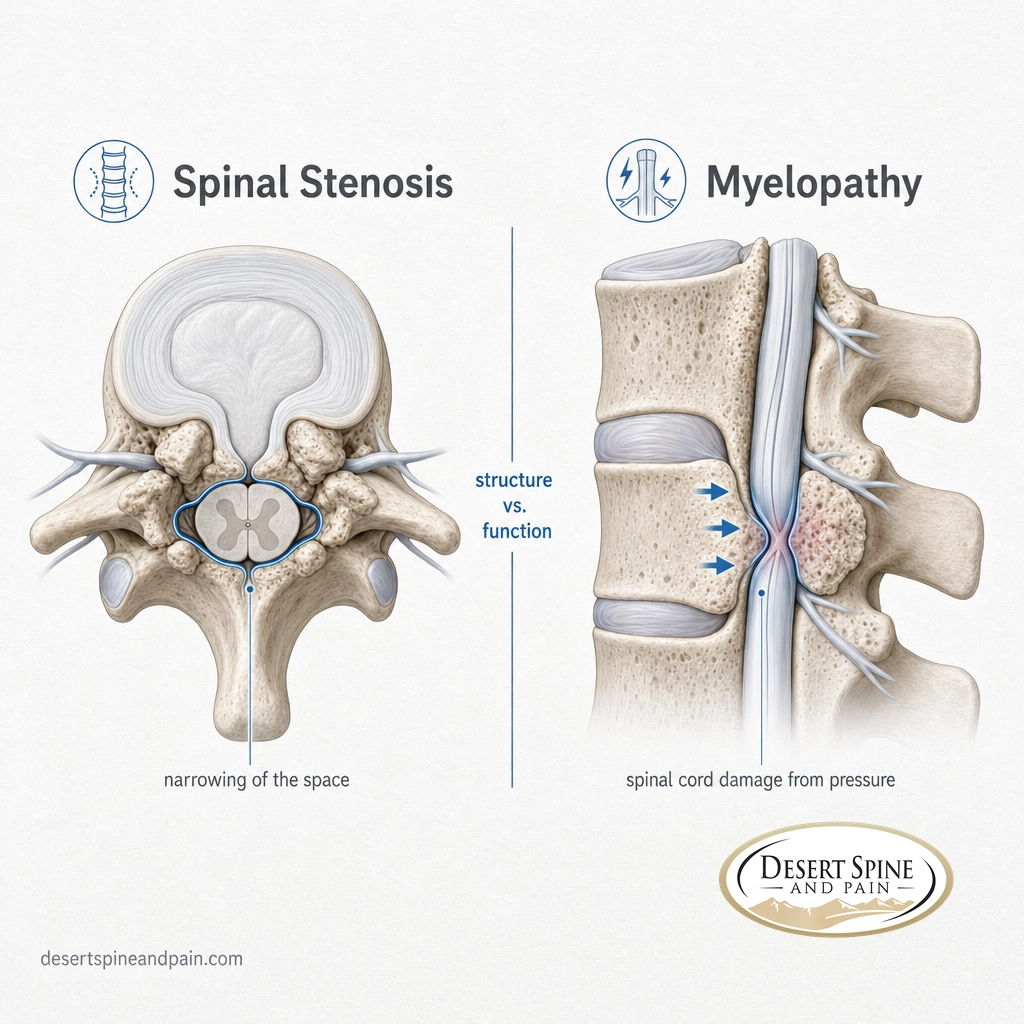
Think of your spine as a protective tunnel for the spinal cord and nerves. Spinal stenosis is what we call it when that tunnel narrows. The narrowing is a structural fact: it shows up on an MRI or CT scan whether or not it is causing you any trouble.
Myelopathy is different. It is not a shape on a scan, it is a decline in function. The term means the spinal cord itself is being injured, usually by pressure, and is no longer sending and receiving signals the way it should. That is why myelopathy shows up as real-world problems: hands that fumble, legs that feel heavy, balance that is suddenly unreliable.
So the relationship is cause and effect. Stenosis is one of the things that can squeeze the cord. Myelopathy is what happens to the cord when the squeeze is bad enough. You can absolutely have the first without ever developing the second.
What Is Spinal Stenosis?
Spinal stenosis is narrowing of the open spaces within the spine, which puts pressure on the spinal cord and the nerves that travel through it. Most often it develops slowly with age as the discs lose height, the facet joints enlarge with arthritis, ligaments thicken, and bone spurs form. It can occur in the neck (cervical stenosis), the mid-back (thoracic stenosis, which is less common), or the lower back (lumbar stenosis, the most common location).
What matters is that stenosis is defined by anatomy, not by symptoms. Scans frequently reveal narrowing in people who feel completely fine, and the amount of narrowing on imaging does not always match how someone feels. When lumbar stenosis does cause symptoms, the classic pattern is neurogenic claudication: aching, cramping, or heaviness in the buttocks and legs that comes on with standing and walking and eases within a few minutes of sitting or leaning forward over a counter or shopping cart. Cervical stenosis, when symptomatic, tends to cause neck pain and arm symptoms, and it carries the added risk of pressing on the cord.
Source: Cleveland Clinic on spinal stenosis | NIAMS (National Institutes of Health)
What Is Myelopathy?
Myelopathy describes injury to the spinal cord that disrupts its function. Because the cord is the main cable carrying signals between the brain and the body, myelopathy produces a distinctive mix of symptoms that often feels different from ordinary back or neck pain, and pain may not even be the main complaint.
Typical signs include loss of fine motor control in the hands (trouble with buttons, zippers, handwriting, or picking up coins), a sense of clumsiness, numbness or tingling in the hands or feet, and problems with balance and walking that can make the gait feel stiff or uncertain. On examination, a clinician may find brisk reflexes and specific signs such as a positive Hoffmann's or Babinski response, which point toward the cord rather than a single pinched nerve. In advanced cases, bladder or bowel control can be affected.
The most frequent form is degenerative cervical myelopathy (also called cervical spondylotic myelopathy), where age-related narrowing in the neck gradually compresses the cord. A key point distinguishes it from simple stenosis: myelopathy tends to be progressive, and once the cord is damaged, recovery is not guaranteed.
Source: Johns Hopkins Medicine on myelopathy | Cleveland Clinic on myelopathy
Side-by-Side Comparison
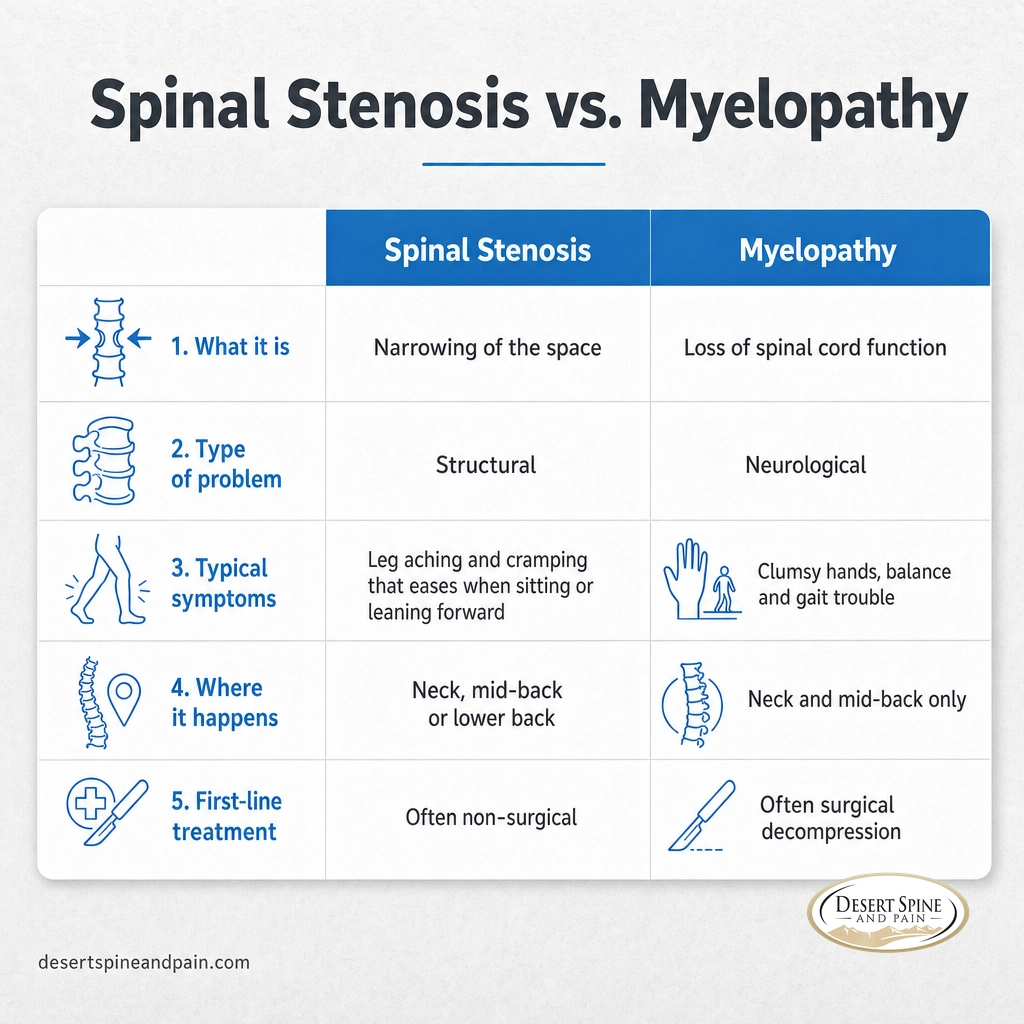
The fastest way to keep the two straight is to put them next to each other. Notice that nearly every row answers a different question: one column is about structure, the other about function.
| Spinal Stenosis | Myelopathy | |
|---|---|---|
| What it is | A narrowing of the spaces inside the spine | A loss of spinal cord function from pressure on the cord |
| Type of problem | Structural / anatomical | Neurological / functional |
| How it's found | Seen on MRI or CT imaging | Diagnosed from symptoms and exam, confirmed by MRI showing cord compression |
| Where it happens | Neck, mid-back, or (most often) lower back | Neck or mid-back, where the spinal cord runs |
| Typical symptoms | Aching or cramping in the legs with walking that eases when sitting or leaning forward; neck or arm pain | Clumsy hands, loss of fine motor control, balance and gait trouble, numbness, brisk reflexes |
| Can exist without the other? | Yes, very commonly without any cord damage | Myelopathy requires cord compression, which stenosis is one cause of |
| Course over time | Variable; can stay stable for years | Often progressive; damage can become permanent |
| First-line treatment | Usually non-surgical care when there is no cord compression | Surgical decompression is frequently recommended for moderate or progressing cases |
How They're Related: When Stenosis Causes Myelopathy
Here is where the two ideas finally connect. Spinal stenosis is one of the leading reasons the spinal cord gets compressed, and compression of the cord is what produces myelopathy. When you hear the full diagnosis "cervical spondylotic myelopathy," it is really saying: age-related narrowing in the neck (the stenosis) has progressed to the point of injuring the cord (the myelopathy).
But this only happens where the cord actually lives. The spinal cord runs through the neck and mid-back and then tapers off in the upper lumbar spine. Below that, the spinal canal carries a fan of nerve roots called the cauda equina, not the cord itself.
That single anatomical fact explains a lot. Severe lumbar stenosis can be miserable and can even become an emergency (cauda equina syndrome), but it does not cause classic myelopathy, because there is no cord at that level to compress. Severe cervical or thoracic stenosis is the setting where myelopathy develops. So when a patient has lower-back stenosis, we are watching for leg pain, weakness, and claudication. When a patient has neck stenosis, we are also watching the hands, the balance, and the reflexes for the earliest hints of cord involvement.
Myth: "It's just stenosis, so I can wait and see." That logic is reasonable for many cases of stenosis without cord compression. It is risky once myelopathy is in the picture. Myelopathy tends to progress, and spinal cord injury does not reliably reverse itself even after pressure is relieved. New clumsiness in the hands, a change in balance, or difficulty walking are not symptoms to monitor for months on your own. They are reasons to be evaluated promptly.
Source: Mayfield Brain & Spine on cervical myelopathy
How Each Is Diagnosed
Both conditions start with a careful history and physical exam, but the exam is doing different work in each case. For suspected stenosis, a clinician is mapping where symptoms occur and what makes them better or worse, then confirming the narrowing on an MRI (the preferred test) or CT. The imaging shows how much space the cord and nerves have.
For suspected myelopathy, the neurological exam carries more weight. A specialist looks for signs that point specifically at the spinal cord: changes in gait and balance, loss of fine hand coordination, abnormal reflexes, and signs such as Hoffmann's or Babinski. MRI then confirms the picture by showing the cord being compressed, and sometimes a bright signal change within the cord that reflects the injury. In other words, stenosis is largely confirmed by imaging, while myelopathy is a clinical diagnosis that imaging supports.
Because scans so often reveal narrowing that is not causing harm, the goal of a good evaluation is to connect the imaging to the person in front of you, not to treat a picture. That is why a thorough consultation matters more than any single report.
Source: Cleveland Clinic on myelopathy | Johns Hopkins Medicine
Treatment: Why the Approach Differs
The treatment philosophy at Desert Spine and Pain is to use the least invasive effective option first. How that plays out depends heavily on whether the spinal cord is involved.
Stenosis without cord compression is often managed conservatively, at least to begin with. That can include physical therapy referral, activity modification, medications, and targeted interventional pain procedures such as epidural steroid injections or nerve blocks to calm inflamed, compressed nerve roots. Many people do well for a long time with this approach, and surgery is considered when symptoms limit daily life despite good non-surgical care.
Explore non-surgical spine care
Myelopathy changes the calculus. Because moderate or progressive cord compression tends to worsen and the damage can become permanent, spine specialists frequently recommend decompression surgery to take pressure off the cord, sometimes paired with fusion or motion-preserving reconstruction to keep the spine stable. The aim is not just to relieve pain; it is to protect cord function and halt the decline. Timing matters, which is the opposite of the wait-and-see mindset that can be appropriate for uncomplicated stenosis.
When surgery is the right call, it can often be done through minimally invasive techniques that spare muscle and speed recovery, depending on the location and severity of the compression.
See surgical decompression options
Myelopathy is fundamentally a problem of the spinal cord, which is why it is reassuring to be evaluated by a surgeon trained in both the spine and the nervous system. Dr. David L. Greenwald is board certified as both a spine surgeon and a neurosurgeon, so cord-level problems are directly in his wheelhouse.
Meet Dr. Greenwald, dual spine & neurosurgeon
Source: Cleveland Clinic on cervical myelopathy | NIAMS (National Institutes of Health)
When to See a Spine Specialist
If you have been told you have stenosis and your symptoms are stable and manageable, there is usually time to pursue conservative care thoughtfully. But a few patterns deserve prompt, specialist attention because they suggest the spinal cord may be involved:
- New clumsiness or weakness in the hands, or trouble with buttons, writing, or small objects
- A noticeable change in balance, coordination, or the way you walk
- Numbness or tingling spreading in the hands or feet
- Symptoms in the arms or legs that are steadily getting worse rather than coming and going
- Any change in bladder or bowel control (this can be an emergency, especially with severe lower-back symptoms)
You do not need a firm diagnosis before reaching out. The value of a specialist is sorting out whether what the scan shows lines up with what your body is doing, and whether you are dealing with stenosis alone or stenosis that has started to affect the cord. Desert Spine and Pain welcomes out-of-network patients and works directly with personal injury attorneys and their clients when an accident is involved.
Book a consultation
Frequently Asked Questions
Is myelopathy the same as spinal stenosis?
Can spinal stenosis turn into myelopathy?
Why doesn't lumbar spinal stenosis cause myelopathy?
What are the warning signs of myelopathy?
Does myelopathy always require surgery?
Related Spine Terms
- Radiculopathy: symptoms from a single compressed nerve root (such as sciatica), as opposed to the cord-level dysfunction of myelopathy.
- Neurogenic claudication: the classic leg pain and heaviness of lumbar stenosis that eases when you sit or lean forward.
- Cervical spondylotic myelopathy: myelopathy caused specifically by age-related narrowing in the neck; the most common form of myelopathy.
- Cauda equina syndrome: a surgical emergency caused by severe compression of the lumbar nerve-root bundle, with bladder or bowel changes and leg weakness.
- Decompression surgery: a procedure such as cervical stenosis surgery that removes the pressure on the cord or nerves. Explore the full range of spine conditions we treat.
Methodology & Sources
This article is a plain-language explainer for patients and is not a substitute for individual medical advice. The distinctions described here reflect established clinical understanding of spinal stenosis and myelopathy from the following sources:
- Cleveland Clinic: Myelopathy
- Cleveland Clinic: Cervical Myelopathy
- Cleveland Clinic: Spinal Stenosis
- Johns Hopkins Medicine: Myelopathy
- Mayfield Brain & Spine: Cervical Myelopathy
- NIAMS (National Institutes of Health): Spinal Stenosis
- Cleveland Clinic: Spinal Cord Anatomy
Desert Spine and Pain is a Phoenix, Arizona spine and pain practice led by Dr. David L. Greenwald, MD, FACS, a board-certified spine surgeon and neurosurgeon. Content is reviewed for medical accuracy and does not guarantee any specific outcome. If you are experiencing progressive weakness, loss of coordination, or changes in bladder or bowel control, seek prompt medical care.