

What Is Sciatica? Symptoms, Causes, and Relief
Sciatica is pain caused by irritation or compression of the sciatic nerve, the largest nerve in the body, and it usually travels from the lower back or buttock down the back of one leg. It is a symptom of an underlying problem, not a diagnosis on its own. The good news: most sciatica improves within a few weeks, and the large majority of cases get better without surgery. Here is what sciatica really is, why one nerve can light up an entire leg, and the proven paths to relief.
- Sciatica is a symptom, not a disease: pain from a compressed or irritated sciatic nerve.
- The sciatic nerve forms from the L4 through S3 nerve roots and is about the width of your thumb.
- An estimated 10% to 40% of people experience sciatica at some point in their lives.
- A herniated lumbar disc pressing on a nerve root is the most common cause.
- Classic signs: burning or shooting pain down one leg, often with numbness, tingling, or weakness.
- Most episodes ease within four to six weeks, and 80% to 90% improve without surgery.
- Loss of bladder or bowel control is a medical emergency, not ordinary sciatica.

What's in This Guide
What Sciatica Is (and Isn't)
Definition: Sciatica is pain that results from irritation or compression of the sciatic nerve or the nerve roots that feed it. It is a symptom of something pressing on the nerve, not a condition in itself, which is why pinning down the cause is the first step toward lasting relief.
The word "sciatica" describes a pattern of pain, not the reason behind it. That distinction matters. Two people can have identical leg pain from two very different causes, and the right treatment depends entirely on which structure is irritating the nerve. Clinicians sometimes separate "true" sciatica, where a nerve root is directly involved, from sciatica-like pain that mimics it, according to the Cleveland Clinic.
The sciatic nerve is the longest and widest nerve in the body. It is formed where the L4 through S3 nerve roots join near the base of the spine, then runs through the pelvis and buttock and down the back of each leg before branching toward the lower leg and foot. Because a single nerve covers that much territory, pressure at one point in the lower back can send pain, numbness, or weakness all the way to the foot.
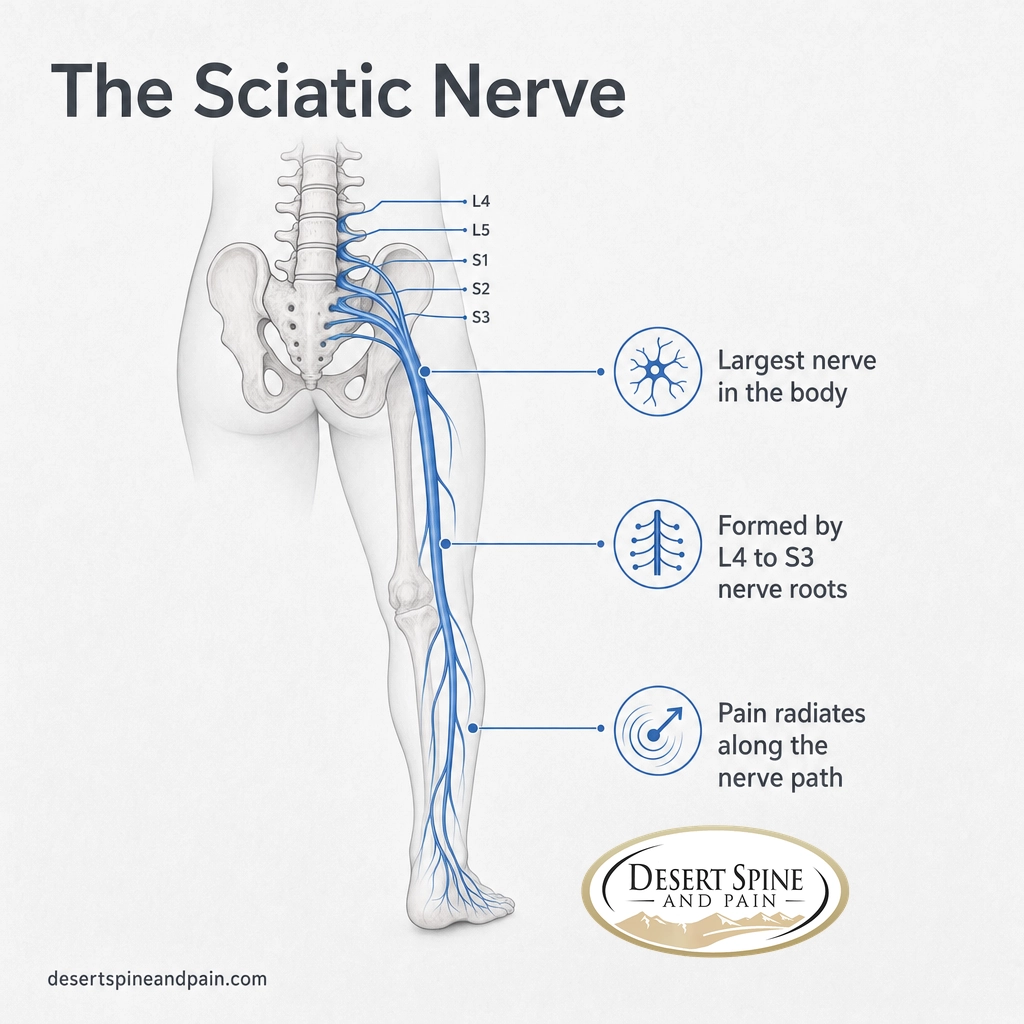
Sciatica is one of the many problems we evaluate among the spine and nerve conditions we treat, where identifying the true source is always the starting point.
Source: Cleveland Clinic (Sciatica) | StatPearls (Sciatica)
How Sciatica Works
If the sciatic nerve is a highway running from your lower back to your foot, sciatica is what happens when something narrows a lane near the on-ramp. The problem usually starts in the spine, but the pain is felt far downstream, in the buttock, thigh, calf, or foot. Here is the basic sequence:
- Something presses on a nerve root. A herniated disc, bone spur, or narrowed canal crowds one of the roots that forms the sciatic nerve.
- Compression triggers inflammation. The pressure, combined with inflammatory chemicals released by an injured disc, irritates the nerve.
- The nerve sends pain down its whole path. Because nerves carry signals along their length, an irritated root refers symptoms down the leg, a pattern clinicians call radicular pain.
This is why sciatica so often feels like a problem in the leg when the real source is the spine. It also explains why stretching the leg alone rarely fixes it: the irritation that needs to settle is usually at the nerve root in the lower back.
Source: StatPearls (Sciatica)
Symptoms: What Sciatica Feels Like
Sciatica has a recognizable signature. The hallmark is pain that radiates from the lower back or buttock down one leg, following the path of the nerve. People describe it in strikingly similar ways:
- Burning, shooting, or electric-shock pain down the back of one leg
- Numbness or tingling ("pins and needles") in the leg, foot, or toes
- Weakness in the leg or foot, or a leg that feels heavy
- Pain that worsens with sitting, coughing, sneezing, or bending
- Symptoms almost always on one side of the body
The intensity ranges from a mild ache to a sharp, debilitating jolt. For a fuller description of the sensations and how they differ from ordinary back pain, see our guide to what sciatica feels like.
Myth: "Sciatica just means a sore lower back."
Not quite. Ordinary low back pain stays in the back. Sciatica is defined by pain that travels down the leg along the nerve, often past the knee. That radiating pattern is the clue that a nerve, not just a muscle, is involved, and it changes how the problem should be evaluated and treated. True nerve-root pain deserves a proper diagnosis rather than guesswork.
Source: Cleveland Clinic (Sciatica)
Sciatica vs. Piriformis Syndrome
The single most common point of confusion is telling true sciatica apart from piriformis syndrome, in which the piriformis muscle deep in the buttock irritates the sciatic nerve after it leaves the spine. The symptoms overlap, but the source, and the fix, differ.
| Feature | True Sciatica (radiculopathy) | Piriformis Syndrome |
|---|---|---|
| Where the problem is | Nerve root in the lower spine | Piriformis muscle in the buttock |
| Most common trigger | Herniated disc or stenosis | Muscle tightness, spasm, or overuse |
| Where pain starts | Lower back, then down the leg | Deep in the buttock, then down the leg |
| Low back pain present | Often | Usually minimal |
| Worse with | Sitting, coughing, bending forward | Sitting, climbing stairs, hip rotation |
Because the treatments diverge, a careful exam matters. We break the distinction down further in piriformis syndrome versus sciatica.
Learn about diagnostic nerve testingWhat Causes Sciatica
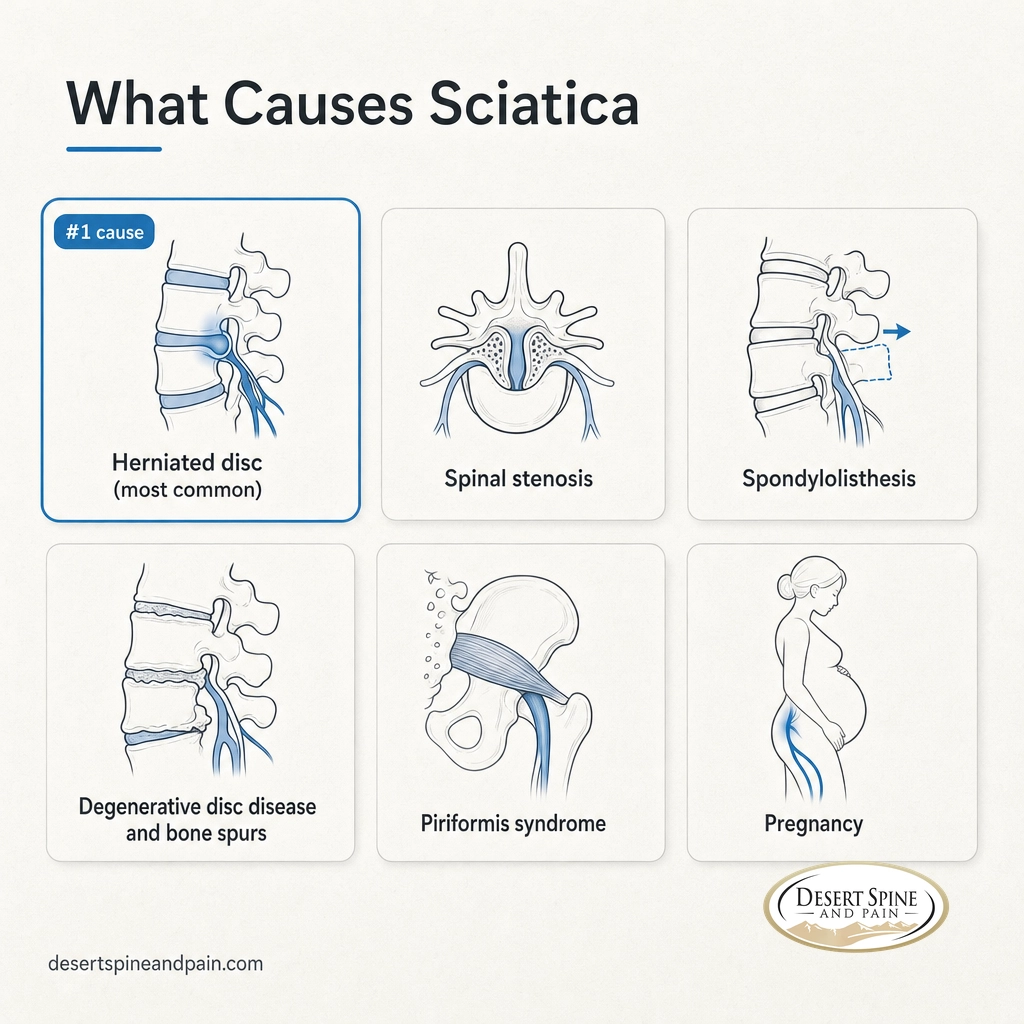
Sciatica is almost always a sign that something is pressing on a nerve root. A herniated lumbar disc is the most common culprit: when the soft center of a disc pushes through its outer wall, it can crowd the adjacent nerve root. But it is far from the only cause.
Common and less-common causes include:
- Herniated or bulging disc (the most frequent cause)
- Spinal stenosis, a narrowing of the spinal canal that squeezes the nerves
- Spondylolisthesis, when one vertebra slips forward over another
- Degenerative disc disease and bone spurs from spinal arthritis
- Piriformis syndrome, muscle irritation of the nerve in the buttock
- Pregnancy, from added weight and shifted posture
- Rarely, a tumor, cyst, or infection near the nerve
Risk factors that raise the odds include age-related disc wear, prolonged sitting, a sedentary lifestyle, obesity, smoking, diabetes, and jobs involving heavy or repetitive lifting and twisting. For a deeper look at each trigger and who is most at risk, read what causes sciatica.
Source: StatPearls (Sciatica) | Cleveland Clinic (Sciatica)
Explore the conditions we treatWhy Sciatica Matters
Sciatica is common, usually self-limited, and highly treatable, but it is also one of the leading reasons people lose work days and seek spine care. Knowing the numbers helps set realistic expectations.
The reported lifetime incidence of sciatica is wide, from roughly 10% to 40%, depending on how it is defined and studied. The reassuring figure is that most episodes settle with conservative care. The cautionary one is that a meaningful minority, about a third, still report bothersome symptoms at one year, which is why persistent sciatica should not just be waited out indefinitely. For the full data picture, see our sciatica statistics.
Source: StatPearls (Sciatica) | BJA Education (sciatica review)
How Long Sciatica Lasts
For most people, sciatica is temporary. It often does not last longer than six weeks, and many cases improve within four to six weeks without any medical treatment as the inflammation settles and, in the case of a herniated disc, the body reabsorbs some of the displaced material.
When symptoms persist beyond 12 weeks, sciatica is considered chronic and becomes less likely to resolve on its own. That is the point at which a focused evaluation and a clear treatment plan matter most. Our guide on how long sciatica lasts covers the acute, subacute, and chronic timelines in detail.
Source: Cleveland Clinic (Sciatica)
How to Find Relief
Treatment for sciatica follows a least-invasive-first principle: start with the simplest measures that work, and escalate only if the pain persists or the cause demands it. Most people never need more than the first step.
1. Conservative care (first line for nearly everyone). Staying gently active rather than on bed rest, applying heat or ice, over-the-counter anti-inflammatory medication, and targeted movement all help most episodes settle. Specific positioning can ease day-to-day flare-ups, as covered in our tips on the best stretches for sciatica, how to sit with sciatica, and how to sleep with sciatica. When appropriate, we also arrange a referral for physical therapy to guide safe, structured rehabilitation.
For a complete at-home plan, see how to treat sciatica.
Explore conservative, non-surgical care
2. Interventional pain procedures (when pain lingers). If conservative care is not enough, image-guided options such as epidural steroid injections can calm nerve-root inflammation and buy time for healing. These target the irritated nerve directly without surgery.
3. Surgery (reserved for the few who need it). Only about 5% to 15% of people with sciatica ultimately require an operation, generally those with severe, persistent, or progressive symptoms, or a clear structural cause like a herniated disc that is not responding. When surgery is the right call, a minimally invasive microdiscectomy can relieve the pressure through a very small incision. These decisions benefit from a surgeon who is both a spine surgeon and a neurosurgeon, so every option, from continued conservative care to precise surgery, is weighed. Meet Dr. Greenwald, spine surgeon and neurosurgeon.
Source: NIHR systematic review (sciatica management) | BJA Education (sciatica review)
Book a consultation: (602) 566-9500When to See a Doctor
Most sciatica can be managed at home at first. But some symptoms signal a problem that needs prompt medical attention, and a few are emergencies.
Seek urgent care right away if you have:
- Loss of bladder or bowel control, or numbness around the groin or inner thighs (saddle area)
- Progressive or severe weakness in a leg or foot
- Sudden, severe sciatica after a fall or accident
- Sciatica with fever, unexplained weight loss, or a history of cancer
These can indicate cauda equina syndrome or another serious cause and are treated as medical emergencies, not ordinary sciatica.
Short of those red flags, it is reasonable to see a specialist if your sciatica is not improving after a few weeks, keeps returning, or is interfering with sleep, work, or daily life. An accurate diagnosis is what connects your symptoms to the real cause and points you to the least-invasive effective treatment.
Source: Cleveland Clinic (Sciatica)
See our interventional pain treatmentsFrequently Asked Questions
What is sciatica?
What does sciatica feel like?
What is the most common cause of sciatica?
How long does sciatica last?
Does sciatica go away on its own or need surgery?
Related Spine and Nerve Terms
- Radiculopathy: the medical term for pinched-nerve-root symptoms; true sciatica is a lumbar radiculopathy. See how it differs from piriformis pain.
- Herniated disc: the most common cause of sciatica, when a disc's center pushes through its outer wall. Learn how discs trigger sciatica.
- Spinal stenosis: narrowing of the spinal canal that can squeeze the nerves and mimic or cause sciatica.
- Piriformis syndrome: buttock-muscle irritation of the sciatic nerve outside the spine.
- Microdiscectomy: a minimally invasive surgery to remove disc material pressing on a nerve, explained on our microdiscectomy page.
- Epidural steroid injection: an image-guided injection that reduces nerve-root inflammation. See how injections are used.
Sources
This article is grounded in Tier 1 medical references: major academic medical centers and peer-reviewed clinical literature. Prevalence figures for sciatica vary by how the condition is defined, so ranges are reported with that context rather than a single number.
Primary sources:
- Cleveland Clinic (Sciatica): definition, sciatic-nerve anatomy, symptoms, typical duration, and warning signs.
- StatPearls (Sciatica), NCBI Bookshelf: nerve-root anatomy (L4–S3), causes, incidence ranges, and clinical course.
- NIHR systematic review (sciatica management): proportion improving with conservative care and surgery rates.
- BJA Education (sciatica review): chronicity, one-year outcomes, and treatment escalation.
This article is for general education and is not individual medical advice. Symptoms described here reflect populations, not any one person. If you have leg pain with weakness, numbness, or loss of bladder or bowel control, seek medical care promptly.