

How Long Does Sciatica Last? Recovery Timeline and What to Expect
Most sciatica does not last long. Many cases improve within four to six weeks, and sciatica often does not last longer than six weeks at all. More stubborn cases can run several weeks to a few months, and when symptoms pass about 12 weeks they are considered chronic. Here is the full recovery timeline, what to expect at each stage and by cause, and the warning signs that mean you should not wait.
- Most sciatica improves in 4 to 6 weeks, and it often does not last longer than six weeks (Cleveland Clinic).
- The outlook is usually very good, and the majority recover without surgery.
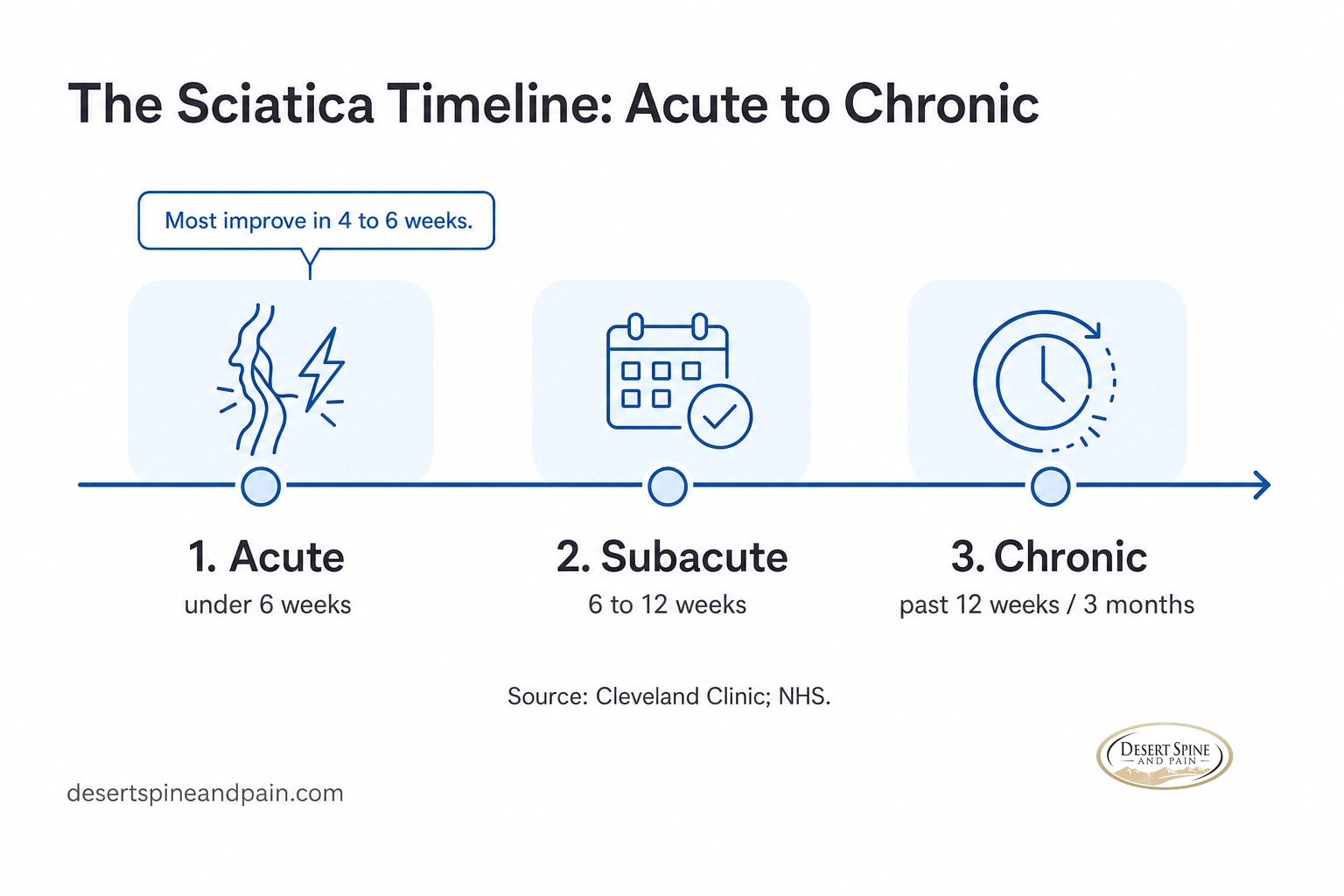
- Symptoms are acute under 6 weeks, subacute at 6 to 12 weeks, and chronic past 12 weeks (3 months).
- Duration depends on the cause: a herniated disc flare settles in weeks; spinal stenosis tends to be chronic.
- In the ATLAS primary-care cohort of 609 patients, 55% had improved at 12 months, so a real minority have longer courses.
- Slower recovery is linked to longer initial pain, higher intensity, and expecting the problem to last.
- Red flags are an emergency: numbness around the genitals or buttocks, or loss of bladder or bowel control.

What's in This Guide
- The Short Answer: Typical Sciatica Timeline
- Acute, Subacute, and Chronic: What the Stages Mean
- How Long Sciatica Lasts by Cause
- What Recovery Looks Like Week by Week
- When Sciatica Won't Go Away
- What Speeds Recovery Up, and What Slows It Down
- When to See a Doctor and Emergency Red Flags
- The Full Timeline in One Table
- Frequently Asked Questions
- Methodology and Sources
The Short Answer: Typical Sciatica Timeline
If you only read one section, read this one. For most people, sciatica is a temporary problem. According to the Cleveland Clinic, many cases improve within four to six weeks without medical treatment, and sciatica often does not last longer than six weeks. The NHS frames it a little more broadly, noting it usually gets better in a few weeks to a few months and can sometimes last longer.
So the honest answer to "how long does sciatica last" is this: expect meaningful improvement within about six weeks, allow up to a few months for a more severe episode, and treat anything past the three-month mark as a signal to get evaluated rather than to keep waiting. The leg pain itself, the burning or electric sensation down the back of the leg, is tracked more closely in our companion guide on how long the nerve pain itself tends to last.
Not sure whether what you are feeling is sciatica at all? Start with our explainer on what sciatica is and the overview of the spine conditions we treat.
Explore the spine conditions we treatSource: Cleveland Clinic, Sciatica | NHS, Sciatica
Acute, Subacute, and Chronic: What the Stages Mean
Clinicians do not describe sciatica only by how it feels. They describe it by how long it has lasted, because duration changes both the outlook and the right next step. The three stages below are the standard clinical framework.
The three stages of sciatica
- Acute (under 6 weeks): The fresh episode. This is where most sciatica lives and where most of it resolves. The priority is calming the nerve irritation and keeping gently active.
- Subacute (6 to 12 weeks): Pain that is taking longer than average to settle. Still very likely to improve, but a good window to add structured care such as physical therapy or an interventional pain procedure.
- Chronic (past 12 weeks, or 3 months): Symptoms that have outlasted the typical healing curve. This is the point to identify the specific cause with imaging and a specialist exam, not to keep waiting it out.
The three-month line matters because it is where the biology and the plan shift. Early on, the goal is simple relief and movement while the body does most of the work. Past the chronic threshold, the question becomes why this particular nerve is still being compressed or irritated, and what will change that. If your symptoms are approaching or past that mark, a focused workup is worth more than another month of guesswork.
See conservative, non-invasive care optionsSource: Cleveland Clinic, Sciatica
How Long Sciatica Lasts by Cause
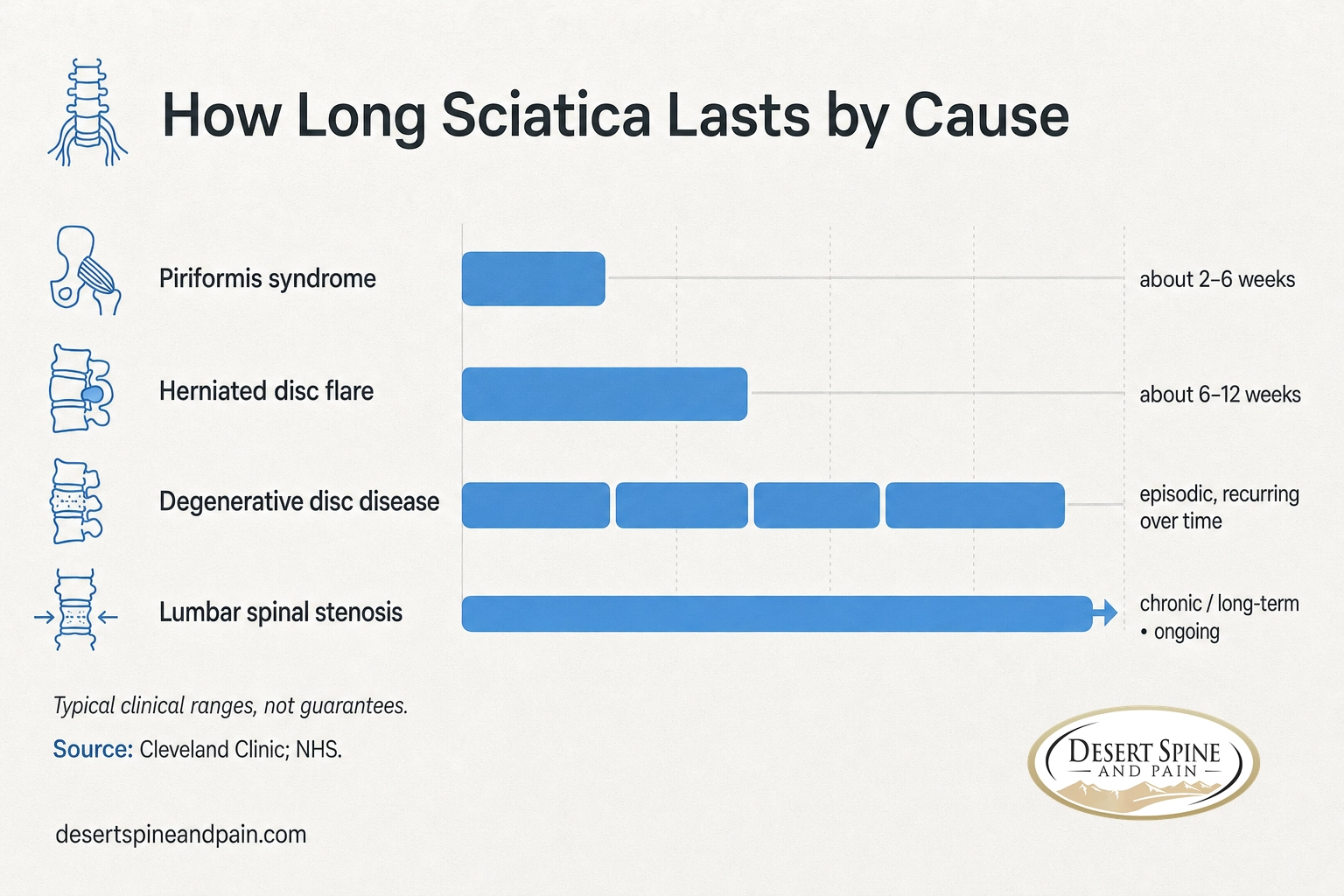
Sciatica is a symptom, not a diagnosis. It is the pain pattern that results when the sciatic nerve or one of its roots is compressed or irritated, and the cause behind it is the single biggest driver of how long it lasts. For the full list of triggers, see our breakdown of what causes sciatica. The typical timelines below are general clinical ranges, not guarantees, since every person and every nerve is different.
| Common cause | Typical course | What tends to shorten it |
|---|---|---|
| Herniated or bulging disc (acute flare) | Often several weeks to a few months; many settle within 6 to 12 weeks | Staying active, nerve-calming care, time for the disc to recede |
| Piriformis syndrome (muscle irritating the nerve) | Often shorter; a few weeks with targeted treatment | Stretching and physical therapy for the hip and glute |
| Lumbar spinal stenosis (narrowing) | Tends to be chronic and recurring rather than self-resolving | Posture and activity strategy, injections, decompression when needed |
| Degenerative disc disease | Often episodic: flares that come and go over time | Core and conditioning, managing flare triggers |
| Spondylolisthesis (slipped vertebra) | Variable; can persist until the instability is addressed | Stabilization, and surgery in select cases |
| Pregnancy-related sciatica | Usually eases after delivery as load and hormones normalize | Support, gentle movement, time post-delivery |
This is why two people with "sciatica" can have completely different timelines. A younger patient with a fresh disc herniation is often weeks from feeling like themselves. A patient whose leg pain comes from piriformis syndrome rather than a spinal nerve may respond quickly to the right stretches. Someone with spinal stenosis is usually managing a longer, more recurrent condition. Pinning down which one you have is the fastest route to a realistic timeline.
Explore interventional pain treatment
Source: Cleveland Clinic, Sciatica | NHS, Sciatica
What Recovery Looks Like Week by Week
Recovery is rarely a straight line. Good days and bad days early on are normal and do not mean the plan is failing. Here is a realistic picture of how a typical episode unfolds.
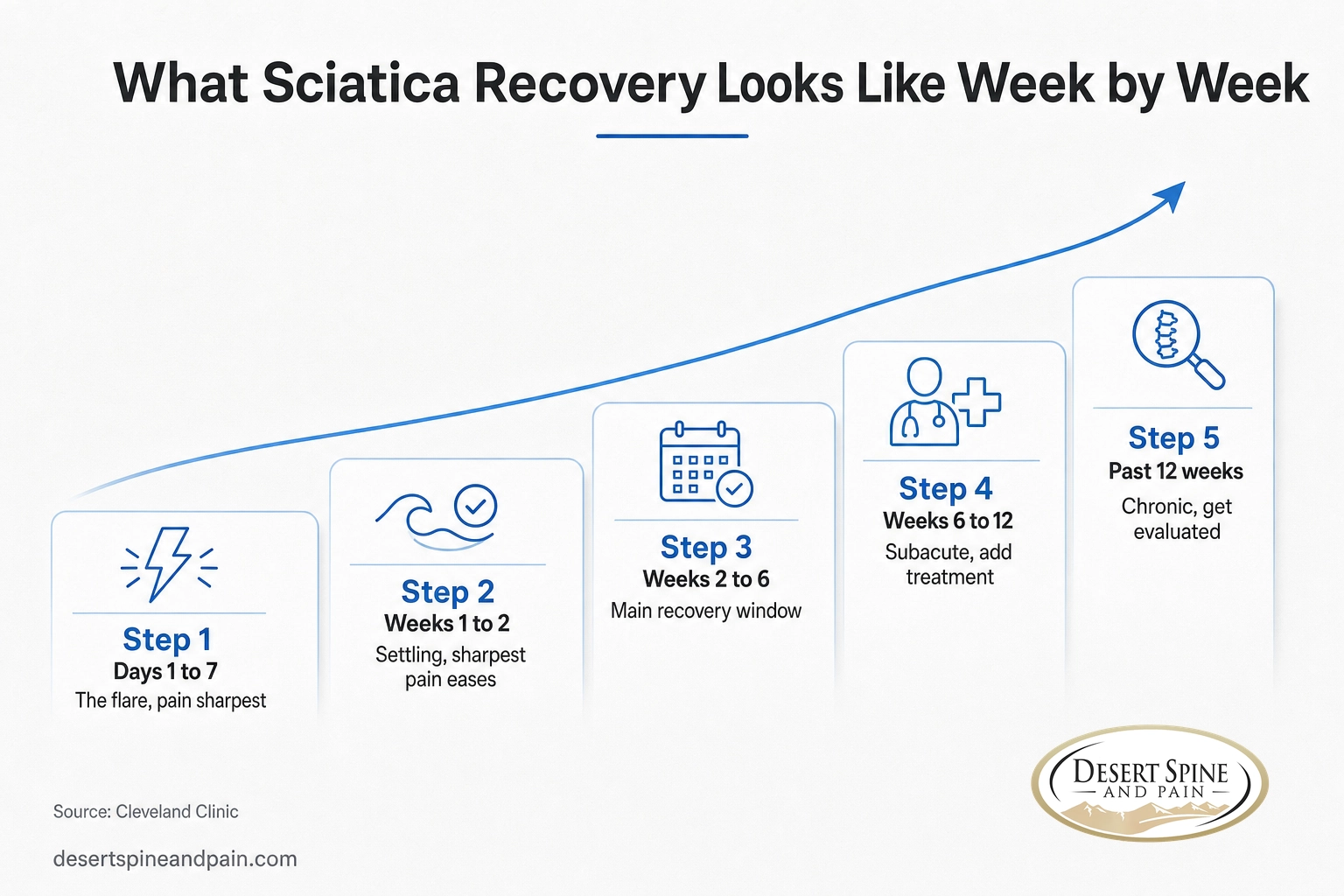
A typical sciatica recovery, stage by stage
- Days 1 to 7, the flare: Pain is often at its sharpest. Short rest is fine, but prolonged bed rest is not. Gentle movement, walking, and position changes usually beat lying still.
- Weeks 1 to 2, settling: The sharpest pain commonly starts to ease. Many people notice the leg pain pulling back up toward the hip or buttock, which is a good sign the nerve is calming.
- Weeks 2 to 6, the main recovery window: This is when most cases meaningfully improve. Activity tolerance rises, and structured movement or physical therapy accelerates it.
- Weeks 6 to 12, the subacute phase: If pain is still limiting you here, it is taking longer than average. This is the right time to add targeted treatment rather than keep waiting.
- Past 12 weeks, chronic: Symptoms that persist this long call for imaging and a specialist exam to identify the exact cause and a plan to resolve it.
Because the sharpest pain usually comes first and then recedes, the early days can feel worse than the trajectory actually is. What matters is the trend over weeks, not the intensity of any single day. If the trend is flat or downward past the six-week mark, that is your cue to get help.
For the practical side of getting through these weeks, see our guides on how to treat sciatica and the best stretches for sciatica.
Source: Cleveland Clinic, Sciatica

When Sciatica Won't Go Away
Most sciatica resolves, but not all of it. Understanding the minority case is important, because it is the group that benefits most from not waiting passively. In the ATLAS primary-care cohort, researchers followed 609 adults with sciatica and back-related leg pain for a full year.
Published in The Spine Journal, the ATLAS cohort found that 55% of patients had improved at 12 months, defined as at least a 30% reduction in disability. Read the other way, close to 45% still had not met that bar a year in. That does not mean they were destined to be stuck, but it does show that persistent sciatica is common enough to take seriously. The same research identified what predicts a slower course: longer leg-pain duration at the outset, higher pain intensity, and the patient's own belief that the problem would last a long time.
Myth: "Chronic sciatica means permanent pain, and surgery is the only option."
Neither half of that is accurate. Chronic only means the symptoms outlasted the usual healing window, and it is often very treatable once the specific cause is identified. The majority of people, even many with longer courses, recover without surgery through conservative care and interventional pain procedures. Surgery is reserved for the specific situations that genuinely need it, such as a nerve under pressure that is not responding to other care, or a red-flag emergency. Giving up on relief is not supported by the evidence.
If your sciatica has lasted longer than it should have, a focused evaluation can find the cause and build a plan. Dr. David L. Greenwald, MD, FACS, is both a spine surgeon and a neurosurgeon, which means the full range of options, from conservative care to minimally invasive surgery, is assessed by one expert rather than scattered across several. A second opinion costs you a visit and can save you months.
Meet Dr. Greenwald: spine surgeon and neurosurgeonSource: The Spine Journal (2018), ATLAS cohort, Konstantinou et al.
What Speeds Recovery Up, and What Slows It Down
You have more influence over your timeline than it may feel like during a flare. The evidence points to a few consistent levers.
What tends to help
- Staying gently active. Movement and walking generally beat prolonged rest. Motion helps the nerve settle and prevents deconditioning.
- Targeted physical therapy. Structured stretching and strengthening, matched to your cause, is one of the most reliable accelerators.
- Addressing the specific cause. An accurate diagnosis lets treatment target the real problem instead of only the symptom.
- Interventional pain care when needed. An epidural steroid injection can quiet nerve inflammation enough to let rehab work.
What tends to slow things down
- Extended bed rest. More than a day or two of lying flat usually backfires.
- Waiting past the subacute window. Letting symptoms run well past six to 12 weeks without a plan lets them entrench.
- Fear of movement. Avoiding all activity out of fear of re-injury is linked to slower recovery in cohort studies.
- Ignoring an underlying structural cause. Stenosis or an unstable segment will not resolve on its own the way a muscle strain does.
There is a sequence to good care, and it runs least invasive first. Conservative and non-surgical options are tried before anything more involved, and surgery is kept for the cases that truly call for it. That is not caution for its own sake. It matches the natural history of the condition, in which most people recover without an operation.
See the full range of treatment optionsSource: Cleveland Clinic, Sciatica | The Spine Journal (2018), ATLAS cohort
When to See a Doctor and Emergency Red Flags
Most sciatica does not need urgent care. But a small number of symptoms are different, and they are the reason this section exists. Knowing them removes the guesswork.
Book a routine visit with a provider if your sciatica fits any of the following, based on NHS guidance: the pain has not improved after a few weeks of home treatment, it is getting worse rather than better, or it is stopping you from doing your normal activities. There is no prize for toughing out a problem that a focused evaluation could solve.
Emergency signs: get help immediately
Seek emergency care right away if you develop any of these, which the NHS flags as requiring immediate hospital attention:
- Numbness around or under your genitals, or around your bottom (the anus)
- Trouble starting to urinate, an inability to urinate, or loss of control over when you urinate
- Loss of control over your bowels, or not noticing when you need to go
- Severe or worsening weakness or numbness in both legs, or sciatica on both sides at once
These can be signs of cauda equina syndrome, a rare but serious compression of the nerves at the base of the spine. It is a surgical emergency, and fast treatment protects long-term bladder, bowel, and leg function. Do not wait to see if it passes.
Short of an emergency, the practical rule is simple. If you are past the six-week mark and not clearly improving, or you are worried, that is a good enough reason to get checked. Early answers prevent long problems.
Book a consultation: (602) 566-9500Source: NHS, Sciatica
The Full Timeline in One Table
| Timeframe | Stage / what it's called | What's usually happening | What to do |
|---|---|---|---|
| Days 1 to 7 | Acute flare | Pain often at its sharpest | Gentle movement, short rest only, avoid bed rest |
| Weeks 1 to 2 | Acute | Sharpest pain commonly starts to ease | Keep active, basic pain relief |
| Weeks 2 to 6 | Acute | Main recovery window; most cases improve | Add structured movement or physical therapy |
| Around 6 weeks | Acute / subacute line | Point sciatica often does not last beyond | If not improving, see a provider |
| Weeks 6 to 12 | Subacute | Taking longer than average, still likely to improve | Targeted treatment; consider injections |
| Past 12 weeks (3 months) | Chronic | Outlasted the usual healing curve | Imaging and specialist exam to find the cause |
| At 12 months | Long-term (cohort data) | 55% improved, roughly 45% not yet (ATLAS) | Active plan, not watchful waiting |
| Herniated disc flare | By cause | Often settles within 6 to 12 weeks | Stay active, nerve-calming care |
| Piriformis syndrome | By cause | Often a few weeks with treatment | Hip and glute stretching, physical therapy |
| Lumbar spinal stenosis | By cause | Tends to be chronic and recurring | Activity strategy, injections, decompression if needed |
| Degenerative disc disease | By cause | Episodic flares over time | Core conditioning, manage triggers |
| Spondylolisthesis | By cause | Variable; may persist until instability is treated | Stabilization, surgery in select cases |
| Pregnancy-related | By cause | Usually eases after delivery | Support, gentle movement, time |
| Any time | Red flags | Bladder/bowel changes, saddle numbness, both-leg weakness | Emergency care immediately |
Frequently Asked Questions
How long does sciatica usually last?
Does sciatica go away on its own?
When is sciatica considered chronic?
Why is my sciatica lasting so long?
When should I see a doctor for sciatica?
Methodology and Sources
The duration figures and definitions in this article are drawn from major clinical authorities and a peer-reviewed cohort study. Typical timelines by cause are general clinical ranges, not guarantees, and are presented as such. No blog-to-blog citations are used.
Primary sources:
- Cleveland Clinic, Sciatica: recovery within four to six weeks, the six-week framing, and the general outlook.
- NHS, Sciatica: general duration, when to see a GP, and the emergency red-flag symptoms (cauda equina).
- The Spine Journal (2018), Konstantinou et al., "Prognosis of sciatica and back-related leg pain in primary care: the ATLAS cohort": 609 patients, 55% improved at 12 months, and the predictors of a slower course.
This article is for general educational purposes and is not individual medical advice. Timelines describe typical cases, not any one person. If you have sciatica that is not improving, is worsening, or is accompanied by any red-flag symptom, consult a qualified provider promptly.
Media and press: Journalists and researchers are welcome to cite the figures in this guide with attribution to the original primary source named alongside each one, and a link to this page as the compiled reference. For commentary from a board-certified spine surgeon and neurosurgeon, contact Desert Spine and Pain in Phoenix, Arizona at (602) 566-9500.