
What Causes Sciatica? The Real Causes of Sciatic Nerve Pain
What causes sciatica, in plain terms: Sciatica is not a disease on its own. It is pain that travels along the sciatic nerve when a nerve root in the lower spine is compressed or inflamed. In roughly 90% of cases the trigger is a herniated disc pressing on that nerve root.
If pain is shooting from your lower back down through the buttock and leg, you are probably wondering what is actually causing it. Sciatica is a symptom, not a diagnosis, which means the real question is what is pressing on or irritating the sciatic nerve in the first place. For most people the answer is a herniated disc in the lower spine, but spinal stenosis, bone spurs, a slipped vertebra, and other problems can do the same thing. This guide explains what causes sciatic nerve pain, why the nerve hurts the way it does, the risk factors that make it more likely, and when the cause is serious enough to see a spine specialist.
- Sciatica is a set of symptoms, not a cause. The pain comes from a compressed or irritated nerve root in the lower spine, not from the sciatic nerve spontaneously malfunctioning.
- A herniated disc is the single most common cause, behind about 90% of cases, when the soft disc center pushes out and presses a nearby nerve root.
- Other causes include spinal stenosis, degenerative bone spurs, spondylolisthesis, piriformis syndrome, and less often trauma, tumors, or pregnancy.
- The pain is driven by two things working together: mechanical pressure on the nerve and chemical inflammation around it, which is why relief often depends on calming inflammation, not just removing pressure.
- Most sciatica improves within a few weeks with nonsurgical care, but worsening weakness, numbness, or any loss of bladder or bowel control is a red flag that needs prompt evaluation.

What's in This Guide
- What Sciatica Is, and What "Cause" Really Means
- The Main Causes of Sciatica
- Herniated Disc: The Most Common Cause
- Why the Nerve Actually Hurts: Pressure Plus Inflammation
- Risk Factors That Make Sciatica More Likely
- When It Looks Like Sciatica but Is Something Else
- Symptoms and Red Flags: When to See a Specialist
- How the Cause Is Diagnosed and Treated
- How to Get Started
- Common Questions
- Related Spine Terms
- Sources
What Sciatica Is, and What "Cause" Really Means
The sciatic nerve is the longest and widest nerve in the body. It is formed where several nerve roots exit the lower spine, then runs through the buttock and down the back of each leg. Sciatica, also called lumbar radiculopathy, is the pattern of pain, numbness, tingling, or weakness that appears along that path when one of those nerve roots is compressed or irritated.
That distinction matters for anyone trying to find relief. Because sciatica is a symptom rather than a diagnosis, treating it well means identifying what is pressing on the nerve. The same shooting leg pain can come from a disc, a narrowed spinal canal, or a muscle, and each one is managed differently. For a fuller primer on the condition itself, see our guide on what sciatica is and how it is defined, or how sciatica typically feels.
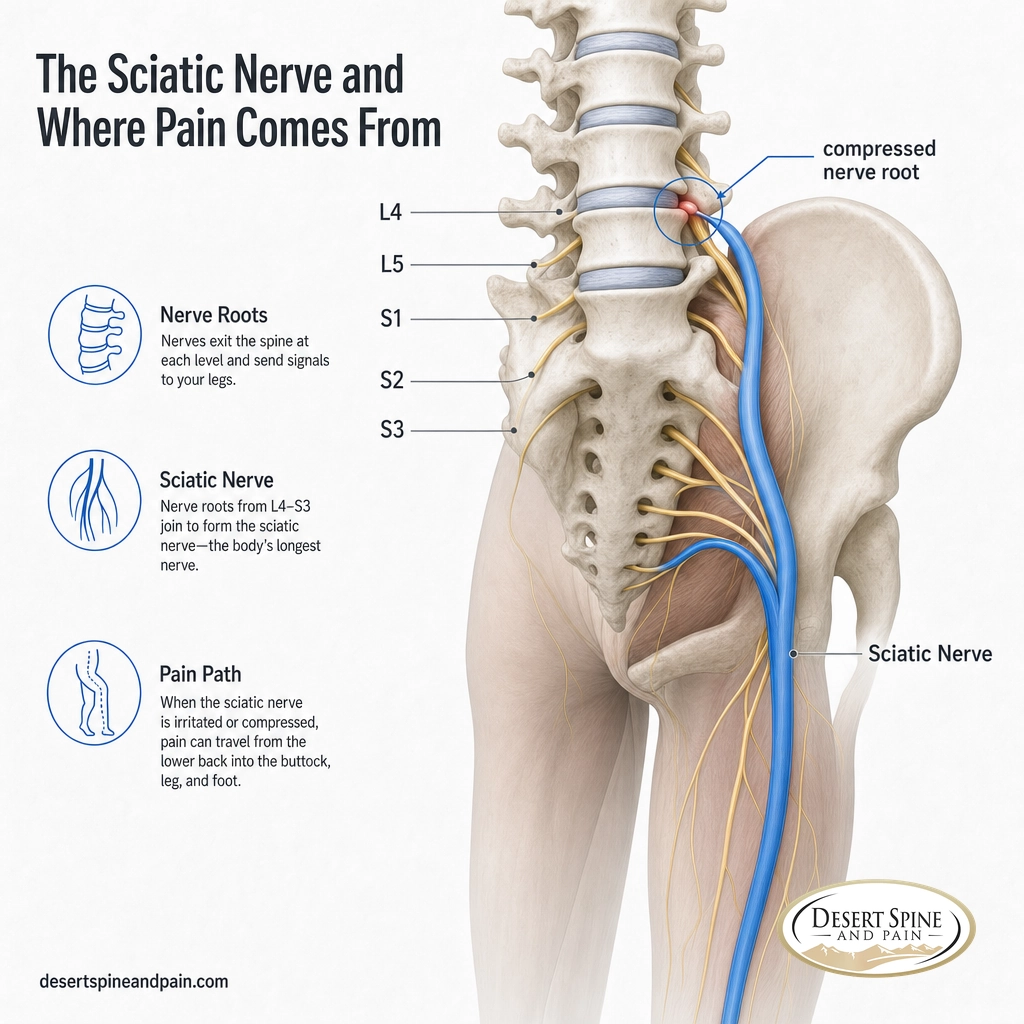
Almost every true cause of sciatica traces back to one of those lumbar nerve roots being squeezed or chemically irritated as it leaves the spine. What differs is the structure doing the squeezing.
Source: National Institute of Neurological Disorders and Stroke: Low Back Pain | American Academy of Orthopaedic Surgeons: Sciatica
The Main Causes of Sciatica
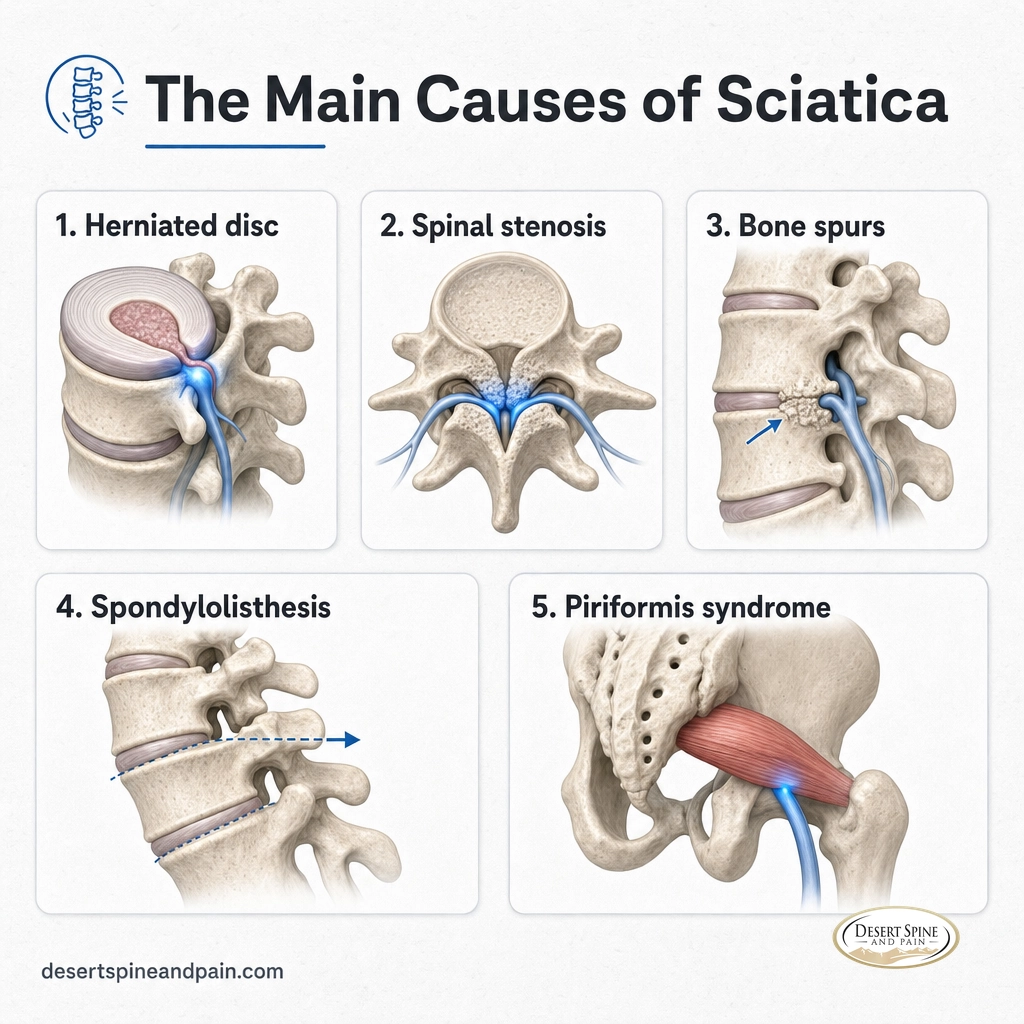
Several different spine problems can pinch a lumbar nerve root. They range from very common to rare, and the table below lays out what each one does and roughly how often it is the culprit.
| Cause | What happens to the nerve | How common |
|---|---|---|
| Herniated (slipped) disc | The soft center of a disc pushes out through its outer wall and presses on a nearby nerve root | The most common cause, behind about 90% of cases |
| Spinal stenosis | The spinal canal or the nerve's exit opening narrows and squeezes the nerve roots | Common, especially in adults over 60 |
| Bone spurs and degenerative changes | Age-related wear and bony overgrowth crowd the space the nerve passes through | Common with aging, often alongside stenosis |
| Spondylolisthesis | One vertebra slips forward over the one below and narrows the nerve's path | Less common |
| Piriformis syndrome | The piriformis muscle deep in the buttock presses on the sciatic nerve itself, outside the spine | Less common and debated |
| Trauma, tumor, or pregnancy | A direct injury, a mass, or pregnancy-related pressure irritates the nerve or its roots | Uncommon; a tumor is a rare cause |
The common thread is clear: the great majority of sciatica starts inside the spine, where a disc or bony change narrows the space a nerve root needs. The chart below shows how dominant the disc cause really is.
What causes sciatica, by share of cases
Share of sciatica cases caused by a herniated disc versus all other causes combined. Source: Ropper & Zafonte, Sciatica, New England Journal of Medicine (2015).Source: Mayo Clinic: Sciatica symptoms and causes | Ropper & Zafonte, Sciatica, New England Journal of Medicine (2015)
Herniated Disc: The Most Common Cause
If you only remember one cause of sciatica, make it this one. A spinal disc has a tough outer ring and a soft, gel-like center. When the outer ring weakens, the center can push out, and if that bulge lands on a nerve root as it exits the spine, the result is sciatica. This is why a herniated disc and sciatica are so often discussed together.
Most disc herniations happen in the lower lumbar spine, at the L4-L5 or L5-S1 levels, which is exactly where the nerve roots that form the sciatic nerve pass. That is why a single herniated disc so reliably produces the classic down-the-leg pain rather than just a localized backache.
The reassuring part is that a herniated disc does not have to mean surgery. Most people improve with nonsurgical care, and a disc herniation frequently shrinks on its own over weeks to months. Surgery enters the conversation mainly when pain is severe and persistent or when there is progressive nerve weakness. If a procedure is ever needed, a minimally invasive microdiscectomy is a common, targeted option.
Source: AAOS OrthoInfo: Sciatica | Ropper & Zafonte, NEJM (2015)

Why the Nerve Actually Hurts: Pressure Plus Inflammation
Here is something many explanations skip, and it is the part that matters most for relief. Mechanical pressure on a nerve root is only half the story. When disc material contacts a nerve root, it also sets off a chemical reaction. Substances from inside the disc inflame and sensitize the nerve, so the nerve becomes painful not only because it is squeezed but because it is chemically irritated.
This two-part mechanism, pressure plus inflammation, explains several things patients find confusing. It is why a fairly small disc bulge can cause intense pain while a larger one sometimes causes little. It is why pain can ease as inflammation settles even before the disc itself changes shape. And it is why anti-inflammatory treatments and targeted epidural steroid injections can calm sciatica by reducing the chemical irritation around the nerve, not just the physical pressure.
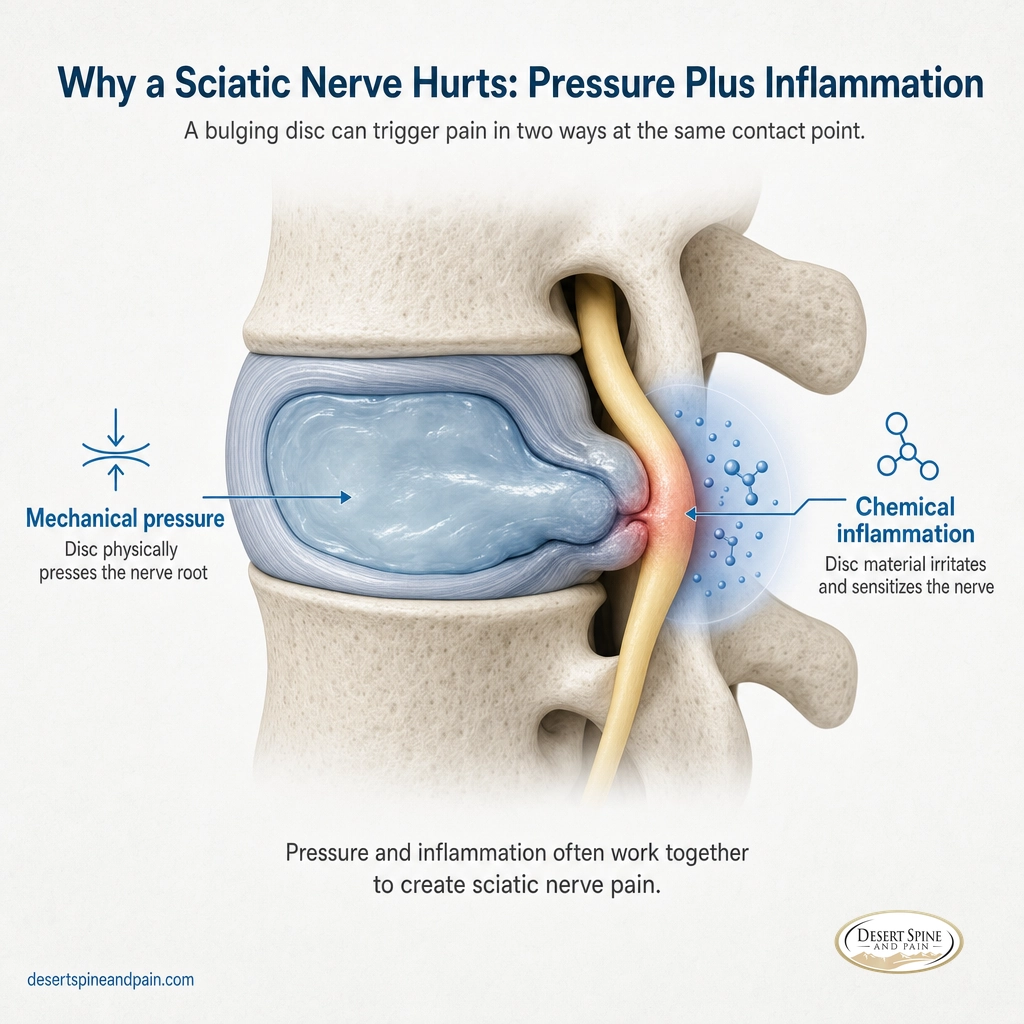
Myth: "Sciatica just means a pinched nerve, so the fix is to un-pinch it." Compression alone does not fully explain sciatic pain. Inflammation around the nerve root is a major driver, which is why calming that inflammation is often what brings relief, and why pain can improve long before any structural change is visible on a scan. Treating sciatica well means addressing both the pressure and the irritation.
Source: Ropper & Zafonte, Sciatica, New England Journal of Medicine (2015)
Risk Factors That Make Sciatica More Likely
The underlying causes above are more likely to develop, or to flare, under certain conditions. None of these guarantees sciatica, but together they raise the odds that a nerve root ends up compressed or irritated.
- Age. Disc herniations and degenerative changes are most common in the working-age years, roughly the 30s through 50s, as discs lose water and flexibility.
- Occupation and activity. Jobs that involve heavy lifting, twisting, or long hours of driving or sitting place repeated load on the lower spine.
- Prolonged sitting and a sedentary lifestyle. Sitting for long stretches and limited physical activity are both linked to a higher risk of sciatica.
- Excess body weight. Extra weight increases the mechanical stress carried by the lumbar spine.
- Diabetes. Diabetes affects how nerves tolerate stress and can increase the risk of nerve damage.
- Smoking. Smoking reduces the already limited blood supply discs depend on, which can speed degeneration.
Because so many adults deal with sciatica eventually, knowing your own risk factors is a practical way to protect your spine, and to recognize early when leg pain is worth getting checked.
Source: Mayo Clinic: Sciatica risk factors | Ropper & Zafonte, NEJM (2015)
When It Looks Like Sciatica but Is Something Else
Not every pain in the back of the leg is true sciatica. A few look-alikes are worth knowing, because the cause, and the treatment, differ.
- Piriformis syndrome. Here the problem is a muscle, not the spine. The piriformis in the buttock compresses the sciatic nerve directly. The leg symptoms can mimic disc-related sciatica, so it is a frequent point of confusion. See our comparison of piriformis syndrome versus sciatica.
- Referred pain from the hip or sacroiliac joint. Problems in the hip joint or the sacroiliac joint can send pain into the buttock and thigh without any nerve-root compression at all.
- Pain that is limited to the buttock. When symptoms stay in the buttock rather than travelling down the leg, the source can be different again, as covered in our guide to what causes sciatica buttock pain.
Sorting a true nerve-root cause from a muscle or joint source is one of the main reasons a proper exam matters. The treatment that helps a compressed disc is not the same as the treatment that helps a tight piriformis muscle.
Source: Cleveland Clinic: Sciatica | AAOS OrthoInfo: Sciatica
Symptoms and Red Flags: When to See a Specialist
Typical sciatica causes a shooting or burning pain that runs from the lower back or buttock down one leg, often with tingling, numbness, or a weak feeling in that leg. It frequently worsens with sitting, bending, or coughing. Most of the time it is uncomfortable but not dangerous, and it eases with time and care. You can read more about how long sciatica usually lasts as it settles.
Seek urgent care for red flags. Rapidly worsening or severe weakness in a leg, numbness around the groin or inner thighs, or any new loss of bladder or bowel control can signal serious nerve compression, including a rare emergency called cauda equina syndrome. These need immediate evaluation, not watchful waiting.
Outside those emergencies, a good rule is to see a spine specialist when sciatica lasts more than a few weeks, keeps returning, or comes with weakness or numbness, so the exact cause can be pinned down and the right treatment started. If you are not sure who to see, our guide on what kind of doctor treats sciatica can help.
Source: Mayo Clinic: Sciatica symptoms and when to see a doctor | NINDS: Low Back Pain
How the Cause Is Diagnosed and Treated
Finding the cause starts with your history and a physical exam that tests reflexes, strength, and which movements reproduce the pain. When imaging is needed, an MRI can show a herniated disc, stenosis, or other structural cause. As with many spine findings, imaging is read alongside your symptoms rather than on its own.
Treatment is matched to the cause, and for most people it begins conservatively, in line with a least-invasive-first approach:
- Activity changes and time. Short-term rest from the movements that aggravate it, then a gradual return to activity while the irritated nerve settles.
- Guided physical therapy. A structured rehabilitation program, coordinated through trusted referral partners, that improves spinal mechanics and support, part of conservative, non-surgical spine care.
- Anti-inflammatory measures. Medication and related steps aimed at calming the inflammation that sensitizes the nerve.
- Targeted injections. When pain persists, an image-guided epidural steroid injection can reduce inflammation around the affected nerve root.
- Surgery, only when warranted. Reserved mainly for a structural cause, such as a herniated disc or stenosis, that is compressing a nerve with symptoms that do not respond to nonsurgical care.
The encouraging reality is that most sciatica improves within a few weeks with nonsurgical treatment, and the majority of people recover without an operation. For practical next steps, see our overview of how to treat sciatica.
Source: AAOS OrthoInfo: Sciatica diagnosis and treatment | Ropper & Zafonte, NEJM (2015)
How to Get Started
If leg pain has lasted more than a couple of weeks, keeps returning, or comes with any weakness or numbness, the most useful next step is a focused evaluation that identifies exactly what is compressing or irritating the nerve. A thorough consult reviews your history, your exam, and any imaging together, and it is the right moment to ask about conservative options and to get a second opinion before any surgery is considered.
Desert Spine and Pain is a Phoenix, Arizona practice led by Dr. David L. Greenwald, MD, FACS, a board-certified surgeon who is both a spine surgeon and a neurosurgeon, and it cares for patients across the Greater Phoenix area and beyond. Care always starts with the least invasive effective option and moves toward a procedure only when it is genuinely the best path.
Learn about sciatica care at Desert Spine and Pain
Explore non-surgical sciatica treatment
Book a consultation or second opinion
Common Questions About What Causes Sciatica
What is the most common cause of sciatica?
Is sciatica caused by a muscle or a nerve?
What makes sciatica pain flare up?
Can sciatica go away on its own?
When should I see a doctor for sciatica?
Related Spine Terms
- Sciatic nerve: the longest nerve in the body, formed from lower lumbar and sacral nerve roots, running from the spine through the buttock and down the leg.
- Radiculopathy: the medical term for symptoms caused by a compressed or irritated nerve root, of which sciatica is the lumbar form.
- Herniated disc: when a disc's soft center pushes out through its outer wall, the leading cause of sciatica.
- Spinal stenosis: narrowing of the spinal canal or nerve openings that can squeeze the nerve roots.
- Spondylolisthesis: a forward slip of one vertebra over another that can narrow the nerve's path.
- Piriformis syndrome: compression of the sciatic nerve by the piriformis muscle in the buttock, a non-spinal cause of sciatica-like pain.
- Discogenic pain: pain arising from a damaged disc itself, including the inflammatory irritation that contributes to sciatica.
Sources
Sources and Methodology
This guide summarizes established clinical references and peer-reviewed data on the causes of sciatica, including nerve-root compression, disc herniation, and the role of inflammation. The figure that a herniated disc causes about 90% of cases, and the lifetime occurrence range of 13% to 40%, are drawn from a New England Journal of Medicine clinical review. It is educational information, not medical advice. Decisions about diagnosis and treatment should be made with a qualified spine specialist after an in-person evaluation.