
How to Sleep With Sciatica: Best Positions for Relief
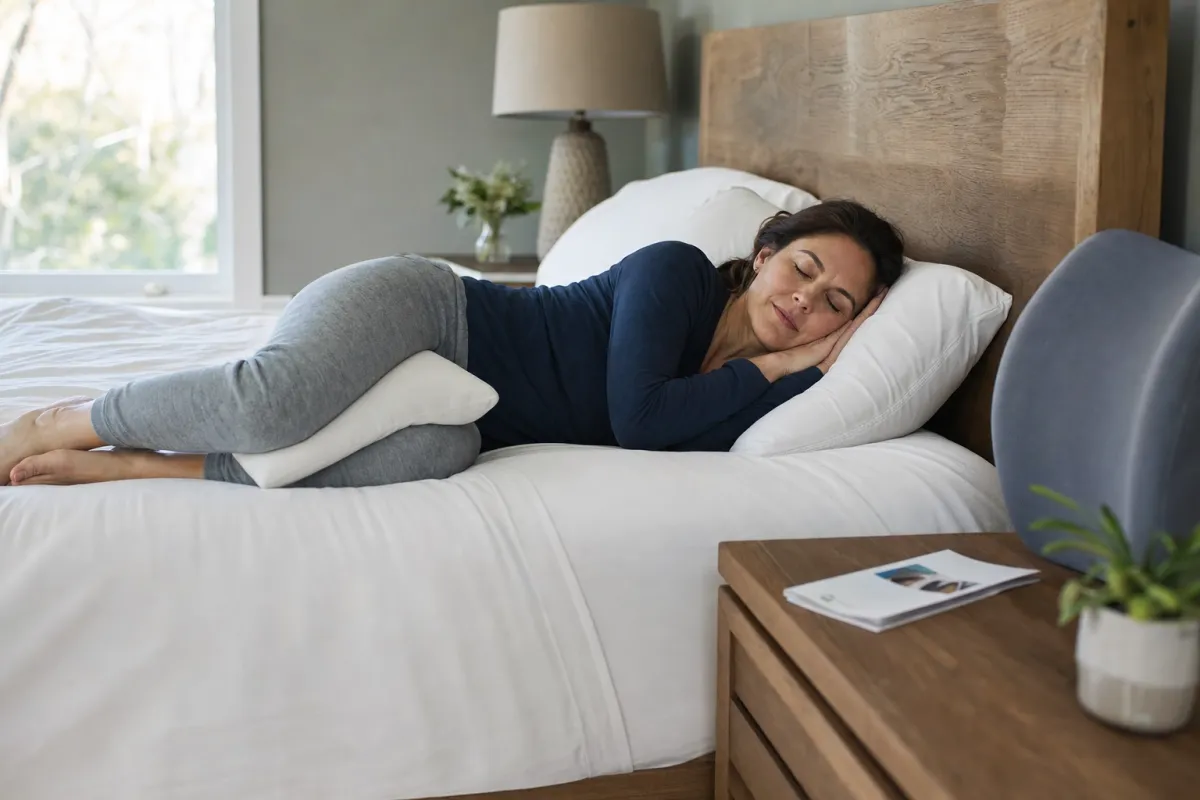
Short answer: The best way to sleep with sciatica is on your side, on the side away from the pain, with a firm pillow between your knees, or flat on your back with a pillow under your knees. Both keep your hips and spine aligned and take pressure off the sciatic nerve. Avoid sleeping on your stomach, use a medium-firm mattress, and try each position for a few nights to find what quiets your leg pain.
Sciatica has a cruel way of saving its worst for bedtime. The shooting pain down your leg that was manageable all day can flare the moment you lie down, and once sleep is broken, the next day's pain feels even harder to handle. You are not imagining it, and you are far from alone: in a systematic review of nearly 2,000 patients with low back pain, close to 6 in 10 reported disturbed sleep. The good news is that how you position your body at night has a real, immediate effect on how much that nerve is irritated. This guide walks through the sleeping positions, pillow setup, and simple wind-down habits that help most people with sciatica rest more comfortably, and it explains the warning signs that mean it is time to see a spine specialist.
- The two best positions are side sleeping on your unaffected side with a pillow between your knees, and back sleeping with a pillow under your knees.
- A gentle fetal position can help when sciatica comes from a herniated disc, because curling slightly opens space around the pinched nerve.
- Stomach sleeping is the position to avoid, as it flattens the lower back's natural curve and can worsen nerve irritation.
- A medium-firm mattress and the right pillow setup matter as much as the position itself.
- Protect sleep with position, but stay gently active by day, prolonged bed rest tends to make sciatica worse.
- Pain that lasts beyond a few weeks, or any leg weakness, groin numbness, or bladder or bowel changes, calls for a specialist, urgently for those red flags.

What's in This Guide
- Why Sciatica Feels Worse at Night
- Before You Begin
- Step 1: Sleep on Your Side With a Pillow Between Your Knees
- Step 2: Or Sleep on Your Back With a Pillow Under Your Knees
- Step 3: Try a Gentle Fetal Position for Disc-Related Sciatica
- Step 4: Dial In Your Mattress and Pillows
- Step 5: Build a Wind-Down Routine That Calms the Nerve
- Positions and Habits to Avoid
- When to Call a Professional
- Troubleshooting Common Problems
- What to Do If Sleep Problems Persist
- How to Get Started
- Common Questions
- Sources
Why Sciatica Feels Worse at Night
Sciatica is pain that travels along the sciatic nerve, the large nerve that runs from the lower back through the hip and buttock and down each leg. It is usually a symptom of an underlying problem, such as a herniated disc, spinal stenosis, or a slipped vertebra pressing on a nerve root. When that nerve is irritated, the result is the classic burning, shooting, or electric pain down one leg, often with numbness or tingling.
At night, a few things make that pain louder. Daytime movement distracts the brain and keeps the discs and joints mobile, and once you lie still, there is nothing to pull your attention away from the ache. Certain positions also raise pressure on the nerve or let the pelvis rotate out of line. Inflammation that built up over a day of sitting or standing can settle in, and the simple fact of staying in one position for hours can stiffen the area. Then there is the loop that makes it all worse: a bad night lowers your pain tolerance the next day, which makes the following night harder still.
The encouraging part is that most of these nighttime factors respond to simple changes. Because position directly affects how much the sciatic nerve is compressed or stretched, the right setup can ease pain within minutes, not weeks. The steps below start with the two positions that help the most people.
Source: Alsaadi et al., Prevalence of sleep disturbance in patients with low back pain, European Spine Journal (2011) | Cleveland Clinic: Sciatica
Before You Begin
What you need and what to expect
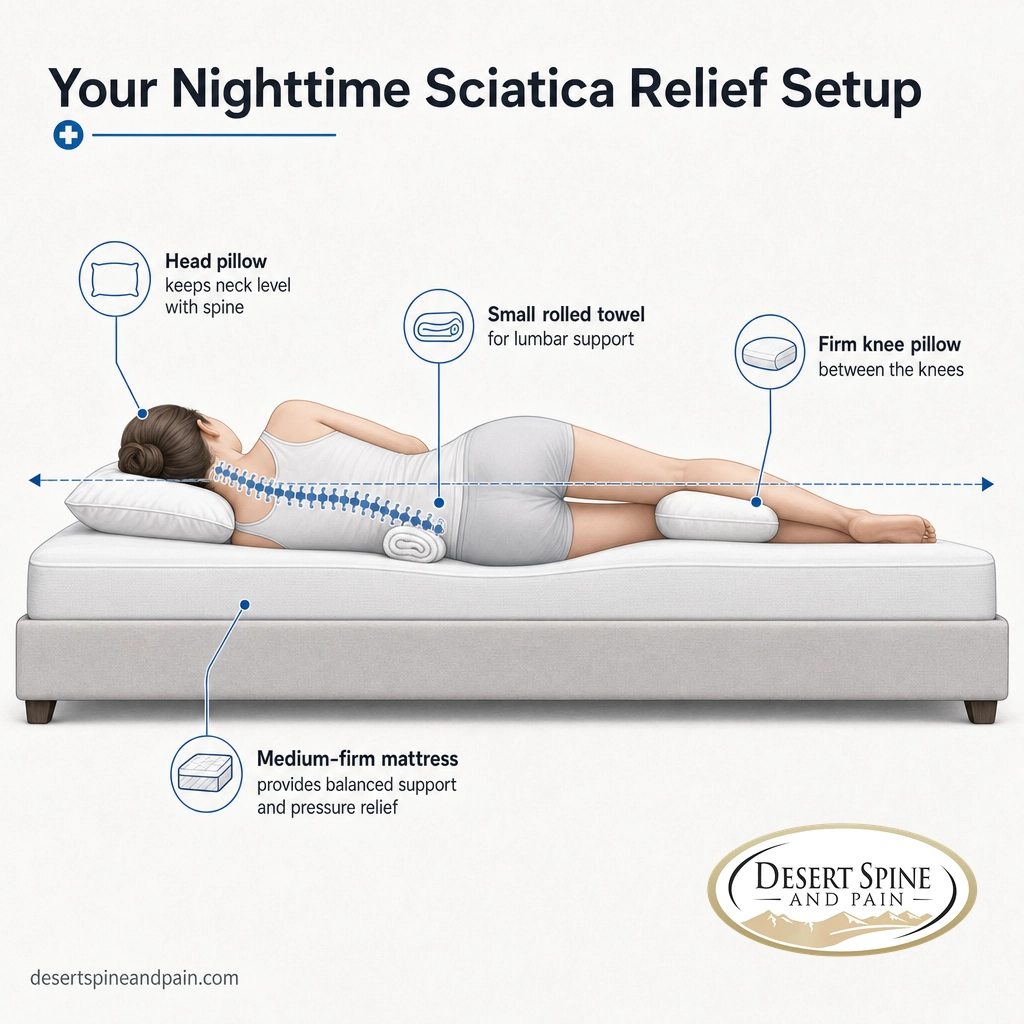
- What you need: a supportive head pillow, one firm pillow for your knees, and a small rolled towel for lumbar support. A medium-firm mattress helps, but you can test the positions tonight on whatever you have.
- Time to set up: about 15 to 20 minutes to arrange pillows and get comfortable the first few nights, then it becomes automatic.
- Skill level: none. These are positional changes anyone can make.
- How to use this guide: there is no single position that works for everyone. Try side sleeping first, then back sleeping, giving each a few nights, and keep the one that most reduces your leg pain.
- One ground rule: these steps ease symptoms, they do not treat the cause. If pain persists, see the "When to Call a Professional" section below.
Source: Sleep Foundation: Sciatic nerve pain relief at night
Step 1: Sleep on Your Side With a Pillow Between Your Knees
For most people with sciatica, this is the most comfortable and spine-friendly position. Lie on your side on the side away from your pain, so if your right leg hurts, lie on your left. Bend your knees slightly toward a relaxed, natural angle, then place a firm pillow between your knees.
Why this step matters: without a pillow between the knees, the upper leg drops forward and pulls your hips and lower spine out of alignment, twisting the very area where the nerve is already irritated. The pillow squares the hips and keeps the spine in a neutral line from your neck to your tailbone.
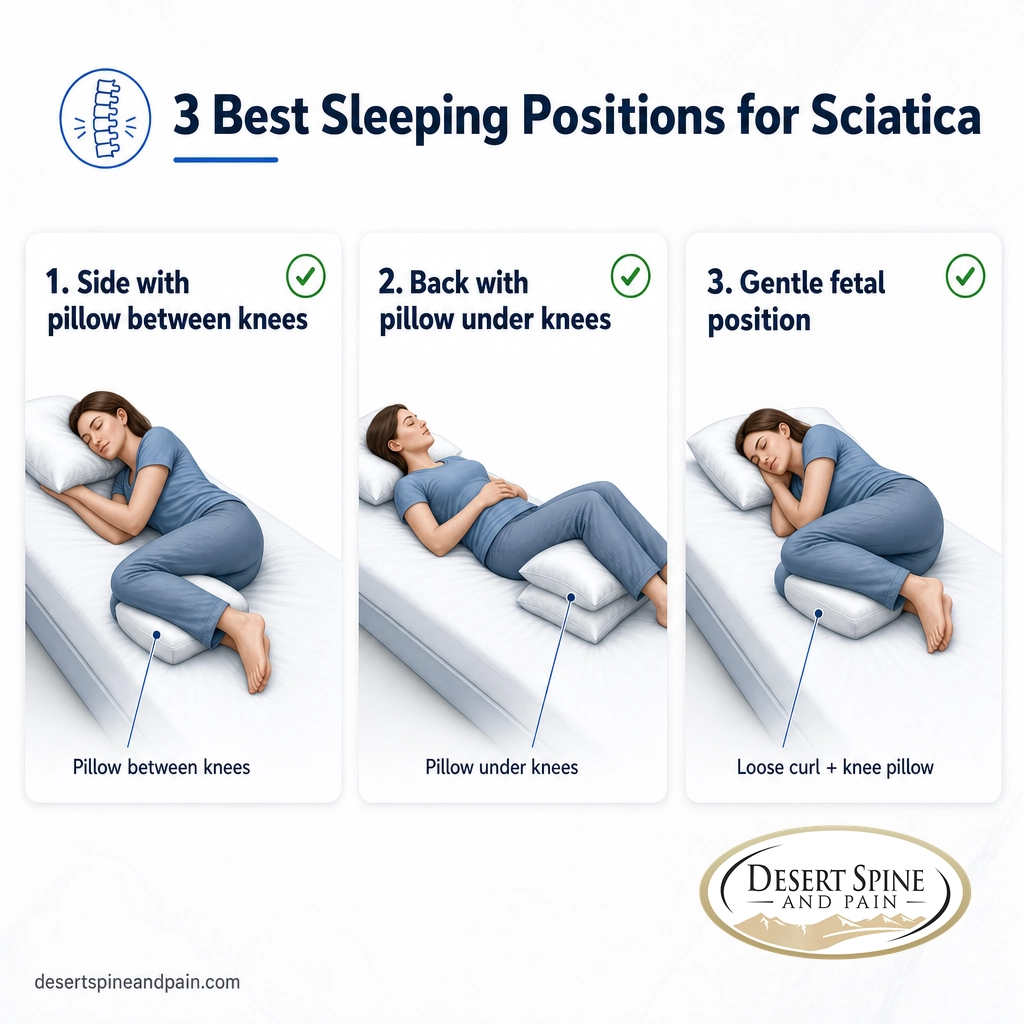
What success looks like: your top leg rests level rather than sagging toward the mattress, your lower back feels supported rather than twisted, and the leg pain eases or at least does not intensify when you settle in.
Fine-tuning tip: if you feel a gap between your waist and the mattress, slide a thin pillow or folded towel into it so your spine stays straight rather than dipping sideways. If the pain is directly in your hip on the down side, a slightly thicker mattress topper can reduce the pressure.
Source: Sleep Foundation: Sciatic nerve pain relief at night | Cleveland Clinic: Sciatica self-care
Step 2: Or Sleep on Your Back With a Pillow Under Your Knees
If you are a natural back sleeper, you do not have to force yourself onto your side. Lie flat on your back and place one or two pillows under your knees so your legs bend gently. The goal is a slight bend, not your knees pulled high.
Why this step matters: lying flat with straight legs tilts the pelvis and flattens the lower back against the mattress, which can tug on the sciatic nerve. Supporting the knees lets the pelvis sit in a neutral position and restores the small natural curve in the lower back, easing tension on the nerve.
What success looks like: your lower back rests comfortably with a slight, supported curve rather than pressing hard and flat into the mattress, and your legs feel relaxed rather than stretched.
Fine-tuning tip: if your lower back still lifts away from the mattress and feels unsupported, tuck a small rolled towel or thin lumbar pillow into that space. Keep your head pillow modest, a pillow that props your head too high pushes your neck and upper spine out of line.
Source: Sleep Foundation: How to sleep with lower back pain
Step 3: Try a Gentle Fetal Position for Disc-Related Sciatica
When sciatica is caused by a herniated disc, a gentle fetal position can bring extra relief. Lie on your side, place a pillow between your knees as in Step 1, then draw your knees a little way toward your chest so your body makes a loose curl.
Why this step matters: curling forward slightly opens the space between the vertebrae at the back of the spine, which can reduce pressure where a disc is pressing on the nerve root. For some people with disc-related sciatica, that small change is the difference between a restless night and a comfortable one.
What success looks like: your leg pain eases as you curl, and the curl feels relaxed. If pulling your knees up tightly makes the pain worse or strains your lower back, ease off, the curl should be gentle, never a hard tuck.
Not everyone benefits. A gentle curl helps many people with disc-related sciatica, but if your sciatica comes from spinal stenosis, bending the other way (slightly extended) sometimes feels better, and a tight fetal curl may not. Let comfort be your guide, and mention what helps and what hurts to your specialist, as it is a useful diagnostic clue.
Source: Sleep Foundation: Sleeping in the fetal position | Cleveland Clinic: Sciatica
Step 4: Dial In Your Mattress and Pillows
The best position in the world cannot fully overcome a sagging mattress or a pile of the wrong pillows. Three pieces of equipment carry most of the weight here.
- Mattress: aim for medium-firm. It supports the spine's natural curve without being so hard that it creates pressure points at the hip and shoulder, or so soft that your body sinks into a misaligned heap.
- Knee or lumbar pillow: a dedicated firm pillow between or under the knees, as in Steps 1 and 2. A purpose-shaped knee pillow holds its position better than a soft bed pillow.
- Head pillow: high enough to keep your head level with your spine, no higher. Side sleepers usually need a thicker pillow than back sleepers.
The mattress point is not just folk wisdom. In a randomized trial of adults with chronic low back pain, those who slept on a medium-firm mattress fared better than those on a firm one.
What success looks like: you wake with less stiffness than before, your mattress holds your spine level rather than letting your hips sink, and your pillows stay put through the night instead of being kicked away by 2 a.m.
Source: Kovacs et al., Effect of firmness of mattress on chronic non-specific low-back pain, The Lancet (2003) | Sleep Foundation: Mattress guidance for sciatica

Step 5: Build a Wind-Down Routine That Calms the Nerve
What you do in the hour before bed shapes how the night goes. A short, consistent routine gives the irritated nerve the best chance to settle.
- Gentle stretching. A few easy moves, such as a knee-to-chest stretch or a gentle piriformis stretch, can loosen the muscles around the nerve. Keep stretches slow and pain-free, never forced.
- Heat to relax, or ice to numb. Many people find 15 to 20 minutes of heat before bed relaxes tight muscles. If your flare is sharp and recent, a cold pack can calm it instead. Use whichever consistently helps you.
- Mind the timing of activity. Avoid heavy exercise or long sitting right before bed. A short, easy walk earlier in the evening is better than being sedentary all day and then lying down stiff.
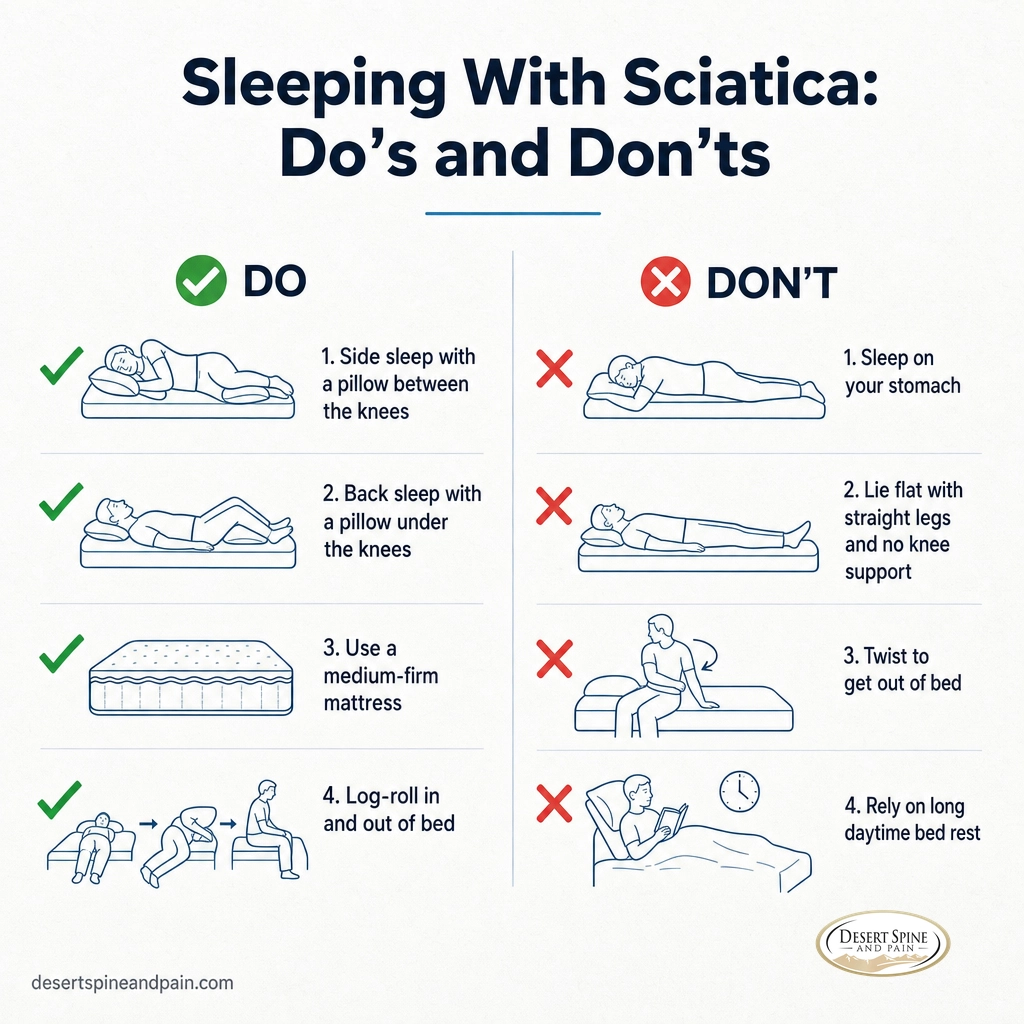
- Get in and out of bed with a log roll. Rather than twisting up from flat, roll onto your side as one unit, drop your lower legs off the edge, and push up with your arms. Reverse it to lie down. This keeps the spine aligned and avoids the twist that often triggers a jolt of sciatic pain.
What success looks like: you fall asleep with less pain, wake fewer times, and can change positions or get up without a sharp spike down your leg.
Source: Sleep Foundation: Sciatic nerve pain relief at night | Cleveland Clinic: Sciatica self-care
Positions and Habits to Avoid
A few habits reliably make sciatica harder to sleep through. Steer clear of these while you heal.
- Stomach sleeping. This is the main one to avoid. Lying face down flattens the natural curve of your lower back and forces the lumbar spine into extension, and it usually means turning your neck to one side for hours.
- Straight-legged back sleeping with no knee support. Flat on your back with legs extended tilts the pelvis and can tug the nerve. Add the knee pillow from Step 2.
- Twisting to get in or out of bed. The sudden rotation is a classic trigger. Use the log roll.
- Long bed rest during the day. It is tempting, but too much rest stiffens the area and tends to prolong sciatica rather than heal it.
Myth: "If a position hurts, a firmer mattress or no mattress will fix it." A rock-hard surface or the floor is not a cure. The evidence points to medium-firm support, not maximum firmness, and sleeping on the floor offers too little cushioning for the hip and shoulder for most people. Match your setup to spinal alignment, not to how hard it is.
Source: Sleep Foundation: How to sleep with lower back pain | Kovacs et al., The Lancet (2003)
When to Call a Professional
Better sleep positions ease symptoms, but they do not treat what is pressing on the nerve. If you have dialed in your positions and setup and your sciatica still wakes you most nights, keeps returning, or is slowly getting worse, that is the point to have the underlying cause evaluated rather than managing it night to night on your own. Studies estimate the lifetime incidence of sciatica at anywhere from 13% to 40%, and while many cases settle within weeks, the ones that linger are exactly the ones worth investigating.
A focused consultation connects your symptoms to imaging and your exam, identifies whether a disc, stenosis, or another cause is behind the pain, and lays out non-surgical care options first, from targeted therapy to an image-guided epidural steroid injection when appropriate. Surgery is considered only when it is genuinely the best path.
Seek urgent care for red flags. Progressive or severe weakness in a leg, numbness around the groin or inner thighs (saddle numbness), or any new loss of bladder or bowel control can signal serious nerve compression (cauda equina syndrome) and should be evaluated immediately, not slept on. These are uncommon, but they are emergencies.
Source: Koes, van Tulder, Peul, Diagnosis and treatment of sciatica, BMJ (2007) | Cleveland Clinic: Sciatica warning signs
Troubleshooting Common Problems
If the positions above are not quite working yet, this table covers the most common snags and how to adjust.
| Problem | Likely cause | What to try |
|---|---|---|
| Pain spikes the moment I lie down flat | Pelvis tilting and tugging the nerve | Add a pillow under the knees (back) or between the knees (side); never lie flat with straight legs |
| I wake with a stiff, aching lower back | Mattress too soft or too firm, or no lumbar support | Move toward medium-firm, add a small rolled towel at the lower back, replace a sagging mattress |
| My knee pillow is gone by morning | A soft bed pillow shifts as you move | Use a firmer, purpose-shaped knee pillow that holds its place |
| A jolt of leg pain every time I get up | Twisting the spine to rise | Use the log roll: turn as one unit, legs off the edge, push up with the arms |
| Nothing helps and pain is worsening | An underlying cause that needs treatment | See a spine specialist for evaluation; go urgently for any red-flag symptoms |
Source: Sleep Foundation: Sciatic nerve pain relief at night
What to Do If Sleep Problems Persist
Once you have found positions that help, keep a few habits going so progress holds. Stick with the same supportive setup every night rather than reverting to old habits once a flare eases. Stay gently active during the day, since movement, not rest, is what keeps sciatica improving. Track which positions and routines help most, and bring that note to any appointment, as it tells a specialist a lot about where the problem sits.
If weeks of good sleep habits and conservative care are not moving the needle, that is a signal the cause needs addressing directly. Ongoing nerve pain is not something to just live around indefinitely, and identifying the source early tends to make treatment easier. You can read more about when back pain is considered chronic and review the broader data on how common and how persistent sciatica is to put your own timeline in context.
Source: Cleveland Clinic: Sciatica outlook and when rest helps
How to Get Started
If sciatica is stealing your sleep and better positions are only taking you so far, the most useful next step is a focused evaluation that pins down what is irritating the nerve and what will actually relieve it. A thorough consult reviews your history, your exam, and your imaging together, and it is the right place to ask about conservative options and to get a second opinion before any surgery is considered.
Desert Spine and Pain is a Phoenix, Arizona practice led by Dr. David L. Greenwald, MD, FACS, a board-certified surgeon who is both a spine surgeon and a neurosurgeon, and it draws patients from across the Greater Phoenix area and beyond. Care always starts with the least invasive effective option and moves toward a procedure only when it is genuinely the best path.
Learn about sciatica care at Desert Spine and Pain
Explore interventional pain treatment options
Book a consultation or second opinion
Common Questions About Sleeping With Sciatica
What is the best sleeping position for sciatica?
Why is my sciatica worse at night?
Should I sleep on the floor with sciatica?
Is it better to sleep or stay active with sciatica?
When should I see a doctor about sciatica that disrupts my sleep?
Sources
Sources and Methodology
This guide summarizes established clinical references and peer-reviewed data on sciatica, sleep, and conservative back care. Sleep-position and self-care guidance reflects patient-education resources from the Cleveland Clinic and the Sleep Foundation. Statistics are drawn from peer-reviewed studies: the prevalence of sleep disturbance in low back pain from a systematic review, the mattress-firmness finding from a randomized controlled trial, and the lifetime-incidence range of sciatica from an epidemiology review. These figures are general reference, not individual predictions. This is educational information, not medical advice. Decisions about diagnosis and treatment should be made with a qualified spine specialist after an in-person evaluation.
- Alsaadi et al. (2011): Prevalence of sleep disturbance in patients with low back pain, European Spine Journal
- Kovacs et al. (2003): Effect of firmness of mattress on chronic non-specific low-back pain, The Lancet
- Koes, van Tulder, Peul (2007): Diagnosis and treatment of sciatica, BMJ (lifetime incidence 13% to 40%)
- Cleveland Clinic: Sciatica
- Sleep Foundation: Sciatic nerve pain relief at night