
How to Sit With Sciatica: Posture Tips for Pain Relief
The best way to sit with sciatica is to support your lower back in its natural curve, plant both feet flat with your knees at or just below hip level, recline the backrest slightly, and then get up and move about every 30 minutes. The posture matters, but so does the clock: a slumped, forward-flexed spine held still for hours is what tends to aggravate a compressed sciatic nerve. Here are the sitting habits that take pressure off the nerve, why each one works, and how to set them up at your desk, in the car, and on the couch.
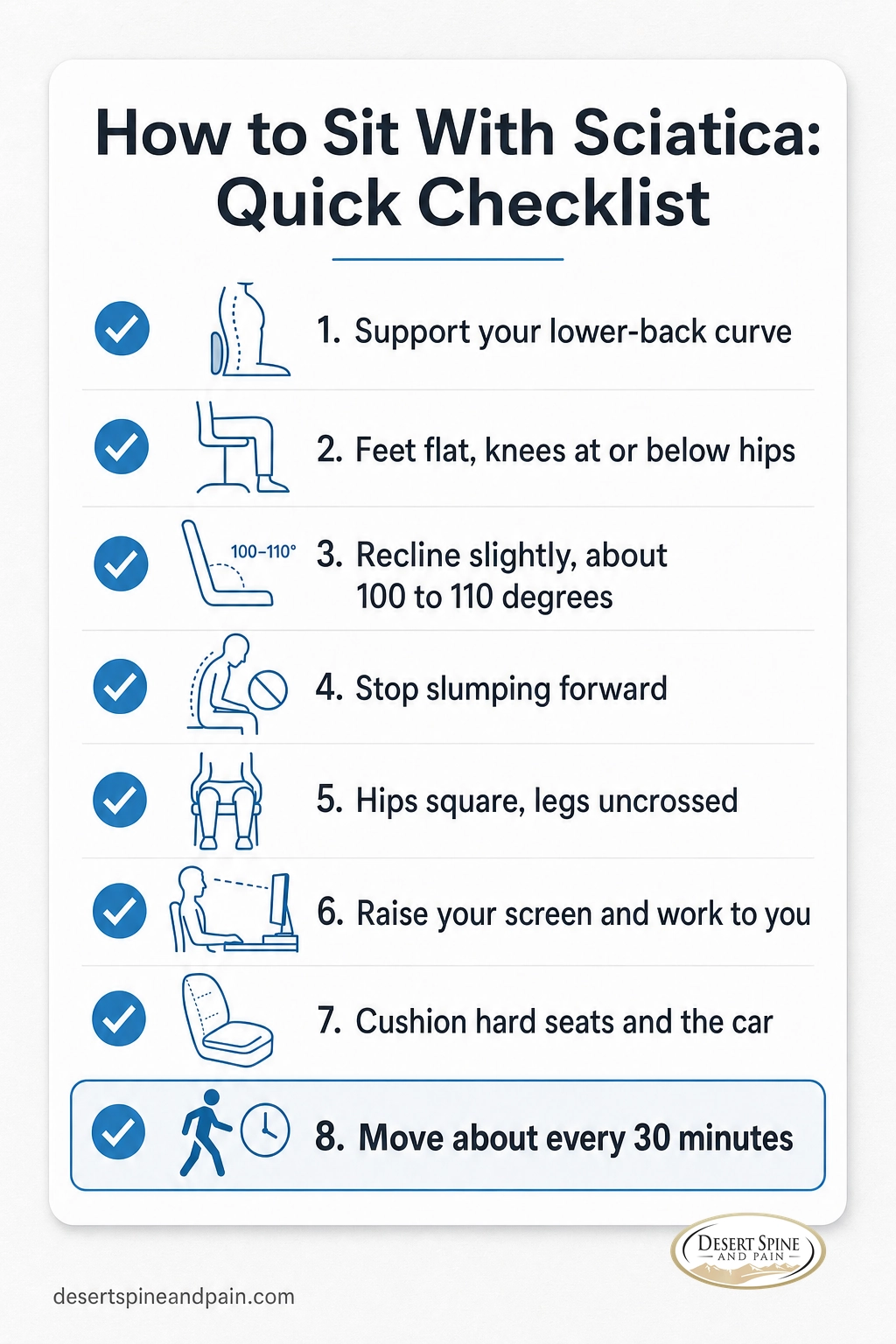
- Neutral, supported spine wins. Keep the natural inward curve of your lower back, not a slump and not a rigid arch.
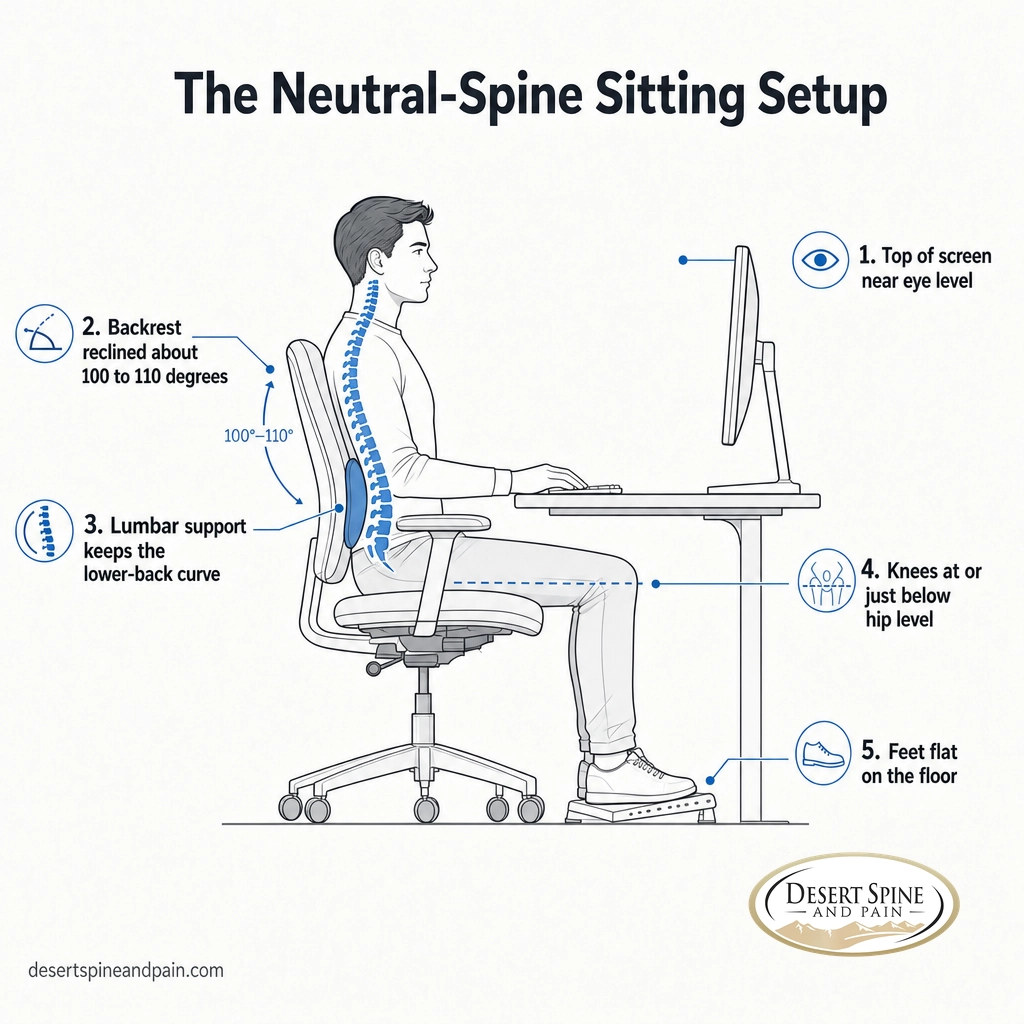
- Feet flat, knees at or just below hip level. Use a footrest if your feet dangle.
- Lean back a little. A slight recline of about 100 to 110 degrees offloads the lumbar discs versus bolt-upright or hunched.
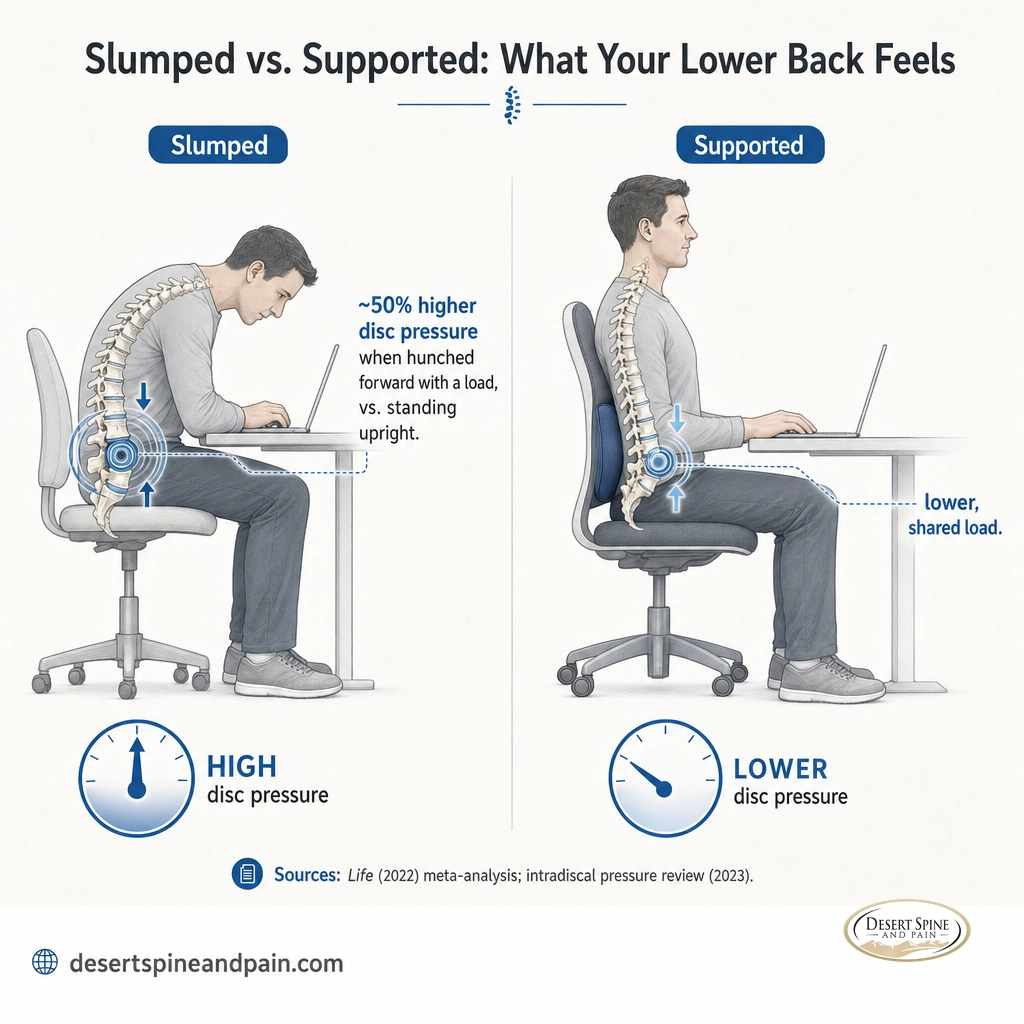
- Slumping is the real enemy. Forward-flexed, loaded sitting can raise lumbar disc pressure by roughly 50% compared with standing upright.
- Movement beats any single chair. Change position or stand about every 30 minutes; the posture you hold too long is the wrong one.
- Most sciatica improves. An estimated 80% to 90% of cases get better without surgery, and early, appropriate care protects that outcome.

What's in This Guide
- 1. Support the natural curve of your lower back
- 2. Plant your feet flat, knees at or below hip level
- 3. Recline the backrest slightly, not bolt-upright
- 4. Stop slumping forward
- 5. Keep your hips square and uncross your legs
- 6. Bring your screen and work up to you
- 7. Cushion hard seats and set up the car
- 8. Move about every 30 minutes
Sciatica is pain that travels along the sciatic nerve, from the lower back through the buttock and down the leg, usually because a nerve root is compressed or inflamed. Bending, twisting, and prolonged sitting are classic aggravators, which is exactly why how you sit makes a real difference day to day. If you want the background first, start with what sciatica actually is and what causes sciatica, then come back to the setup below.
1 Support the Natural Curve of Your Lower Back
Your lower spine has a gentle inward curve called lordosis. When you sit without support, that curve tends to flatten or reverse into a slump, which increases the forward bend on your lumbar discs and the nerve roots nearby. A supported curve keeps the spine closer to the neutral position it holds when you stand.
Why it matters: A slumped lumbar spine is the single most common seated mistake behind aggravated sciatica. Holding that flexed position for hours is what loads the disc and irritates the nerve root.
How to set it up: Choose a chair with built-in lumbar support, or add a small pillow or a rolled towel behind the small of your back at belt height. You should feel the support filling the gap behind your lower back, gently restoring the curve rather than pushing you forward.
Source: StatPearls (Sciatica)
Explore the conditions we treat2 Plant Your Feet Flat, Knees at or Below Hip Level
Where your legs sit changes the angle at your hips and the load through your pelvis and lower back. Feet that dangle, or knees pulled up higher than your hips, tug the pelvis into a backward tilt and flatten that protective lumbar curve again.
Why it matters: A stable base lets your lower back stay neutral instead of rounding. It also keeps you from perching on the edge of the seat, which removes your back support entirely.
How to set it up: Adjust the chair so both feet rest flat on the floor with your knees at the same height as your hips or slightly lower. If your feet do not reach, add a footrest, a low box, or even a stack of books. If the seat is too deep, the lumbar cushion from Tip 1 also helps you sit back fully.
Source: StatPearls (Sciatica)
3 Recline the Backrest Slightly, Not Bolt-Upright
A rigid 90-degree "good posture" position is not actually the lowest-load way to sit. Leaning back a little lets the backrest share some of your upper-body weight instead of stacking all of it straight down through the lumbar discs.
Why it matters: Offloading even part of your torso weight onto a supportive backrest reduces the pressure your lower-back discs carry while you are seated, which can ease pressure on an irritated nerve root.
How to set it up: Set the backrest to a slight recline of roughly 100 to 110 degrees, while keeping the lumbar support in contact with your lower back. The goal is relaxed but supported, not reclined so far that you slide forward and lose the curve.
Source: Intradiscal pressure literature review (2023)
See our conservative, non-invasive care4 Stop Slumping Forward
If there is one habit to break, it is hunching forward over a desk, a phone, or a steering wheel. Forward flexion of the spine, especially combined with holding or lifting something, drives up the pressure inside your lumbar discs far more than sitting tall does.
Why it matters: A disc under higher pressure can bulge slightly more against a nerve root that is already sensitized, which is often felt as a flare of leg pain, numbness, or tingling.
How to set it up: Catch yourself drifting forward and reset: ribs stacked over hips, shoulders relaxed down, and your weight back into the lumbar support. Pull work toward you rather than leaning into it (see Tip 6), and avoid reaching and twisting for heavy items while seated.
Myth: "Sitting always crushes your disc more than standing, so standing is the fix."
It is more nuanced than that. A 2022 meta-analysis of in-vivo pressure studies found that sitting did raise lumbar disc pressure more than standing in healthy discs overall. But in studies published since 1990, and in people with already-degenerated discs, there was no meaningful difference between the two. The takeaway is not "never sit." It is that posture and time under load matter more than the label of sitting versus standing. A supported, neutral sit with regular breaks can be perfectly comfortable, and standing badly for hours is not a cure.
Source: Life (2022) intradiscal pressure meta-analysis | Intradiscal pressure literature review (2023)
Try the best stretches for sciatica5 Keep Your Hips Square and Uncross Your Legs
Crossing your legs, sitting on a wallet, or tucking one foot under you tilts your pelvis and twists your lower spine out of alignment. Over a long sitting session, that small, steady asymmetry can load one side of your back and the sciatic nerve pathway more than the other.
Why it matters: Sciatica is usually one-sided, and an uneven seated posture can concentrate stress on the exact side that is already irritated. Keeping the pelvis level keeps the load symmetrical.
How to set it up: Sit with both hips evenly on the seat and both feet on the floor. Clear your back pockets before you sit, and if you tend to cross your legs automatically, a footrest gives your legs somewhere else to rest.
Source: StatPearls (Sciatica)

6 Bring Your Screen and Work Up to You
Most forward slumping starts with where your work sits. A low laptop, a phone in your lap, or paperwork flat on the desk pulls your head and shoulders down and forward, and the lower back follows into flexion.
Why it matters: Raising your work to you removes the reason to hunch, so the neutral posture from Tips 1 through 4 is easier to hold without thinking about it. It also eases the neck and mid-back.
How to set it up: Raise your monitor or laptop so the top of the screen is near eye level, and pull the keyboard and mouse close so your elbows stay near your sides. Hold your phone up instead of looking down into your lap. Keep the items you reach for often within easy range so you are not twisting to grab them.
Source: Intradiscal pressure literature review (2023)
More ways to treat sciatica at home7 Cushion Hard Seats and Set Up the Car
Not all sitting happens in an office chair. Hard benches, bleachers, and especially the car seat on a long commute put the same flexed, static load on your lower back, often with less support than your desk setup.
Why it matters: A hard, flat seat has no lumbar support and no give, so your spine rounds and stays rounded. Driving adds vibration and a fixed, slightly reclined-and-reaching position that many people with sciatica find aggravating.
How to set it up: On a hard seat, add a folded towel or cushion to soften the surface, and use a rolled towel for lumbar support. In the car, slide the seat close enough that you are not reaching for the pedals or wheel, add lumbar support behind your lower back, and break up long drives with stops to stand and walk.
Source: Life (2022) intradiscal pressure meta-analysis
8 Move About Every 30 Minutes
The most powerful sitting tip is to not sit still. No posture, however good, is meant to be held for hours. Prolonged static loading is a recognized aggravator of sciatic nerve pain, and the fix is movement, not a perfect chair.
Why it matters: Regular position changes keep the nerve from staying compressed in one spot and keep the discs from sitting under steady load. Gentle movement also helps calm an irritated nerve, which is why staying active beats prolonged bed rest for most people with sciatica.
How to set it up: Stand up, walk, or change position about every 30 minutes. A phone or calendar reminder helps until it becomes a habit. A sit-stand desk lets you alternate without leaving your work, and a short walk or a gentle stretch between tasks resets your posture.
The outlook is encouraging
Good sitting habits are one piece of conservative care, and conservative care works for most people. An estimated 80% to 90% of sciatica cases improve without surgery, and symptoms are often most responsive in the first several weeks. That is why the goal is not to tough it out indefinitely, but to combine smart daily habits with early, appropriate care if the pain is not settling. For the full picture, see our sciatica statistics, and if nighttime is also hard, our guide on how to sleep with sciatica.
Source: NIHR systematic review (sciatica management)
Explore interventional pain managementHow to Prioritize These Tips
If your sitting setup needs an overhaul, do not try to fix everything at once. These three changes give the most relief for the least effort:
If you only do three things from this list:
- Add lumbar support so your lower back keeps its curve (Tip 1).
- Stop slumping forward, the habit that loads the disc most (Tip 4).
- Stand or move every 30 minutes, the one habit that beats any chair (Tip 8).
| Tip | Priority | Difficulty | Impact |
|---|---|---|---|
| Lumbar support for the natural curve | High | Easy | High |
| Stop slumping forward | High | Moderate (habit) | High |
| Move every 30 minutes | High | Easy | High |
| Feet flat, knees at or below hips | Medium | Easy | Medium |
| Slight backrest recline | Medium | Easy | Medium |
| Raise screen and work to you | Medium | Easy | Medium |
| Hips square, legs uncrossed | Medium | Easy | Medium |
| Cushion hard seats and car setup | Lower | Easy | Situational |
Every Tip in One Table
| # | Tip | Why It Matters | Difficulty |
|---|---|---|---|
| 1 | Support the lower-back curve | Stops the slump that loads the disc and nerve root | Easy |
| 2 | Feet flat, knees at or below hips | Stable base keeps the spine neutral | Easy |
| 3 | Slight backrest recline (100–110°) | Backrest shares torso weight, offloads discs | Easy |
| 4 | Stop slumping forward | Flexed, loaded sitting spikes disc pressure | Moderate |
| 5 | Hips square, legs uncrossed | Keeps load even on a one-sided problem | Easy |
| 6 | Raise screen and work to you | Removes the main reason to hunch | Easy |
| 7 | Cushion hard seats and car | Adds support where seating gives none | Easy |
| 8 | Move every 30 minutes | Prevents prolonged static nerve compression | Easy |
Frequently Asked Questions
What is the best sitting position for sciatica?
Is sitting bad for sciatica?
Should I sit or stand with sciatica?
How long can I sit with sciatica?
When should I see a doctor for sciatica?
Methodology and Sources
The sitting and ergonomic guidance in this article reflects standard conservative-care principles for sciatica, and every figure cited is drawn from a Tier 1 primary source: a peer-reviewed study, a systematic review, or a major medical reference. No blog-to-blog citations are used. Posture advice describes general principles, not a prescription for any one person.
Primary sources:
- StatPearls (NCBI Bookshelf): definition of sciatica, aggravating movements, conservative management, and red-flag symptoms.
- Life, 2022 systematic review and meta-analysis: in-vivo comparison of lumbar intradiscal pressure between sitting and standing, including the subgroup findings for post-1990 studies and degenerated discs.
- Intradiscal pressure literature review, 2023 (NCBI PMC): relative lumbar disc pressures by posture and load, including flexed, loaded sitting.
- NIHR systematic review (NCBI Bookshelf): natural history of sciatica and the share of cases that improve without surgery.
This article is for general educational purposes and is not individual medical advice. If you have leg pain with new weakness, numbness in the saddle area, or loss of bladder or bowel control, seek emergency medical evaluation. Physical therapy at Desert Spine and Pain is provided by referral.
Still hurting when you sit? If sciatica is interfering with work, driving, or sleep despite good habits, an accurate diagnosis can identify the source and guide the least-invasive effective treatment. In Phoenix, Arizona, board-certified spine surgeon and neurosurgeon Dr. David L. Greenwald offers consultations for persistent sciatic nerve pain.