
9 Best Stretches for Sciatica Pain Relief
The best stretches for sciatica are gentle, controlled moves that take pressure off the irritated nerve and loosen the muscles around it, done daily and stopped the moment pain travels further down your leg. Nine stretches do most of the work: knee-to-chest, the reclining figure-4, knee-to-opposite-shoulder, the seated spinal twist, a standing hamstring stretch, pelvic tilts, cat-cow, child's pose, and the prone press-up. Below you will find exactly how to do each one, why it helps, how to stay safe, and the red-flag symptoms that mean it is time to stop stretching and call a spine specialist.
Key Takeaways
- Gentle beats aggressive. Sciatica calms down with slow, supported stretches held 20 to 30 seconds, not deep or bouncing movements.
- Follow the centralization rule. If a stretch pulls pain back toward your spine or eases it, keep going. If pain travels further down the leg, stop that stretch.
- Most sciatica improves with conservative care. Cleveland Clinic notes many cases get better within four to six weeks without medical treatment, and staying active helps more than bed rest.
- The cause matters. About 90% of sciatica comes from a herniated disc pressing on a nerve root, which is why extension moves like the prone press-up often help disc-related cases.
- Some symptoms are emergencies. Loss of bladder or bowel control, saddle numbness, or weakness in both legs needs immediate medical care, not stretching.

What's in This Guide
Why Stretching Helps Sciatica
Sciatica is nerve pain that radiates along the sciatic nerve, from the lower back through the buttock and down the back of the leg. It is a symptom, not a diagnosis. The underlying problem is usually something pressing on or irritating a lumbar or sacral nerve root, and in about 90% of cases that something is a herniated disc, according to a review in The BMJ. Tight, guarded muscles around the spine and hips then pile on, squeezing the nerve further and locking you into a painful posture.
Stretching helps on both fronts. Slow, targeted stretches lengthen the muscles that crowd the sciatic nerve, especially the piriformis deep in the buttock and the hamstrings behind the thigh. Gentle spinal movement also encourages fluid exchange around the disc and can, in disc-related cases, help ease pressure off the nerve root. The goal is not to muscle through a deep stretch. It is to restore easy, pain-free motion so the nerve has room to settle.

The encouraging part is that sciatica is usually self-limiting. The lifetime incidence of sciatica is estimated at 13% to 40%, yet most episodes settle with conservative care rather than surgery.
Because a herniated disc drives most sciatica, the direction that eases your symptoms is a clue to the cause. Many disc-related cases feel better with gentle backward-bending (extension) moves and worse with deep forward folds. That is why this list leans on supported, low-risk stretches and finishes with a careful extension move you can test against your own response. If you are still mapping out what is happening in your spine, our explainers on what sciatica actually is and what causes sciatica are good companions to this guide.
Source: The BMJ, Diagnosis and treatment of sciatica (Koes et al.) | Cleveland Clinic, Sciatica
How to Stretch Safely With Sciatica
A stretch that helps one person's sciatica can aggravate another's, because the cause and the irritated nerve level differ. These ground rules keep your sessions productive and protect the nerve while it heals.
Five rules for every session
- Warm up first. A few minutes of easy walking or gentle marching in place loosens tissue so stretches are more comfortable and effective.
- Move slowly, never bounce. Ease into each position and hold it. Bouncing (ballistic stretching) can trigger the muscle to tighten and can irritate the nerve.
- Hold, do not force. Aim for a mild, tolerable pull held 20 to 30 seconds. Stretching should not hurt. Sharp or electric pain means back off.
- Watch the direction of your pain. If leg pain pulls up toward your spine or fades, that stretch is helping. If it travels further down the leg, stop and try a different one.
- Breathe and stay consistent. Relax into each hold rather than bracing, and do your routine daily. Consistency, not intensity, drives recovery.
Staying active is part of the plan. The NHS advises people with sciatica to keep up normal activities as much as possible and to start gentle exercise as soon as they can, noting that even when moving hurts, it is not harmful and can help you recover faster.
Myth: You should rest in bed until sciatica goes away
Prolonged bed rest was once standard advice, and it is now understood to slow recovery. Muscles deconditon, joints stiffen, and the nervous system becomes more sensitive to pain. Gentle movement and the stretches below, paced to your symptoms, are a far better strategy than lying still and waiting.
Stop and seek urgent care if you notice these red flags
A small number of sciatica cases signal a serious problem called cauda equina syndrome, which is a medical emergency. Do not stretch through these symptoms. Seek emergency care right away if you experience:
- Loss of bladder or bowel control, or new difficulty urinating
- Numbness in the groin, buttocks, or inner thighs (saddle numbness)
- Numbness or weakness in both legs, or weakness that is severe or getting worse
- Sudden, severe sciatica after a fall or accident
These warnings are echoed by both the NHS and Cleveland Clinic. When in doubt, get evaluated. This article is general information, not individual medical advice.
Source: NHS, Sciatica | Cleveland Clinic, Sciatica
The 9 Best Stretches for Sciatica
Work through these in order the first few times. The early stretches are the gentlest and safest for most people, and the later moves are slightly more active. You do not need to do all nine every session. Pick the ones that feel best and leave anything that increases leg pain.
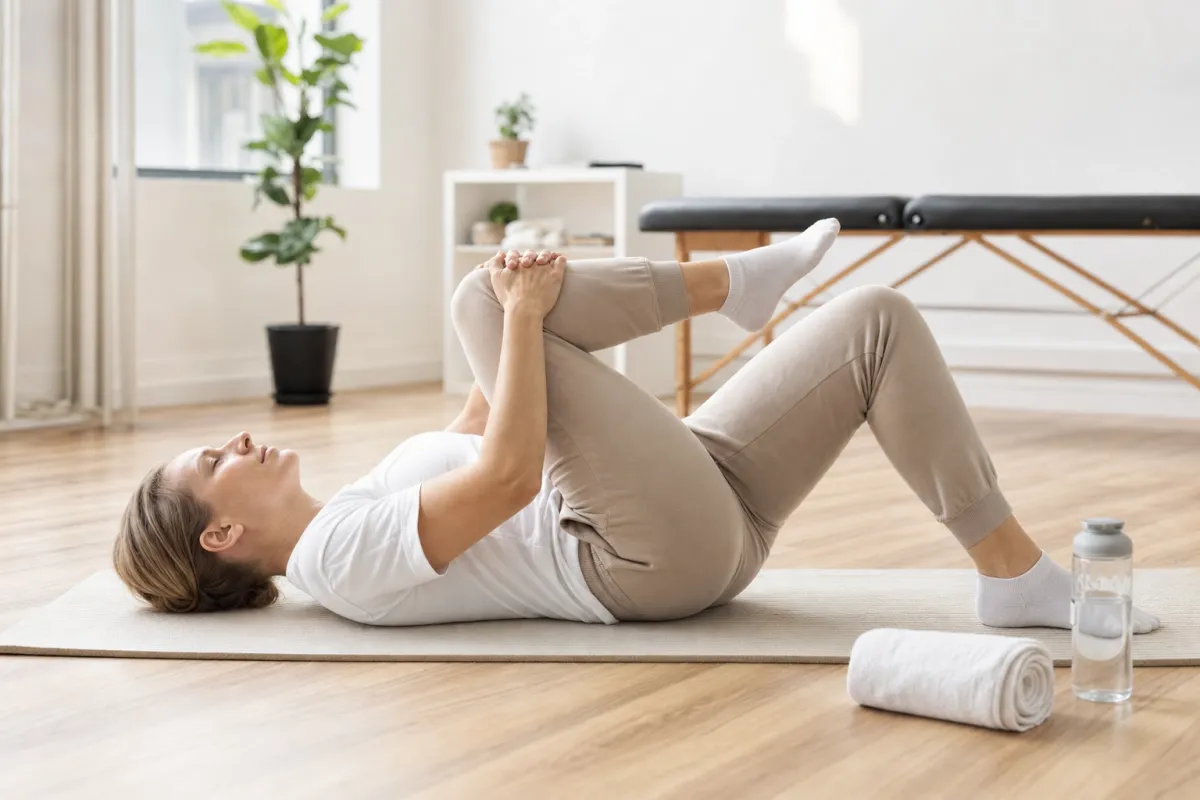
1 Knee-to-Chest Stretch
This is the gentlest place to start. Lying knee-to-chest decompresses the lower back, opens the space around the nerve roots, and relaxes the muscles that tense up when sciatica flares. It is low-risk because your spine stays supported on the floor the whole time.
How to do it: Lie on your back with both knees bent and feet flat. Draw one knee gently toward your chest, clasping your hands behind the thigh or over the shinbone. Keep the opposite foot flat or the leg extended. Hold 20 to 30 seconds, feeling an easy pull in the lower back and buttock, then switch sides. Do 2 to 3 rounds per leg. Progress to drawing both knees in together once single-leg feels comfortable.
Why it matters: Skipping gentle decompression and jumping straight to deep stretches is how people flare their sciatica. Start here to calm the area before asking more of it.
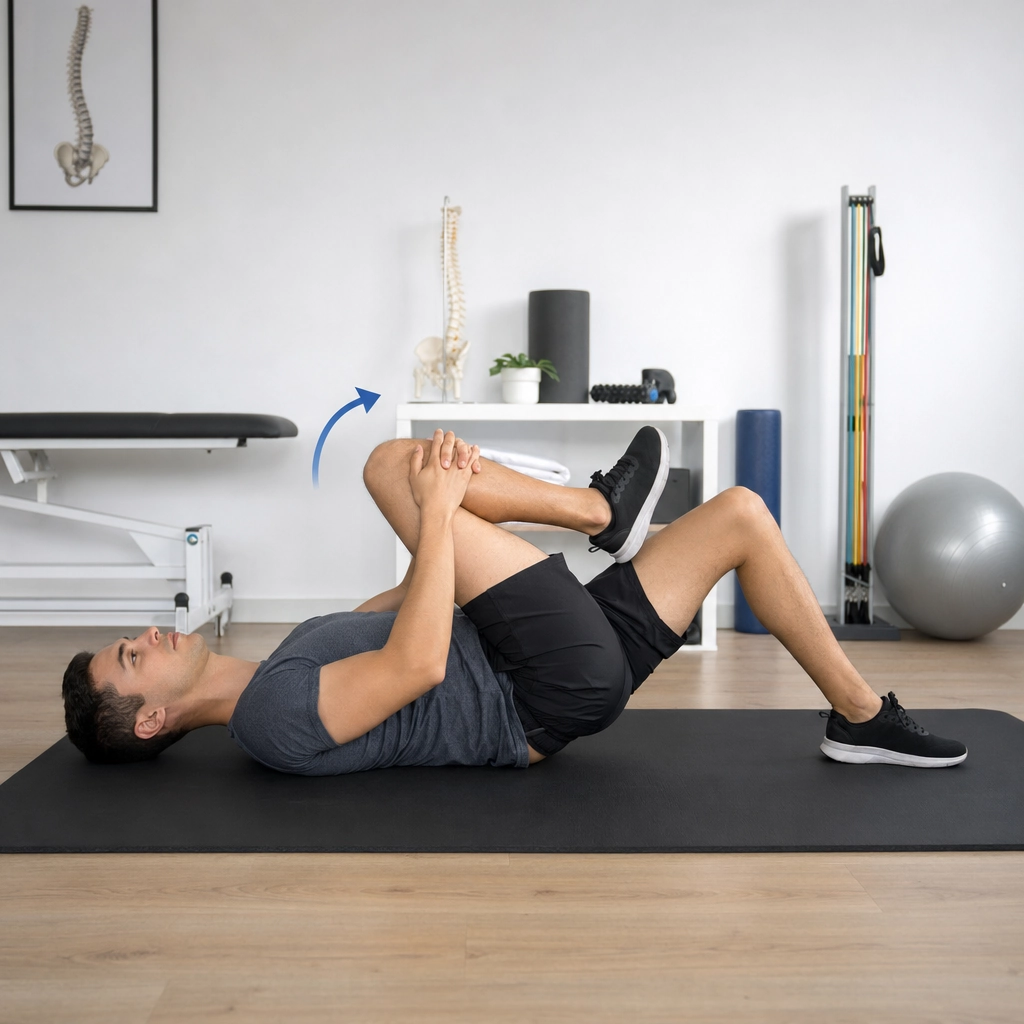
2 Reclining Figure-4 (Piriformis) Stretch
The piriformis is a small muscle deep in the buttock that sits right on top of the sciatic nerve. When it tightens, it can compress or irritate the nerve directly, a pattern often called piriformis-related pain. The reclining figure-4 targets it with your back fully supported.
How to do it: Lie on your back, knees bent. Cross the ankle of the painful side over the opposite thigh, just above the knee, so your legs form a number 4. Reach through and clasp the back of the supporting thigh, then gently draw that thigh toward your chest until you feel a stretch deep in the crossed-leg buttock. Keep your head and shoulders relaxed on the floor. Hold 20 to 30 seconds, repeat 2 to 3 times per side.
Why it matters: If buttock-dominant pain is your main complaint, a tight piriformis may be a key player. Our comparison of piriformis syndrome versus sciatica explains how to tell the two apart.
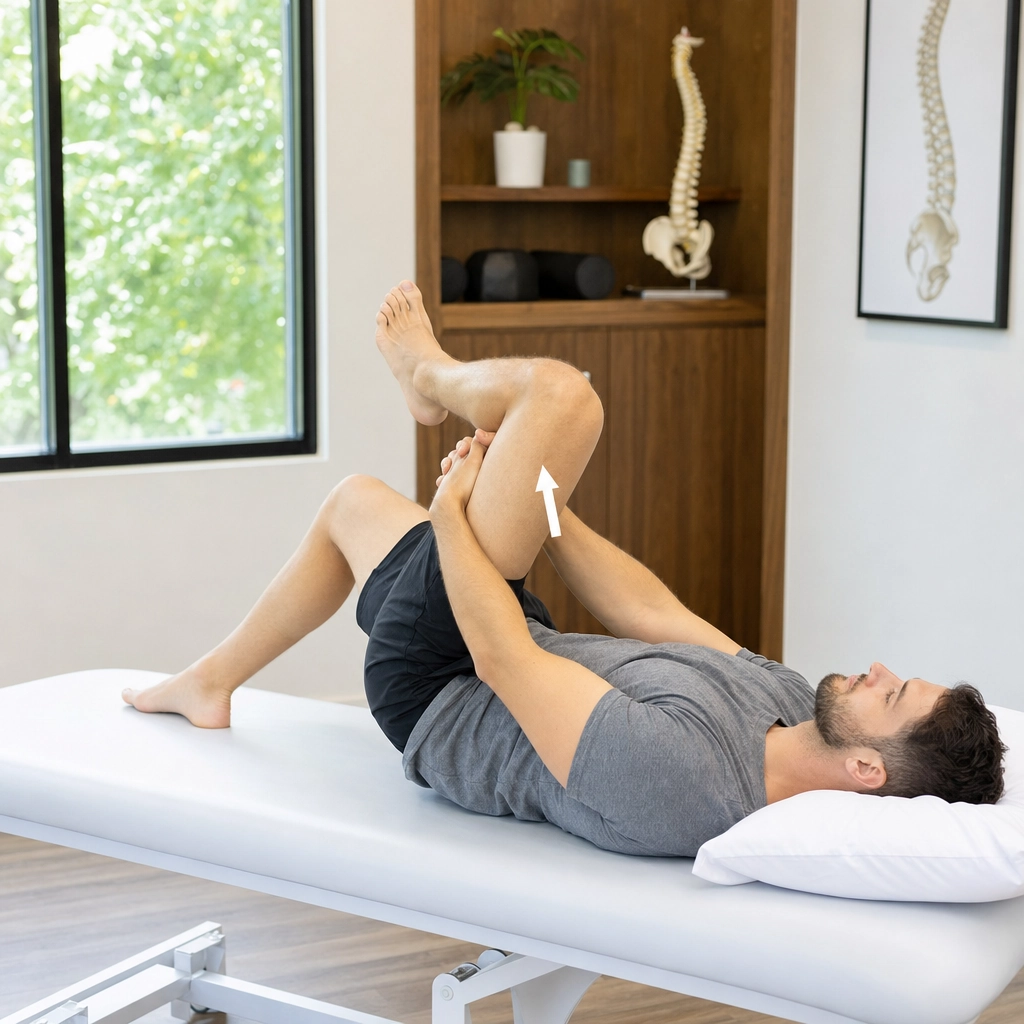
3 Knee-to-Opposite-Shoulder Stretch
A second angle on the piriformis and outer glute, this stretch reaches fibers the figure-4 can miss. It is simple, controlled, and easy to dose because you control exactly how far you pull.
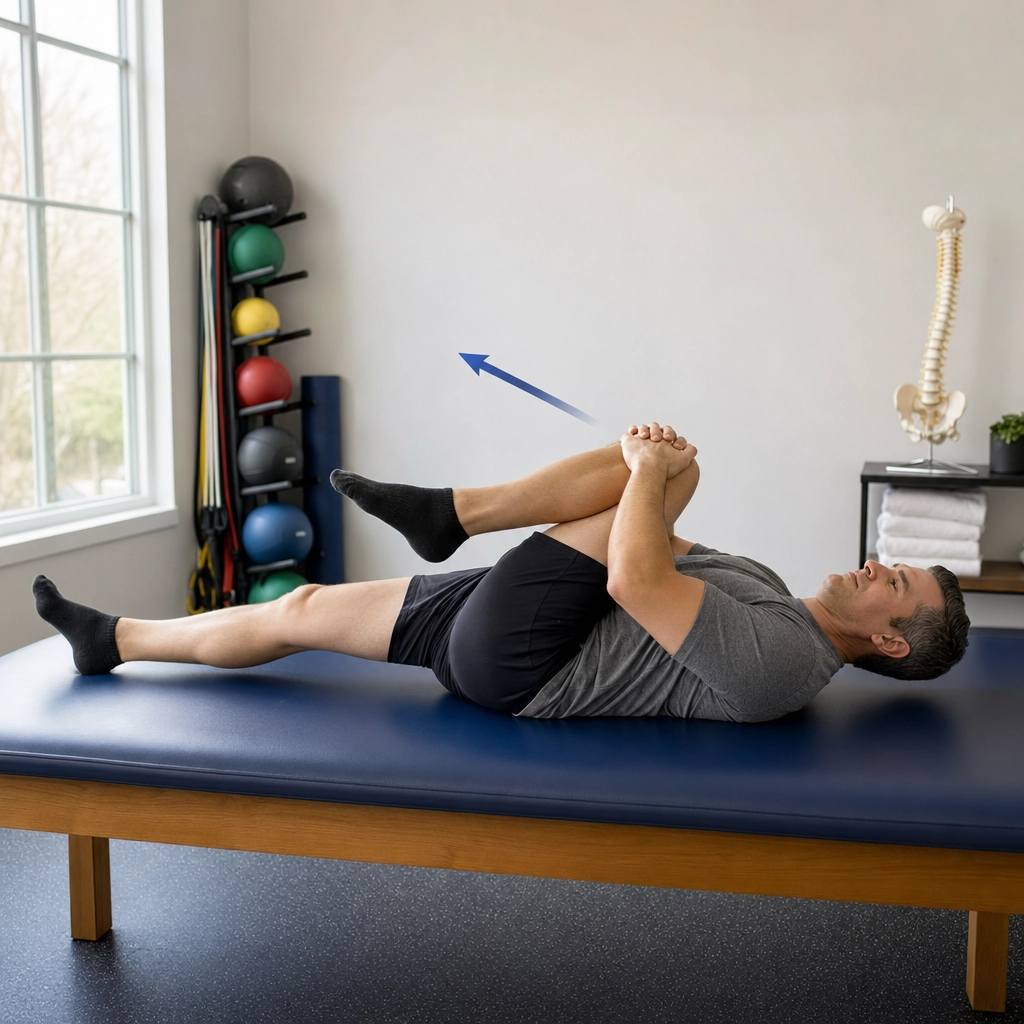
How to do it: Lie on your back with legs extended. Bend the painful-side knee and clasp your hands around it. Gently pull the knee across your body toward the opposite shoulder until you feel a comfortable stretch in the buttock, not pain. Hold about 30 seconds, then return the leg. Repeat 3 times per side.
Why it matters: Pulling too hard or yanking the knee can jolt the nerve. Keep the motion smooth and stay well short of any pain that shoots down the leg.
4 Seated Spinal Twist
A gentle rotational stretch helps mobilize the spine and the deep buttock muscles together. Done lightly, it can relieve the stiffness that builds up when you guard your back all day.
How to do it: Sit on the floor with both legs extended. Bend the painful-side knee and place that foot flat on the outside of the opposite knee. Place the opposite elbow on the outside of the bent knee and turn your torso gently toward the bent-knee side, using the elbow for a light assist. Keep your spine tall rather than slumped. Hold 20 to 30 seconds and repeat 2 to 3 times per side.
Why it matters: Twists should be mild for sciatica. Avoid cranking into a deep rotation, which can load an irritated disc. If twisting worsens leg pain, skip this one.


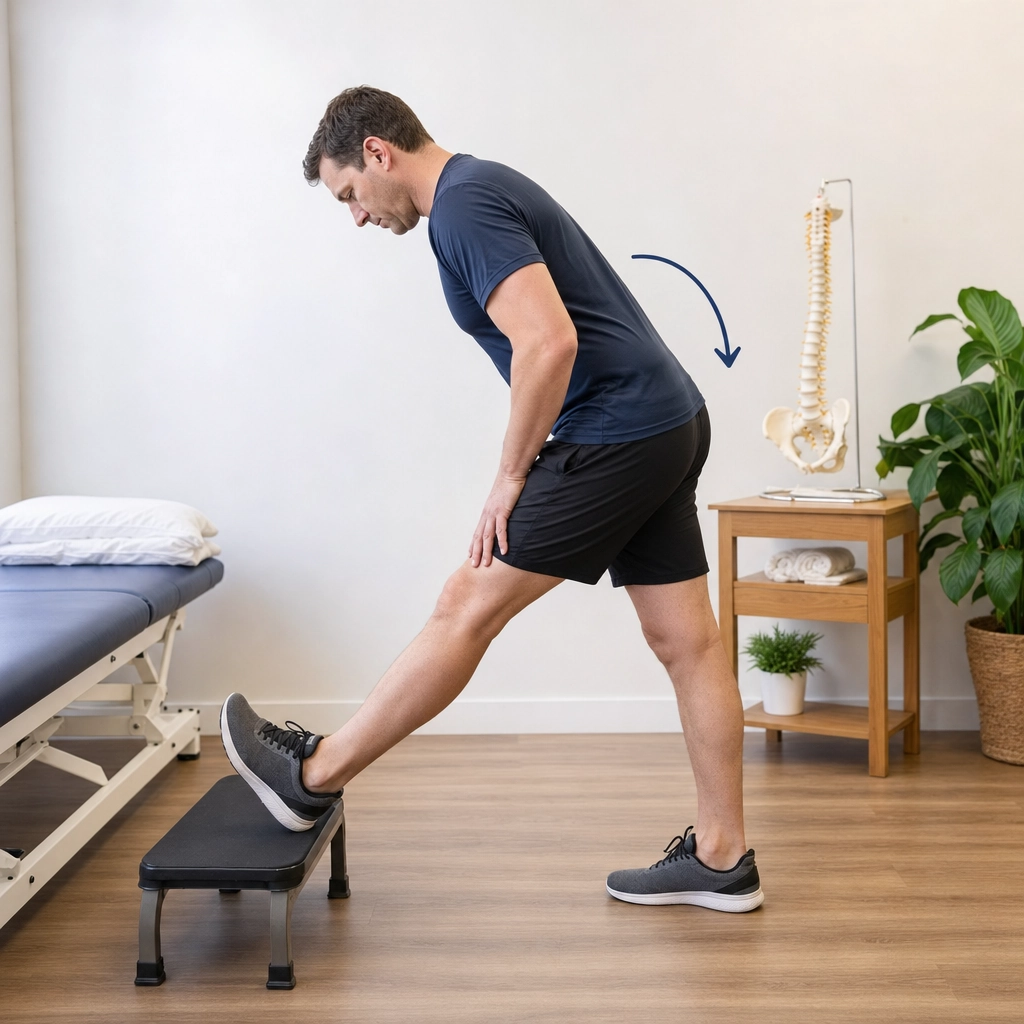
5 Standing Hamstring Stretch
Tight hamstrings tug on the pelvis and lower back and can worsen the pull on an already-sensitive sciatic nerve. A supported, gentle hamstring stretch helps, as long as you keep your back straight and avoid rounding forward.
How to do it: Stand and place the heel of the painful-side leg on a low step or sturdy surface, toes pointing up, leg straight but not locked. Keeping your back flat, hinge forward slightly from the hips until you feel a gentle stretch behind the thigh. Do not reach for your toes with a rounded spine. Hold 20 to 30 seconds, 2 to 3 times per side.
Why it matters: Classic standing toe-touches round the lower back and can increase disc pressure. The hip-hinge version gives you the hamstring benefit without that risk.
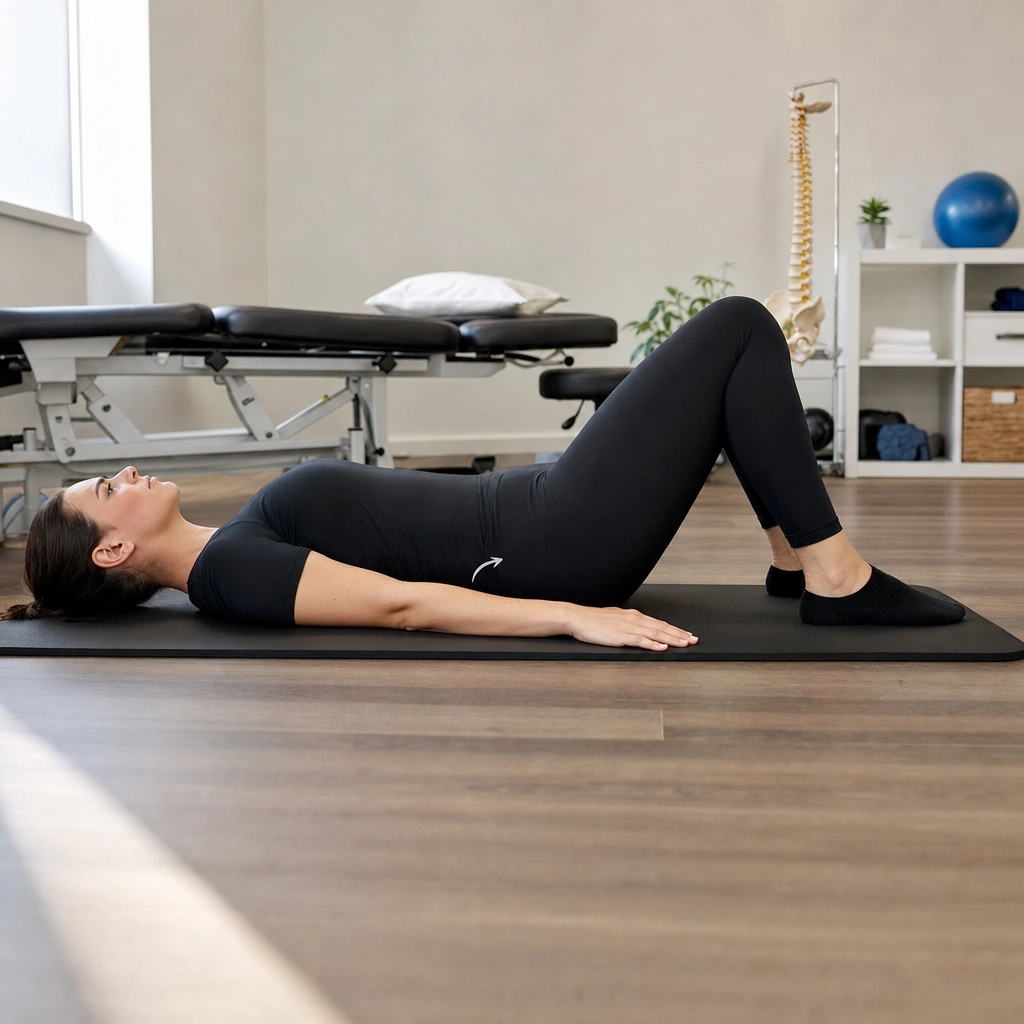
6 Pelvic Tilt
The pelvic tilt is part stretch, part gentle core activation. It teaches the deep abdominal muscles to support the spine and relieves tension in the lower back, which is why physical therapists use it so often in early sciatica recovery.
How to do it: Lie on your back with knees bent and feet flat. Gently flatten your lower back against the floor by tilting your pelvis and tightening your abdominal muscles. Hold 5 to 10 seconds while breathing normally, then release. Repeat 10 times.
Why it matters: A stronger, better-coordinated core shares the load with your spine. This is one of the few moves on the list you can do many times a day without overdoing it.
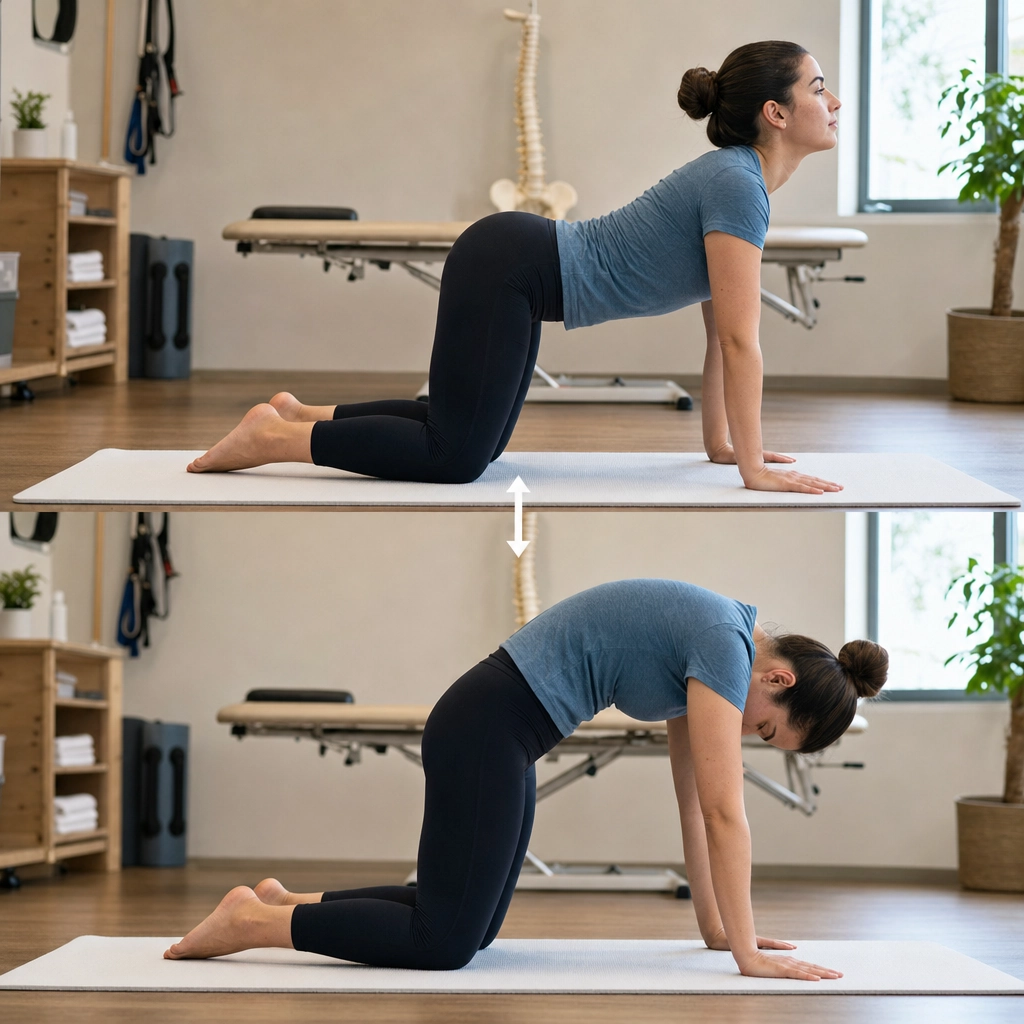
7 Cat-Cow
Cat-cow takes the spine gently through its full range of flexion and extension, which improves mobility and eases the stiffness that feeds a sciatica flare. It also lets you feel which direction your back prefers, useful information for the press-up later.
How to do it: Start on your hands and knees with wrists under shoulders and knees under hips. Slowly arch your back and lift your head and tailbone (cow), then reverse, rounding your back toward the ceiling and tucking your chin (cat). Move with your breath, spending a few seconds in each position. Do about 10 slow cycles.
Why it matters: Keep the motion smooth and pain-free. If one direction clearly aggravates leg symptoms, favor the direction that feels better and ease off the other.
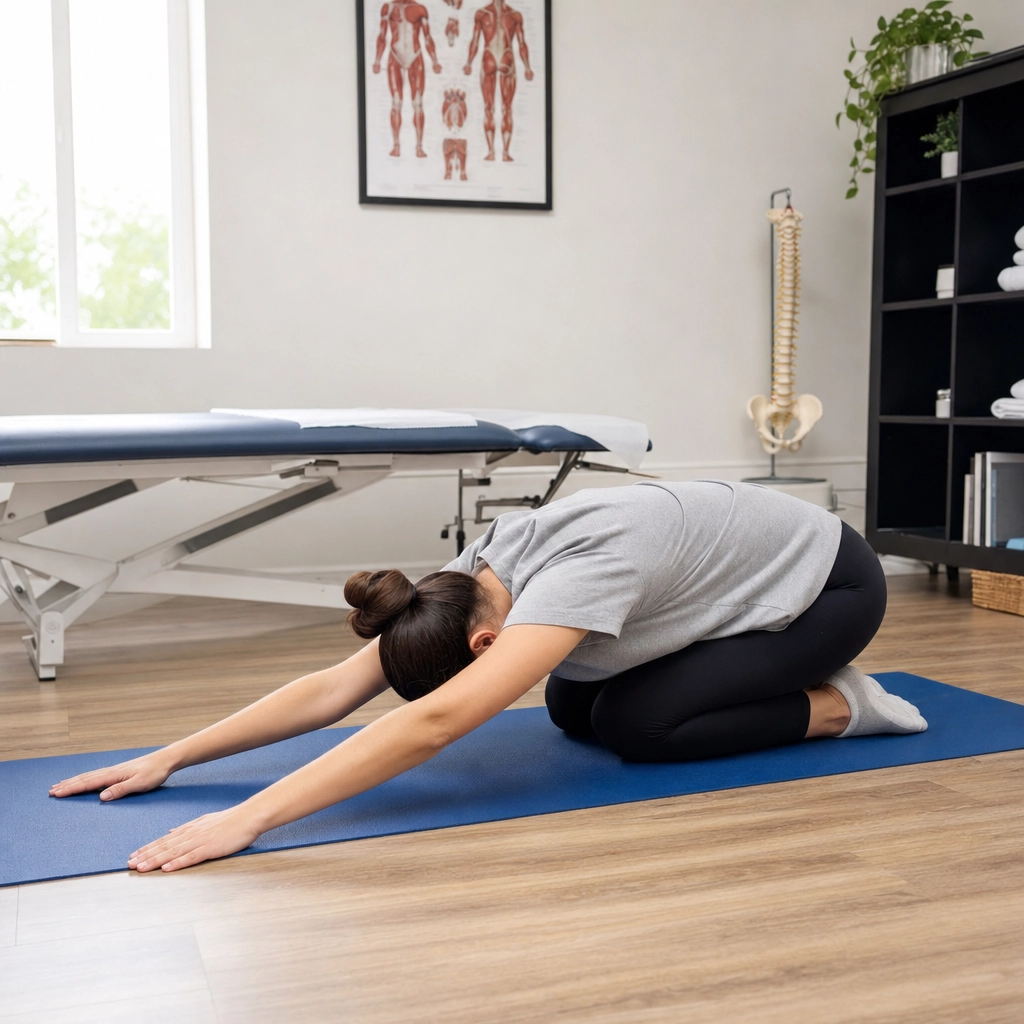
8 Child's Pose
Child's pose is a restful stretch that lengthens the lower back and takes pressure off the spine. It is an ideal cool-down and a good position to return to any time your back feels tight during the day.
How to do it: Kneel on the floor, bring your big toes together, and sit your hips back toward your heels. Fold forward and reach your arms out in front, letting your forehead rest on the floor or a cushion. Breathe into your lower back and hold 20 to 30 seconds, or longer if it feels good. Widen your knees if that is more comfortable.
Why it matters: Some people with disc-related sciatica find deep forward folding uncomfortable. If child's pose increases leg pain, shorten the fold or skip it in favor of the press-up below.
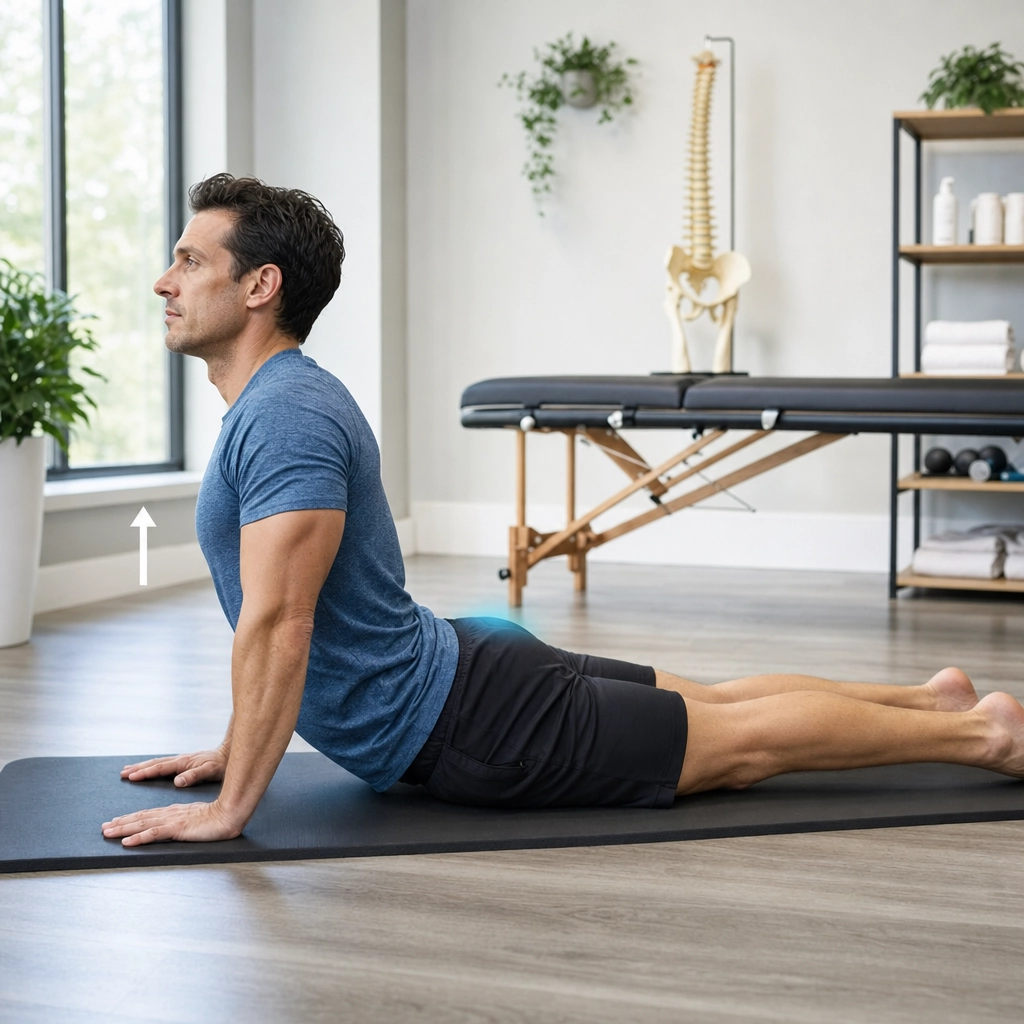
9 Prone Press-Up (McKenzie Extension)
For many people whose sciatica comes from a herniated disc, gentle backward-bending is the move that helps most. The prone press-up extends the lower spine and can encourage the disc to settle away from the nerve root, often causing leg pain to pull up toward the back (centralization), which is the signal you want.
How to do it: Lie face down and rest for a moment. Place your hands under your shoulders as if to do a push-up. Slowly press your upper body up, straightening your arms as far as is comfortable while keeping your hips and pelvis on the floor. Let your lower back relax into the gentle arch. Hold 5 to 10 seconds, lower down, and repeat up to 10 times.
Read your response carefully. If leg pain moves up toward your spine or decreases, this stretch is likely a good fit for you and worth repeating. If pain travels further down the leg, stop. That peripheralizing pattern means this is not the right direction today, and a spine specialist can help you find the one that is.
If gentle stretching takes the edge off but your pain keeps returning, you do not have to guess your way forward. Explore the range of conservative, non-surgical spine care options that build on home stretching.
Explore non-surgical sciatica careHow to Prioritize These Stretches
If you only do three stretches from this list, start with the ones that are gentlest and most broadly helpful, then add the targeted moves once your symptoms settle.
If you only do 3 things from this list: the knee-to-chest stretch to decompress, the reclining figure-4 to release the piriformis, and, if your pain centralizes with backward-bending, the prone press-up to address a disc-related cause.
| Stretch | Priority | Difficulty | Best for |
|---|---|---|---|
| Knee-to-chest | Start here | Easy | Everyone, gentle decompression |
| Reclining figure-4 | High | Easy | Buttock and piriformis pain |
| Knee-to-opposite-shoulder | High | Easy | Deep glute and piriformis |
| Pelvic tilt | High | Easy | Core support, do often |
| Prone press-up | High (if it centralizes) | Moderate | Disc-related sciatica |
| Standing hamstring | Medium | Easy | Tight hamstrings |
| Cat-cow | Medium | Easy | Spinal mobility |
| Child's pose | Medium | Easy | Cool-down, back tension |
| Seated spinal twist | Lower | Moderate | Stiffness, use lightly |
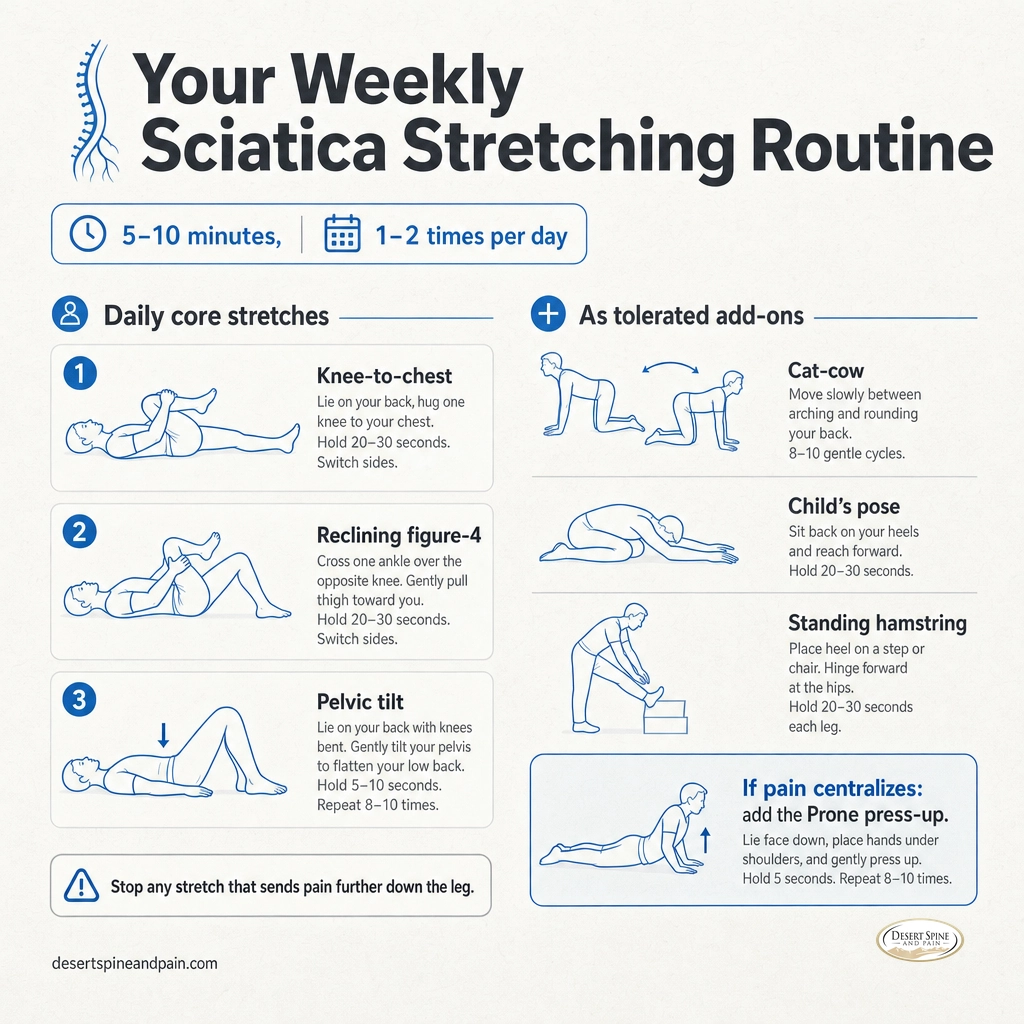
A realistic routine is short and daily: five to ten minutes, once or twice a day, favoring the stretches that feel best. If sitting or sleeping is when your sciatica bites hardest, pair this routine with our guides on how to sit with sciatica and how to sleep with sciatica.
Quick Summary Table
| # | Stretch | Primary target | Hold |
|---|---|---|---|
| 1 | Knee-to-chest | Lower back, glutes | 20–30 sec |
| 2 | Reclining figure-4 | Piriformis, glutes | 20–30 sec |
| 3 | Knee-to-opposite-shoulder | Piriformis, outer glute | ~30 sec |
| 4 | Seated spinal twist | Spine, deep glutes | 20–30 sec |
| 5 | Standing hamstring | Hamstrings | 20–30 sec |
| 6 | Pelvic tilt | Core, lower back | 5–10 sec x10 |
| 7 | Cat-cow | Spinal mobility | ~10 cycles |
| 8 | Child's pose | Lower back | 20–30 sec |
| 9 | Prone press-up | Lumbar extension, disc | 5–10 sec x10 |
When to See a Spine Specialist
Stretching is a strong first step, and for most people it is part of a recovery that happens over a few weeks. But stretching treats the irritation, not always the cause. See a spine specialist if your sciatica is severe, keeps coming back, follows an accident, or has not improved after a few weeks of gentle self-care. You should also get evaluated right away for any of the red-flag symptoms described earlier. For practical relief in the meantime, our guide on how to treat sciatica at home covers what to pair with these stretches.
At Desert Spine and Pain in Phoenix, Arizona, care is led by Dr. David L. Greenwald, MD, FACS, a board-certified surgeon who is both a spine surgeon and a neurosurgeon, and one of the top surgeons in the country. The practice follows a least-invasive-effective-treatment-first philosophy, so an evaluation starts with identifying the real source of your sciatica and the gentlest option that will actually help. When home stretching is not enough, interventional options can calm an irritated nerve without surgery.
See interventional pain treatment optionsPatients travel from across Greater Phoenix, including Scottsdale, Paradise Valley, Tempe, Mesa, and Chandler, and from outside Arizona for complex spine care. A consultation is the fastest way to turn guesswork into a plan. Call (602) 566-9500 to book.
Book a consultation with Desert Spine and PainFrequently Asked Questions
How often should I do sciatica stretches?
How long does it take for stretching to relieve sciatica?
Can stretching make sciatica worse?
Which stretches should I avoid with sciatica?
When should I see a doctor for sciatica?
Sources
This article draws on peer-reviewed and institutional medical sources. Figures are cited to their primary source and matched to the stated year.
- Koes BW, van Tulder MW, Peul WC. Diagnosis and treatment of sciatica. The BMJ, 2007 (herniated disc as cause in about 90% of cases; lifetime incidence 13% to 40%).
- Cleveland Clinic, Sciatica (many cases improve within four to six weeks without medical treatment; recommended self-care movement).
- NHS, Sciatica (typical recovery over a few weeks to a few months; stay active guidance; emergency red flags).
This content is for general education and is not individual medical advice. Always consult a qualified physician about your specific symptoms, and seek emergency care for any red-flag symptoms described above.