

How to Treat Sciatica: Relief Options That May Help
If you want to know how to treat sciatica, start with the good news: most cases calm down on their own. Many sciatica cases improve within four to six weeks without any medical treatment, and the large majority of people recover without surgery or lasting problems. The goal of treatment is to control the pain, take pressure off the irritated nerve, and keep you moving while your body heals. This guide walks through the relief options in the order doctors actually recommend them, from the at-home measures that resolve most cases to the injections, procedures, and warning signs that mean it is time to call a spine specialist.
Key Takeaways
- Conservative care comes first. National guidelines recommend non-drug options like movement, heat, and physical therapy before medication, and most sciatica resolves this way.
- Stay active, not in bed. Prolonged bed rest slows recovery. Gentle walking and normal movement help the nerve settle.
- Ice, then heat, plus an anti-inflammatory is the proven at-home combination for early relief.
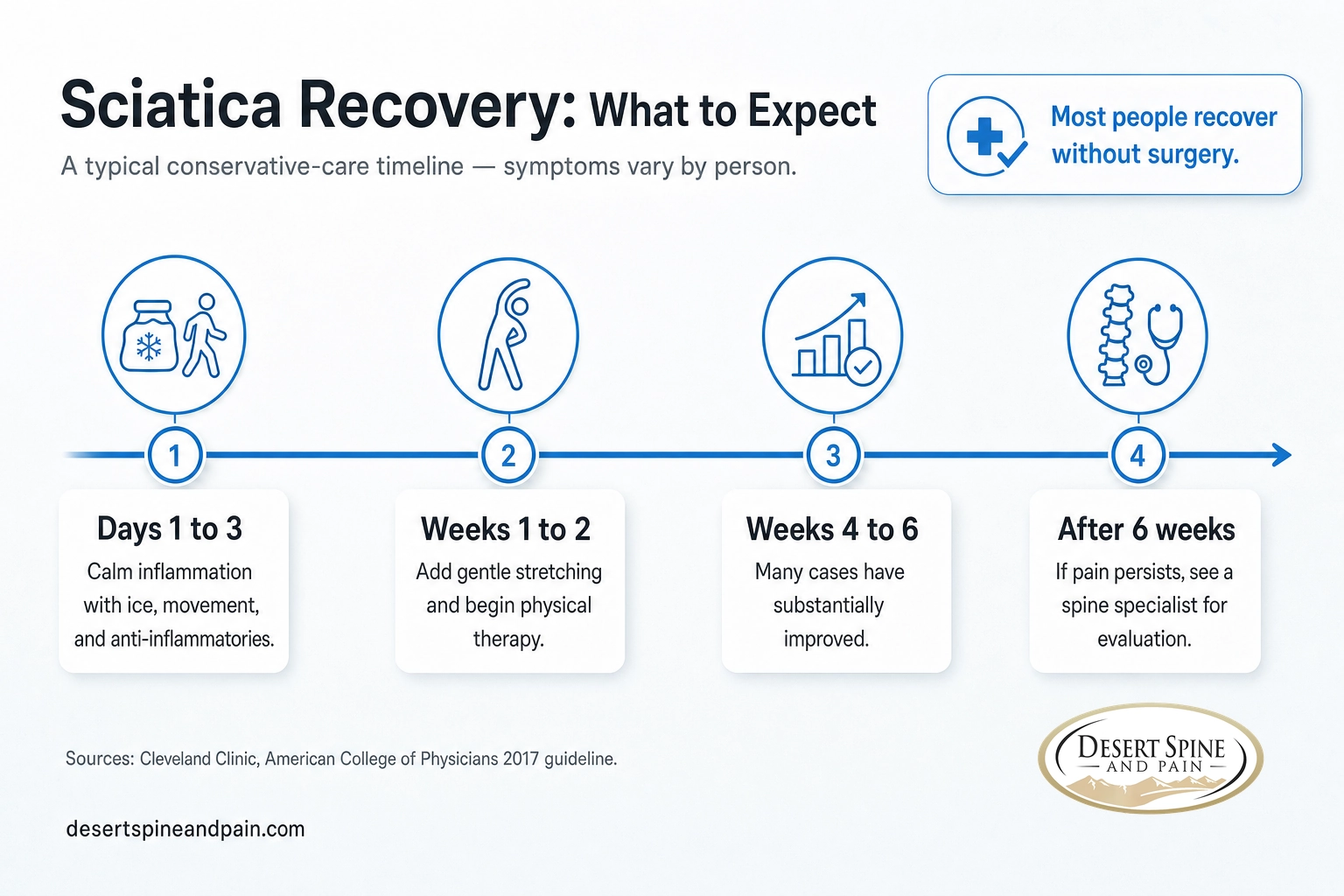
- Give it time, but set a deadline. If significant leg pain has not improved after about six weeks of consistent care, get evaluated.
- Know the red flags. Loss of bladder or bowel control, saddle numbness, or progressive leg weakness is an emergency, not something to treat at home.

What's in This Guide
- Before You Begin: Is It Safe to Treat at Home?
- Start Here: The Conservative Treatments That Work First
- When Conservative Care Is Not Enough: Injections and Nerve Procedures
- When to Call a Professional
- Troubleshooting Common Sciatica Setbacks
- Maintain and Prevent: Keeping Sciatica From Coming Back
- Frequently Asked Questions
Before You Begin: Is It Safe to Treat at Home?
Sciatica is not a diagnosis on its own. It is a set of symptoms, usually a sharp, burning, or electric pain that travels from the lower back or buttock down the back of one leg, often with tingling or numbness. In roughly 90% of cases, it is caused by a herniated (slipped) disc in the lower spine pressing on a nerve root. Because the underlying problem is so often a disc that will heal with time, home treatment is a reasonable and effective first step for most people.
Before you start, make sure your symptoms fit the typical, treat-at-home picture: pain in one leg, no major weakness, and full control of your bladder and bowels. If anything below applies to you, skip the home remedies and get seen right away.
Before you begin, you will want:
- Tools: an ice pack and a heating pad or hot water bottle (each wrapped in a towel), and an over-the-counter anti-inflammatory you tolerate well.
- Time: plan on a few weeks. This is a healing process, not a one-day fix.
- Skill level: beginner. Every step here is safe for most adults.
- A clear exit ramp: a plan to see a spine specialist if pain is severe or has not eased in about six weeks.
Source: Valat et al., "Sciatica," Best Practice & Research Clinical Rheumatology
Not sure what is driving your symptoms in the first place? Our companion guides explain what sciatica actually is and the most common causes of sciatica in plain language.
Start Here: The Conservative Treatments That Work First
This is the heart of how to treat sciatica. The 2017 guideline from the American College of Physicians, the leading U.S. body for internal medicine, recommends starting with non-drug treatments because they carry fewer risks than medication and work for most people. Follow these steps in order.
Step 1: Keep Moving and Skip the Bed Rest
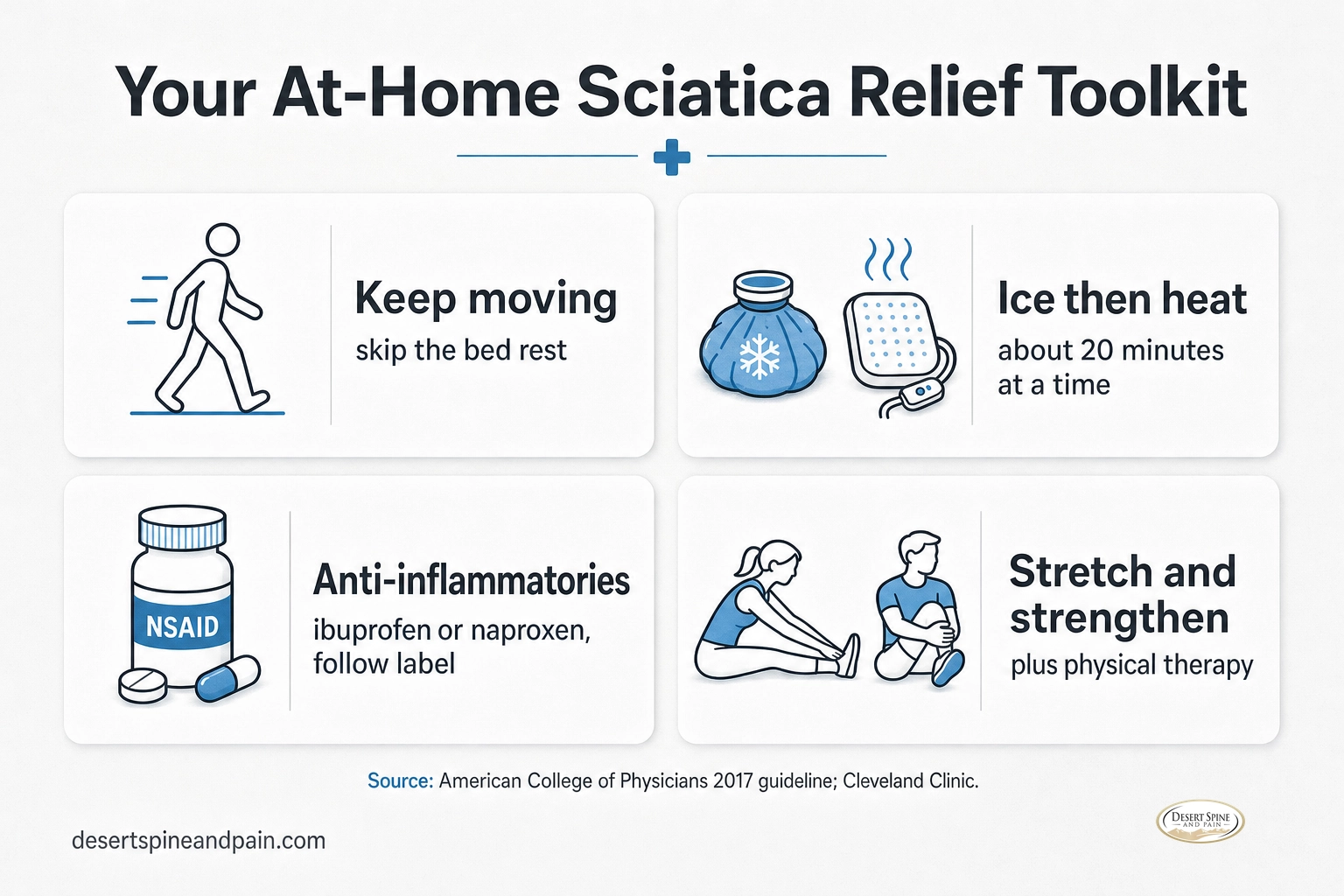
What to do: Stay gently active. Take short walks, change positions often, and continue light daily activities as your pain allows. Limit lying down to a day or two during the worst flare.
Why it matters: Prolonged bed rest weakens the muscles that support your spine and actually slows recovery. Movement keeps the nerve and surrounding tissue healthy.
What success looks like: You can walk and move through your day, even at a slower pace, without a sharp spike in leg pain.
Step 2: Use Ice First, Then Heat
What to do: For the first few days, apply a towel-wrapped ice pack to the lower back and buttock for about 20 minutes at a time to calm inflammation. Once the sharpest phase passes, switch to heat to relax tight muscles and soothe the nerve. If you are unsure which helps more, try both and keep the one that gives you more relief.
Why it matters: Ice reduces the inflammation irritating the nerve; heat loosens the muscle guarding that builds up around an injured area.
What success looks like: The deep ache eases for a while after each session, giving you a window to move and stretch more comfortably.
Step 3: Take Over-the-Counter Anti-Inflammatories
What to do: Over-the-counter NSAIDs such as ibuprofen (Advil, Motrin) or naproxen (Aleve) can reduce the inflammation driving the pain. Follow the dosing on the label.
Why it matters: When a disc presses on a nerve root, much of the pain comes from inflammation. An NSAID targets that directly.
A caution on medication
NSAIDs are not safe for everyone. If you have kidney disease, a history of stomach ulcers or bleeding, uncontrolled blood pressure, heart disease, or you take blood thinners, talk to a pharmacist or physician before using them. Acetaminophen (Tylenol) is an alternative for pain, though it does not reduce inflammation. Avoid relying on opioids: guidelines recommend against them as a routine sciatica treatment because the risks outweigh the modest, short-lived benefit.
Step 4: Add Targeted Stretches and Physical Therapy
What to do: Once the worst pain settles, add gentle nerve-gliding movements and stretches for the hamstrings and piriformis muscle. A structured physical therapy program takes this further, building the core and hip strength that keeps the problem from returning.
Why it matters: Stretching eases the tension pulling on the nerve, and strengthening fixes the weak links that let sciatica flare in the first place.
What success looks like: You can complete your stretches without shooting leg pain, and daily movements like bending and sitting get easier week over week.
Build your routine with our guide to the best stretches for sciatica, and see our tips on how to sit with sciatica and how to sleep with sciatica to protect the nerve the rest of the day.
Desert Spine and Pain begins every sciatica case with this kind of conservative, non-invasive plan before considering anything more.
Explore conservative, non-invasive care optionsSource: American College of Physicians 2017 low back pain guideline (AFP summary) | Cleveland Clinic: Sciatica
When Conservative Care Is Not Enough: Injections and Nerve Procedures
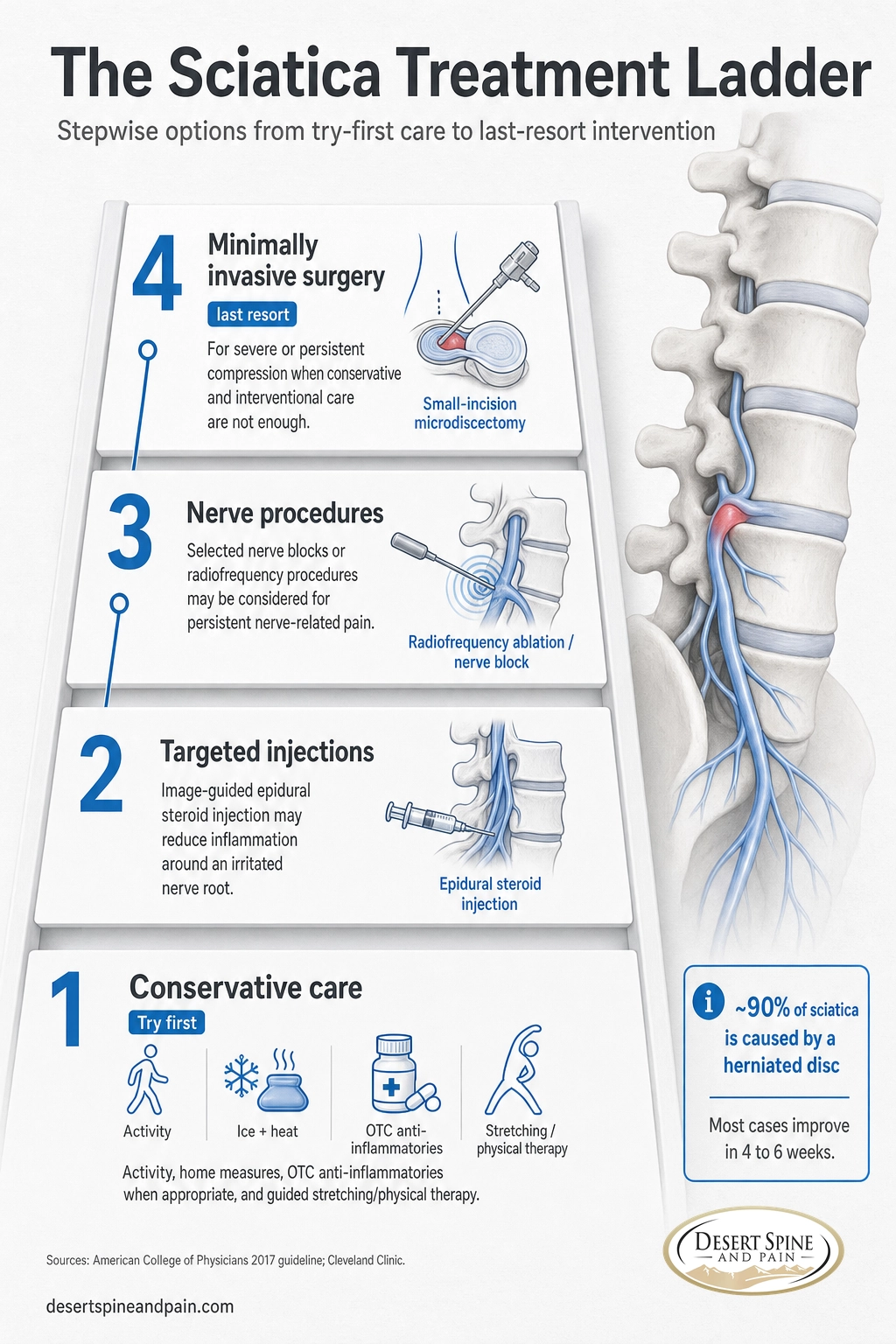
If you have given conservative care a fair trial, usually several weeks, and the leg pain is still limiting your life, the next step is not automatically surgery. A spine and pain specialist has a middle tier of targeted treatments that can calm the nerve without an operation.
Epidural steroid injections
An epidural steroid injection delivers anti-inflammatory medication directly around the irritated nerve root. For many people it breaks the pain cycle enough to let them get back to physical therapy and movement, which is where lasting recovery happens. Relief can last weeks to months and the injection can be repeated within safe limits.
Nerve blocks and ablation
When a specific nerve or joint is driving the pain, a diagnostic nerve block can confirm the source, and radiofrequency ablation can provide longer-term relief by calming the nerve that carries the pain signal. These are outpatient procedures done with imaging guidance.
Interventional pain procedures like these are a core part of how a spine practice treats stubborn sciatica. You can review the full range of interventional pain treatments and, specifically, epidural steroid injections for nerve pain.
Surgery enters the picture only when these steps are exhausted, when there is progressive weakness, or when imaging shows a problem an operation can clearly fix. Even then, modern options are often minimally invasive: a microdiscectomy, for example, removes just the fragment of disc pressing on the nerve through a very small incision.

When to Call a Professional
If you reach this point and your sciatica fits any of the situations below, it is time to stop self-treating and get a specialist evaluation:
- Significant leg or back pain that has not improved after about six weeks of consistent conservative care.
- Pain severe enough that you cannot work, sleep, or function.
- Numbness or weakness that is spreading or getting worse.
- Sciatica that keeps coming back, flare after flare.
A spine specialist can confirm what is actually compressing the nerve with imaging and build a treatment plan matched to your anatomy, not guesswork. At Desert Spine and Pain in Phoenix, every plan is directed by Dr. David L. Greenwald, a dual board-certified spine surgeon and neurosurgeon, so you get an expert read on whether you need a simple nerve-calming procedure or something more.
Red flags: go to the emergency room now
A few symptoms are never safe to treat at home. Seek emergency care immediately if you develop any loss of bladder or bowel control, numbness in the groin or inner thighs (saddle numbness), or sudden, progressive weakness in a leg or foot. These can signal cauda equina syndrome, a rare but serious emergency where the nerves at the base of the spine are compressed. It needs treatment within hours to prevent permanent damage.
Troubleshooting Common Sciatica Setbacks
Even a good recovery has rough patches. Here is how to handle the most common ones.
| Problem | Likely reason | What to do |
|---|---|---|
| Pain spikes after sitting at a desk | Sitting increases pressure on lumbar discs | Stand and walk every 30 to 45 minutes; support the lower back; review sitting posture |
| Stretching makes the leg pain worse | Too aggressive, or the wrong stretch for your cause | Ease off, keep movements gentle and pain-free, and have a physical therapist check your form |
| Better for a week, then it flares again | Returning to heavy activity too soon, or weak core and hip support | Progress gradually and prioritize strengthening, not just stretching |
| Night pain disrupts sleep | Sleep position strains the nerve | Adjust your position and pillow setup; see our sciatica sleep guide |
| No improvement at all after several weeks | The nerve compression may need direct treatment | Stop waiting and schedule a specialist evaluation |
Maintain and Prevent: Keeping Sciatica From Coming Back
Getting out of pain is half the job. Keeping it from returning is the other half, and it is where a little ongoing effort pays off for years.
Source: Cleveland Clinic: Sciatica
To protect your spine for the long run:
- Keep the core and hips strong. This is the single best insurance against another flare. Carry forward the exercises your physical therapist gave you.
- Move often. Avoid long, unbroken stretches of sitting. Get up, walk, and change positions through the day.
- Lift smart. Bend at the hips and knees, keep loads close to your body, and avoid twisting while lifting.
- Mind your sleep setup. A supportive mattress and good position take pressure off the nerve overnight.
Most people manage sciatica for good with these habits. If yours keeps returning despite doing everything right, that pattern itself is worth a conversation with a specialist, because a recurring problem often has a fixable structural cause. Learn more about whether sciatica can be cured permanently and what kind of doctor treats sciatica.
Source: American College of Physicians 2017 low back pain guideline (AFP summary)
Frequently Asked Questions
What is the fastest way to relieve sciatica pain?
How long does sciatica take to go away?
Should I rest or stay active with sciatica?
When does sciatica need surgery?
What are the warning signs that sciatica is serious?
About This Guide
This guide reflects current clinical consensus on sciatica care, including the American College of Physicians 2017 guideline on noninvasive treatment of low back pain and patient guidance from the Cleveland Clinic. It is educational and does not replace a personal evaluation by a qualified clinician. Treatment should always be matched to your diagnosis and medical history.