

Piriformis Syndrome vs. Sciatica: How to Tell the Difference
The difference in one line: Sciatica is a symptom, leg pain traveling along the sciatic nerve, and most of the time it comes from a pinched nerve in the lower spine. Piriformis syndrome is one specific muscle-based cause of that same leg pain, coming from the buttock rather than the spine. So the real question is usually not "piriformis or sciatica," but "is my sciatica coming from my spine or from my piriformis muscle?"
If you have searched "piriformis syndrome vs. sciatica," you are almost certainly dealing with pain that runs from your buttock down your leg and trying to figure out what is causing it. The confusion is understandable, because the two terms are not opposites. Sciatica describes the symptom (irritation of the sciatic nerve), while piriformis syndrome describes one particular reason that nerve gets irritated. Telling them apart matters, because where the pressure on the nerve is coming from, your spine or a muscle in your buttock, changes which tests you need and which treatments actually work. This guide lays the two side by side, explains how a specialist separates them, and shows when leg or buttock pain deserves a prompt look.
- Sciatica is a symptom, not a diagnosis. It means pain, tingling, or weakness along the sciatic nerve, usually down one leg, and it always has an underlying cause.
- Most sciatica starts in the spine. A lumbar herniated disc or narrowing (stenosis) pinches a nerve root, and research suggests up to 90 percent of sciatica traces back to a herniated disc.
- Piriformis syndrome is a buttock-based cause. The piriformis muscle irritates the sciatic nerve where it passes through the hip, producing sciatica-like pain without a spine problem.
- Location and sitting are big clues. Spinal sciatica often begins with back pain radiating down the leg, while piriformis pain centers deep in the buttock and classically worsens after sitting.
- They can overlap, and the diagnosis is clinical. Piriformis syndrome is diagnosed mainly by exam after spinal causes are ruled out, so a proper evaluation is the only reliable way to be sure.

What's in This Guide
- The Core Difference: A Symptom vs. One of Its Causes
- What Sciatica Actually Is
- What Piriformis Syndrome Actually Is
- Symptoms Side by Side
- How Common Is Each One?
- How a Specialist Tells Them Apart
- Piriformis Syndrome vs. Sciatica at a Glance
- How Each Is Treated
- Which One Is More Likely in Your Case?
- How to Get Started
- Common Questions
- Sources
The Core Difference: A Symptom vs. One of Its Causes
The single idea that clears up most of the confusion is this: sciatica and piriformis syndrome are not two versions of the same thing, and they are not opposites. One is a symptom and the other is a cause.
Sciatica is the name for a pattern of symptoms, pain, numbness, tingling, or weakness that travels along the path of the sciatic nerve, the largest nerve in the body, which runs from the lower spine through the buttock and down the back of each leg. Saying you "have sciatica" is a bit like saying you "have a cough." It tells you where the trouble shows up, not what is causing it.
Piriformis syndrome is one of the possible causes of that symptom. The piriformis is a small muscle deep in the buttock, and the sciatic nerve passes right next to it, in some people even through it. When the piriformis tightens, spasms, or thickens, it can press on the nerve and set off sciatica-like pain. In that case the problem is in the buttock, not the spine.
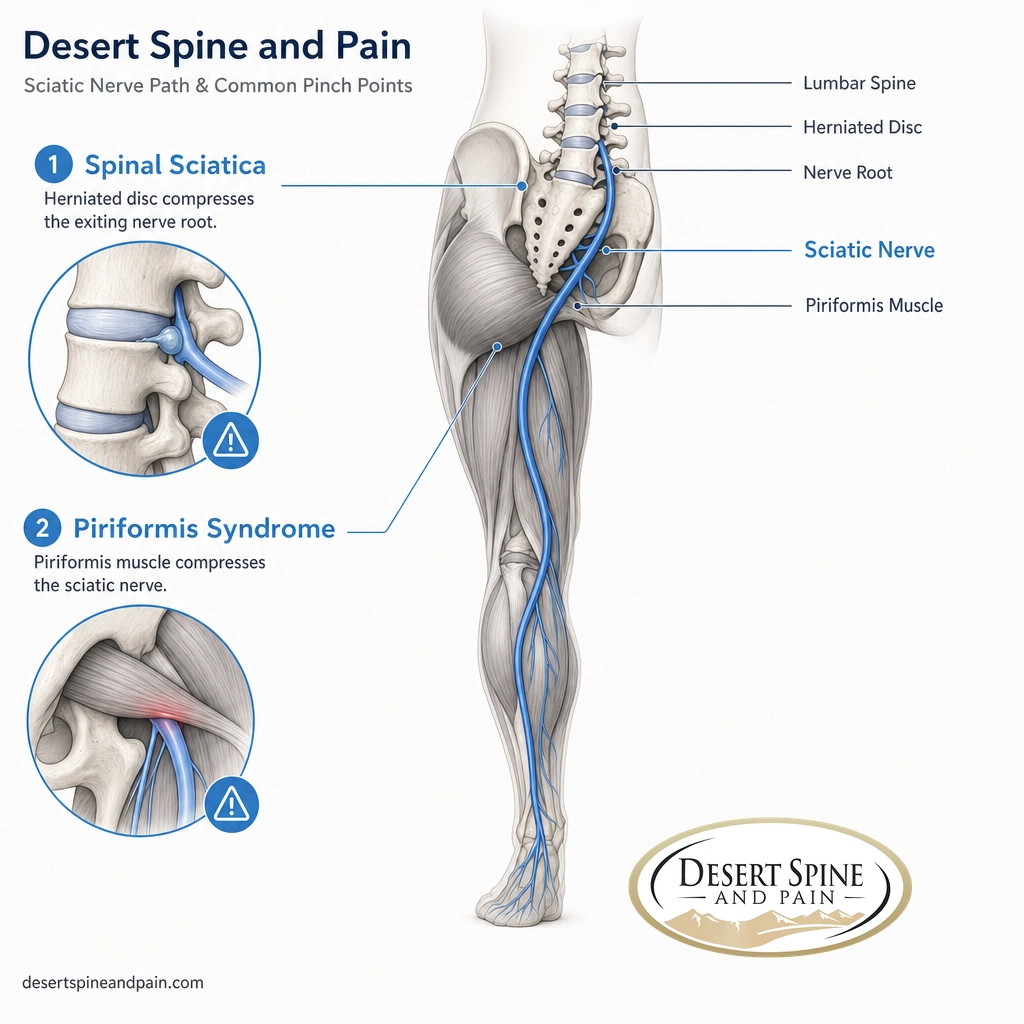
Here is why that distinction is the whole game. The far more common source of sciatica is the spine itself: a herniated or bulging disc, bone spurs, or stenosis pinching a nerve root as it leaves the lower back. That is sometimes called "true" sciatica or radicular pain, because the nerve is compressed at its root. Piriformis syndrome produces similar leg pain, but by squeezing the nerve much farther along its path, out in the buttock. Same nerve, same kind of pain, completely different location and completely different fix.
Source: Cleveland Clinic: Sciatica | Cleveland Clinic: Piriformis Syndrome
What Sciatica Actually Is
When clinicians use the word sciatica precisely, they mean leg pain caused by irritation or compression of the sciatic nerve or the nerve roots that form it in the lower spine. The classic description is pain that starts in the lower back or buttock and shoots down the back or side of one leg, sometimes all the way to the foot, often with pins-and-needles, numbness, or weakness along the way. It is usually on one side.
The reason the spine is the usual suspect is simple anatomy. The sciatic nerve is built from nerve roots that exit the lower lumbar and sacral spine, and those roots are vulnerable exactly where they pass the discs and the bony openings of the spinal canal. A disc that bulges or herniates can press directly on a root, and most research points to disc herniation as the leading culprit.
Because this kind of sciatica comes from a compressed nerve root, it often brings telltale neurological features: numbness in a defined band of skin, a weak specific muscle (such as difficulty lifting the foot), or a reduced reflex. The good news is that even true sciatica usually calms down. Many cases ease within a few weeks of conservative care, and surgery is the exception rather than the rule.
If you want the fuller picture of the symptom itself, our companion guides cover what sciatica is and the common causes behind it in more depth.
Source: Spine-health: Sciatica Causes | Cleveland Clinic: Sciatica
What Piriformis Syndrome Actually Is
Piriformis syndrome is pain and sciatic-nerve irritation that come from the piriformis muscle rather than the spine. The piriformis sits deep in the buttock, running from the sacrum to the top of the thigh bone, and it helps rotate the hip outward. The sciatic nerve runs directly beneath it, and in a minority of people the nerve actually threads through or above the muscle instead of passing cleanly below it. When the piriformis becomes tight, inflamed, or goes into spasm, it can compress or irritate that nearby nerve.
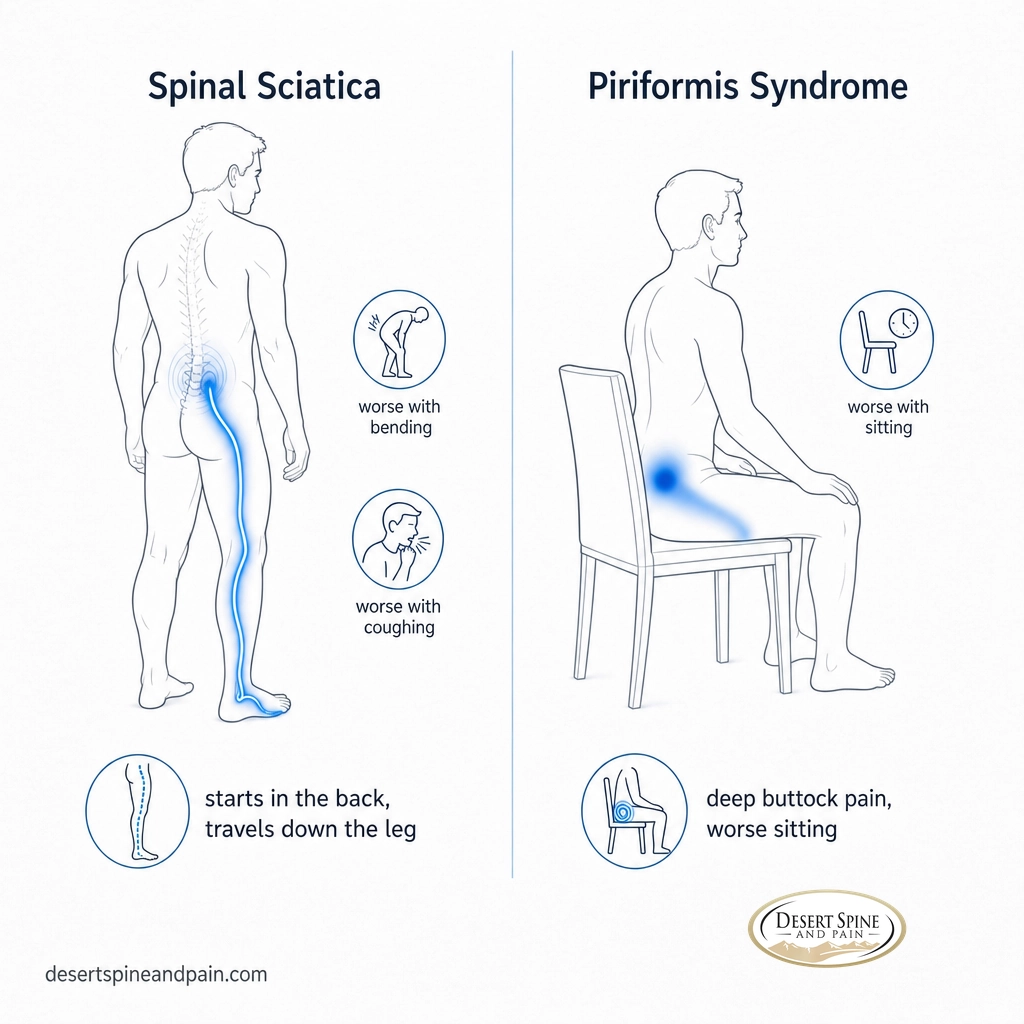
The result is pain that feels a lot like spinal sciatica, but with a different signature. The ache tends to sit deep in the buttock, and it often radiates down the back of the thigh. What stands out is the connection to the hip and to sitting: pain commonly flares after sitting for a long stretch, on hard surfaces, or with activities that load the hip rotators, such as climbing stairs, running, or getting in and out of a car. Many people also feel tenderness if they press into the middle of the buttock.
Piriformis syndrome is also, frankly, a diagnosis that doctors approach with care. There is no single blood test or scan that confirms it, and its symptoms mimic spinal causes closely, so it is generally identified only after a careful exam and after a disc or stenosis in the spine has been ruled out. That is a key practical difference from true sciatica, where an MRI can often show the compressed root directly.
Source: Cleveland Clinic: Piriformis Syndrome
Symptoms Side by Side
No single symptom proves which problem you have, but the overall pattern is usually the fastest clue. Spinal sciatica tends to start higher, in the back, and follow the leg in a defined line. Piriformis pain tends to sit lower and deeper, in the buttock, and track with sitting and hip movement.
| Symptom pattern | Spinal Sciatica (disc or stenosis) | Piriformis Syndrome |
|---|---|---|
| Where pain starts | Lower back, radiating down the leg | Deep in the buttock, sometimes down the thigh |
| Low back pain | Often present | Usually minimal or absent |
| What makes it worse | Bending, coughing, sneezing, straining | Prolonged sitting, hard surfaces, hip rotation |
| Tenderness | Not focal in the buttock | Point tenderness over the mid-buttock |
| Numbness or weakness | Often in a defined nerve-root pattern | Less defined, more of an ache or tingling |
| How far pain travels | Can reach below the knee to the foot | Often stays in the buttock and upper leg |
Myth: "Pain down my leg always means a disc problem." Not necessarily. The sciatic nerve can be irritated anywhere along its path, and the buttock is one of those places. Assuming every case of leg pain is a herniated disc can send someone down the wrong treatment road, chasing the spine when the real trouble is a tight muscle, or ignoring the spine when a disc genuinely needs attention. The location and triggers of the pain matter as much as the fact that it travels.
How Common Is Each One?
Context helps here, because the two are not remotely equal in frequency. Sciatica as a symptom is common, and something most people will brush up against at some point in adult life. Spinal causes dominate that picture. Piriformis syndrome, by contrast, is uncommon and accounts for only a small slice of the people who show up with buttock and leg pain.
Those two facts, that most sciatica is spinal and that piriformis syndrome is rare, are exactly why a good evaluation does not jump to the muscle first. It starts by taking the more common and more consequential spinal causes seriously, then considers piriformis syndrome when the spine comes back clear and the buttock-and-sitting pattern fits. It also means that if you have been told you have piriformis syndrome but never improve, it is reasonable to ask whether the spine was fully evaluated.
Source: Cleveland Clinic: Piriformis Syndrome
How a Specialist Tells Them Apart
Symptoms point the way, but the physical exam and imaging are where the two genuinely separate. A specialist is essentially asking one question: is the sciatic nerve being pinched at its root in the spine, or out in the buttock by the piriformis?
Several exam maneuvers help answer it. For a spinal cause, the classic is the straight-leg raise: lying flat while the leg is lifted, and reproducing the shooting leg pain suggests nerve-root irritation from a disc. For the piriformis, specialists use provocative tests that load or stretch that specific muscle:
- FAIR test (flexion, adduction, internal rotation). The hip is placed in a position that stretches the piriformis across the nerve; reproducing the buttock pain points toward the muscle.
- Pace sign. Pain and weakness when the patient pushes the knees apart against resistance, which activates the piriformis.
- Freiberg sign. Pain when the hip is passively rotated inward, stretching the muscle.
- Point tenderness. Deep pressure over the piriformis near the sciatic notch recreates the familiar ache.
Imaging then plays a defining role, but in opposite directions for the two problems. For suspected spinal sciatica, an MRI can show a herniated disc or stenosis pressing on a nerve root, confirming the source. For piriformis syndrome, imaging is used mostly to rule the spine out: the MRI of the lower back often looks unremarkable, and the diagnosis is made clinically from the exam and the pattern. As with any spine imaging, a scan is always read alongside your symptoms and exam, never on its own.
Source: Cleveland Clinic: Piriformis Syndrome | AAOS OrthoInfo: Sciatica

Piriformis Syndrome vs. Sciatica at a Glance
Here is the full comparison in one place. Remember that spinal sciatica and piriformis syndrome both irritate the same nerve, so no single row is decisive on its own. Together, though, they capture how differently the two behave.
| Feature | Spinal Sciatica | Piriformis Syndrome | What it tells you |
|---|---|---|---|
| Nature of the problem | A symptom of a pinched nerve root | A cause of sciatic-nerve irritation | Symptom vs. one of its causes |
| Where the nerve is pinched | At the root, in the lower spine | In the buttock, by the muscle | The root of every other difference |
| Usual cause | Herniated disc, stenosis, bone spurs | Tight or spasming piriformis muscle | Spine vs. soft tissue |
| Pain location | Back and down the leg | Deep in the buttock | Higher and radiating vs. lower and focal |
| Worse with | Bending, coughing, straining | Sitting, hard surfaces, hip rotation | Different triggers |
| How it is confirmed | MRI can show the compressed root | Clinical exam after ruling out the spine | Direct vs. diagnosis of exclusion |
| How common | The usual source of sciatica | Roughly 0.3% to 6% of low back pain | Common vs. uncommon |
How Each Is Treated
Both conditions start with the least invasive effective care, and both respond to it most of the time. The difference is what the treatment targets: the irritated nerve root and disc for spinal sciatica, and the muscle itself for piriformis syndrome.
Treating spinal sciatica
Care usually begins with the simplest steps and escalates only if needed, in keeping with a least-invasive-first philosophy. A typical path can include:
- Activity changes and time. Short-term adjustment of movements that aggravate the nerve while the inflammation settles.
- Guided physical therapy. A structured program, coordinated through trusted referral partners, to take pressure off the nerve root and restore movement, part of non-surgical spine care.
- Medication. Anti-inflammatory and nerve-calming options to control symptoms during recovery.
- Targeted injections. When leg pain persists, an image-guided epidural steroid injection can reduce inflammation around the irritated root.
- Surgery, only if needed. Reserved mainly for sciatica that does not improve or that causes meaningful weakness, often through a focused, minimally invasive procedure to relieve the disc pressure.
Treating piriformis syndrome
Because the trouble is muscular, treatment focuses on relaxing and freeing the piriformis so it stops pressing on the nerve:
- Stretching and therapy. Specific piriformis and hip-rotator stretches and a rehab program are the backbone of care. Our guide to stretches that relieve sciatic pain covers several that target this muscle.
- Activity and posture changes. Breaking up long periods of sitting, cushioning hard seats, and easing aggravating hip activities.
- Medication. Anti-inflammatories and, at times, muscle relaxants to calm the spasm.
- Targeted injections. When conservative care stalls, a trigger-point injection into the piriformis, or a botulinum-toxin injection to relax the muscle, can relieve the pressure on the nerve.
- Surgery, rarely. Operating to release the muscle is uncommon and reserved for the small number of cases that do not respond to everything else.
This is the practical payoff of getting the diagnosis right. Stretching and injecting a muscle will not fix a herniated disc, and spine-directed care will not loosen a tight piriformis. Matching the treatment to the true source is what turns months of frustration into real relief.
Source: Cleveland Clinic: Piriformis Syndrome | Cleveland Clinic: Sciatica
Which One Is More Likely in Your Case?
These profiles are not a substitute for an exam, but they capture the typical picture each problem presents.
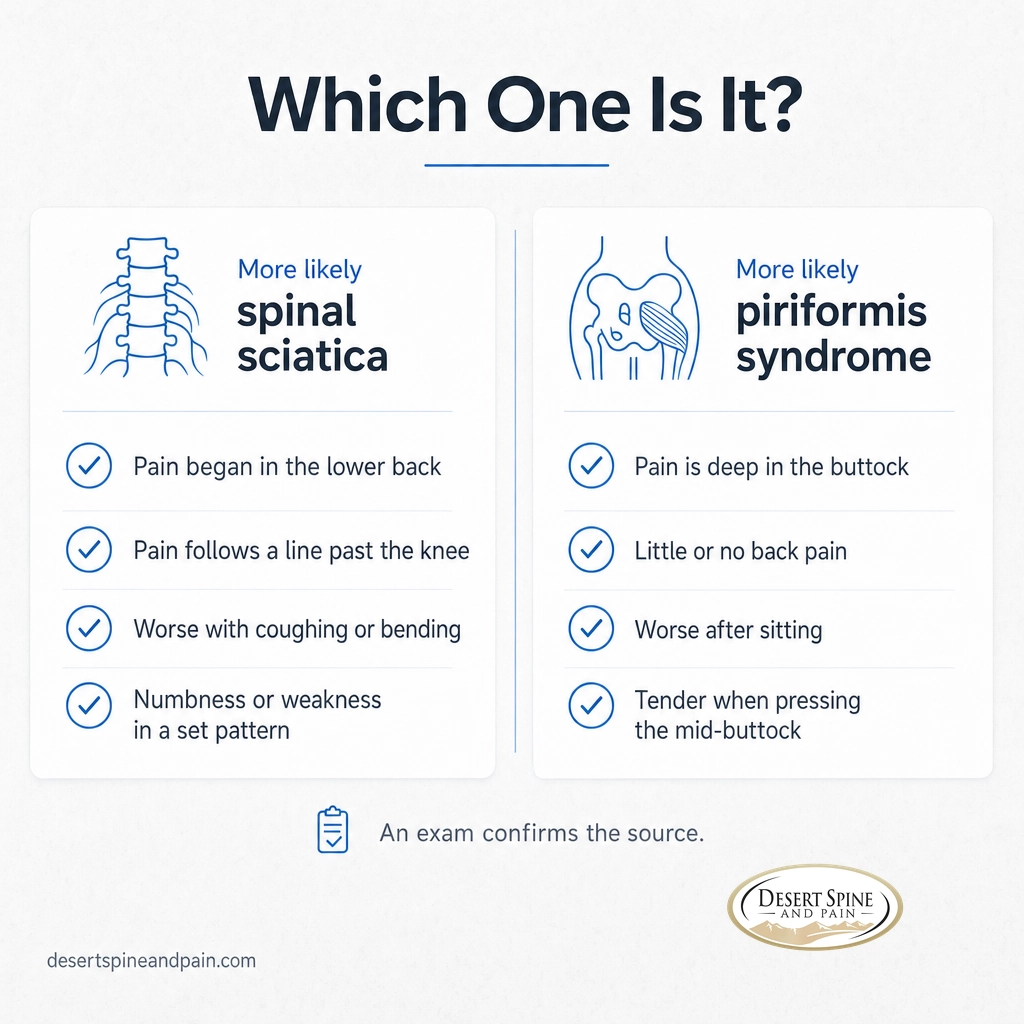
It is more likely spinal sciatica when
- Your pain began in the lower back and then traveled down the leg.
- The pain follows a clear line, sometimes reaching below the knee to the foot.
- Coughing, sneezing, bending, or straining makes the leg pain worse.
- You notice numbness or weakness in a specific pattern, such as a weak foot.
It is more likely piriformis syndrome when
- The pain sits deep in the buttock, with little or no back pain.
- Sitting for a while, especially on a hard surface, clearly brings it on.
- Pressing into the middle of your buttock reproduces the familiar ache.
- Hip movements like climbing stairs or getting out of a car aggravate it.
Seek urgent care for red flags. Rapidly worsening leg weakness, numbness in the groin or inner thighs (the "saddle" area), or any new loss of bladder or bowel control can signal serious nerve compression such as cauda equina syndrome, and should be evaluated immediately, not watched at home. These situations are uncommon, but they are the ones where timing matters most.
How to Get Started
If buttock or leg pain has settled in and you are not sure whether it is coming from your spine or your hip, the most useful next step is a focused evaluation that connects your symptoms and exam to the right imaging and sorts out the true source. That answer is what determines whether you need spine-directed care, muscle-directed care, or a combination, and it is also the right time to ask about least-invasive options before anyone discusses surgery.
Desert Spine and Pain is a Phoenix, Arizona practice led by Dr. David L. Greenwald, MD, FACS, a board-certified surgeon who is both a spine surgeon and a neurosurgeon. The practice draws patients from across the Greater Phoenix area and beyond, and care always starts with the least invasive effective option, moving toward a procedure only when it is genuinely the best path. If you have a confusing diagnosis or a plan that has not helped, it is also a sensible moment for a second opinion. You can also learn which kind of doctor treats sciatica before you book.
Explore the spine and nerve conditions we treat
See non-surgical treatment options
Book a consultation or second opinion
Common Questions About Piriformis Syndrome and Sciatica
What is the difference between piriformis syndrome and sciatica?
How do I know if my pain is coming from my spine or my piriformis muscle?
Can piriformis syndrome cause sciatica?
What test is used to diagnose piriformis syndrome?
Is piriformis syndrome treated differently from spinal sciatica?
Sources
Sources and Methodology
This guide summarizes established clinical references on sciatica and piriformis syndrome. The figure that up to 90 percent of sciatica is caused by a lumbar herniated disc is reported by Spine-health, citing Kumar (2011). The estimate that piriformis syndrome accounts for roughly 0.3 percent to 6 percent of lower back pain, and the typical four-to-six-week improvement window for sciatica, are reported by the Cleveland Clinic. Figures are presented as general reference, not individual predictions. This is educational information, not medical advice. Decisions about diagnosis and treatment should be made with a qualified spine specialist after an in-person evaluation.