

What Does Sciatica Feel Like? Symptoms and Where It Hurts
Sciatica usually feels like a burning or electric-shock pain that shoots from your lower back or buttock down the back of one leg, often reaching the foot and toes. Alongside the pain, you may feel tingling or pins and needles, numbness, or weakness in the same leg. It almost always affects one side at a time, and the leg pain is typically worse than any back pain. Here is exactly what the sensations feel like, where the pain travels, how to tell it apart from ordinary back pain, and the warning signs that mean you should not wait.
- Sciatica classically feels like a burning or electric-shock pain that shoots down one leg (Cleveland Clinic).
- It often comes with tingling (pins and needles), numbness, or weakness in the same leg (NHS).
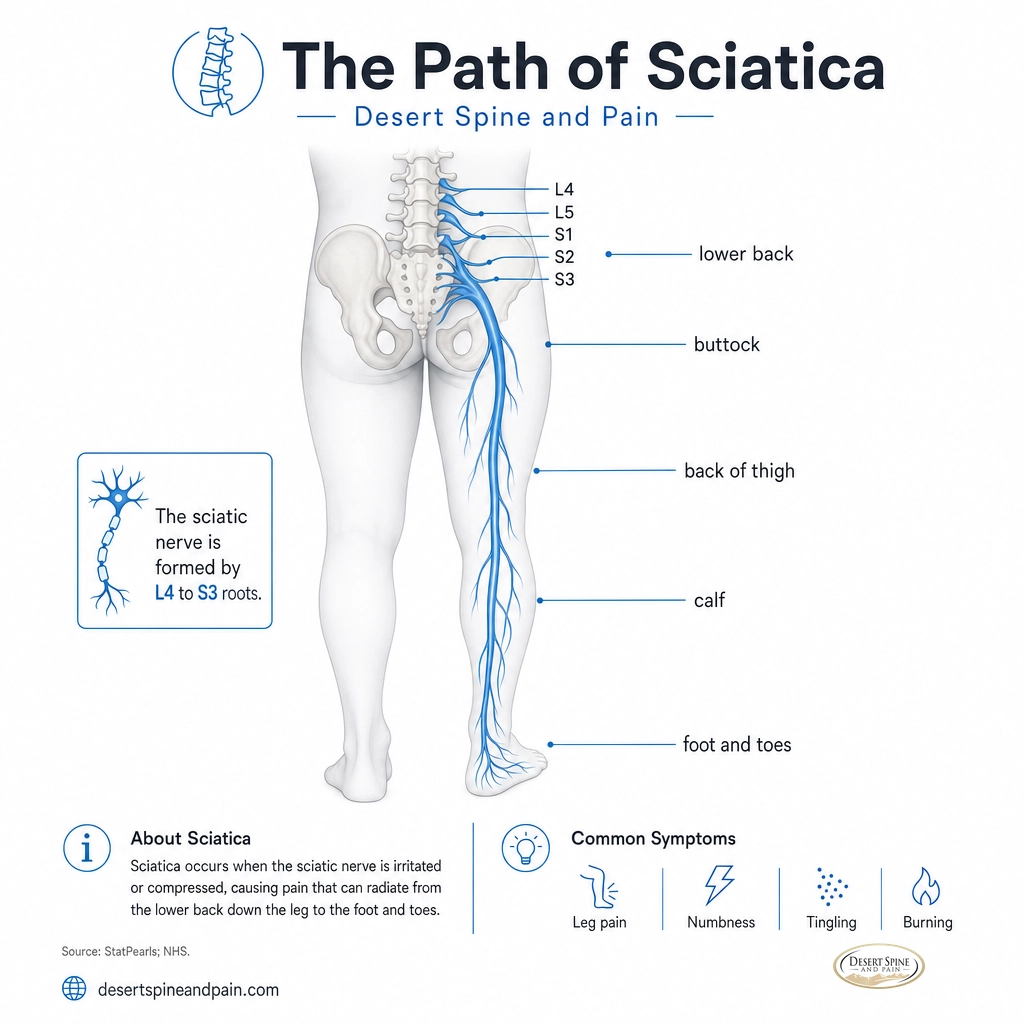
- The pain follows the sciatic nerve: lower back, buttock, back of thigh, calf, foot and toes (NHS).
- It usually affects one leg at a time, and the leg pain is typically worse than the back pain.
- Symptoms range from mild to severe and can start suddenly or build gradually.
- Pain often flares with coughing, sneezing, bending, or long sitting.
- Red flags are an emergency: sciatica in both legs, saddle numbness, or loss of bladder or bowel control.

What's in This Guide
- What Sciatica Feels Like, in One Sentence
- The Sensations: Burning, Electric, Tingling, Numb
- Where Sciatica Hurts: The Path Down Your Leg
- Which Part Hurts Depends on Which Nerve
- Why It's Usually Just One Side
- What Makes the Feeling Worse
- What Sciatica Does Not Feel Like
- When the Feeling Is an Emergency
- Frequently Asked Questions
- Methodology and Sources
What Sciatica Feels Like, in One Sentence
In one sentence: Sciatica is pain along the path of the sciatic nerve, and it classically feels like a burning or electric-shock sensation that shoots from the lower back or buttock down one leg, often with tingling, numbness, or weakness in that same leg.
The word people reach for most is "shooting." According to the Cleveland Clinic, sciatica often feels like a burning or electric-shock sensation that travels down one leg. The NHS describes it as a sharp, burning pain down the back of the leg. That radiating, travels-down-the-leg quality is the signature of sciatica, and it is what separates it from a dull backache that stays put.
It helps to know what is actually being irritated. The sciatic nerve is the body's largest nerve, formed by nerve roots from L4 to S3 in the lower spine. It runs from the base of the spine through the buttock and down each leg, and at its widest it can reach around 2 cm across. When one of those roots, or the nerve itself, is compressed or inflamed, the signal you feel is pain and altered sensation all the way along its route. That is why a problem in your back can be felt most strongly in your foot.
Not sure the pain you have is sciatica at all? Our companion explainer on what sciatica is covers the definition in full, and the spine conditions we treat page shows where it fits among related problems.
Explore the spine conditions we treat
Source: Cleveland Clinic, Sciatica | StatPearls, Sciatica
The Sensations: Burning, Electric, Tingling, Numb
Sciatica is not one single feeling. Most people describe a mix of sensations that can shift from hour to hour and day to day. Recognizing them as a group is often the first clue that a nerve, rather than a muscle, is the source.
The sensations people describe most
- Burning or electric shock. A hot, searing, or jolting pain that fires down the leg. The Cleveland Clinic lists this burning or electric-shock quality as a hallmark of sciatica.
- Shooting or sharp pain. Pain that feels like it runs in a line, rather than a dull ache that sits in one spot. It can be brief and stabbing or a longer, searing run down the leg.
- Tingling or pins and needles. A prickling, fizzing, or "leg has fallen asleep" feeling, described by the NHS as tingling, in the leg or foot.
- Numbness. A patch of the leg or foot that feels dulled, wooden, or less sensitive to touch.
- Weakness. The leg or foot feeling heavy, unreliable, or hard to control, such as a foot that catches or slaps when you walk.
These can appear alone or together, and they can come on suddenly or build up gradually. A mild case might be a faint tingle and occasional twinge. A severe case can be a relentless, electric pain that makes sitting, standing, or sleeping difficult. The NHS notes that symptoms range from mild to severe, which matches what we hear from patients: there is no single "normal" level of sciatica.
If what you feel is mostly numbness and tingling with little pain, that still counts. Sciatica is defined by the nerve being involved, not by how loud the pain is.
Source: Cleveland Clinic, Sciatica | NHS, Sciatica
Where Sciatica Hurts: The Path Down Your Leg
This is the question that brings most people here: where exactly does sciatica hurt? The answer is that it follows the nerve. The NHS describes symptoms that usually affect your bottom and the back of one leg, often including the foot and toes. A typical episode traces a route like this:
The usual route sciatica travels
- Lower back. Many episodes start here, though the back pain is often milder than what follows.
- Buttock. A deep, aching or burning pain in one side of the buttock is extremely common, and for some people it is the loudest spot of all.
- Back of the thigh. The pain or tingling runs down the back of the thigh, usually in a line rather than spread across the whole leg.
- Calf. It continues down into the calf or the side of the lower leg.
- Foot and toes. Many people feel it reach the foot and toes as tingling, numbness, or pain, depending on the nerve involved.
A key tell is that the leg pain is usually worse than the back pain. The NHS points out that while back pain can occur with sciatica, it is often less severe than the pain, numbness, or tingling in the leg. If your leg hurts more than your back, that pattern actually fits sciatica well. For the buttock-centered version specifically, see our guide on what causes sciatica buttock pain.
The sensation does not have to fill the entire route. Some people feel it only in the buttock and calf and nothing in between, because the nerve signal is most affected at certain points. The line it draws, from the back or buttock toward the foot, is the pattern that matters.
Source: NHS, Sciatica
Which Part Hurts Depends on Which Nerve
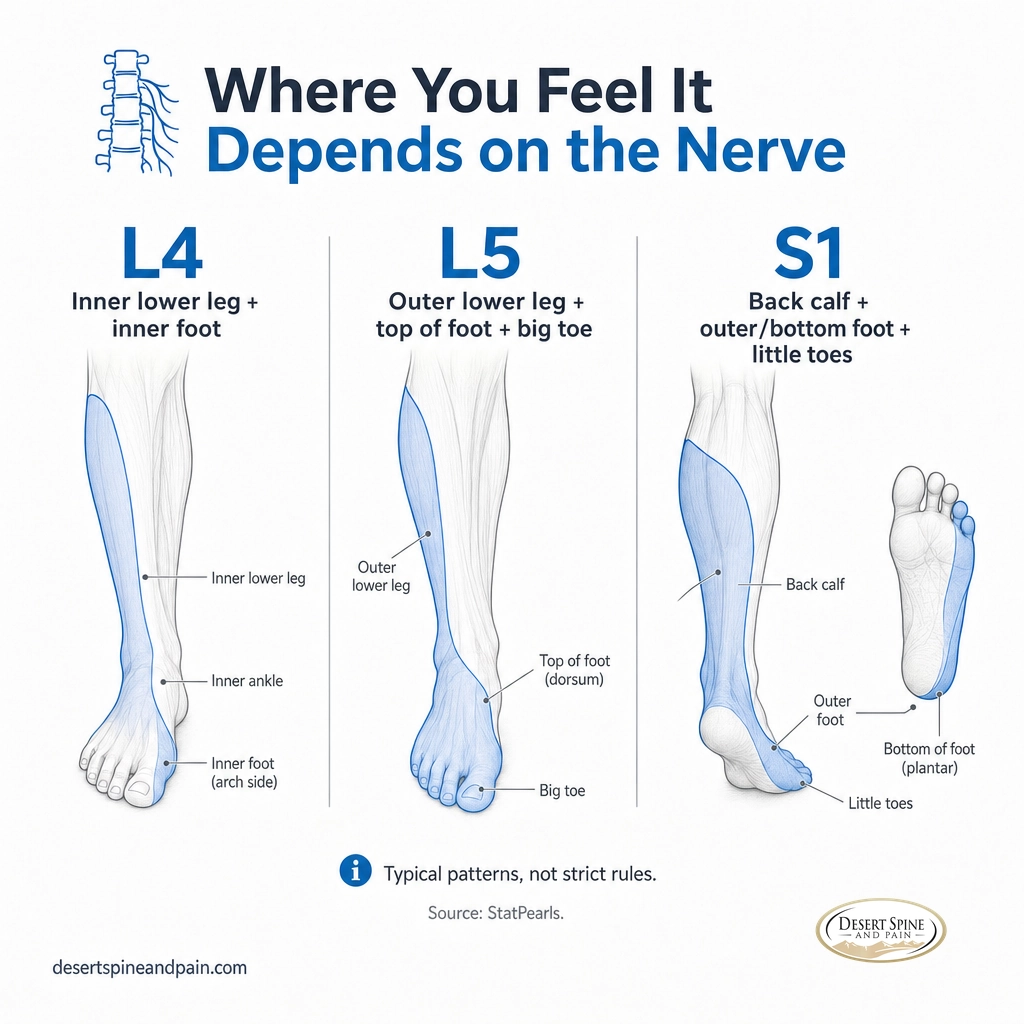
Because the sciatic nerve is built from several nerve roots, where you feel it most can hint at which root is irritated. Clinicians use this general mapping as one clue during an exam. These are typical patterns, not strict rules, and only a proper evaluation can confirm the level.
| Nerve root | Where the sensation is often felt | Possible weakness |
|---|---|---|
| L4 | Front of the thigh, inner lower leg, and inner foot | Straightening the knee; the "knee gives way" feeling |
| L5 | Outer lower leg, top of the foot, and the big toe | Lifting the foot or big toe; a foot that drops or slaps |
| S1 | Back of the thigh and calf, outer and bottom of the foot, little toes | Pushing off, standing on tiptoe; a weak ankle |
This is why two people can both have "sciatica" and point to completely different parts of the foot. One feels it along the top of the foot and big toe, another along the outer edge and heel. The nerve root under pressure, often from a herniated disc or another cause of sciatica, is what sets the address. A dual-trained spine surgeon and neurosurgeon can map your symptom pattern to the likely level and confirm it with imaging when needed.
Learn about diagnostic nerve testing
Source: StatPearls, Sciatica

Why It's Usually Just One Side
One of the most reliable features of sciatica is that it is one-sided. Both the Cleveland Clinic and the NHS note that sciatica usually affects one leg at a time. There is a sciatic nerve on each side of the body, and a typical problem, such as a disc pressing on a root, is on one side, so the symptoms are too.
That one-sidedness is a useful self-check. A burning line running down your right leg while the left feels normal is a classic sciatica pattern. Symmetrical aching across your whole lower back, or pain in both legs equally, points somewhere else and, in the case of both legs, can be a reason to seek urgent care (see the red flags below).
Myth: "If my whole lower back aches, it must be sciatica."
Not necessarily. Generalized, both-sided low back ache is more often a muscular or general back problem than true sciatica. Sciatica is specifically nerve pain that radiates along the sciatic nerve, usually down one leg, with the leg pain often louder than the back pain. Mislabeling every backache as sciatica is a common mistake, and it can send people down the wrong treatment path. If you are not sure which you have, an exam settles it quickly.
Source: Cleveland Clinic, Sciatica | NHS, Sciatica
What Makes the Feeling Worse
Sciatica tends to have triggers, and noticing yours is part of describing it accurately to a provider. The common ones raise pressure on the already-irritated nerve root.
Common things that flare sciatica
- Coughing and sneezing. A sudden spike in pressure can send a fresh jolt down the leg. The Cleveland Clinic lists coughing and sneezing among the actions that worsen sciatica.
- Bending and twisting. Movements that load or rotate the lower spine often amplify the pain.
- Lifting your legs while lying on your back. This stretches the nerve and frequently reproduces the symptoms.
- Long periods of sitting. Many people find that prolonged sitting is one of the worst positions for sciatica.
The flip side is that gentle movement and position changes often help more than staying still. If you want the practical day-to-day strategies, our guides on how to treat sciatica and how long sciatica lasts cover what to expect and what helps during a flare.
See conservative, non-invasive care optionsSource: Cleveland Clinic, Sciatica
What Sciatica Does Not Feel Like
Just as important as knowing what sciatica feels like is knowing what it does not. Several common problems get called sciatica by mistake because they also cause pain around the lower back, hip, or leg.
| What it is | How it usually feels | How it differs from sciatica |
|---|---|---|
| True sciatica | Burning, electric, shooting pain down one leg, often with tingling or numbness, leg pain worse than back pain | Follows the sciatic nerve path; one-sided; radiates toward the foot |
| Ordinary low back strain | Dull, aching, or stiff pain that stays mainly in the back | Does not shoot down the leg in a line; little or no leg numbness |
| Piriformis syndrome | Deep buttock pain that can mimic sciatica, sometimes with leg symptoms | Comes from a muscle irritating the nerve, not a spinal root; often eased by hip and glute work |
| Hip joint problems | Groin or outer-hip pain, worse with weight-bearing | Centered on the hip and groin, not a line down the back of the leg to the foot |
The one that trips people up most is piriformis syndrome, because the buttock and leg symptoms can look almost identical from the outside. The underlying problem is different, though, and so is the fix. Our side-by-side breakdown of piriformis syndrome versus sciatica walks through how to tell them apart. When the picture is unclear, the right move is an exam rather than a guess, which is where the right kind of doctor for sciatica earns their keep.

Source: StatPearls, Sciatica | Cleveland Clinic, Sciatica
When the Feeling Is an Emergency
Most sciatica is miserable but not dangerous, and the majority of cases improve with time and conservative care. A small set of symptoms are different, though, and they are the reason this section exists. If sciatica ever feels like any of the following, it is an emergency.
Emergency signs: get help immediately
Seek emergency care right away if you develop any of these, which the NHS flags as needing immediate hospital attention:
- Numbness around or under your genitals, or around your bottom (the anus)
- Trouble starting to urinate, an inability to urinate, or loss of control over when you urinate
- Loss of control over your bowels, or not noticing when you need to go
- Sciatica on both sides at once, or severe or worsening weakness or numbness in both legs
These can be signs of cauda equina syndrome, a rare but serious compression of the nerves at the base of the spine. It is a surgical emergency, and fast treatment protects long-term bladder, bowel, and leg function. Do not wait to see if it passes.
Short of an emergency, book a visit if the pain has not improved after a few weeks of home care, is getting worse rather than better, or is stopping you from your normal activities. A focused evaluation can pinpoint which nerve is involved and why. Dr. David L. Greenwald, MD, FAANS, FACS, is both a spine surgeon and a neurosurgeon, so the full range of options, from conservative care to minimally invasive surgery, is assessed by one expert rather than scattered across several.
Book a consultation: (602) 566-9500Source: NHS, Sciatica
Frequently Asked Questions
What does sciatica feel like?
Where does sciatica hurt?
Can sciatica affect both legs at once?
What makes sciatica pain worse?
How do I know if my leg pain is sciatica or something else?
Methodology and Sources
The symptom descriptions, pain locations, and anatomy in this article are drawn from major clinical authorities and a peer-reviewed clinical reference. The nerve-level map is presented as the general clinical pattern, not a strict rule, and the article states that only an in-person evaluation can confirm which nerve root is involved. No blog-to-blog citations are used.
Primary sources:
- Cleveland Clinic, Sciatica: the burning and electric-shock quality, one-sided involvement, mild-to-severe range, and the coughing, sneezing, and bending triggers.
- NHS, Sciatica: the sharp, burning pain down the back of the leg, tingling, numbness, and weakness, the pain locations (bottom, back of one leg, foot and toes), leg pain being worse than back pain, and the emergency red-flag symptoms.
- StatPearls (NCBI Bookshelf), Sciatica: the definition of sciatica as pain or paresthesia in the distribution of the sciatic nerve or lumbosacral nerve root, the L4 to S3 nerve roots, and the sciatic nerve being the body's largest nerve at up to 2 cm in diameter.
This article is for general educational purposes and is not individual medical advice. The sensations and locations describe typical patterns, not any one person. If you have leg or back pain that is not improving, is worsening, or is accompanied by any red-flag symptom, consult a qualified provider promptly.
Media and press: Journalists and researchers are welcome to cite the descriptions in this guide with attribution to the original primary source named alongside each one, and a link to this page as the compiled reference. For commentary from a board-certified spine surgeon and neurosurgeon, contact Desert Spine and Pain in Phoenix, Arizona at (602) 566-9500.