

What Is Myelopathy? Causes, Symptoms, and Treatment
Myelopathy, defined: Myelopathy is any loss of spinal cord function caused by something compressing or injuring the cord itself, most often in the neck. It can produce clumsy hands, numbness, and an unsteady walk, frequently with little pain. Because the spinal cord does not heal easily, myelopathy is evaluated with urgency.
If an MRI report or a doctor has mentioned myelopathy, it can sound alarming and unfamiliar. The word means the spinal cord is not working properly because something is pressing on it or has damaged it. That single fact, that the problem is the cord and not just a pinched nerve, explains almost everything about myelopathy: why the symptoms are more about clumsy hands and balance than pain, why it tends to progress instead of settling down, and why specialists treat it with more urgency than a routine neck complaint. This guide walks through what myelopathy is, what causes it, the warning signs to watch for, how it is diagnosed and graded, and the treatment options from conservative care to surgical decompression.
- Myelopathy is spinal cord compression. It is not a pinched nerve root (that is radiculopathy); it is pressure on the cord itself, which carries signals to everything below the level of injury.
- The neck is the usual site. Degenerative cervical myelopathy, from age-related wear in the neck, is the most common form and the leading cause of spinal cord impairment in adults.
- It is often painless early. The hallmark signs are clumsy hands, trouble with fine tasks, and an unsteady walk, not neck pain, which is why it is so often missed.
- It tends to progress. Unlike a pinched nerve, myelopathy usually does not improve on its own, and cord damage can become permanent, so timing matters.
- Treatment protects function. Mild cases may be monitored, but moderate or worsening myelopathy is usually treated with surgery to decompress the cord before further damage sets in.

What's in This Guide
What Myelopathy Actually Is
To understand myelopathy, it helps to picture what the spine protects. Running down the center of the spinal column is the spinal cord, a thick bundle of nervous tissue that carries signals between the brain and the rest of the body. Branching off the cord at every level are nerve roots, individual nerves that exit the spine and travel out to a specific patch of skin and a specific set of muscles. Myelopathy is a problem with the main cord. A problem with one of the branching roots is a different condition called radiculopathy.
The word itself breaks down cleanly: "myelo" refers to the spinal cord, and "pathy" means disease or dysfunction. So myelopathy literally describes any condition in which the spinal cord is not functioning the way it should. Most of the time that dysfunction comes from compression, when discs, bone, or ligaments crowd the cord and squeeze it. Less often it comes from injury, inflammation, or disease within the cord itself.
Where the compression sits on the cord matters, because the spinal cord does not run the entire length of the back. In most adults it ends around the first or second lumbar vertebra, high in the lower back. Below that point there is no cord to compress, only a bundle of nerve roots, which is why pressure low in the lumbar spine causes nerve-root problems rather than true myelopathy. That anatomy is the reason myelopathy is primarily a neck and mid-back condition.
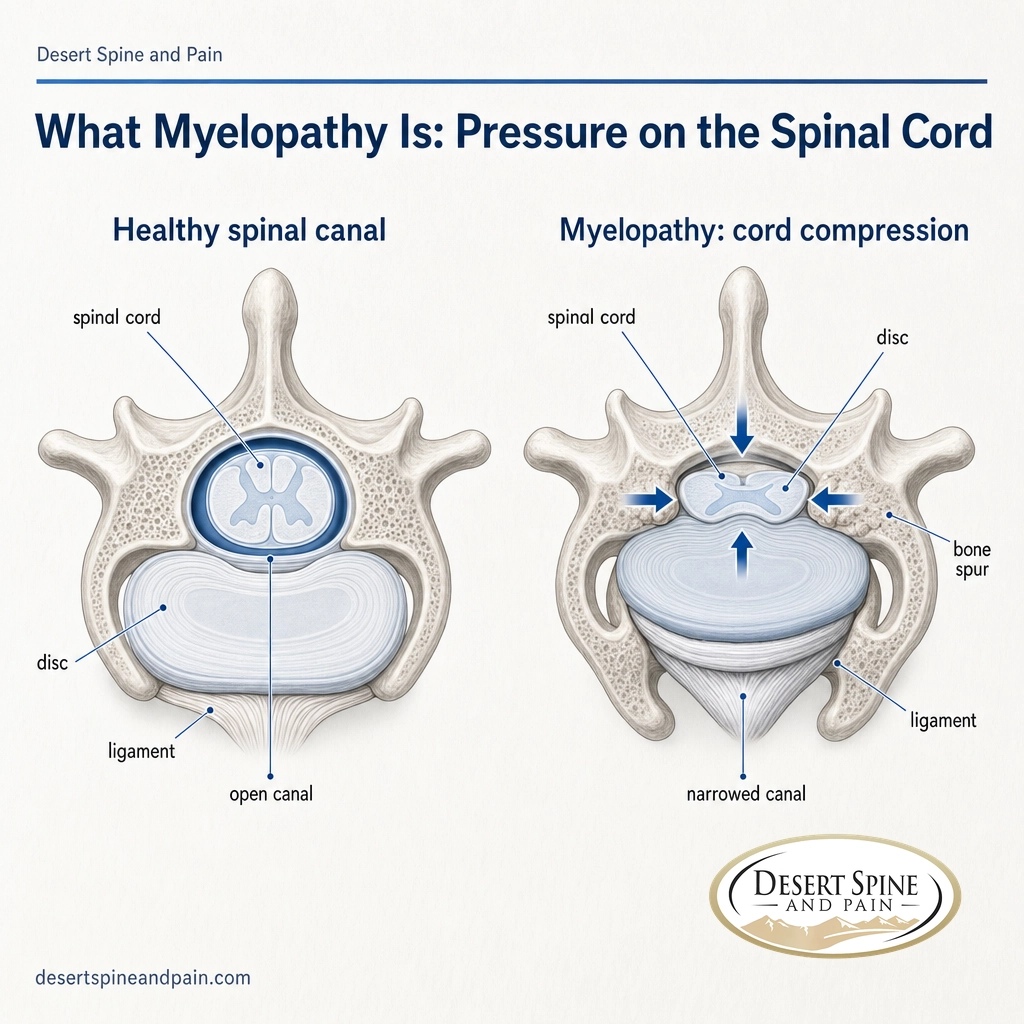
Because the cord is the body's main signal cable, pressure on it tends to cause widespread, function-based problems rather than pain in one spot. Understanding that distinction is the key to recognizing myelopathy early, which is exactly where the comparison to a pinched nerve becomes useful.
Source: National Institute of Neurological Disorders and Stroke | StatPearls: Cervical Myelopathy (NCBI Bookshelf)
Myelopathy vs. Radiculopathy
The single most common point of confusion is between myelopathy and radiculopathy, because both can start from the same wear in the spine and the words look similar on a report. The difference comes down to what is being squeezed. Radiculopathy is compression of a single exiting nerve root, so it usually causes pain, tingling, or weakness traveling down one arm or one leg in a defined pattern. Myelopathy is compression of the spinal cord itself, so the effects are broader, often two-sided, and defined by loss of coordination more than by pain. For a deeper side-by-side, see our full breakdown of how myelopathy and radiculopathy differ.
| Feature | Myelopathy | Radiculopathy |
|---|---|---|
| What is compressed | The spinal cord | A single nerve root |
| Where symptoms appear | Both hands, often the legs too | One arm or one leg, in a pattern |
| Pain | Often mild or absent early | Prominent, a leading symptom |
| Hand and walking function | Clumsy hands, unsteady gait | Usually preserved |
| Reflexes on exam | Overactive (upper motor neuron) | Reduced (lower motor neuron) |
| Natural history | Tends to progress | Often improves over time |
The two can also occur together when the same degenerative changes pinch a root and press on the cord at once, a mix sometimes called myeloradiculopathy. Telling them apart is not an academic exercise. It changes how urgent the problem is and whether the right plan is watchful conservative care or earlier surgery.
Source: Kane et al., Degenerative Cervical Myelopathy, American Family Physician (2020) | Davies et al., Degenerative cervical myelopathy, BMJ (2018)
Types of Myelopathy
Myelopathy is usually named for where it sits on the spine, and occasionally for its cause. The location matters because it shapes which part of the body is affected.
Cervical myelopathy
This is cord compression in the neck, and it is by far the most common type. Because the cervical cord carries signals to the arms, hands, trunk, and legs, cervical myelopathy can affect fine hand control and walking at the same time. It is the form most people mean when they say "myelopathy." Our dedicated guide explains what cervical myelopathy is in detail.
Thoracic myelopathy
This is cord compression in the mid-back, which is less common because the thoracic spine is more rigid and better protected. When it happens, it tends to affect the legs, balance, and sometimes bladder or bowel function, while sparing the hands.
What about "lumbar myelopathy"?
Because the spinal cord ends high in the lower back, true myelopathy in the lumbar spine is uncommon. Compression low in the lumbar canal typically irritates nerve roots instead, producing sciatica-type radiculopathy or, in severe cases, cauda equina syndrome. People sometimes see "spondylosis without myelopathy" on a lumbar report, which means wear-and-tear changes are present but the cord is not involved. We cover that nuance in our explainer on spondylosis without myelopathy.
Source: StatPearls: Cervical Myelopathy (NCBI Bookshelf) | National Institute of Neurological Disorders and Stroke
What Causes Myelopathy?
Anything that narrows the space around the spinal cord or damages the cord can cause myelopathy. By a wide margin, the leading cause in adults is simple age-related wear in the neck.
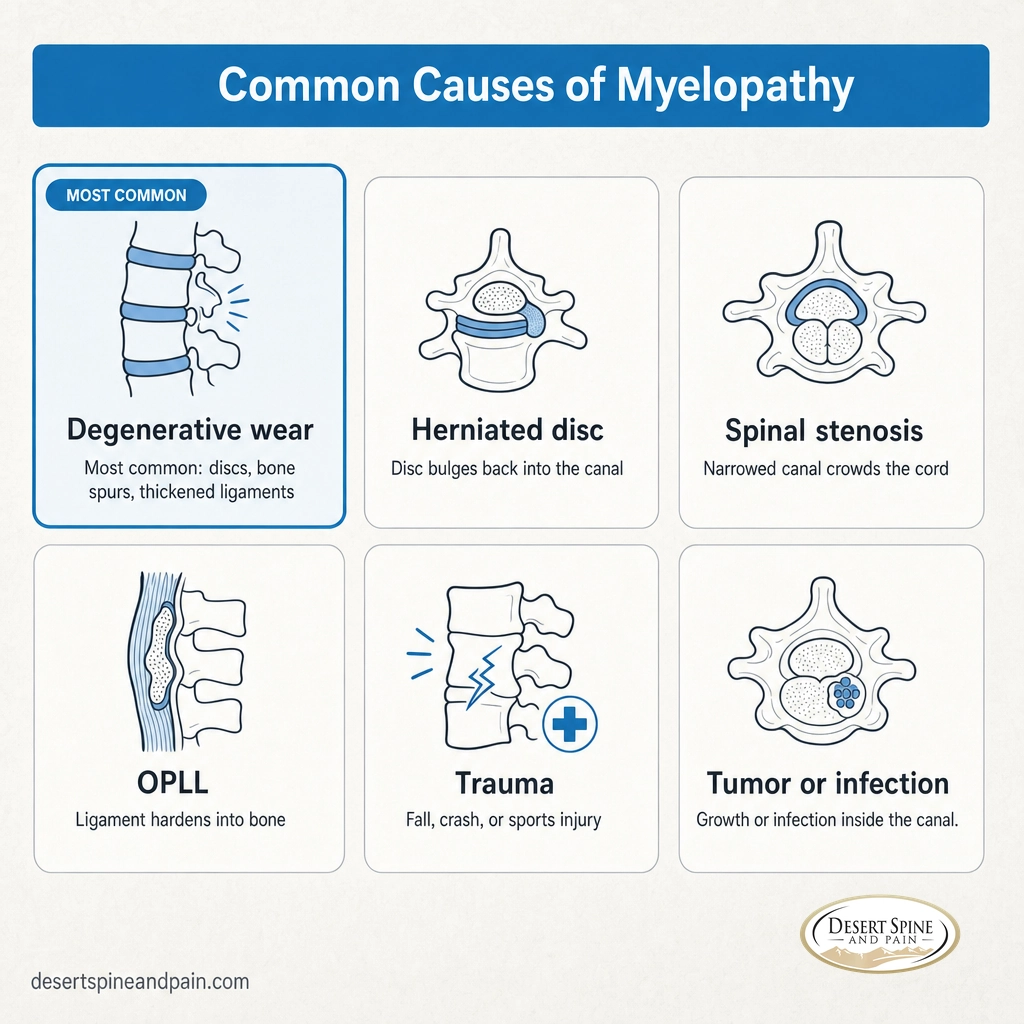
The main causes break down into a few groups:
- Degenerative changes (the most common). Over years, discs flatten and bulge, bone spurs form, and the ligaments lining the canal thicken. Together these gradually narrow the canal (spinal stenosis) and press on the cord. In the neck this is called degenerative cervical myelopathy or cervical spondylotic myelopathy.
- Herniated discs. A disc that bulges or ruptures backward into the canal can press directly on the cord, sometimes suddenly after a strain or minor injury.
- Spinal stenosis. Narrowing of the canal from any cause reduces the room the cord needs, which is closely tied to myelopathy. See how the two relate in our guide on myelopathy vs. stenosis.
- Ossification of ligaments (OPLL). A ligament behind the vertebral bodies can harden into bone, intruding on the canal and compressing the cord.
- Trauma. A fall, car crash, or sports injury can fracture or dislocate the spine and injure the cord acutely.
- Tumors, infections, and inflammation. Less commonly, a growth, an abscess, or an inflammatory or vascular condition inside the canal can damage the cord from within.
Myelopathy becomes more likely with age because degenerative changes accumulate over time, and most degenerative cases are diagnosed after midlife. That gradual onset is part of why the early signs are so easy to brush off as normal aging.
Source: Kane et al., American Family Physician (2020) | Davies et al., BMJ (2018)
Symptoms and Warning Signs
Myelopathy rarely announces itself with a dramatic symptom. Instead it tends to creep in through small losses of control that are easy to blame on getting older. Because the cord carries signals to the whole body below the compression, the symptoms are typically widespread and function-based.
The most common patterns include:
- Clumsy hands. Dropping objects, and difficulty with buttons, zippers, coins, keys, or handwriting.
- Numbness or tingling in both hands, rather than one, sometimes described as a "gloved" feeling.
- An unsteady walk. A stiff, wide-based, or uncertain gait, as if balance has become harder.
- Heaviness or weakness in the legs, and sometimes a feeling that the legs do not respond the way they used to.
- Neck pain or stiffness, which may be present but is often mild and is not the defining feature.
- Bladder or bowel changes, which usually appear only in advanced cases and warrant prompt evaluation.
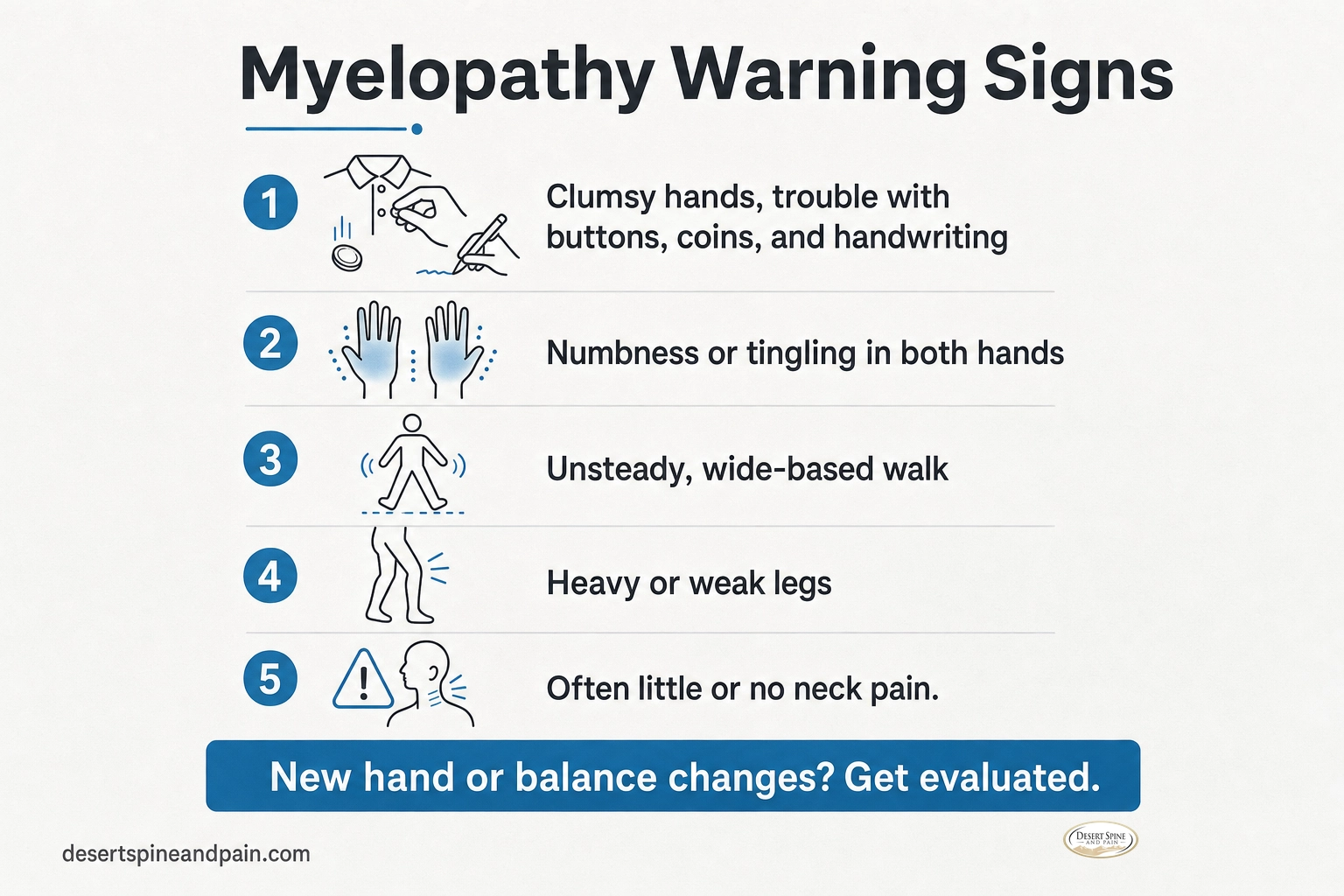
Myth: "No neck pain means it is nothing serious." With myelopathy, the opposite can be true. Pain is not the hallmark of spinal cord compression, and some of the most important early signs, like dropping things or an unsteady walk, are painless. Judging a neck problem by how much it hurts can let myelopathy advance unnoticed. The symptoms to watch are about function, not pain.
Red flags that call for urgent evaluation include rapidly worsening weakness, a fast decline in hand function or balance, or any new loss of bladder or bowel control. Because untreated cord compression can progress to serious, lasting disability, these signs should be acted on rather than watched at home. We explain why advanced cases are taken so seriously in our article on how cervical myelopathy can become life-threatening.
Source: National Institute of Neurological Disorders and Stroke | Kane et al., American Family Physician (2020)
How Myelopathy Is Diagnosed and Graded
Diagnosing myelopathy starts with the story and a focused physical exam, then confirms the picture with imaging. Symptoms point the way, but the exam is where the spinal cord gives itself away, because cord compression produces a specific pattern of overactive reflexes and telltale signs.
A spine specialist typically checks for:
- Hyperreflexia, or overactive deep tendon reflexes below the level of compression.
- Hoffmann sign, a reflex twitch of the thumb and index finger when the middle fingernail is flicked.
- Babinski sign and clonus, an abnormal upward toe response or rhythmic ankle beats that point to the cord.
- Gait and balance testing, including heel-to-toe walking, to reveal an unsteady, cord-related walk.
An MRI is the key imaging test. It shows whether the cord is compressed, where, and whether it has developed signal changes from the pressure. As with all spine imaging, the scan is read alongside the symptoms and exam, never on its own, because many people have wear on an MRI without true myelopathy.
To track severity and guide treatment, specialists often grade myelopathy using the modified Japanese Orthopaedic Association (mJOA) scale, which rates arm and hand function, leg function, sensation, and bladder control.
Grading matters because it connects directly to the treatment decision. Mild, stable myelopathy is handled very differently from moderate or progressive disease, which is the heart of the next section.
Source: Kane et al., American Family Physician (2020) | StatPearls: Cervical Myelopathy (NCBI Bookshelf)

How Myelopathy Is Treated
Treatment is guided by how severe the myelopathy is and whether it is getting worse. The principle at a specialist practice is to use the least invasive effective option first and to move toward surgery only when it is genuinely the best path to protect the cord.
Conservative care for mild cases
Mild, non-progressive myelopathy may be managed without surgery while it is watched closely. That can include guided physical therapy through trusted referral partners, activity adjustments, and medication to control symptoms, as part of a broader program of non-surgical spine care. The important caveat is that conservative care does not reverse cord compression; it manages symptoms while the specialist monitors for any sign of progression that would change the plan.
Surgical decompression for moderate or progressive cases
When myelopathy is moderate, severe, or clearly worsening, surgery to decompress the cord is usually recommended. The goal is specific: stop the condition from advancing and protect the function that remains, because cord tissue recovers poorly once it is damaged. Operating before significant damage sets in gives the best chance of preserving hand function and walking. Depending on where and how the cord is compressed, options include decompression procedures such as laminectomy, decompression for cervical stenosis, and fusion to stabilize a segment when needed. Where appropriate, many of these can be performed with minimally invasive techniques that spare muscle and speed recovery. Our overview of spinal myelopathy surgery explains the approaches in more detail.
The reason timing is emphasized so often is simple: because the cord does not heal like a pinched nerve, the window to preserve function is part of the treatment itself. That is why a suspected myelopathy diagnosis is worth a prompt, expert evaluation rather than a wait-and-see approach.
Source: Kane et al., American Family Physician (2020) | Davies et al., BMJ (2018)
When to See a Spine Specialist
If clumsy hands, numbness in both hands, or an unsteady walk has shown up, especially with little or no pain, that combination deserves a focused evaluation rather than a wait. The most useful next step is an assessment that connects your symptoms and exam to an MRI and sorts out whether the spinal cord is involved, how severe it is, and whether the right plan is careful monitoring or decompression. It is also the right time to ask about least-invasive options and to get a second opinion before any surgery.
Desert Spine and Pain is a Phoenix, Arizona practice led by Dr. David L. Greenwald, MD, FACS, a board-certified surgeon who is both a spine surgeon and a neurosurgeon. That dual expertise is especially relevant for myelopathy, because the condition involves the spinal cord itself. The practice serves patients across the Greater Phoenix area, including Scottsdale, Tempe, Mesa, and Chandler, and also treats patients who travel from outside the region for complex spine care. Care always begins with the least invasive effective option and moves toward a procedure only when it is the best path forward.
Explore the spine conditions we treat
Learn about spinal cord decompression surgery
Book a consultation or second opinion
Common Questions About Myelopathy
What is myelopathy in simple terms?
What is the most common cause of myelopathy?
Is myelopathy serious and does it go away on its own?
Can myelopathy be treated without surgery?
What are the early warning signs of myelopathy?
Related Terms
- Cervical myelopathy: spinal cord compression in the neck, the most common form of myelopathy.
- Radiculopathy: compression of a single nerve root, a pinched nerve, as opposed to the cord.
- Spinal stenosis: narrowing of the spinal canal, a leading setup for cord compression.
- Neuropathy: damage to peripheral nerves, which can mimic myelopathy but originates outside the cord.
- Myopathy: a muscle disease that causes weakness but, unlike myelopathy, does not involve the spinal cord.
- Spondylosis without myelopathy: age-related spinal wear present on imaging without cord involvement.
- Myeloradiculopathy: compression affecting both the spinal cord and a nerve root at the same time.
Sources
Sources and Methodology
This guide summarizes established clinical references and peer-reviewed data on myelopathy, with a focus on degenerative cervical myelopathy because it is the most common form in adults. The prevalence figure and the statement that degenerative cervical myelopathy is the most common cause of spinal cord impairment in adults come from a current clinical review and are presented as general reference, not individual predictions. Anatomical details, diagnostic signs, and the mJOA grading scale are drawn from authoritative neurological and surgical references. This is educational information, not medical advice, and decisions about diagnosis and treatment should be made with a qualified spine specialist after an in-person evaluation.
- Kane, Flanigan, et al. (2020): Degenerative Cervical Myelopathy, American Family Physician 102(12):740-750
- Davies et al. (2018): Degenerative cervical myelopathy, BMJ 360:k186
- National Institute of Neurological Disorders and Stroke: Cervical Spondylotic Myelopathy
- StatPearls: Cervical Myelopathy (NCBI Bookshelf)