
Myelopathy vs. Myopathy: How They Differ
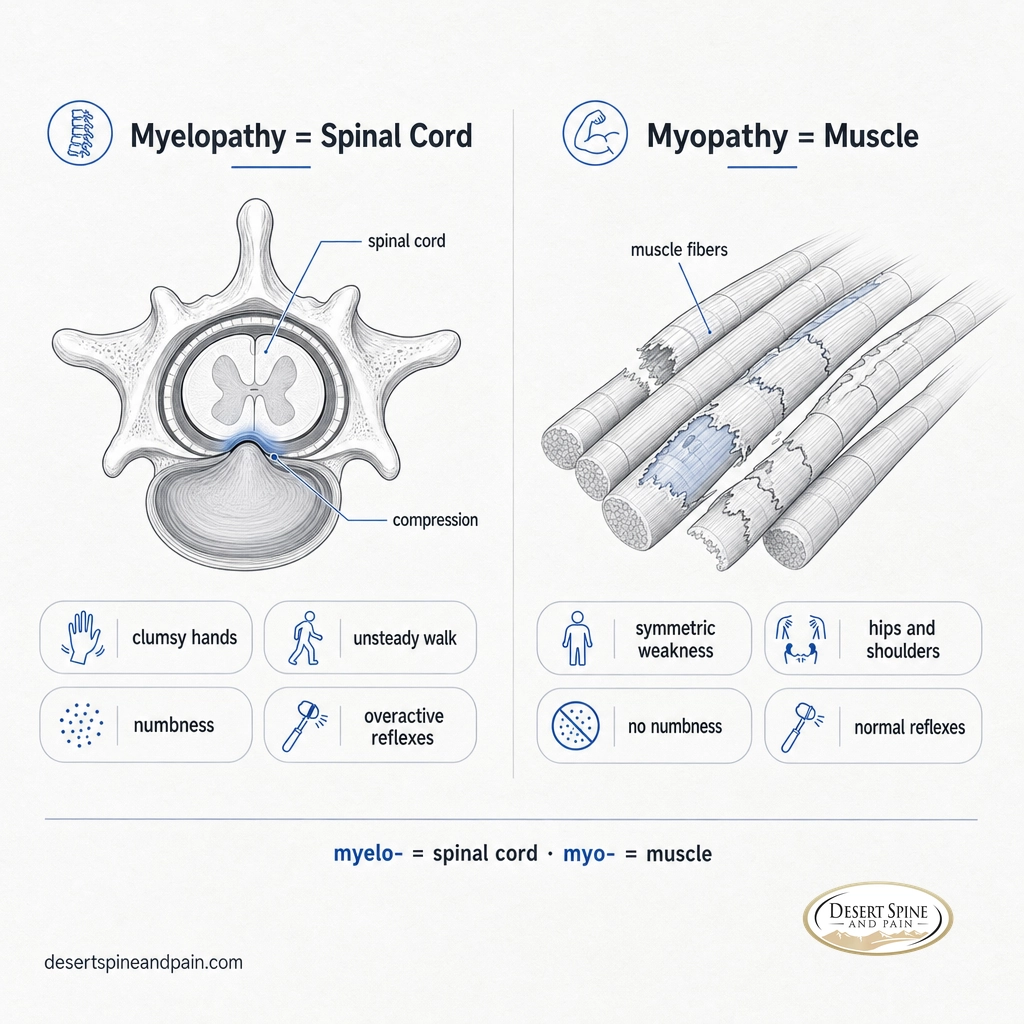
The short answer: Myelopathy is a problem with the spinal cord itself, usually because something is pressing on it. Myopathy is a problem with the muscle itself. The names are almost identical because myelo- means spinal cord and myo- means muscle, but the two conditions affect different parts of the body, cause different symptoms, and are treated by different specialists.
If a doctor, a family member, or an internet search has left you staring at the words myelopathy and myopathy wondering whether they are the same thing, you are not alone. They look nearly identical, they both involve weakness, and they are easy to mix up. They are, however, two very different conditions. Myelopathy is a disorder of the spinal cord. Myopathy is a disorder of the muscle. This guide explains what each one is, how their symptoms and causes differ, how doctors tell them apart, and which kind of specialist treats each, so you can walk into your next appointment understanding what is actually being discussed.
- Myelopathy is a problem with the spinal cord itself, most often from pressure on the cord; myopathy is a problem with the muscle itself, from a disease of the muscle tissue.
- The names look alike because myelo- means spinal cord and myo- means muscle, but the two conditions are unrelated in cause and treatment.
- Myelopathy tends to cause clumsy hands, an unsteady walk, numbness or tingling, and overactive reflexes, and in advanced cases bladder or bowel changes.
- Myopathy tends to cause symmetric weakness in the large muscles close to the trunk, such as the hips, thighs, and shoulders, with normal sensation and no overactive reflexes.
- Doctors use different tests: an MRI of the spine for myelopathy, and a creatine kinase blood test, EMG, and sometimes a muscle biopsy for myopathy.
- Myelopathy from spinal cord compression is the area of a spine surgeon and neurosurgeon; most myopathies are managed by a neurologist or rheumatologist.
- Timing matters most with myelopathy, because untreated spinal cord compression can lead to permanent nerve damage.
What's in This Guide
- Myelopathy vs. Myopathy at a Glance
- What Is Myelopathy?
- What Is Myopathy?
- The Core Difference: Spinal Cord vs. Muscle
- How the Symptoms Differ
- How Doctors Tell Them Apart
- Can You Have Both, and Where Nerves Fit In
- What This Means If You're Worried About Your Spine
- Common Questions
- Related Spine Terms
- Sources
Myelopathy vs. Myopathy at a Glance
Before the detail, here is the whole comparison in one place. The single most important line is the first one: myelopathy affects the spinal cord, and myopathy affects the muscle. Almost every other difference flows from that one fact.
| Feature | Myelopathy | Myopathy |
|---|---|---|
| What is affected | The spinal cord, part of the central nervous system | The muscle fibers themselves |
| Type of problem | Neurological, most often from pressure on the cord | Muscular, a primary disease of the muscle |
| Common causes | Cervical spondylosis, spinal stenosis, disc herniation, injury, tumor | Inherited muscular dystrophy, inflammatory myositis, endocrine or drug-related causes |
| Weakness pattern | Can affect the hands and the legs, often with stiffness or spasticity | Symmetric, in the large muscles near the trunk (hips, thighs, shoulders) |
| Reflexes | Overactive, with signs such as a positive Hoffmann or Babinski response | Normal or reduced, with no overactive reflexes |
| Numbness or tingling | Common, because the cord carries sensation | Usually absent; muscle disease does not cause numbness |
| Balance and walking | Often unsteady, with a stiff or clumsy gait | Limited by weakness, but without spasticity or loss of balance |
| Bladder or bowel | Can be affected in more advanced cases | Not typically affected |
| Key test | MRI of the spine | CK blood test, EMG, muscle biopsy |
| Usual specialist | Spine surgeon or neurosurgeon | Neurologist or rheumatologist |
Source: Mayo Clinic: Cervical spondylosis | National Institute of Neurological Disorders and Stroke: Myopathy
What Is Myelopathy?
Myelopathy means dysfunction of the spinal cord. The spinal cord is the thick bundle of nerves that runs down the spinal canal and carries signals between your brain and the rest of your body. When something squeezes or injures that cord, the signals traveling through it are disrupted, and the result is myelopathy. The most common version in adults is cervical myelopathy, which happens in the neck.
Most myelopathy in older adults is caused by gradual wear. As the spine ages, discs flatten, ligaments thicken, and bone spurs form, all of which can narrow the space around the cord. This age-related narrowing is why degenerative changes in the cervical spine are a leading reason for spinal cord dysfunction later in life. Other causes include a large disc herniation pressing on the cord, spinal stenosis, traumatic injury, and less often a tumor or inflammatory disease.
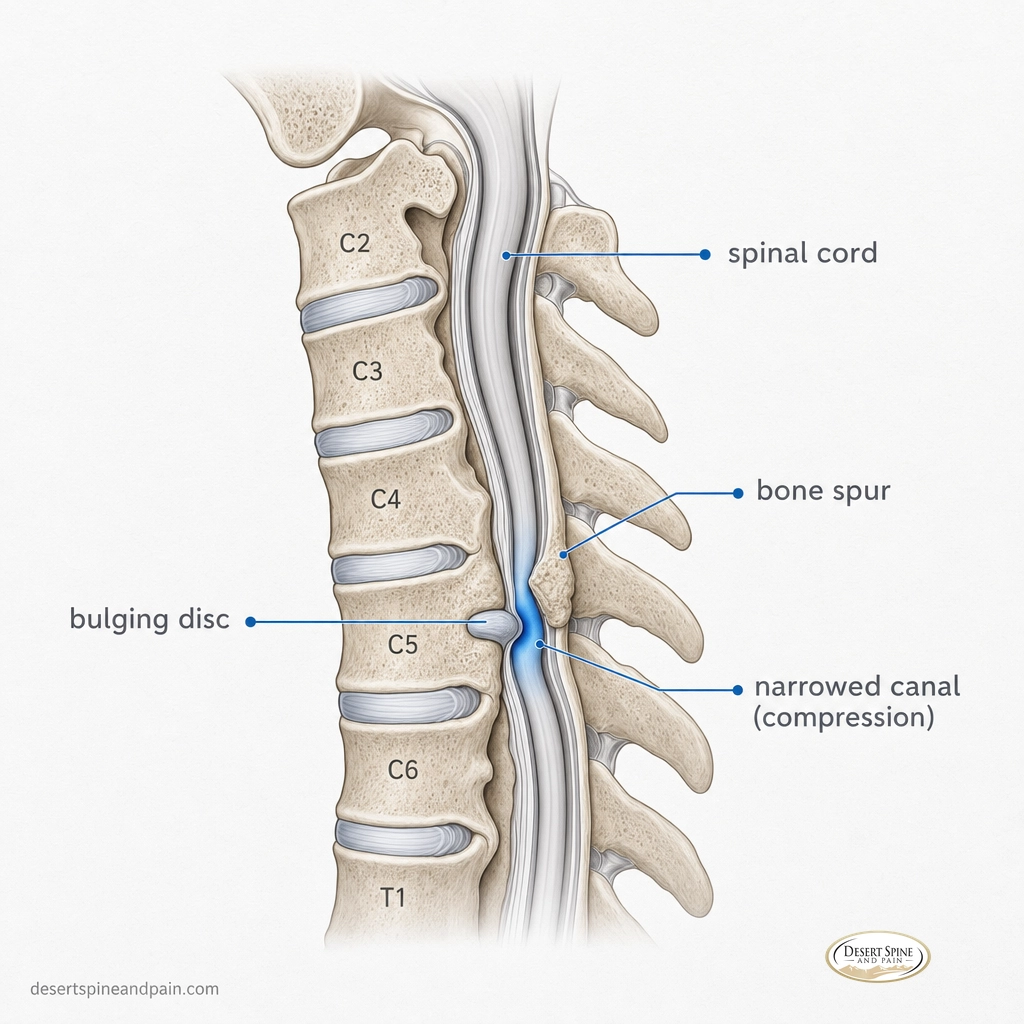
Because the cord carries both movement and sensation, myelopathy produces a telling mix of symptoms. People often notice their hands becoming clumsy first, struggling with buttons, zippers, handwriting, or picking up small objects. Walking can feel stiff, heavy, or unsteady, as if balance is slipping. Numbness or tingling in the hands or feet is common. On examination, a doctor frequently finds overactive reflexes, a hallmark of a problem above the level of the nerve root, inside the cord itself. In more advanced cases, bladder or bowel control can be affected. For a fuller walk-through of the condition on its own, see our overview of what myelopathy is.
Why the reflexes tell the story. A healthy spinal cord quietly restrains your reflexes. When the cord is compressed, that restraint is lost, so reflexes become exaggerated and new signs appear, like a thumb that twitches when the middle finger is flicked (a positive Hoffmann sign). This is the opposite of what happens in muscle disease, and it is one of the clearest ways to separate the two at the bedside.
Source: Mayo Clinic: Cervical spondylosis and myelopathy | American Association of Neurological Surgeons: conditions and treatments
What Is Myopathy?
Myopathy is the general term for a disease of the muscle itself. In a myopathy, the nerves and spinal cord are working, but the muscle fibers they are signaling are weak or damaged. That distinction is the whole point of this comparison: the wiring is fine, the motor is not.
Myopathies come in several families. Inherited myopathies include the muscular dystrophies, a group of genetic conditions that cause progressive muscle weakness. Inflammatory myopathies, also called myositis, happen when the immune system attacks muscle, and include polymyositis, dermatomyositis, and inclusion body myositis. There are also endocrine myopathies tied to thyroid or adrenal problems, metabolic myopathies, and drug-induced myopathies, where a medication irritates muscle. Certain cholesterol-lowering statins and long courses of corticosteroids are well-known examples of the drug-related type.
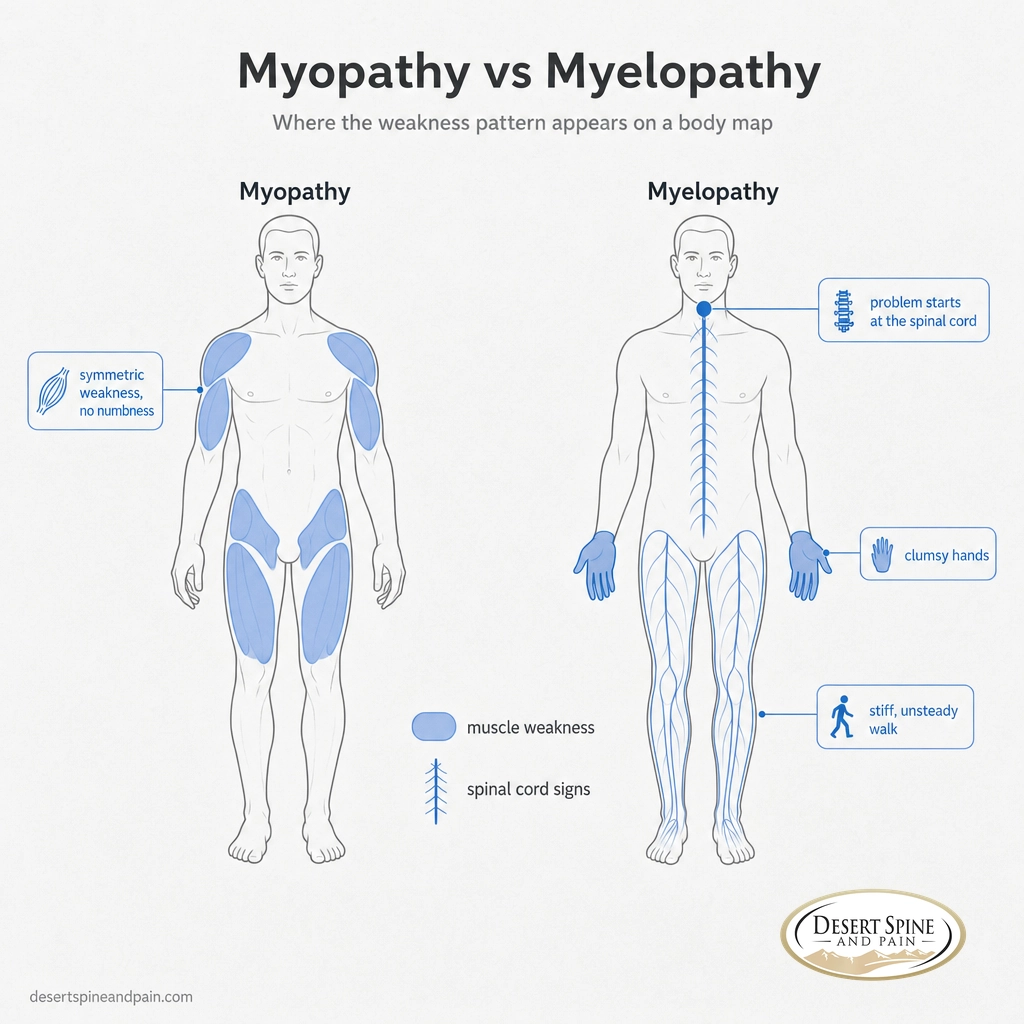
The symptom pattern of myopathy is different from myelopathy in a way that experienced clinicians recognize quickly. Myopathy usually causes symmetric weakness in the proximal muscles, the large ones closest to the center of the body. People notice trouble climbing stairs, rising from a low chair, lifting objects overhead, or washing their hair. Crucially, a pure myopathy does not cause numbness, tingling, or loss of balance, because sensation and coordination run through nerves that are not the problem. Reflexes stay normal, or fade only in proportion to the weakness, and never become overactive. Muscle aches, cramps, and fatigue are common, and many myopathies raise the level of an enzyme called creatine kinase in the blood.
Source: National Institute of Neurological Disorders and Stroke: Myopathy | Mayo Clinic: Muscular dystrophy
The Core Difference: Spinal Cord vs. Muscle
Everything in this comparison comes back to one idea, and the words themselves hold the key. In medical language, myelo- refers to the spinal cord, and myo- refers to muscle. The suffix -pathy means disease or disorder. So myelopathy is literally a disorder of the spinal cord, and myopathy is a disorder of muscle. One letter of difference in the name, an entire system apart in the body.
A simple analogy helps. Think of your body like a house with electrical wiring and appliances. The spinal cord is the main wiring running through the walls. The muscles are the appliances plugged into it. Myelopathy is a fault in the wiring, so many appliances downstream behave strangely at once, and you also lose feedback signals like sensation and balance. Myopathy is a fault in the appliance itself, while the wiring delivering power is intact. That is why a muscle disease leaves sensation and reflexes alone, and why a cord problem does not.
Myth: "They sound the same, so they must be related." They are not. Myelopathy and myopathy share a few letters and the symptom of weakness, and nothing else of substance. They sit in different parts of the body, come from different causes, are found with different tests, and are treated by different specialists. Assuming one when you have the other can send you down the wrong path entirely, which is why getting the diagnosis right at the start matters so much.
How the Symptoms Differ
Patients and families can often tell these two apart by paying attention to three questions: Is there any numbness? Are the reflexes overactive or not? And where is the weakness located? The answers point firmly in one direction or the other.
Sensation. Myelopathy commonly brings numbness, tingling, or a loss of position sense, because the spinal cord carries sensory signals. Myopathy does not touch sensation at all. If weakness comes with numbness, the problem is far more likely to be in the nervous system than in the muscle.
Reflexes and tone. Myelopathy makes reflexes overactive and can add stiffness or spasticity, along with special signs like the Hoffmann or Babinski response. Myopathy keeps reflexes normal or slightly reduced and never makes them brisk.
Where the weakness sits. Myopathy favors the large muscles near the trunk on both sides equally, so hips, thighs, and shoulders tire first, which shows up as trouble with stairs and overhead reaching. Myelopathy more often produces clumsy hands and an unsteady, stiff-legged walk, a combination that points to the spinal cord in the neck.
Balance and walking. A cord problem disturbs balance and coordination, so people describe feeling unsteady or walking as if on an uneven floor. In a muscle disease, walking is limited by weakness, but the sense of balance itself is intact.
Source: National Institute of Neurological Disorders and Stroke | Mayo Clinic: Cervical spondylosis

How Doctors Tell Them Apart
The clinical exam usually points the way, and then targeted tests confirm it. Because the two conditions live in different tissues, the tests used to find them are almost entirely different.
For suspected myelopathy, the central tool is an MRI of the spine. It shows the spinal cord directly and reveals whether something, such as a bone spur, thickened ligament, or herniated disc, is compressing it, and sometimes shows a bright change within the cord itself where it has been injured. A doctor pairs the images with the examination findings, because the signs of cord compression and the picture on the scan need to agree before anyone acts on them.
For suspected myopathy, the workup starts in the blood. A creatine kinase (CK) level is often raised when muscle is being damaged. An EMG and nerve conduction study measures the electrical behavior of muscle and nerve and can show a myopathic pattern while confirming the nerves are intact. When the cause is still unclear, a muscle biopsy or genetic testing can identify the specific type. Notably, a spine MRI is usually normal in a pure myopathy, which itself helps rule myelopathy out.
The one-sentence version for the exam room: if the spine MRI shows cord compression, think myelopathy; if the CK is high and the EMG looks myopathic while the spine imaging is clean, think myopathy. Real cases are rarely that tidy, which is exactly why the exam and the tests are read together by someone who evaluates these problems regularly.
Source: Mayo Clinic: Polymyositis diagnosis | National Institute of Arthritis and Musculoskeletal and Skin Diseases: Myositis
Can You Have Both, and Where Nerves Fit In
It is possible, though uncommon, to have a spinal cord problem and a muscle problem at the same time, and neither causes the other. When both are present, the mixed picture can be confusing, which is why a methodical exam and the right tests matter even more.
There is also a third family of conditions that gets folded into the confusion: problems with the nerves. A pinched nerve root in the spine is called radiculopathy, and damage to the peripheral nerves themselves is called neuropathy. These sit between the cord and the muscle in the signal chain, and each has its own fingerprint. The broad map is simple: myelopathy is the cord, radiculopathy and neuropathy are the nerves, and myopathy is the muscle. Weakness can come from any point along that chain, so the job of a good evaluation is to find exactly where the signal is breaking down.
What This Means If You're Worried About Your Spine
If your symptoms include numbness, clumsy hands, or an unsteady walk, especially alongside neck pain, a spinal cord cause is worth taking seriously, because myelopathy from compression can worsen over time and, if left too long, can leave lasting damage. If your weakness is symmetric in the hips and shoulders with no numbness, a muscle cause is more likely, and the right first stop is usually a neurologist or rheumatologist rather than a spine surgeon.
Desert Spine and Pain is a Phoenix, Arizona practice led by Dr. David L. Greenwald, who is both a spine surgeon and a neurosurgeon. That dual training is useful precisely because questions like myelopathy versus myopathy sit at the border of the spine, the nerves, and the muscle. A focused evaluation can confirm whether a spine problem is behind your symptoms, rule a cord compression in or out, and point you to the correct specialist if the cause turns out to be muscular. When the spinal cord is involved, care follows a least-invasive-first philosophy, moving to a procedure such as surgical decompression of the spinal cord only when it is genuinely the best path.
Explore the spine conditions we treat
See non-surgical spine care options
Book a consultation or second opinion
Common Questions About Myelopathy and Myopathy
What is the difference between myelopathy and myopathy?
Why are myelopathy and myopathy so easily confused?
How do doctors tell myelopathy and myopathy apart?
Can you have myelopathy and myopathy at the same time?
Is myelopathy or myopathy a medical emergency?
Does a spine surgeon treat myopathy?
Related Spine Terms
- Spinal cord: the bundle of nerves inside the spinal canal that carries signals between the brain and the body; it is what is affected in myelopathy.
- Creatine kinase (CK): a muscle enzyme that rises in the blood when muscle is damaged, often used to screen for myopathy.
- Hoffmann sign: a thumb twitch triggered by flicking the middle finger, a clue that the spinal cord is being compressed.
- Radiculopathy: a pinched nerve root in the spine, a nerve problem that sits between the cord and the muscle in the signal chain.
- Neuropathy: damage to the peripheral nerves themselves, another cause of weakness and numbness that is not myelopathy or myopathy.
- Myositis: inflammation of muscle, a family of inflammatory myopathies that includes polymyositis and dermatomyositis.
- Cervical myelopathy: myelopathy occurring in the neck, the most common form in adults.
Sources
Sources and Methodology
This guide summarizes established clinical references on myelopathy (a disorder of the spinal cord) and myopathy (a disorder of muscle), drawing on patient-education material from major medical institutions and U.S. health agencies. It explains how the two conditions differ in cause, symptoms, diagnosis, and treatment. It is educational information, not medical advice. Decisions about diagnosis and treatment should be made with a qualified specialist after an in-person evaluation.
- National Institute of Neurological Disorders and Stroke: Myopathy
- Mayo Clinic: Cervical spondylosis (a leading cause of myelopathy)
- Mayo Clinic: Muscular dystrophy
- National Institute of Arthritis and Musculoskeletal and Skin Diseases: Myositis
- American Association of Neurological Surgeons: Conditions and Treatments