
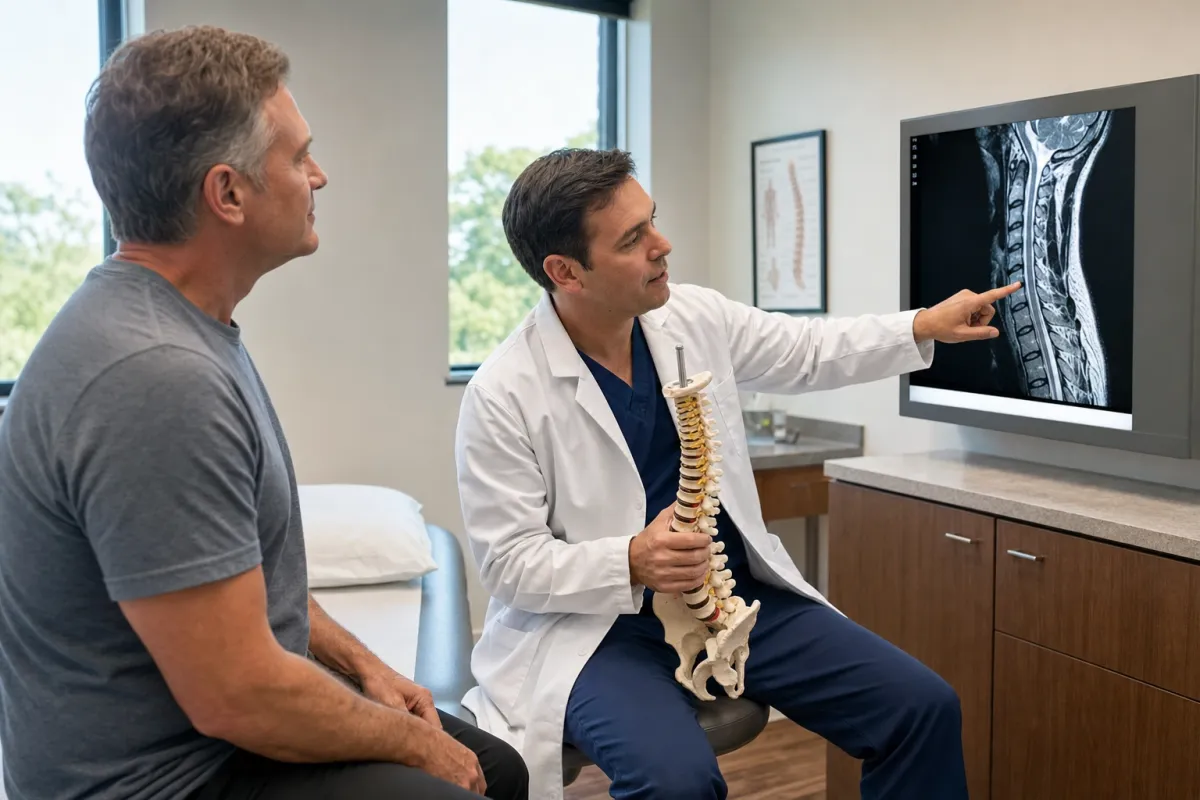
Spondylosis Without Myelopathy: What It Means
Spondylosis without myelopathy, in plain terms: Spondylosis is the age-related arthritis and wear-and-tear degeneration of the spine. Myelopathy is damage or dysfunction of the spinal cord. So spondylosis without myelopathy means you have spinal arthritis, but it has not affected your spinal cord, which is the more reassuring version of the diagnosis.
If the phrase spondylosis without myelopathy has appeared on an MRI report, a visit summary, or an insurance statement, it can look alarming even though it is often good news. The wording is clinical and diagnostic rather than plain English, so it is natural to want it decoded. This guide breaks the phrase into its two parts, explains why without myelopathy is the reassuring half, shows where the diagnosis fits in the ICD-10 coding system (the M47.81 family), and walks through how common it is and how it is typically treated.
- Spondylosis is spinal osteoarthritis, the gradual age-related wear of the discs, joints, and bones of the spine.
- Myelopathy means the spinal cord is being compressed or damaged, so without myelopathy tells you the cord is not involved.
- The full diagnosis is often written spondylosis without myelopathy or radiculopathy, meaning neither the spinal cord nor a nerve root is being pinched.
- The ICD-10 codes live in the M47.81 family, such as M47.812 (cervical) and M47.816 (lumbar).
- Spondylosis is extremely common with age and is usually managed without surgery, but new balance, walking, or hand-coordination problems are red flags to report right away.

What's in This Guide
- What Does Spondylosis Without Myelopathy Mean?
- Spondylosis With vs. Without Myelopathy
- "Without Myelopathy or Radiculopathy" and the ICD-10 Codes
- How Common It Is, and Why It Is Usually Reassuring
- Symptoms and the Red Flags That Need Attention
- How Spondylosis Without Myelopathy Is Treated
- How to Get Started
- Common Questions
- Related Spine Terms
- Sources
What Does Spondylosis Without Myelopathy Mean?
The phrase is really two medical words joined by a reassuring qualifier. Spondylosis is the medical term for the age-related, wear-and-tear changes that build up in the spine over time. It is often described as arthritis of the spine. As the years pass, the cushioning discs between the vertebrae lose height and water content, the small facet joints can develop arthritis, and the body may form bone spurs along the edges of the bones. These changes are a normal part of aging, and they can show up in the neck (cervical spine), the mid-back (thoracic spine), or the lower back (lumbar spine).
Myelopathy is the second word, and it refers to damage or dysfunction of the spinal cord itself. The spinal cord is the thick bundle of nerves that runs down the protective bony canal of your spine and carries signals between your brain and the rest of your body. When degenerative changes narrow that canal enough to press on the cord, the result is myelopathy, which can affect balance, walking, and fine hand movements.
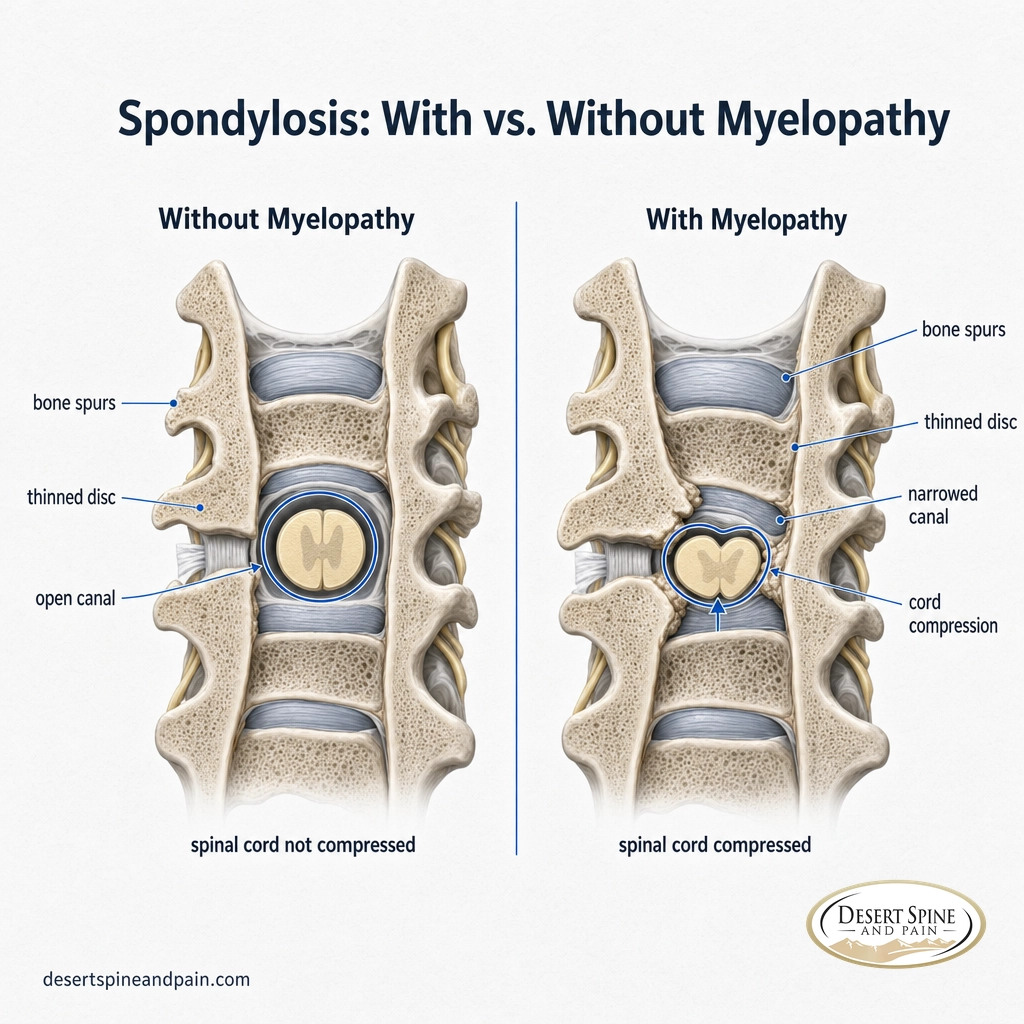
Put the pieces together and the meaning is clear: spondylosis without myelopathy is spinal arthritis that has not reached or compressed the spinal cord. That qualifier is doing important work. It is the difference between a common, generally manageable wear-and-tear diagnosis and the more serious situation where the cord is at risk. In most reports, seeing without myelopathy is a sign the findings are being described as degenerative changes rather than cord compression.
Source: American Academy of Orthopaedic Surgeons: Cervical Spondylosis | Columbia Neurosurgery: Cervical Spondylotic Myelopathy
Spondylosis With vs. Without Myelopathy
The clearest way to understand your diagnosis is to see it next to the version you were told you do not have. The underlying arthritis can be identical in both columns below. What separates them is whether that arthritis has started to compress the spinal cord.
| Feature | Spondylosis Without Myelopathy | Spondylosis With Myelopathy |
|---|---|---|
| Spinal cord | Not compressed or damaged | Compressed by bone spurs, disc bulges, or thickened ligaments |
| Typical symptoms | Often none, or neck/back pain and stiffness | Balance and walking trouble, clumsy hands, numbness, sometimes bladder urgency |
| Usual severity | Generally mild to moderate, slow to change | More serious, can progress and affect function |
| First-line care | Conservative, non-surgical care in most cases | Prompt evaluation, with surgery often considered to decompress the cord |
| What it signals | Degenerative change, monitored over time | The cord is at risk, so timing of treatment matters |
A useful way to picture it: spondylosis is like rust and wear building up around a protected cable channel. Without myelopathy, the channel is narrower but the cable (the spinal cord) is still running freely. With myelopathy, the buildup has started to squeeze the cable itself, which is when symptoms like a stiff, unsteady, robotic walk or fumbling hands can appear. Cervical spondylotic myelopathy is in fact described as the most common spinal cord disorder in people over the age of 55, which is exactly why the without myelopathy wording is worth recognizing as the better-case scenario.
Myth: "Spondylosis always means surgery is coming." It does not. Spondylosis is an extremely common, often symptomless part of aging, and the large majority of cases, especially those labeled without myelopathy, are managed without any operation. Surgery enters the conversation mainly when the spinal cord or a nerve is being compressed and symptoms are not responding to conservative care.
Source: Columbia Neurosurgery on spondylotic myelopathy | AAOS OrthoInfo: Cervical Spondylosis
"Without Myelopathy or Radiculopathy" and the ICD-10 Codes
Many reports use the longer phrase spondylosis without myelopathy or radiculopathy. That adds a third term. Radiculopathy is irritation or compression of a nerve root, the point where a nerve branches off the spinal cord and exits the spine. When a nerve root is pinched, it tends to cause radiating symptoms: pain, tingling, numbness, or weakness that travels down an arm or a leg. Sciatica is the familiar example in the leg.
So the full phrase is telling you two bits of good news at once: the degenerative changes are not pressing on the spinal cord (no myelopathy) and they are not pinching a nerve root either (no radiculopathy, which affects the nerve roots rather than the cord). It is essentially spinal arthritis that is present on imaging but has not yet caused a compressive nerve problem.
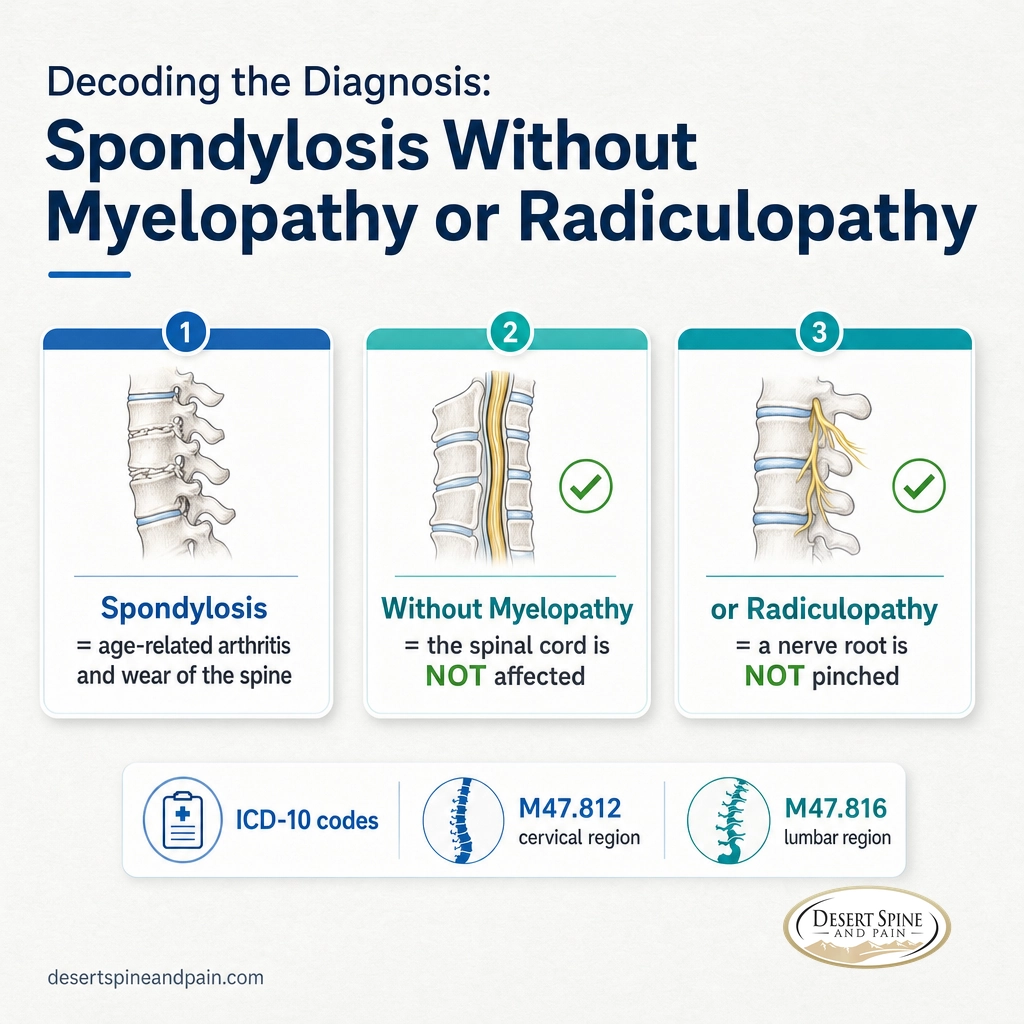
This exact wording exists because of ICD-10-CM, the diagnosis coding system used on medical records and insurance claims. The codes for this diagnosis live in the M47.81 family, and the last digit specifies the region of the spine:
- M47.812 is spondylosis without myelopathy or radiculopathy of the cervical region (the neck).
- M47.816 is the same diagnosis in the lumbar region (the lower back).
- Other digits in the same family cover the remaining regions, including the cervicothoracic, thoracic, thoracolumbar, lumbosacral, and sacral areas.
If you see one of these codes on paperwork, it is not a separate or hidden condition. It is just the standardized label for the plain-English diagnosis your clinician described, so the record and any claim read consistently.
Source: ICD-10-CM code M47.812 official descriptor | ICD-10-CM code M47.816 official descriptor
How Common It Is, and Why It Is Usually Reassuring
One reason the diagnosis is usually reassuring is how common these changes are. Spondylosis is close to a universal part of aging, and it often shows up on imaging in people who have little or no pain. That context matters: a degenerative finding on a scan is read alongside how you actually feel, never as a verdict on its own.
The same source notes that nearly half of all middle-aged and older people have worn discs that do not cause any painful symptoms at all. In other words, the spine shows its mileage long before, and often without ever, causing a problem. When your diagnosis specifically says without myelopathy or radiculopathy, it is telling you that despite the wear, the two parts that matter most, the spinal cord and the nerve roots, are not under pressure.
Why the wording helps you. The without myelopathy label is more than a technicality. It signals that your care is likely to focus on comfort, mobility, and keeping the spine healthy rather than on an urgent structural problem. It also gives you and your spine specialist a clear baseline, so if anything changes in the future, it is easy to recognize.
Source: AAOS OrthoInfo: Cervical Spondylosis prevalence and overview

Symptoms and the Red Flags That Need Attention
Many people with spondylosis have no symptoms whatsoever. When symptoms do appear, the most common is neck or back pain and stiffness that can come and go, sometimes worse after holding one position for a long time. Headaches, a grinding or popping sensation when turning the neck, and muscle tightness in the neck and shoulders are also typical of the cervical form.
Because your diagnosis says without myelopathy, the serious cord-related symptoms are, by definition, not present right now. The value in knowing them is so you can recognize a change. These are the signs that the situation may be moving beyond simple arthritis and toward spinal cord or nerve involvement.
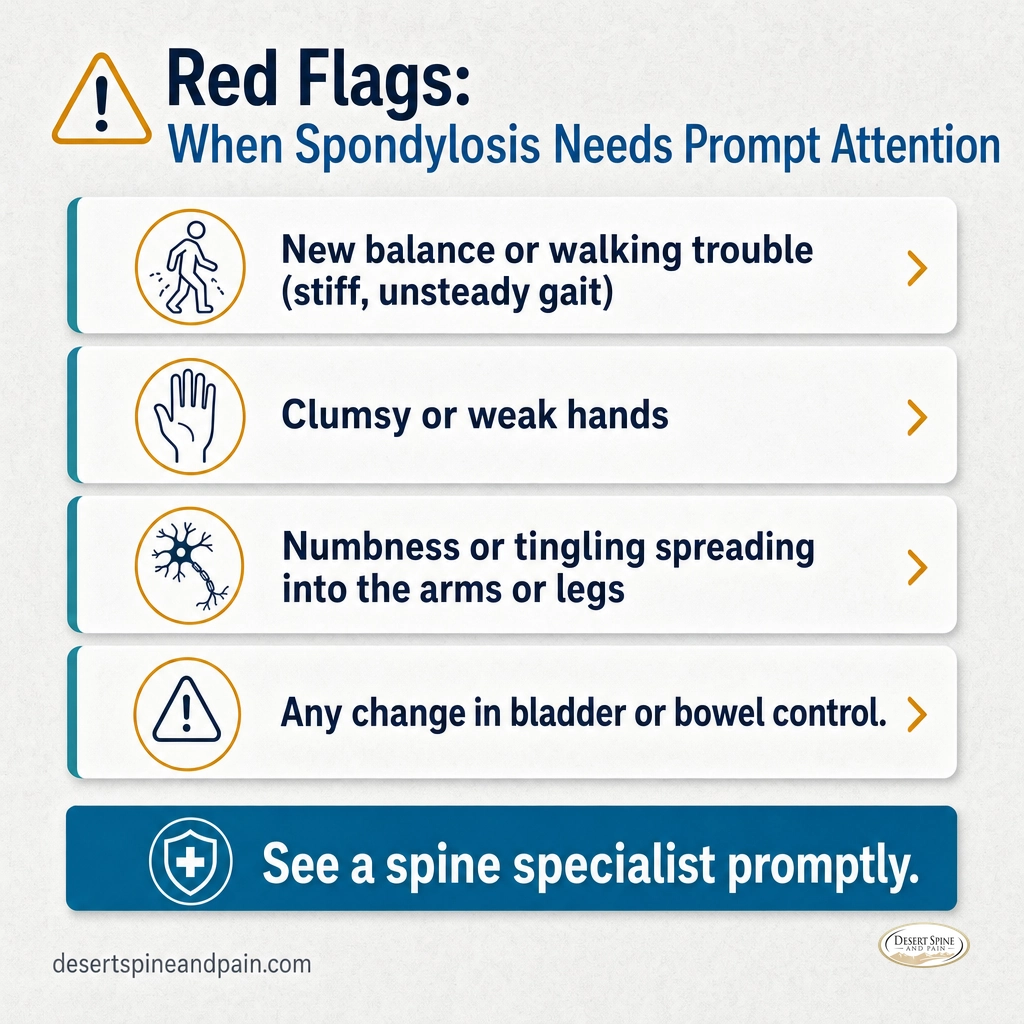
Report these red flags promptly. New problems with balance or walking (a stiff, unsteady, or robotic gait), increasing clumsiness or weakness in the hands, numbness or tingling spreading into the arms or legs, or any change in bladder or bowel control can signal that the spinal cord or a nerve is becoming compressed. These point toward myelopathy or radiculopathy and should be evaluated quickly rather than watched at home.
Short of those red flags, a sensible rule of thumb is to see a spine specialist when neck or back pain lasts more than a few weeks, keeps returning, or starts to interfere with sleep and daily activities, so the cause can be confirmed and a plan started. A specialist can also compare any future imaging to your current baseline, which is one of the practical benefits of having a clearly worded diagnosis today.
Source: AAOS OrthoInfo: Cervical Spondylosis symptoms | Columbia Neurosurgery: symptoms of spondylotic myelopathy
How Spondylosis Without Myelopathy Is Treated
Because the spinal cord is not compressed, treatment almost always begins with conservative, non-surgical care, and most people do well with it. The goals are straightforward: calm pain and inflammation, keep the spine moving and strong, and protect against the kinds of changes that could, over time, lead to cord or nerve compression. A typical plan can include:
- Guided physical therapy. A structured program, generally running several weeks, that improves strength, flexibility, and posture. Desert Spine and Pain coordinates this through trusted referral partners as part of conservative, non-surgical spine care.
- Medications and local measures. Over-the-counter anti-inflammatories or other prescribed medication, along with heat, ice, and short-term activity changes to settle a flare.
- Targeted injections. When pain persists, an image-guided epidural steroid injection or a facet joint procedure can reduce inflammation around an irritated area.
- Posture and activity habits. Simple ergonomic adjustments and regular movement that keep the spine supported and reduce repeated strain.
- Surgery, only if the picture changes. Surgery is not usually part of the plan for spondylosis without myelopathy. It is considered mainly if the condition progresses to compress the cord or a nerve and symptoms do not respond to conservative care, in which case minimally invasive spine surgery may be an option.
The guiding principle at a quality spine practice is to start with the least invasive effective option and to escalate only when the anatomy and your symptoms genuinely call for it. For a diagnosis that specifically excludes myelopathy, that usually means a patient, conservative plan with periodic check-ins rather than anything urgent.
Source: AAOS OrthoInfo: nonsurgical treatment of cervical spondylosis
How to Get Started
If spondylosis without myelopathy has shown up on your paperwork and you want to understand what it means for you, the most useful next step is a focused evaluation that connects the imaging to your actual symptoms. A thorough consult reviews your history, your exam, and your images together, confirms that the cord and nerves are indeed clear, and sets a simple plan to keep them that way. It is also the right moment to ask about conservative options and to get an expert second opinion before anyone suggests a procedure.
Desert Spine and Pain is a Phoenix, Arizona practice led by Dr. David L. Greenwald, MD, FACS, a board-certified surgeon who is both a spine surgeon and a neurosurgeon. That dual expertise matters for a diagnosis like this one, because reading the line between simple degeneration and early cord involvement is exactly where experience counts. Care always starts with the least invasive effective option and moves toward a procedure only when it is truly the best path.
Explore spine conditions at Desert Spine and Pain
See non-surgical spine care options
Book a consultation or second opinion
Common Questions About Spondylosis Without Myelopathy
What does spondylosis without myelopathy mean?
Is spondylosis without myelopathy serious?
What is the ICD-10 code for spondylosis without myelopathy?
What is the difference between spondylosis with and without myelopathy?
Can spondylosis without myelopathy turn into myelopathy?
Related Spine Terms
- Spondylosis: the general term for age-related degeneration (osteoarthritis) of the spine's discs, joints, and bones.
- Myelopathy: compression or dysfunction of the spinal cord itself, the serious complication that your diagnosis says you do not have.
- Radiculopathy: pinching of a nerve root, which causes radiating pain, numbness, or weakness into an arm or leg.
- Bone spurs (osteophytes): small bony growths that form along worn joints and can narrow the space around nerves and the cord.
- Spinal stenosis: narrowing of the spinal canal, which is the step that can turn spondylosis into cord or nerve compression.
- Degenerative disc disease: the gradual drying and thinning of the spinal discs that is part of the spondylosis process.
- Facet joint arthritis: arthritis of the small paired joints at the back of the spine, a common component of spondylosis.
Sources
Sources and Methodology
This guide summarizes established clinical references on spondylosis, myelopathy, radiculopathy, and the ICD-10-CM coding of these diagnoses. The prevalence figure for cervical spondylosis is drawn from the American Academy of Orthopaedic Surgeons and is presented as a general population reference, not an individual prediction. ICD-10 code descriptors are the official coding definitions. This is educational information, not medical advice, and decisions about diagnosis and treatment should be made with a qualified spine specialist after an in-person evaluation.
- American Academy of Orthopaedic Surgeons, OrthoInfo: Cervical Spondylosis (Arthritis of the Neck)
- Columbia University Department of Neurological Surgery: Cervical Spondylotic Myelopathy
- ICD-10-CM M47.812: Spondylosis without myelopathy or radiculopathy, cervical region
- ICD-10-CM M47.816: Spondylosis without myelopathy or radiculopathy, lumbar region