

Myelopathy vs. Neuropathy: Key Differences
The short answer: Myelopathy is damage to the spinal cord itself, usually from something compressing the cord, and it tends to cause clumsy hands, balance and walking problems, and whole-limb symptoms. Neuropathy is damage to the peripheral nerves outside the brain and spinal cord, and it tends to cause burning, tingling, and numbness in a stocking-and-glove pattern starting in the feet or hands. Myelopathy is usually the more time-sensitive of the two, and the two conditions can also occur together.
Myelopathy and neuropathy sound alike, both involve the nervous system, and both can cause numbness, weakness, and clumsiness, so it is no surprise that people, and sometimes even early assessments, mix them up. The distinction matters, though, because the two problems sit in completely different places in the body, call for different tests, and carry different degrees of urgency. Getting it right is the difference between calming an irritated nerve in your foot and relieving pressure on a spinal cord before the damage becomes permanent. This guide breaks down exactly how the two differ, how doctors tell them apart, and what each one means for you.
- Myelopathy is a spinal cord problem (the central cable); neuropathy is a peripheral nerve problem (the branch wires running to your limbs).
- Myelopathy classically causes hand clumsiness, balance and gait changes, and overactive reflexes; neuropathy classically causes burning, tingling, and numbness in a stocking-and-glove pattern with reduced reflexes.
- Diabetes is the single most common cause of peripheral neuropathy, while age-related wear in the neck is the most common cause of myelopathy in adults.
- MRI is the key test for myelopathy; nerve conduction studies and EMG are the key tests for neuropathy.
- Myelopathy is usually the more urgent problem because cord damage can become permanent, and the two can occur at the same time, which is why a careful workup matters.

What's in This Guide
- Myelopathy vs. Neuropathy at a Glance
- Understanding Myelopathy
- Understanding Neuropathy
- The Key Differences, Side by Side
- Master Comparison Table
- How Each Is Diagnosed
- How Each Is Treated
- Can You Have Both at Once?
- When Your Symptoms Point to Myelopathy
- When Your Symptoms Point to Neuropathy
- Why One Expert Across Cord and Nerve Matters
- Common Questions
- Related Spine Terms
- Sources
Myelopathy vs. Neuropathy at a Glance
Before the detail, here is the core of it. Picture the nervous system as an electrical system: the brain is the power source, the spinal cord is the thick central cable running down your back, and the peripheral nerves are the branch wires that split off the cord and travel out to your arms, legs, hands, and feet. Myelopathy is trouble on the central cable. Neuropathy is trouble on the branch wires.
Myelopathy (the spinal cord)
- A problem with the spinal cord inside the spinal canal
- Most often caused by compression from age-related wear, a disc, or bone spurs
- Symptoms affect whole limbs and often both sides: clumsy hands, stiff or weak legs
- Balance and walking changes are a hallmark, and reflexes are usually overactive
- Found mainly with MRI; often time-sensitive and frequently treated with decompression surgery
Neuropathy (the peripheral nerves)
- A problem with the nerves outside the brain and spinal cord
- Most often caused by diabetes, with many other causes such as alcohol, chemotherapy, and vitamin deficiency
- Symptoms follow the nerve: burning, tingling, and numbness in a stocking-and-glove pattern
- Starts in the feet or hands and creeps inward, and reflexes are usually reduced
- Mapped mainly with nerve conduction studies and EMG; usually managed by treating the cause
Understanding Myelopathy
Myelopathy means any disorder that affects the spinal cord, the dense bundle of nerve tissue that carries signals between your brain and the rest of your body. The most common form in adults is cervical myelopathy, where the cord is compressed in the neck. When arthritis, thickened ligaments, bone spurs, or a bulging disc narrow the spinal canal over time, they can slowly squeeze the cord. Because the cord is the main relay for everything below the neck, that pressure can disrupt signals to the arms, hands, trunk, and legs all at once.
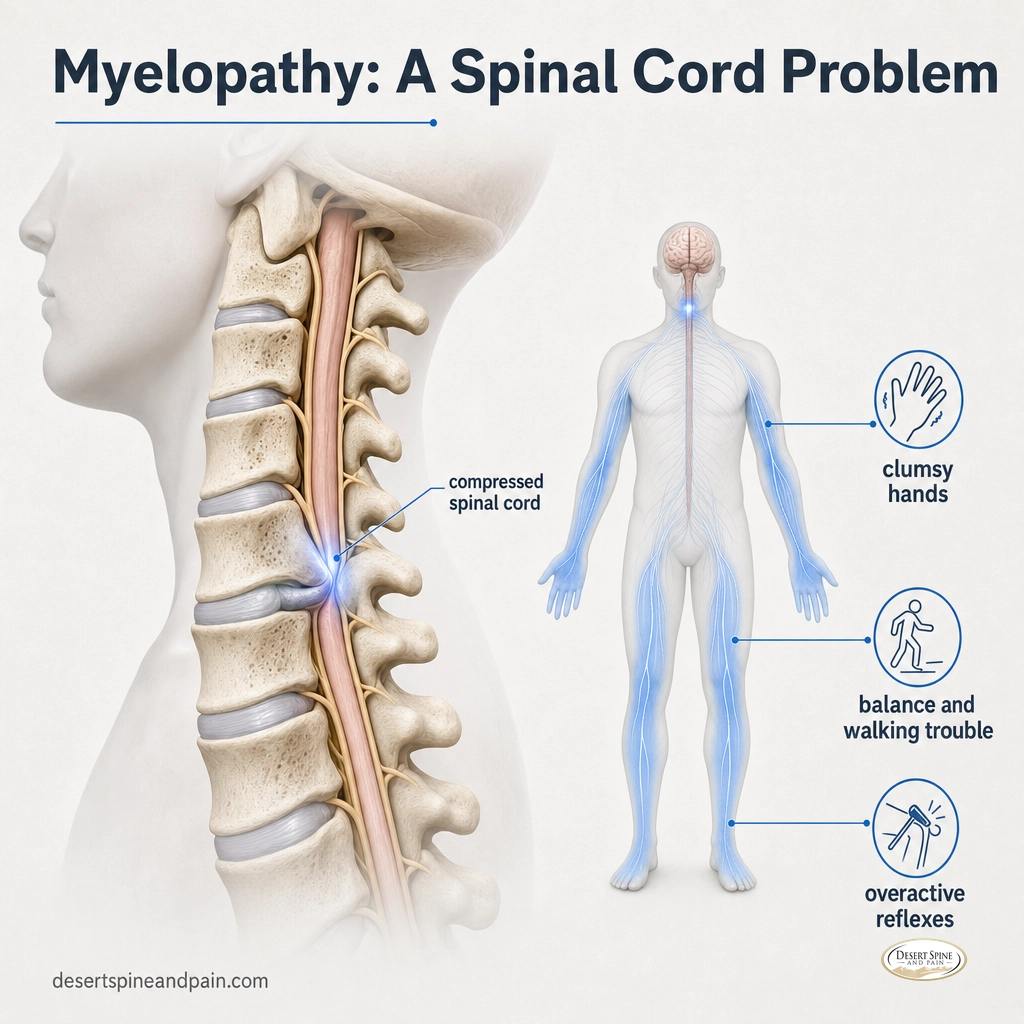
Degenerative cervical myelopathy is widely described in the medical literature as the most common cause of spinal cord dysfunction in adults, and it tends to appear later in life as the spine accumulates normal wear. The symptoms are often subtle at first and easy to dismiss as aging: buttons and zippers become fiddly, handwriting changes, grip feels weaker, and walking feels less steady. Pain is not always the loudest symptom, which is part of why myelopathy gets missed.
The classic signs of myelopathy come from the fact that the problem sits above the peripheral nerves, in the central nervous system. That produces what clinicians call upper motor neuron signs: overactive reflexes, muscle stiffness or spasticity, and specific exam findings a doctor looks for. The practical, everyday version patients notice is a combination of clumsy hands and an unsteady gait.
Myelopathy red flags, do not wait on these: new clumsiness with fine tasks (buttons, coins, handwriting), a heavy or weak feeling in the arms or legs, loss of balance or a wide, careful walk, a shock-like sensation down the spine when you bend your neck forward, or any change in bladder or bowel control. These point to the spinal cord itself and call for prompt evaluation, because cord damage that is relieved early has a much better chance of recovering than cord damage left to progress.
Common causes of myelopathy include cervical spondylosis (age-related neck arthritis), a large herniated disc pressing on the cord, spinal stenosis, ossification of the ligaments, trauma, tumors, and inflammatory conditions. Whatever the cause, the central concern is the same: the cord has limited room, and sustained pressure can injure it. For a closer look at how cord compression differs from the narrowing that often precedes it, see our comparison of myelopathy and spinal stenosis.
Source: Davies et al., Degenerative Cervical Myelopathy, BMJ (2018)
Understanding Neuropathy
Neuropathy, more precisely peripheral neuropathy, is damage to the peripheral nerves: the network that branches off the spinal cord and reaches every part of the body. The Cleveland Clinic describes it as the term for any type of nerve damage outside the brain and spinal cord. Because these nerves are long and exposed, they are vulnerable to a wide range of insults, from blood sugar to toxins to pressure.

The symptoms are distinctive. Instead of the whole-limb, both-sides picture of myelopathy, neuropathy usually starts at the far ends of the longest nerves, the feet, and later the hands, and works its way inward. That is the stocking-and-glove pattern. People describe burning, tingling, pins and needles, numbness, or sharp, electric-shock pain, often worse at night. Over time, reduced sensation can make the feet feel unreliable, which affects balance in a different way than myelopathy does.
By far the most common cause is diabetes. High blood sugar over years damages the small blood vessels that feed the nerves, and the nerves suffer for it. The scale of that single cause is large.
Diabetes is far from the only cause. Peripheral neuropathy can also stem from long-term heavy alcohol use, chemotherapy and certain other medications, vitamin deficiencies (especially B12), autoimmune diseases, infections, kidney or liver disease, inherited conditions, and physical compression or trauma to a nerve. When a single nerve is pinched in one spot, such as the median nerve at the wrist or the ulnar nerve at the elbow, that is a compressive neuropathy, a category that behaves a little differently from the body-wide neuropathy of diabetes.
Source: Cleveland Clinic: Peripheral Neuropathy | NIDDK: Diabetic Neuropathy
The Key Differences, Side by Side
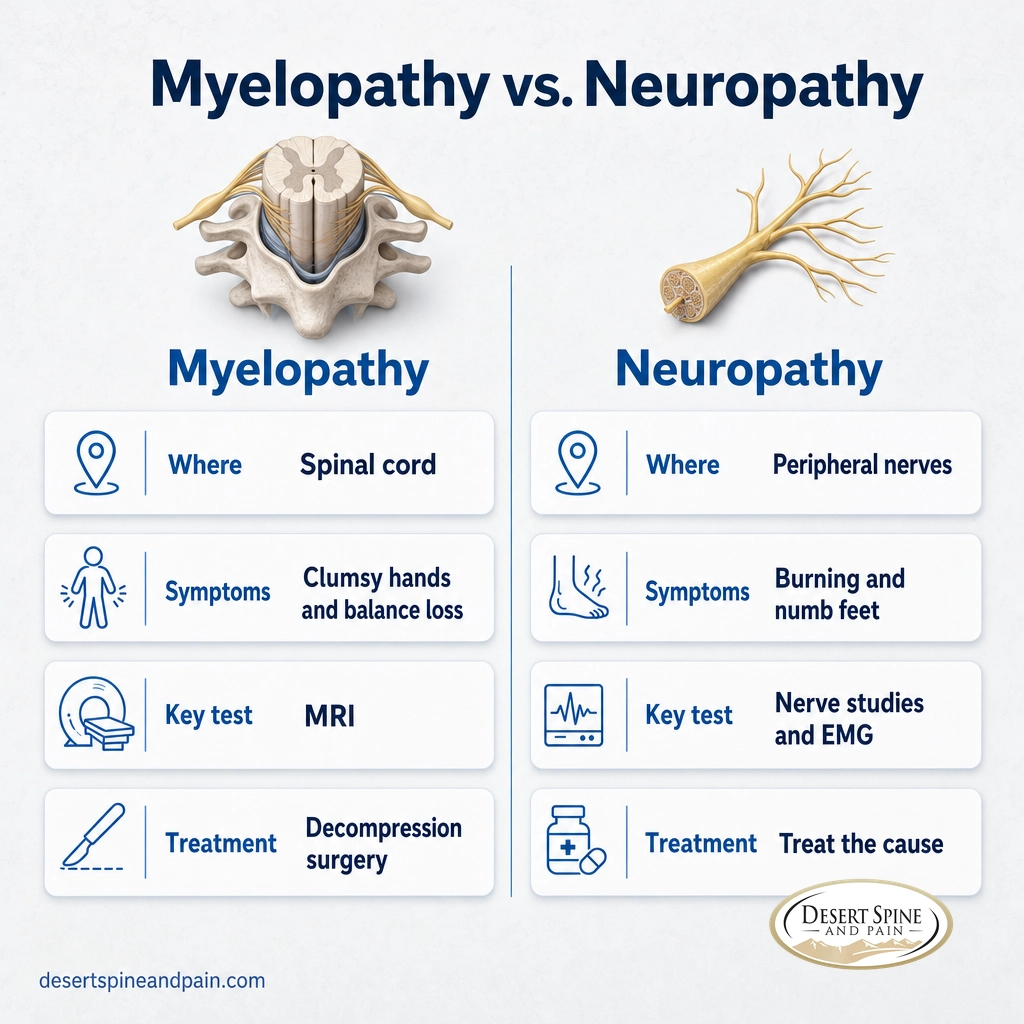
Myelopathy and neuropathy differ on four things that matter most: where the damage sits, what the symptoms feel like, what causes each, and how fast they move. Here is each one in turn.
1. Where the damage sits
This is the root difference everything else flows from. Myelopathy is a central nervous system problem: the spinal cord. Neuropathy is a peripheral nervous system problem: the nerves beyond the cord. A single compressed cord in the neck can affect both arms and both legs, because every signal to the body passes through it. A peripheral nerve problem affects only the territory that nerve serves, which is why diabetic neuropathy shows up symmetrically in the feet rather than throughout the body at once.
2. What the symptoms feel like
Myelopathy leans toward motor and coordination problems: clumsy hands, stiff or heavy legs, poor balance, and a careful, unsteady walk, often without severe pain. Neuropathy leans toward sensory problems at the extremities: burning, tingling, and numbness that begins in the toes or fingertips. A useful rule of thumb is that neuropathy is loud in the feet and hands, while myelopathy is quiet but spread across whole limbs and tied to balance and fine-motor control.
3. What causes each
Myelopathy is usually structural and mechanical: something is pressing on the cord, most often age-related changes in the neck, a disc, or stenosis. Neuropathy is usually metabolic or systemic: diabetes above all, plus alcohol, chemotherapy, deficiencies, and autoimmune disease. In short, myelopathy is often a plumbing problem you can see on a scan, while neuropathy is often a chemistry problem you find in bloodwork and nerve testing.
4. How fast they move
Both can be gradual, but the stakes differ. Myelopathy can progress in a stepwise way, and because the spinal cord has little margin, lost function can become permanent, so progressive myelopathy is treated as time-sensitive. Most neuropathies progress more slowly and are often stabilized or improved by treating the cause, though some can advance if the underlying problem is not addressed.
Source: National Institute of Neurological Disorders and Stroke (NINDS): Peripheral Neuropathy | Davies et al., Degenerative Cervical Myelopathy, BMJ (2018)

Master Comparison Table
The table below puts the two conditions next to each other across the points that most often come up in a consultation.
| Feature | Myelopathy | Neuropathy |
|---|---|---|
| What is damaged | The spinal cord (central nervous system) | Peripheral nerves outside the brain and cord |
| Most common cause | Age-related neck wear, stenosis, disc, bone spurs | Diabetes, then alcohol, chemotherapy, deficiencies |
| Typical symptoms | Clumsy hands, weak or stiff legs, balance and gait trouble | Burning, tingling, numbness in feet then hands |
| Pattern | Whole limbs, often both sides, below the compression | Stocking-and-glove, starting at the extremities |
| Reflexes | Usually overactive (upper motor neuron signs) | Usually reduced or absent |
| Pain | Not always prominent; coordination loss stands out | Often prominent, burning or electric, worse at night |
| Key test | MRI of the spine | Nerve conduction studies and EMG, plus bloodwork |
| Usual treatment | Decompression surgery when progressing; monitoring if mild | Treat the cause, medication, therapy; surgery if compressive |
| Urgency | Often time-sensitive; damage can become permanent | Usually slower; cause-driven management |
How Each Is Diagnosed
The confusion between these two conditions is exactly why a structured workup matters. A good evaluation starts the same way for both: a detailed history and a hands-on neurological exam that maps where symptoms are, tests strength and sensation, and checks reflexes. That exam alone often points one direction, because overactive reflexes and balance problems suggest the cord, while reduced reflexes and a stocking-glove pattern suggest the peripheral nerves. From there, the tests diverge.
For suspected myelopathy, imaging leads. An MRI of the spine is the best way to see the spinal cord and whether anything is compressing it, and it can reveal changes in the cord itself. X-rays and CT scans add detail about the bones and alignment. The goal is to match the exam findings to a specific level of compression on the scan.
For suspected neuropathy, nerve testing leads. Nerve conduction studies and electromyography (EMG) measure how well signals travel along the peripheral nerves and into the muscles, which confirms neuropathy, shows how severe it is, and can suggest the cause. Bloodwork is central here too, checking blood sugar and A1c, vitamin B12, thyroid function, and other markers, because finding the cause is half the treatment. Specialized diagnostic nerve testing is often the step that separates a peripheral nerve problem from a cord problem.
When the picture is mixed, a doctor may order both, because an MRI can show cord compression while nerve studies simultaneously reveal peripheral damage. Reading the two together is how an experienced clinician decides which problem is driving your symptoms, or how much each is contributing. If you want the broader map of which nerves relate to which parts of the body, our guide to which vertebrae affect which nerves is a helpful companion.
Source: Cleveland Clinic: diagnosis of peripheral neuropathy | NINDS: Peripheral Neuropathy
How Each Is Treated
Treatment follows the cause, and this is where the two conditions separate most clearly.
Myelopathy treatment centers on relieving pressure on the cord. Mild, non-progressive myelopathy is sometimes watched closely with regular exams and imaging. But when symptoms are progressing, surgery to decompress the cord is usually the most reliable way to stop further injury and give the cord room to recover. Depending on where and why the cord is compressed, that may involve removing a disc and fusing the segment, removing bone to widen the canal, or a motion-preserving approach. You can explore the options on our spine surgery overview, including decompression procedures such as laminectomy and cervical stenosis surgery. The guiding principle is to act before the damage becomes fixed.
Neuropathy treatment centers on the underlying cause plus symptom relief. For diabetic neuropathy, tight blood sugar control is the foundation and can slow or stop progression. Across causes, treatment often includes medications developed for nerve pain, physical therapy, and lifestyle changes, with interventional pain management for symptoms that are hard to control. The important exception is compressive neuropathy, where one nerve is pinched in a specific spot: there, a targeted release can resolve the problem, as with carpal tunnel release or ulnar nerve decompression. Because a compressive neuropathy looks like general neuropathy at first glance, it is worth having the distinction confirmed, since the compressive type is often the most fixable.
Source: NIDDK: managing diabetic neuropathy | Davies et al., Degenerative Cervical Myelopathy, BMJ (2018)
Can You Have Both at Once?
Yes, and this overlap is one of the biggest reasons the two get confused. A person can have peripheral neuropathy from diabetes and, at the same time, develop cervical myelopathy from age-related narrowing in the neck. When nerve signals are squeezed in two places, at the cord and out in the peripheral nerves, the symptoms blur together, and treating only one may leave the person still struggling.
Why the overlap trips people up: numbness in the hands could be carpal tunnel (peripheral), cervical myelopathy (cord), or both. Balance trouble could come from numb feet (sensory neuropathy) or from the cord (myelopathy). Weakness could be either. The only reliable way to separate them is to combine the exam with the right tests, MRI for the cord and nerve studies for the peripheral nerves, and let the findings, not the symptom name, drive the plan.
This is also why the clinician you see matters. A doctor who evaluates the entire pathway, from the brain and spinal cord down to the nerve roots and peripheral nerves, is best positioned to recognize when two problems are stacked on top of each other, rather than forcing your symptoms into a single diagnosis.
When Your Symptoms Point to Myelopathy
Certain symptom patterns should move you toward prompt spine evaluation rather than a wait-and-see approach. Consider myelopathy, and act sooner, if you notice:
- Hand clumsiness and loss of fine motor control: new trouble with buttons, coins, zippers, or handwriting, often in both hands.
- Balance and walking changes: feeling unsteady, walking more carefully or with a wider stance, or feeling your legs are heavy or stiff.
- Whole-limb involvement: weakness or odd sensations spanning entire arms or legs rather than just the toes or fingertips.
- Neck-triggered shock sensations: an electric feeling down the spine or into the limbs when you bend your neck forward.
- Bladder or bowel changes: these are later, serious signs and warrant urgent evaluation.
These findings point to the spinal cord, and because cord injury relieved early recovers better than cord injury left to progress, they are a reason to see a spine specialist promptly. A related condition worth understanding is how myelopathy differs from a pinched nerve root, which we cover in myelopathy vs. radiculopathy.
When Your Symptoms Point to Neuropathy
Other patterns point toward the peripheral nerves. Consider neuropathy if your symptoms look like this:
- Feet-first, symmetric numbness and burning: tingling or burning that started in both feet and may now reach the hands, in a stocking-and-glove pattern.
- A known risk factor: diabetes or prediabetes, heavy alcohol use, chemotherapy, a B12 deficiency, or a thyroid or autoimmune condition.
- Sensory symptoms over motor ones: the dominant experience is how things feel (burning, pins and needles, numbness) rather than clumsiness or balance loss.
- Worse at night: many people with neuropathy notice the burning and tingling peak when they are trying to sleep.
- One-nerve, one-spot symptoms: numbness and tingling in a specific hand or finger pattern can suggest a compressive neuropathy such as carpal tunnel, which is often very treatable.
Neuropathy still deserves a real workup, both to find and treat the cause and to rule out a cord problem hiding underneath. The point is not to self-diagnose, but to know which symptoms deserve which kind of attention.
Why One Expert Across Cord and Nerve Matters
Myelopathy and neuropathy live at two different points on the same nervous system, and the hardest cases are the ones that straddle both. That is exactly where it helps to see a physician whose training spans the entire pathway rather than just one segment of it.
At Desert Spine and Pain, that question has a clear answer. The practice is led by Dr. David L. Greenwald, MD, FAANS, FACS, who is board certified as both a spine surgeon and a neurosurgeon. That dual training covers the whole axis, from the brain and spinal cord to the nerve roots and the peripheral nerves around them, so one expert can sort out whether your symptoms are coming from the cord, the peripheral nerves, or both, and then match the treatment to the real source. Just as important, the practice leads with the least invasive effective option and reserves surgery for when it is genuinely the right call, such as relieving pressure on a compressed cord before the damage sets.
Desert Spine and Pain serves the Greater Phoenix, Arizona area, welcomes out-of-network patients, and also partners with personal injury attorneys and their clients. If you are dealing with numbness, weakness, clumsy hands, or balance problems and you are not sure what is behind them, a focused consultation is the fastest way to get a clear answer.
Meet Dr. David L. Greenwald, MD, FAANS, FACS
Explore spine conditions we treat
Book a consultation or second opinion
Common Questions About Myelopathy and Neuropathy
What is the difference between myelopathy and neuropathy?
Which is more serious, myelopathy or neuropathy?
Can you have myelopathy and neuropathy at the same time?
How do doctors tell myelopathy and neuropathy apart?
Does myelopathy or neuropathy require surgery?
Related Spine Terms
- Myelopathy: damage or dysfunction of the spinal cord, most often from compression in the neck.
- Peripheral neuropathy: damage to the nerves outside the brain and spinal cord, most often caused by diabetes.
- Radiculopathy: a pinched nerve root where it exits the spine, different from both cord and peripheral nerve problems. For the full contrast, see cervical myelopathy vs. radiculopathy.
- Spinal stenosis: narrowing of the spinal canal that can lead to myelopathy when it compresses the cord.
- Myopathy: a muscle disorder, a separate condition that is also sometimes confused with myelopathy.
- Upper motor neuron signs: overactive reflexes and spasticity that point to the spinal cord or brain rather than the peripheral nerves.
- Spinal nerve map: which vertebrae and nerve roots relate to which parts of the body.
Sources
Sources and Methodology
This guide summarizes established clinical references and peer-reviewed data on myelopathy and peripheral neuropathy. Prevalence figures are general population data presented for reference, not as individual predictions, and symptom descriptions are typical patterns, not a substitute for examination. This is educational information, not medical advice. Decisions about diagnosis and treatment should be made with a qualified physician after an in-person evaluation.
- Davies BM, Mowforth OD, Smith EK, Kotter MR (2018): Degenerative Cervical Myelopathy, BMJ 360:k186
- Cleveland Clinic: Peripheral Neuropathy (definition, causes, symptoms)
- National Institute of Neurological Disorders and Stroke (NINDS): Peripheral Neuropathy
- CDC: National Diabetes Statistics Report (2023 estimates)
- NIDDK: Diabetic Neuropathy (Nerve Damage & Diabetes)
- Nouri A, Tetreault L, Singh A, Karadimas SK, Fehlings MG (2015): Degenerative Cervical Myelopathy: Epidemiology, Genetics, and Pathogenesis, Spine (peer-reviewed reference)