

How Much Pain Is Normal After a Laminectomy?
The short answer: Pain after a laminectomy is usually moderate, not severe, and improves steadily. Expect incision and muscle soreness for the first few days to a few weeks, with most people recovering within four to six weeks after a minimally invasive procedure. Many patients wake up with the leg pain that sent them to surgery already relieved. Pain that worsens, returns, or comes with new weakness or bladder changes is the exception, and it needs a call to your surgeon.
If you are facing a laminectomy, or recovering from one and wondering whether what you feel is normal, the honest answer is reassuring: most people find the pain manageable and short-lived relative to the pain that brought them to surgery. A laminectomy removes a small piece of bone (the lamina) to take pressure off a crowded spinal nerve, so the leg pain, sciatica, or heaviness from that pinched nerve is often better right away. What replaces it for a while is ordinary surgical soreness at the incision and in the muscles, which fades on a predictable schedule. This guide walks through exactly what pain is normal, how long it lasts, what makes it more or less intense, how it is managed, and the specific warning signs that mean your recovery needs a closer look.
- Laminectomy pain is typically moderate incision and muscle soreness, not severe pain, and it is usually controlled with medication.
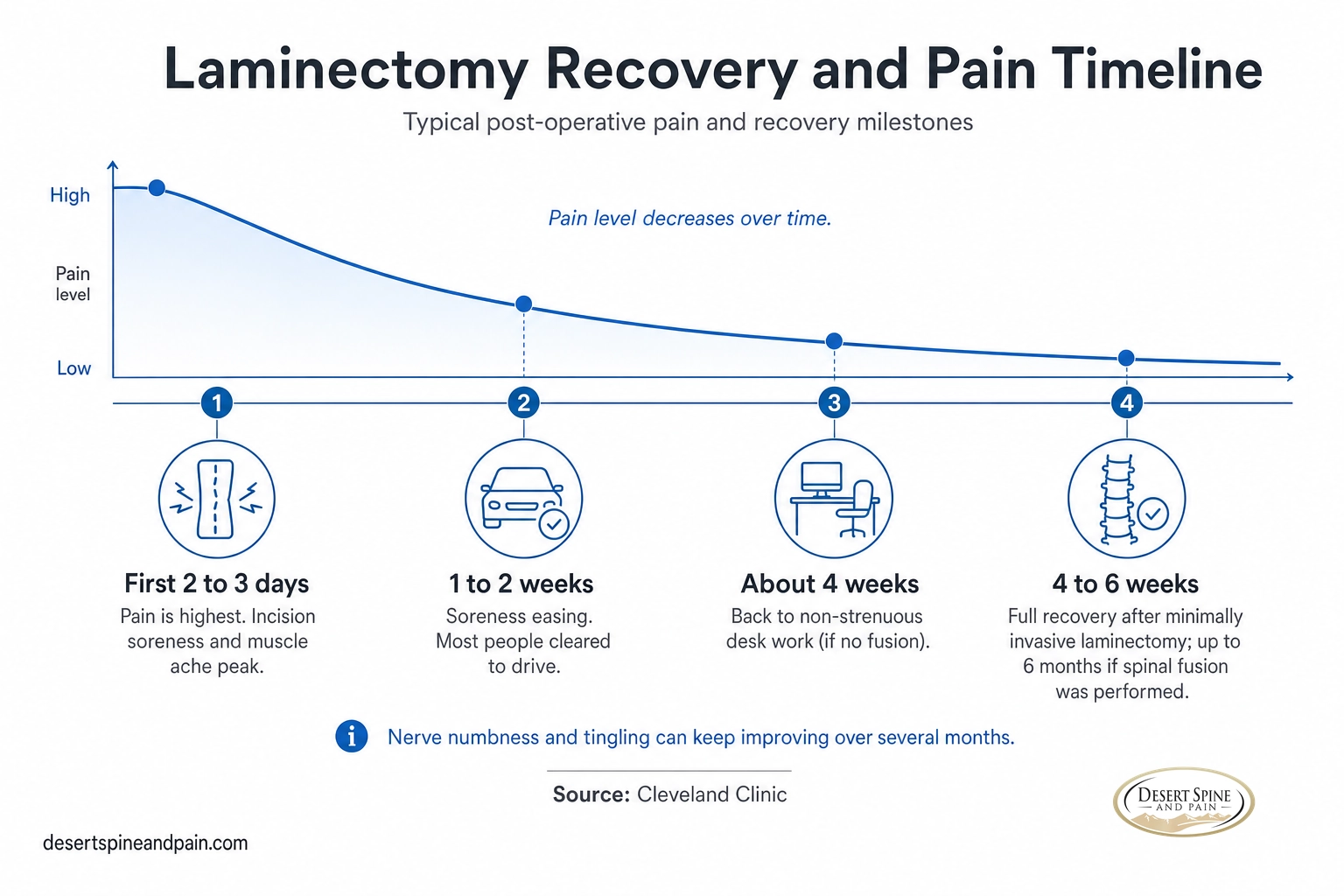
- Discomfort peaks in the first two to three days, then eases over the next few weeks; full recovery is about four to six weeks after a minimally invasive laminectomy, and up to six months if a fusion was added.
- The leg pain from the pinched nerve is often relieved immediately, while residual numbness or tingling can keep improving over months as the nerve heals.
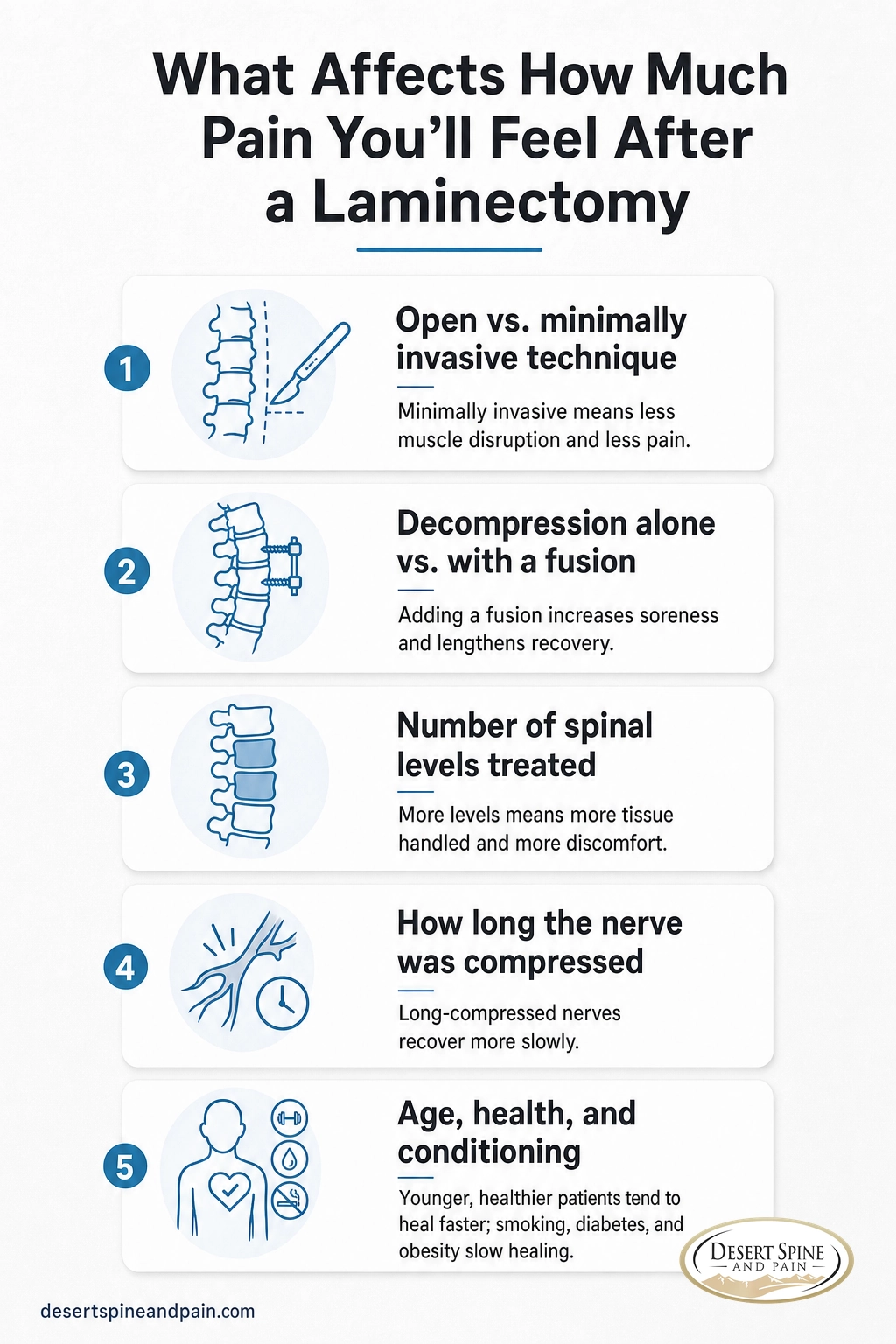
- How much it hurts depends on open versus minimally invasive technique, whether a fusion was done, how many levels were treated, how long the nerve was compressed, and your overall health.
- Pain that worsens, returns after improving, or comes with new weakness, fever, or loss of bladder or bowel control is not normal and needs prompt medical attention.

What's in This Guide
What Pain Is Normal Right After a Laminectomy?
It helps to separate two very different kinds of pain. The first is the pain you had before surgery: the sciatica, leg heaviness, cramping, or numbness caused by a nerve being squeezed in a narrowed spinal canal. The second is surgical pain, the soreness that comes from the procedure itself. A laminectomy is designed to fix the first by creating room for the nerve, so that pain is frequently gone or dramatically reduced the day of surgery. The soreness that takes its place is the normal, temporary kind.
In the first days after a laminectomy, it is normal to feel:
- Incision pain. A focused soreness or tenderness around the surgical site that is usually worst for the first few days and then settles.
- Muscle aches and spasm. The muscles beside the spine are moved or retracted during surgery, so a deep, bruised ache and occasional spasm in the low back are expected, especially with an open procedure.
- Stiffness. A tight, reluctant feeling when you first stand or change position that loosens as you gently move.
- Lingering nerve sensations. If a nerve was compressed for a long time, tingling, numbness, or a residual ache can remain for a while and keep improving slowly as the nerve recovers.
What is reassuring is how most patients describe the trade. The sharp, radiating leg pain that limited walking and sleep is usually the thing that improves first, while the back soreness that replaces it is a more predictable, steadily fading discomfort. The American Association of Neurological Surgeons notes that a large share of lumbar spinal stenosis patients who undergo surgery report significant pain relief, which is the whole point of the operation. To understand the procedure itself in plain terms, see our overview of what a laminectomy is and how it works.
Source: American Association of Neurological Surgeons: Lumbar Spinal Stenosis | Cleveland Clinic: Laminectomy
The Laminectomy Pain and Recovery Timeline
Pain after a laminectomy follows a recognizable arc. It is highest early, then declines week by week. Knowing the schedule helps you tell the difference between a bump in the road and a real problem.
The first few days
This is when discomfort is greatest. Incision soreness and muscle ache peak in the first two to three days as the anesthesia and in-hospital pain control taper off. Many laminectomies are now done as same-day or short-stay surgery, so a good share of this window happens at home with the medication your team sends you home with. Short, frequent walks starting the day of or day after surgery are encouraged and genuinely help, because gentle movement eases stiffness and lowers the risk of complications.
The first weeks
Soreness eases noticeably over the first two to four weeks. According to the Cleveland Clinic, most people feel well enough to drive within one to two weeks and can return to non-strenuous work within about one month when no fusion was performed. This is also when you gradually rebuild activity, avoiding heavy lifting, bending, and twisting while the tissues heal.
Typical milestones after a minimally invasive laminectomy (no fusion)
General guidance for a laminectomy without spinal fusion; your surgeon's instructions take priority. Source: Cleveland Clinic.The first months
Two timelines stretch longer. First, if a spinal fusion was added to stabilize the segment, full healing can take up to six months because bone has to knit together. Second, nerve recovery is slow by nature. A nerve that was compressed for months can take weeks to months to calm down, so residual numbness, tingling, or a background ache can keep improving well after the incision has healed. That slow fade is normal and not a sign the surgery failed.
For a deeper look at week-by-week expectations and practical do's and don'ts, see our laminectomy recovery tips, and if you are still in the planning stage you may want our breakdown of how long the surgery itself takes.
Source: Cleveland Clinic: Laminectomy Surgery for Back Pain
What Affects How Much Pain You'll Feel
There is no single pain experience for a laminectomy, because several variables move the dial. Understanding them explains why two people can have the same procedure name and very different recoveries.
Open versus minimally invasive technique
The single biggest lever is how the surgery is done. A traditional open laminectomy requires a larger incision and more disruption of the muscles beside the spine, which means more post-operative muscle soreness. A minimally invasive approach uses small incisions and tubular retractors that spread rather than cut the muscle, which generally means less tissue trauma, less pain, and a faster return to activity. When a decompression can be done this way, most patients feel the difference.
Decompression alone versus a fusion
A laminectomy by itself removes bone to free the nerve. If the spine is unstable, a surgeon may add a fusion to lock two vertebrae together. Fusion adds hardware and requires bone to heal, so it adds soreness and extends the recovery window, as the timeline above shows. Decompression-only procedures are typically the lighter recovery.
The number of levels treated
Freeing one level of the spine is a smaller operation than decompressing several. More levels mean a longer incision, more tissue handled, and usually a bit more post-operative discomfort and a longer road back.
How long the nerve was compressed
A nerve that has been pinched for a short time tends to bounce back quickly once the pressure is gone. One that has been compressed for months or years may have been irritated enough that numbness, tingling, or weakness improve slowly and incompletely, even when the surgery was technically perfect. This is about nerve biology, not surgical quality.
Your age, health, and conditioning
Younger, healthier, more active patients generally heal faster. Conditions such as diabetes, smoking, and obesity slow tissue healing and can make recovery longer and more uncomfortable. Going into surgery in the best shape you can, and following your activity plan afterward, meaningfully affects how the recovery feels.
Source: Weinstein et al., Surgical versus Nonsurgical Therapy for Lumbar Spinal Stenosis (SPORT), NEJM 2008 | Cleveland Clinic: Laminectomy
How Post-Laminectomy Pain Is Managed
Modern spine care manages post-operative pain with a layered, multimodal plan rather than leaning on any one medication. The goal is to keep you comfortable enough to move, because movement is what drives recovery, while using the strongest drugs sparingly. A 2020 systematic review of pain management after lumbar laminectomy supports exactly this approach: combine several methods and reserve opioids as rescue medication rather than the foundation.
A typical plan draws on several of these:
- Scheduled non-opioid medication. Acetaminophen and anti-inflammatory medicines form the base of pain control for most patients.
- Short-term opioids as rescue only. Stronger pain medicine may be used for the first days for breakthrough pain, then tapered quickly.
- Muscle relaxants. Helpful for the muscle spasm that often accompanies the first week.
- Ice and positioning. Cold therapy and comfortable positioning calm incision soreness without any medication.
- Early, gentle walking. The most underrated tool. Frequent short walks reduce stiffness, improve circulation, and speed the return to normal.
- Guided physical therapy. A structured program, coordinated through trusted referral partners, rebuilds core and spinal support once your surgeon clears it.
- Targeted injections for persistent pain. If specific pain lingers, image-guided epidural steroid injections or other interventional options can help calm an irritated nerve.
Taking medication on the schedule your team sets, rather than waiting until pain is severe, keeps you ahead of it and usually means needing less overall. For the conservative and interventional side of care, see our pain management options.

When Your Pain Is Not Normal: Warning Signs
The vast majority of recoveries are uneventful. But knowing which symptoms fall outside the normal pattern is the most important thing you can take from this guide, because a few of them are genuine emergencies.
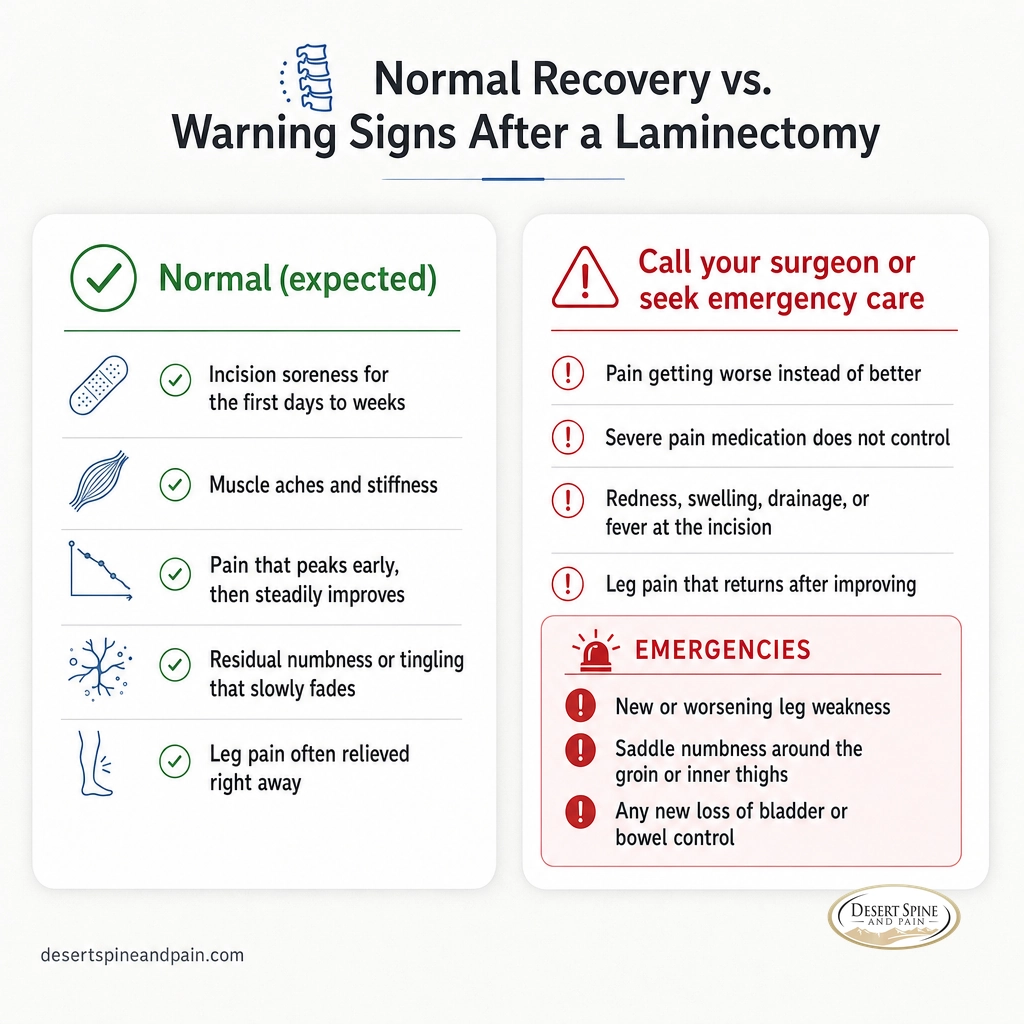
Get emergency care immediately for any of these. New or worsening weakness in a leg or foot, numbness around the groin, buttocks, or inner thighs (saddle numbness), or any new loss of bladder or bowel control can signal serious compression of the nerves and should be treated as an emergency, not watched at home. These are uncommon, but they are time-sensitive.
Call your surgeon promptly, though not necessarily as an emergency, for:
- Pain that is steadily getting worse after the first few days instead of better.
- Severe pain that your prescribed medication does not control at all.
- Redness, increasing swelling, warmth, or drainage at the incision, or a fever, which can point to infection.
- Leg pain that had resolved and then returns, which can suggest a recurrent problem.
Persistent pain and post-laminectomy syndrome
A small share of patients continue to have meaningful back or leg pain after spine surgery, a situation often called failed back surgery syndrome or post-laminectomy syndrome. Reported rates vary widely with how it is defined, from roughly 10 percent to 40 percent across studies, with patient-reported surveys commonly landing near 20 percent. Causes can include scar tissue around a nerve, incomplete decompression, a recurrent disc herniation, instability, or a problem at an adjacent segment.
The important point is that persistent pain is a recognized, workable problem, not a dead end. It has specific causes that can be identified and treated, which is exactly why an expert evaluation matters when pain does not follow the normal downward path.
Source: Thomson et al., Prevalence, characteristics, and burden of failed back surgery syndrome, Journal of Pain Research (2017) | Cleveland Clinic: when to call your provider
How to Set Up the Smoothest Recovery
Two decisions shape your pain experience more than almost anything else, and both happen before the first incision. The first is choosing the least invasive effective approach, because minimally invasive decompression consistently means less muscle disruption and less post-operative pain. The second is making sure the surgery is the right one for your specific anatomy, so that the nerve is fully freed and nothing is left to cause lingering trouble.
Desert Spine and Pain is a Phoenix, Arizona practice led by Dr. David L. Greenwald, MD, FACS, a board-certified surgeon who is both a spine surgeon and a neurosurgeon, and it draws patients from across the Greater Phoenix area and beyond. Care always starts with the least invasive effective option and moves to surgery only when it is genuinely the best path, which is the philosophy that keeps recovery as light as it can be. If surgery has been recommended and you want to understand your options, or if your recovery is not going the way you expected, a focused consultation or second opinion is the right next step.
Learn about laminectomy at Desert Spine and Pain
Explore options for persistent or post-surgical pain
Book a consultation or second opinion
Common Questions About Laminectomy Pain
How bad is the pain after a laminectomy?
How long does pain last after a laminectomy?
Why does my back still hurt after a laminectomy?
What is the most painful day after a laminectomy?
When should I worry about pain after a laminectomy?
Is a laminectomy more painful than a microdiscectomy?
Sources
Sources and Methodology
This guide summarizes established clinical references and peer-reviewed data on pain and recovery after a laminectomy. Recovery timeframes are drawn from patient-education guidance and reflect typical, not guaranteed, outcomes; individual recovery varies with technique, whether a fusion was done, the number of levels treated, and personal health. This is educational information, not medical advice. Decisions about your care should be made with a qualified spine specialist after an in-person evaluation, and your surgeon's post-operative instructions always take priority.
- Cleveland Clinic: Laminectomy Surgery for Back Pain (recovery timeline, when to call your provider)
- American Association of Neurological Surgeons: Lumbar Spinal Stenosis
- Weinstein et al. (2008): Surgical versus Nonsurgical Therapy for Lumbar Spinal Stenosis, SPORT, NEJM
- Dunn et al. (2020): Systematic review of pain management after lumbar laminectomy, European Spine Journal
- Thomson et al. (2017): Prevalence, characteristics, and burden of failed back surgery syndrome, Journal of Pain Research