

Post-Laminectomy Syndrome: Causes, Symptoms, and Treatment
Post-laminectomy syndrome, in plain terms: Post-laminectomy syndrome is chronic back or leg pain that continues, returns, or newly appears after spine surgery, most often a laminectomy. It is used interchangeably with failed back surgery syndrome. It is not one disease but an umbrella term for several possible pain sources, which is why finding the real cause comes first.
If the pain is still there months after a laminectomy, or it eased at first and then came back, that experience has a name: post-laminectomy syndrome. It describes lasting pain after decompression surgery and is used interchangeably with failed back surgery syndrome. The most useful thing to understand up front is that it is a signal, not a dead end. It means a specific pain source still needs to be found and treated, and in most cases one can be. This guide explains what post-laminectomy syndrome is, why it develops, its symptoms and causes, how long it tends to last, and the treatments that help, written in plain language so you can make a confident next decision.
- Post-laminectomy syndrome is chronic pain that persists or returns after spine surgery, especially a laminectomy, and is used interchangeably with failed back surgery syndrome.
- It is an umbrella term for many possible causes, so effective treatment depends on pinpointing the real pain source first.
- Persistent pain after spine surgery is more common than many patients expect, reported in roughly 10 to 40 percent of operations depending on how it is defined.
- Leading causes include epidural scar tissue, recurrent disc herniation, wrong-level or incomplete surgery, instability, and untreated joint pain.
- By definition it is chronic, but targeted, least-invasive-first treatment often brings meaningful, lasting relief.
- Spinal cord stimulation can be more effective than repeat surgery for ongoing nerve pain, so more surgery is not automatically the answer.

What's in This Guide
- How Post-Laminectomy Syndrome Develops
- Symptoms of Post-Laminectomy Syndrome
- Causes of Post-Laminectomy Syndrome
- Post-Laminectomy Syndrome vs. Normal Recovery
- How Long Post-Laminectomy Syndrome Lasts
- How Post-Laminectomy Syndrome Is Treated
- How to Get Started
- Common Questions
- Related Spine Terms
- Sources
How Post-Laminectomy Syndrome Develops
A laminectomy removes part of a vertebra called the lamina to take pressure off the spinal cord or a nerve root. For most people it does its job, and the pain it was meant to relieve settles as the body heals. Post-laminectomy syndrome is what we call it when that does not happen: the original pain never fully clears, or it returns weeks or months later, or a new pain appears that was not there before. The surgery itself may have been done well; the term just says the pain problem is not solved.
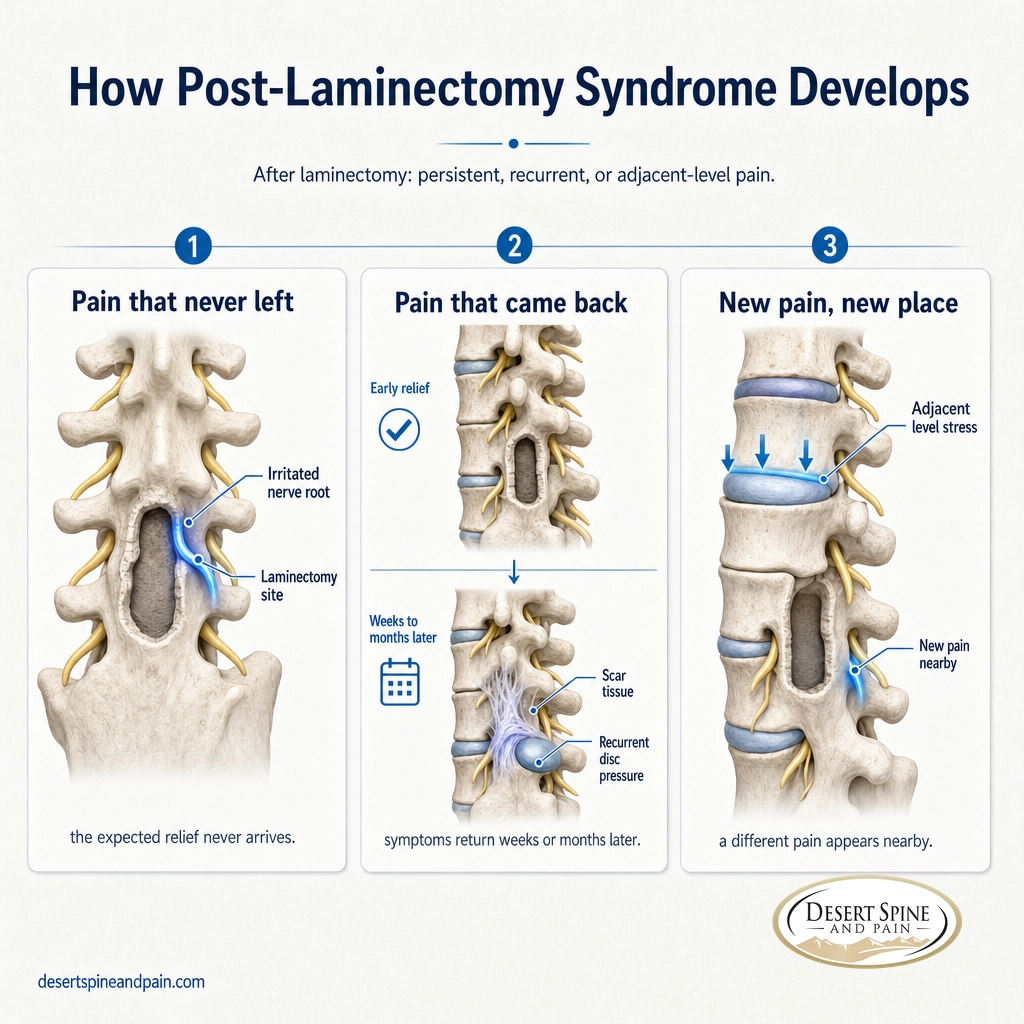
It helps to picture it as one of three timelines:
- Pain that never went away. The expected relief does not arrive after surgery, which often points to a pain source that was not the real target of the operation.
- Pain that came back. Early relief is followed by a return of symptoms, which can signal scar tissue forming around a nerve, a disc herniating again, or a nearby level starting to wear.
- New pain in a new place. A different pattern of pain appears, sometimes from the segment next to the one that was operated on, or from a joint that was quietly contributing all along.
The key idea is that post-laminectomy syndrome names a result, not a cause. Pain is the symptom telling the care team that something specific, scar tissue, a disc, a joint, a level, still needs attention. Reframing it this way turns a frightening label into a solvable problem, because each of those sources can be identified and, in most cases, treated.
Source: Failed back surgery syndrome: terminology, etiology, evaluation, and management, a narrative review
Symptoms of Post-Laminectomy Syndrome
The hallmark of post-laminectomy syndrome is pain that outlasts the normal recovery from surgery. The exact pattern depends on what is driving it, but a few experiences come up again and again.
- Ongoing back pain at or near the surgical area that does not settle as expected, or that returns after an early stretch of relief.
- Leg pain, numbness, or tingling (radiculopathy) that travels from the back into the buttock, thigh, or lower leg, often a sign a nerve root is still irritated.
- A different pain than before. New pain in a new location, which can point to the level next to the surgery or to a joint such as the sacroiliac joint.
- Pain that worsens with activity such as standing, walking, or sitting for long periods, and that limits daily function.
- Reduced mobility and sleep, and, for many people, the mood effects that come with living with chronic pain.
Because these symptoms overlap with several different causes, they do not by themselves reveal the source. They do, however, tell you when it is time to return to a spine specialist for a focused re-evaluation rather than waiting it out. Residual low back pain in particular is extremely common among people who meet the definition of this syndrome.
Source: Prevalence, characteristics, and burden of failed back surgery syndrome: a nationwide survey (PMC)
Causes of Post-Laminectomy Syndrome
This is where the explanation becomes genuinely useful, because post-laminectomy syndrome almost always traces to an identifiable cause. The causes fall into a handful of groups, and more than one can be present at the same time.
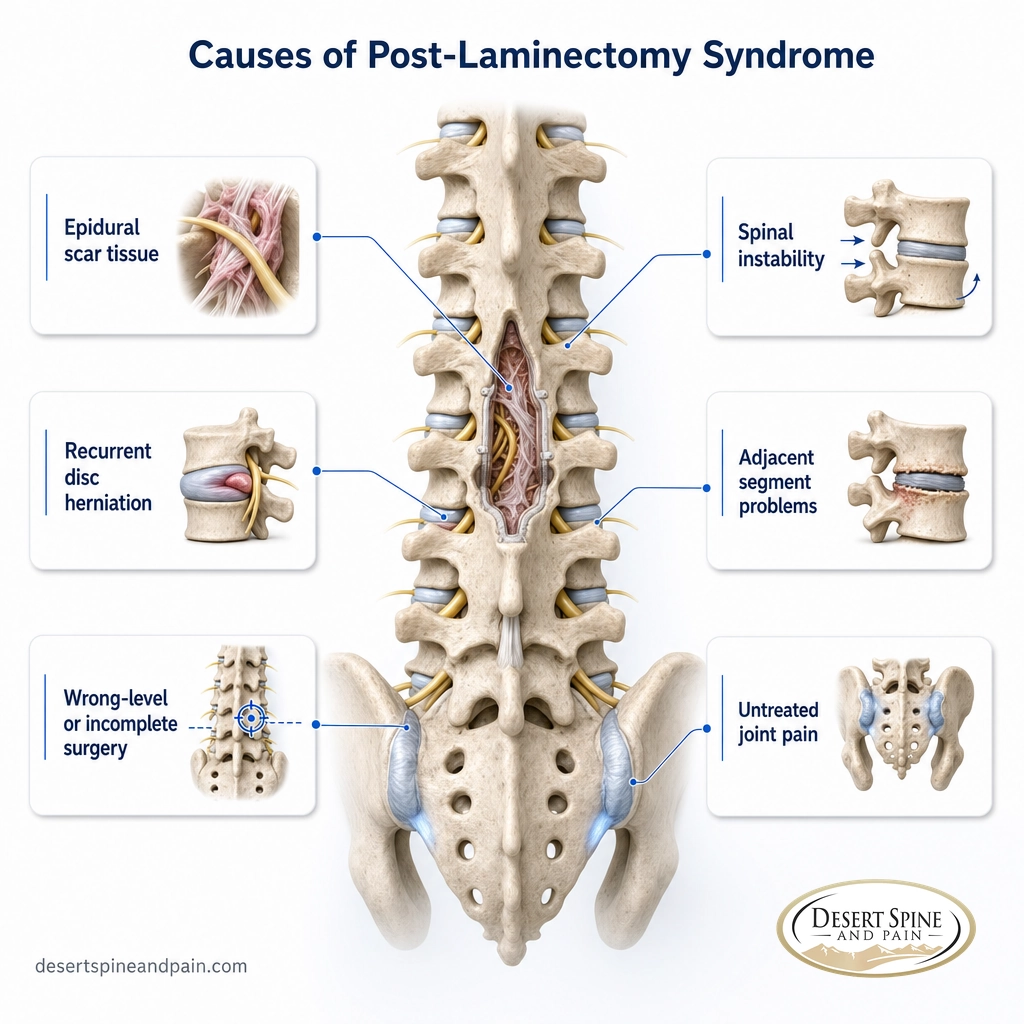
- Epidural scar tissue (fibrosis). Scar tissue forming around a nerve root after surgery is one of the most frequently cited contributors to persistent pain.
- Recurrent or new disc herniation. A disc at the same level can herniate again, or a new one can herniate, re-compressing a nerve.
- Wrong-level or incomplete surgery. If the operation addressed a level that was not the true pain source, or did not fully relieve the pressure, symptoms continue.
- Spinal instability. Removing bone during decompression can, in some cases, leave a segment less stable, which can generate new mechanical pain.
- Adjacent segment problems. The level next to the surgery can take on extra stress and begin to wear or compress a nerve over time.
- An untreated pain source. Pain from the facet joints or the sacroiliac joint may have contributed to the symptoms all along and was never the target of the laminectomy.
A crucial point sits inside this list: some of these causes relate to the decision and plan around the first surgery, and some develop afterward. That is exactly why a careful re-diagnosis, not a reflexive second operation, is the smart first move. A large share of cases can be traced to a source that a repeat surgery would not fix, which is why identifying the culprit matters as much as treating it.
Source: Clinical insights and statistical analysis of failed back surgery syndrome, a multicentric retrospective review (PMC) | Etiology, evaluation, and treatment of failed back surgery syndrome (PubMed)
Post-Laminectomy Syndrome vs. Normal Recovery
The question nearly every patient asks is the right one: is this pain just part of healing, or is it something more? Normal recovery from a laminectomy involves soreness that improves over weeks. Post-laminectomy syndrome is pain that outlasts that window or clearly worsens, and the distinction guides what to do next.
| Feature | Normal Post-Surgery Recovery | Post-Laminectomy Syndrome |
|---|---|---|
| Pain trend | Gradually improves week by week | Persists, plateaus, or returns after early relief |
| Timeline | Eases over the normal healing window of weeks to a few months | Continues beyond that window or recurs later |
| Leg symptoms | Nerve symptoms steadily fade | Leg pain, numbness, or tingling lingers or comes back |
| Function | Activity tolerance keeps improving | Pain keeps limiting daily activity |
| What it calls for | Continue the recovery plan | A focused re-evaluation to find the pain source |
If your pain fits the right-hand column, that is the signal to return to a spine specialist. It does not mean your situation is hopeless; it means the care plan needs updating based on what is actually driving the pain. For a fuller look at how common this is and the data behind it, see our roundup of failed back surgery syndrome statistics and outcomes.
How Long Post-Laminectomy Syndrome Lasts
There is no single number, and anyone who gives you one is guessing. By definition, post-laminectomy syndrome is chronic: it describes pain that has already outlasted the normal healing window of roughly a few months, or that has returned after it. What matters far more than a timeline is the answer to a different question: has the specific cause been found and treated?
The honest version: Left unexamined, post-laminectomy syndrome can persist for years, because the underlying source, whether scar tissue, a recurrent disc, a joint, or an unstable segment, does not resolve on its own. Once the real cause is pinpointed and matched to the right treatment, many people get meaningful and lasting relief. So the duration is far less about how much time has passed and far more about whether the care plan is aimed at the true pain source.
In practice, that means the most important step is not waiting longer; it is getting an accurate re-diagnosis so the clock can start working in your favor. Pooled data put the prevalence of chronic pain after spinal surgery at around 15 percent, which is a reminder that this is a recognized, well-studied problem with established treatment paths, not a rare mystery.
Source: Failed back surgery syndrome narrative review

How Post-Laminectomy Syndrome Is Treated
Treatment follows one principle: find the exact pain source, then use the least invasive effective option that targets it. Because post-laminectomy syndrome has many possible causes, there is no single fix, but there is a sensible ladder that most care plans climb only as far as they need to.
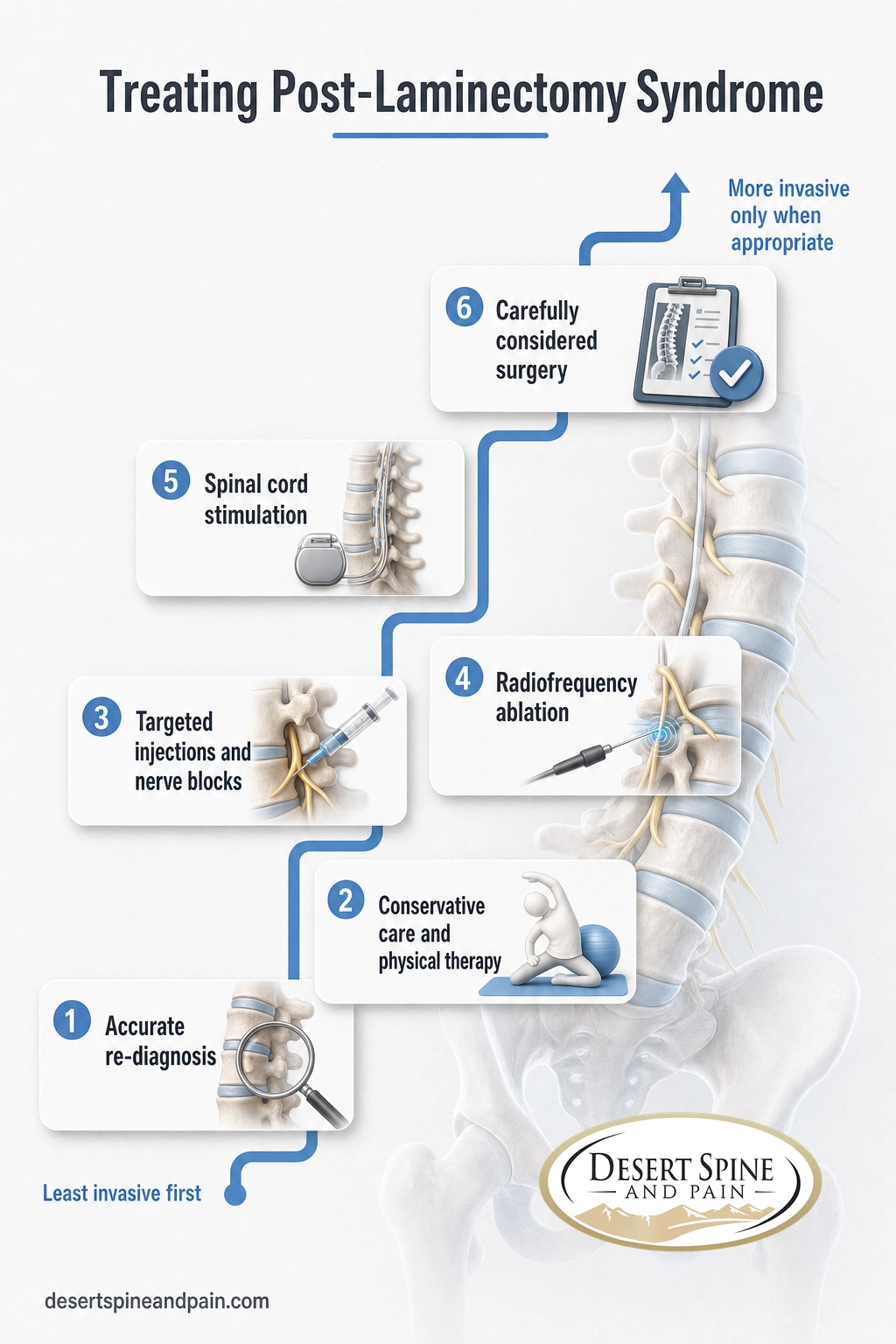
- Accurate re-diagnosis first. A new history, exam, and updated imaging, sometimes with diagnostic injections, pinpoint which source is driving the pain. Everything else depends on getting this right.
- Conservative care. Activity adjustments and a guided physical therapy program (arranged by referral) rebuild strength and often reduce pain, and are the foundation for most plans.
- Targeted injections and nerve blocks. Epidural steroid injections and nerve blocks can calm an irritated nerve and also help confirm the source.
- Radiofrequency ablation. For certain joint-driven pain, radiofrequency ablation uses heat to interrupt the pain signals from specific nerves.
- Spinal cord stimulation. For persistent nerve pain, spinal cord stimulation delivers mild electrical signals that mask pain, and studies show it can be more effective than repeat surgery for ongoing post-surgical pain.
- Carefully considered surgery. A further operation is reserved for clear, correctable problems such as a recurrent herniation or instability, and only when the benefit is likely to outweigh the added risk.
Myth: "If the first surgery did not work, I just need another one." Not usually. The evidence urges caution, because additional operations can compound the risk of continued pain, and repeat surgery is strongly associated with worse pain outcomes. For persistent nerve pain, targeted, less invasive treatment such as spinal cord stimulation often outperforms another operation. A surgeon who says more surgery is not the answer is frequently protecting you, not withholding care.
At our Phoenix spine and pain practice, the philosophy is the least invasive effective treatment first, which is exactly the approach the data on this condition supports.
Explore interventional pain management options
Learn about spinal cord stimulation
Source: Failed back surgery syndrome management review | Nationwide failed back surgery syndrome survey (PMC)
How to Get Started
If pain is still with you after a laminectomy, the most valuable next step is a focused evaluation that answers two questions: what is the specific source of this pain, and what is the least invasive treatment that will actually address it. A thorough consult reviews your symptoms, your exam, and your imaging together, and it is the right moment to ask about every option and to get a second opinion before agreeing to any further surgery.
Desert Spine and Pain is a Phoenix, Arizona practice led by Dr. David L. Greenwald, MD, FAANS, FACS, who is board certified as both a spine surgeon and a neurosurgeon. The practice evaluates patients with continued pain after prior spine surgery to find what is truly driving it, and care always begins with the least invasive effective option. You can read more about Dr. Greenwald's background and credentials before you decide.
Book a consultation or second opinion: (602) 566-9500
Common Questions About Post-Laminectomy Syndrome
What is post-laminectomy syndrome?
What causes post-laminectomy syndrome?
How long does post-laminectomy syndrome last?
How is post-laminectomy syndrome treated?
Is post-laminectomy syndrome the same as failed back surgery syndrome?
Related Spine Terms
- Laminectomy: the decompression surgery that removes part of a vertebra to relieve pressure on the spinal cord or a nerve.
- Spinal decompression surgery: the broader family of procedures that take pressure off compressed nerves in the spine.
- Failed back surgery syndrome: the interchangeable term for persistent pain after any spine operation, with the full data roundup.
- Epidural fibrosis: scar tissue that can form around a nerve root after surgery and a common contributor to this syndrome.
- Radiculopathy: pain, numbness, or tingling that travels along a nerve into the leg, a frequent symptom.
- Spinal cord stimulation: a treatment that masks pain signals and can outperform repeat surgery for ongoing nerve pain.
- Adjacent segment disease: wear or compression at the spinal level next to a prior surgery, a possible source of new pain.
Sources
Sources and Methodology
This guide summarizes established clinical references and Tier 1 peer-reviewed data on post-laminectomy syndrome, also called failed back surgery syndrome. Prevalence figures are drawn from large database studies, a nationwide patient survey, and peer-reviewed reviews; because the condition is defined differently across studies, reported rates vary, and the figures describe populations rather than any individual patient. This is educational information, not medical advice. Decisions about treatment or further surgery should be made with a qualified spine surgeon after an in-person evaluation, and no outcome can be guaranteed.
- Failed back surgery syndrome: terminology, etiology, prevention, evaluation, and management, a narrative review
- Etiology, evaluation, and treatment of failed back surgery syndrome (PubMed)
- The incidence of failed back surgery syndrome varies between clinical setting and procedure type, 102,047 patients (PubMed)
- Prevalence, characteristics, and burden of failed back surgery syndrome: a nationwide survey (PMC)
- Clinical insights and statistical analysis of failed back surgery syndrome, a multicentric retrospective review (PMC)
- Desert Spine and Pain: Failed Back Surgery Syndrome Statistics (2026)