
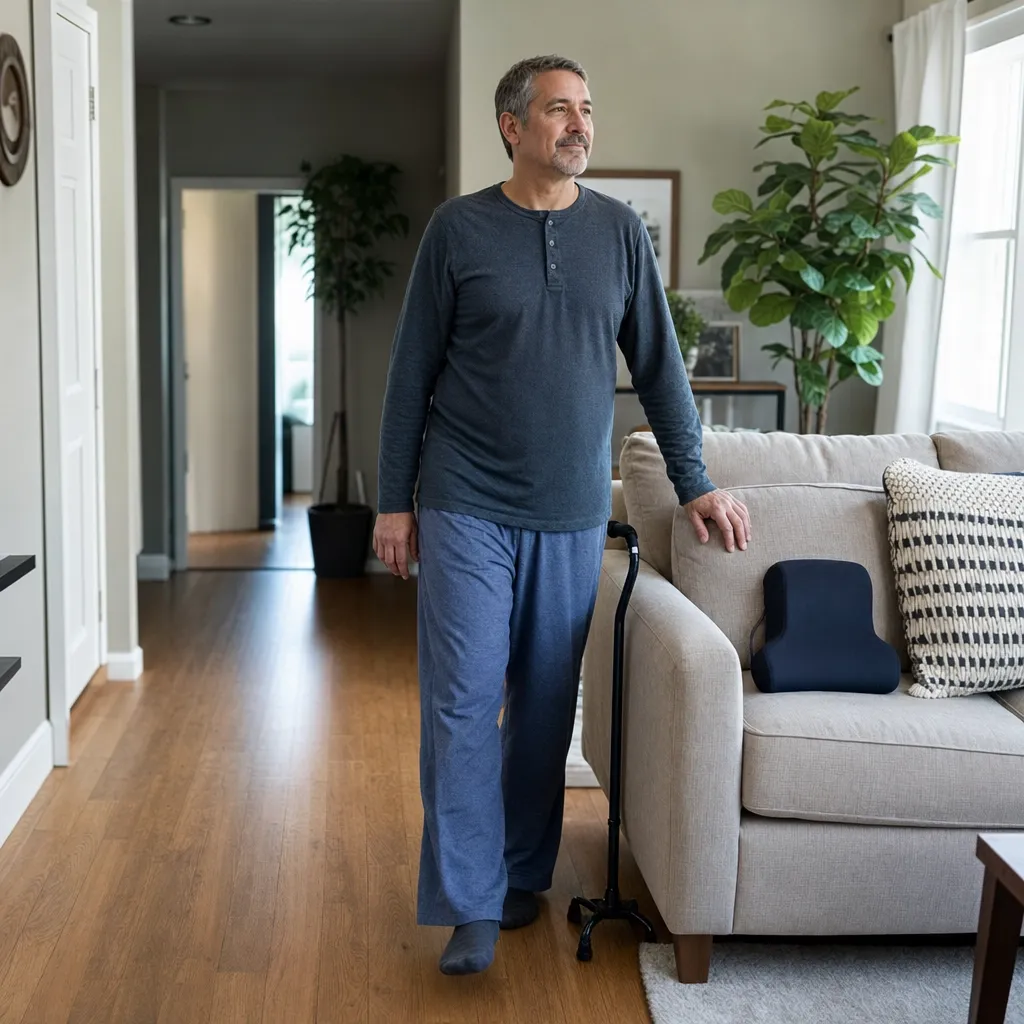
Microdiscectomy Recovery Timeline: What to Expect Week by Week
A microdiscectomy is one of the fastest-healing spine operations, and most people are surprised by how quickly the worst of the pain lifts. The sciatic leg pain that drove you to surgery often eases within days, you will likely walk the same day, and many patients are back to desk work in 2 to 4 weeks. Full recovery, meaning a return to lifting, exercise, and physically demanding work, usually lands somewhere between 6 and 12 weeks, while nerve-related numbness can keep improving for up to a year. This guide walks you through exactly what to expect at each stage, so you know what is normal, what is not, and when it is time to call your surgeon.
Key Takeaways
- Most patients walk the same day and go home within 24 hours after a minimally invasive microdiscectomy.
- Leg (sciatic) pain often improves within days; incision and muscle soreness usually peak in the first week.
- Desk workers typically return in 2 to 4 weeks, while physically demanding jobs often need 6 to 12 weeks.
- The "BLT" limits (no heavy Bending, Lifting, or Twisting) protect the healing disc in the early weeks.
- Numbness and tingling can keep improving for 6 to 12 months, well after the pain is gone.
- About 84% of microdiscectomy patients report good-to-excellent long-term results in large pooled studies.
- Sudden bladder or bowel changes, saddle numbness, or fast-worsening leg weakness are medical emergencies.

What's in This Guide
- What Recovery Really Looks Like
- Your Week-by-Week Recovery Timeline
- When Can You Drive, Work, and Lift Again?
- Physical Therapy and Rehabilitation
- Nerve Healing: Why Numbness Takes Longer
- Reherniation and Setbacks: What Research Shows
- Warning Signs That Need Immediate Attention
- How to Get the Best Possible Recovery
- Frequently Asked Questions
- Methodology and Sources
What Recovery Really Looks Like
A microdiscectomy removes the small fragment of a herniated disc that is pressing on a spinal nerve, usually the one causing sciatica down the leg. Because the surgeon works through a small incision and moves muscle aside rather than cutting through it, the recovery is far gentler than most people expect from "spine surgery." That is the whole point of the minimally invasive microdiscectomy approach: relieve the nerve with the least possible disruption to everything around it.
Quick answer: Microdiscectomy recovery is a staged process. Pain relief comes first and fast, often within days. Functional recovery (driving, working, light exercise) follows over the next several weeks. Tissue healing and nerve recovery finish last, over several months. Knowing which stage you are in keeps normal healing from feeling like a setback.
The destination is good for most patients. In a pooled analysis of more than 39,000 lumbar disc surgery patients, the microdiscectomy group (roughly 3,400 patients) reported good-to-excellent results about 84% of the time at a mean follow-up of about four years. Recovery is not always perfectly linear, but the overall trajectory is strongly in your favor.
Source: Dohrmann and Mansour, Medical Principles and Practice (2015)
Your Week-by-Week Recovery Timeline
Every patient and every surgeon is a little different, so treat the windows below as typical ranges rather than deadlines. Your own surgeon's instructions always come first. Here is how the weeks generally unfold after a lumbar microdiscectomy.
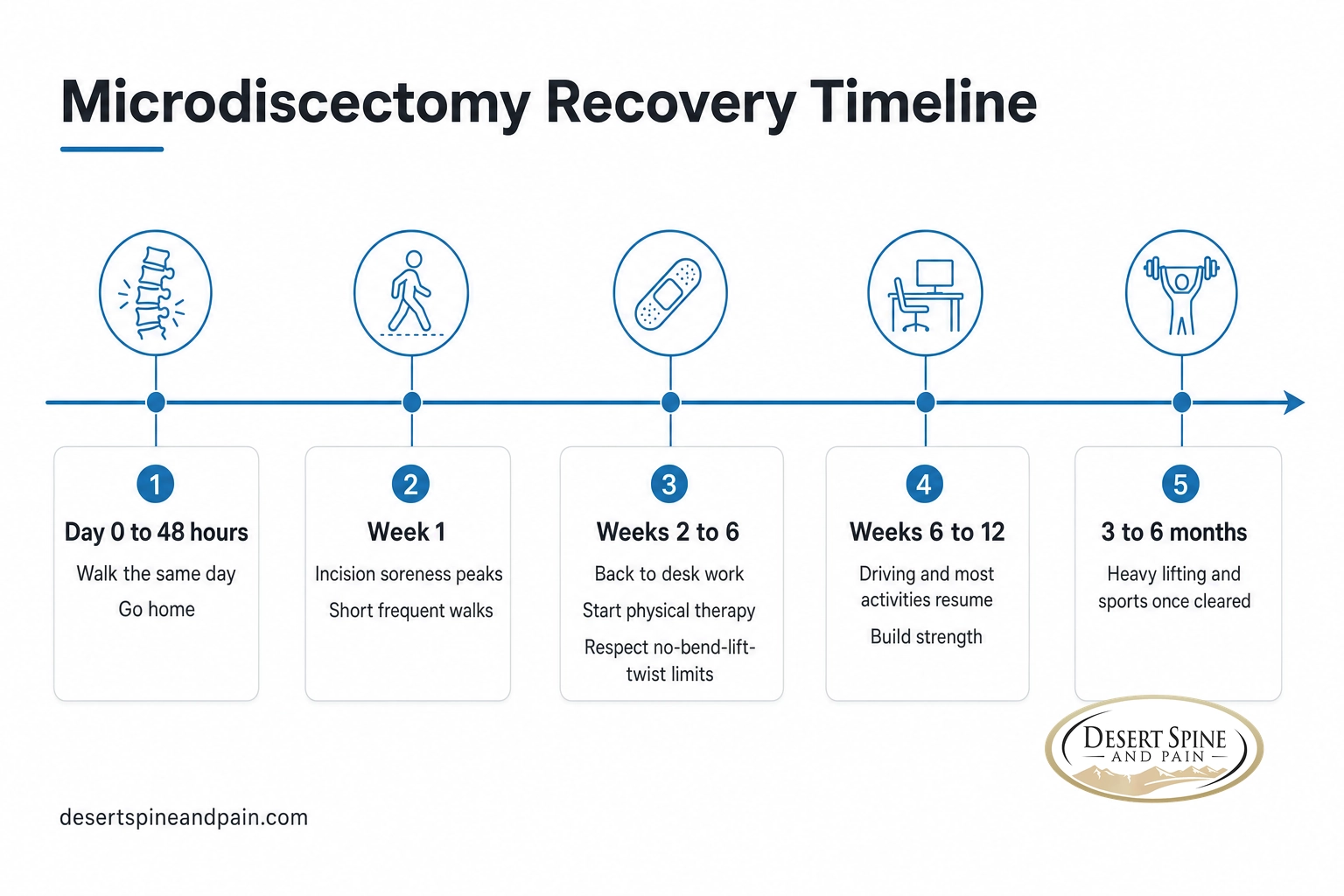
Day of Surgery and the First 48 Hours
Microdiscectomy is frequently an outpatient procedure, and many patients go home the same day, sometimes with a single overnight stay depending on their health and how the surgery went. You will be encouraged to stand and walk within a few hours, because gentle walking is the single best thing you can do early on. It keeps blood moving, protects against clots, and helps the back loosen up. Expect soreness at the incision, grogginess from anesthesia, and often an immediate, noticeable drop in the leg pain you had before surgery.
Week 1
This is usually the most tender week. Incision and muscle soreness tend to peak now even as your leg pain continues to fade. The rhythm that works best is short, frequent walks broken up by rest, rather than long periods of sitting, which tends to be the least comfortable position early on. Keep walks gentle and brief, change positions often, and take pain medication as directed. Most patients are off the strongest medication within the first week or so.
Weeks 2 to 6
Energy returns and daily pain drops substantially for most people. By around two weeks, many patients are walking comfortably, sleeping better, and ready for desk-based work. This is still the window where surgeons ask you to respect the "BLT" limits, avoiding heavy bending, lifting, and twisting that could stress the healing disc. Many surgeons begin or expand a structured physical therapy program your surgeon refers you to during this phase to rebuild core and back strength safely.
Weeks 6 to 12
By six weeks, many patients have returned to most regular activities, including driving, household chores, and light recreation. Restrictions ease, and strength work ramps up. Physically demanding jobs, heavier lifting, and higher-impact exercise are typically reintroduced across this window, often with clearance around the 12-week mark. Most people feel close to normal by three months, even if they are not yet back to maximum effort.
Three to Six Months and Beyond
Pain relief is usually well-established by now, and the remaining work is strength, endurance, and nerve recovery. Heavy lifting, contact sports, and the most strenuous activities are generally safe once your surgeon clears you. Any lingering numbness or tingling continues to fade gradually, because nerves are the slowest tissue to heal. We cover that nerve timeline in detail below.
| Phase | How you'll likely feel | What you can usually do | Key restrictions |
|---|---|---|---|
| Day 0 to 48 hrs | Sore incision, groggy, leg pain often already easing | Walk within hours, go home same day, short rests | No driving, no lifting, no long sitting |
| Week 1 | Incision soreness peaks, leg pain fading | Short frequent walks, basic self-care | BLT limits, no driving on narcotics |
| Weeks 2 to 6 | More energy, much less daily pain | Desk work, longer walks, often start physical therapy | No heavy bending, lifting, or twisting |
| Weeks 6 to 12 | Close to normal, building strength | Most activities, driving, light recreation | Reintroduce heavy work gradually with clearance |
| 3 to 6 months | Strong, pain usually resolved | Heavy lifting and sports once cleared | Nerve symptoms may still be resolving |
Source: Spine-health lumbar microdiscectomy recovery guidance | StatPearls Microdiscectomy review
When Can You Drive, Work, and Lift Again?
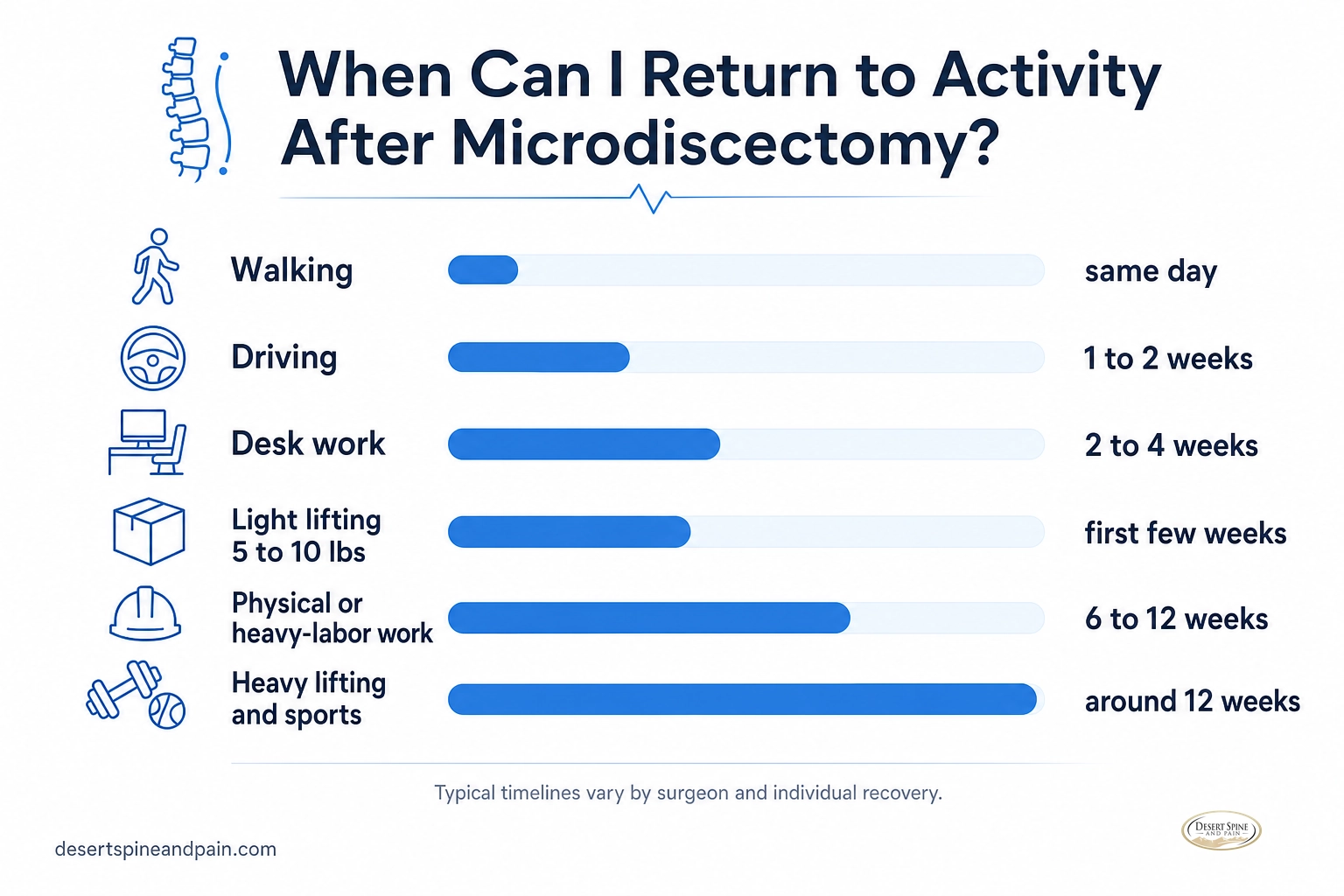
These three questions come up more than any others, because they determine how fast you get your life back. The honest answer is that the timing depends on your job, your pain level, and your surgeon, but the typical ranges are well established.
| Activity | Typical timeframe | What it depends on |
|---|---|---|
| Walking | Same day | Encouraged immediately, kept short and frequent |
| Driving | About 1 to 2 weeks | Must be off narcotic pain medication and able to react in an emergency |
| Desk or sedentary work | 2 to 4 weeks | Comfort sitting, ability to take walking breaks |
| Light lifting (5 to 10 lbs) | First few weeks | Surgeon-set limit, roughly a gallon of milk |
| Physical or heavy-labor work | 6 to 12 weeks | Strength, clearance, and job demands |
| Heavy lifting and sports | Around 12 weeks | Surgeon clearance after strength rebuilds |
A quick word on driving: the issue is not just comfort, it is safety. You should be able to sit without significant pain, turn your head and body to check mirrors, and slam the brake in an emergency, all while completely off narcotic medication, before you get behind the wheel. On lifting, the early cap of roughly 5 to 10 pounds is deliberately conservative. It is not that a heavier object will instantly undo the surgery, but repeated heavy bending, lifting, and twisting in the first weeks is the kind of load the healing disc does not need.
Source: StatPearls Microdiscectomy review
Physical Therapy and Rehabilitation
Surgery removes the disc fragment that was pinching the nerve, but it does not rebuild the strength and flexibility you lost during the months of pain that came before it. That is what rehabilitation is for. Timing varies: some surgeons start gentle guided therapy within the first couple of weeks, while others prefer to wait until around six weeks so the earliest healing is complete. There is no single right answer, which is why it is set case by case.
A good program progresses in a sensible order: walking and gentle mobility first, then core and spinal stabilization, then gradual strengthening and a return to your specific activities or sport. The goal is not just to recover but to make your spine more resilient than it was before, which also helps lower the chance of a future problem. Desert Spine and Pain coordinates therapy by referral as part of your overall spine surgery and recovery plan, so the rehab matches the procedure you actually had.
Nerve Healing: Why Numbness and Tingling Take Longer
Here is the part that catches many patients off guard: the pain can be gone while the numbness lingers. That is normal, and it is a biology problem, not a surgery problem. Compressed nerves heal slowly, and symptoms like numbness, tingling, or a patch of altered sensation in the leg or foot can keep improving for 6 to 12 months after surgery. The longer and more severely a nerve was compressed before surgery, the longer this recovery tends to take.
Most patients see steady, gradual gains rather than a sudden switch. What matters is the direction: improving sensation, even slowly, is a good sign. Numbness or weakness that is clearly getting worse rather than better is the exception that should prompt a call to your surgeon.
Source: Spine-health recovery guidance
Reherniation and Setbacks: What the Research Shows
Microdiscectomy has a strong track record, but it is honest to acknowledge that a minority of patients have setbacks. The most common is reherniation, where disc material herniates again at the same level. Published rates vary widely depending on how studies define and track it, with reported recurrent herniation ranging from about 5% to 24%. Separately, a smaller share of patients develop persistent symptoms sometimes labeled failed back surgery syndrome, estimated at roughly 3% to 15% within 10 years, with revision surgery needed in about 7% to 10% of those cases.
Source: StatPearls Microdiscectomy review | Recurrent Lumbar Disk Herniation and Revision Surgery Rates (2025)
Myth: you must lie still for six weeks or the surgery will fail
This is one of the most persistent recovery myths, and the research does not support strict, prolonged immobilization. A landmark prospective study in Spine followed 152 working patients who were given no postoperative activity restrictions after discectomy. Early return to work and normal activity did not increase reherniation, reoperation, or worse outcomes, and patients returned to work far sooner than the old "rest for weeks" model predicted. Later trials comparing short (2-week) versus long (6-week) restrictions found comparable reherniation rates. The point is not to go reckless: the BLT limits still matter early on. But sensible, progressive movement is part of healing, not a threat to it. Follow your surgeon's specific plan rather than blanket fear of movement.
Source: Carragee et al., Spine (1999), 152-patient activity-restriction study

Warning Signs That Need Immediate Attention
The vast majority of microdiscectomy recoveries are uneventful. But a small set of symptoms are genuine emergencies, and recognizing them early protects your long-term function. Do not wait and see with these.
Go to the emergency room immediately for:
- New loss of bladder or bowel control, or difficulty urinating
- Numbness around the groin, buttocks, or inner thighs (saddle numbness)
- Rapidly worsening weakness in one or both legs
These can signal cauda equina syndrome, a rare but time-sensitive nerve emergency. Separately, call your surgeon promptly for a fever, spreading redness, warmth or drainage at the incision, severe or one-sided calf swelling and pain (a possible clot), or a sudden return of severe leg pain, which can indicate reherniation.
How to Get the Best Possible Recovery
Outcomes are not purely luck. A handful of factors are within your control and consistently help recovery go smoothly:
- Walk early and often. Short, frequent walks from day one are the most reliably helpful habit.
- Respect the BLT limits. Avoiding heavy bending, lifting, and twisting early protects the disc while it heals.
- Do your rehab. A guided, progressive program rebuilds the strength that prevents future problems.
- Do not smoke. Smoking impairs disc and tissue healing and is linked to worse spine-surgery outcomes.
- Manage weight and stay active long term. A strong, mobile core takes load off the spine for good.
- Keep your follow-up appointments. They let your surgeon catch and solve small issues before they grow.
Recovery also depends heavily on the quality and precision of the surgery itself, which is why the choice of surgeon matters as much as any post-op tip. Desert Spine and Pain is led by Dr. David L. Greenwald, who is board-certified as both a spine surgeon and a neurosurgeon, with a least-invasive-first philosophy aimed at giving the nerve relief with the smallest possible footprint. If you are weighing surgery or want to understand how often microdiscectomy succeeds for pain like yours, a consultation is the place to start.
See how minimally invasive microdiscectomy works
Book a consultation with Desert Spine and Pain
Frequently Asked Questions
How long does it take to fully recover from a microdiscectomy?
When can I drive after a microdiscectomy?
How much can I lift after microdiscectomy surgery?
Is it normal to still have pain or numbness weeks after a microdiscectomy?
What are the warning signs of a problem after microdiscectomy?
Methodology and Sources
This guide combines peer-reviewed spine-surgery literature and established clinical patient-education sources to describe typical microdiscectomy recovery. Recovery timelines are presented as common ranges, not individual medical advice, because they vary by patient, procedure, and surgeon. Your own surgeon's instructions always take priority. Primary sources include:
- Dohrmann GJ, Mansour N. Long-Term Results of Various Operations for Lumbar Disc Herniation: Analysis of over 39,000 Patients. Medical Principles and Practice, 2015.
- Dowling TJ, et al. Microdiscectomy. StatPearls, NCBI Bookshelf.
- Carragee EJ, et al. Activity restrictions after posterior lumbar discectomy: a prospective study of 152 cases with no postoperative restrictions. Spine, 1999.
- Recurrent Lumbar Disk Herniation and Revision Surgery Rates After Single-Level Microdiscectomy, 2025.
- Spine-health: Lumbar Microdiscectomy Recovery, Weeks 6 to 12 (medically reviewed).