
Facetectomy vs. Laminectomy: How These Spine Surgeries Differ
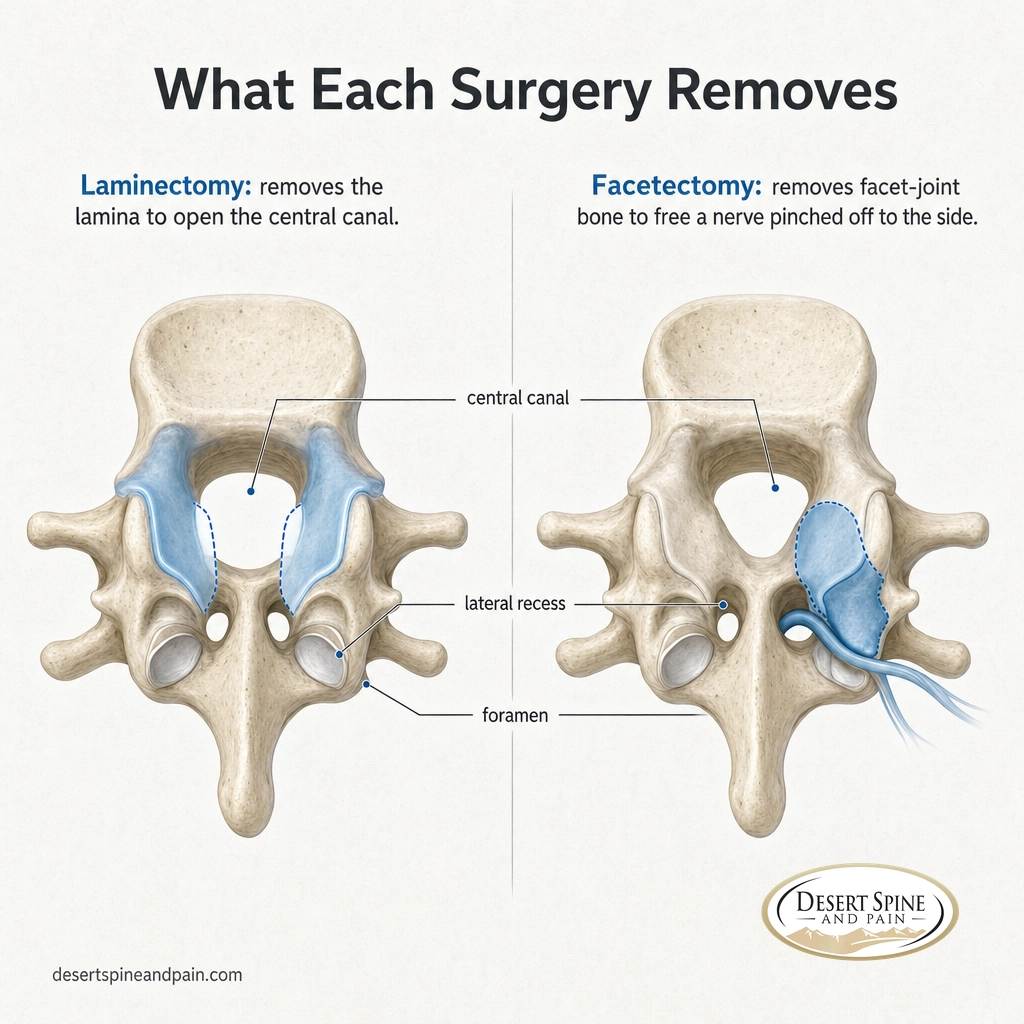
A facetectomy and a laminectomy are both decompression surgeries that take pressure off pinched spinal nerves, but they remove different pieces of bone for different reasons: a laminectomy removes the lamina (the bony roof over the spinal canal) to relieve central pressure, while a facetectomy removes part or all of a facet joint to free a nerve where it branches off to the side. Getting the distinction right matters because lumbar spinal stenosis, the condition these operations most often treat, affects roughly 11% of adults in general population studies, and the two procedures carry different implications for your spine's long-term stability.
Key Takeaways
- Different target, same goal. A laminectomy opens the central canal by removing the lamina; a facetectomy removes facet-joint bone to clear a side (lateral) nerve pathway. Both aim to decompress nerves.
- They are often done together. This is rarely a strict either/or choice. Many decompressions combine a laminectomy with a partial facetectomy or foraminotomy in one operation.
- Stability is the key difference. The lamina is a protective roof; the facet joints are load-bearing stabilizers. Removing facet joints has a larger effect on how stable the spinal segment stays.
- Fusion depends on how much facet is removed. A small partial facetectomy usually needs no fusion. Removing more than about half of a facet is where stability begins to drop, and extensive or bilateral removal often calls for a fusion.
- Decompression works well for leg pain. In the landmark SPORT trial, surgical decompression beat non-operative care for lumbar spinal stenosis through four years of follow-up.
- Your imaging decides. Where the pressure sits (center of the canal versus the lateral recess or foramen) is what points toward one procedure, the other, or a combination.

What's in This Guide
- Facetectomy vs. Laminectomy at a Glance
- What Is a Laminectomy?
- What Is a Facetectomy?
- What Each Surgery Removes, and Why It Matters
- The Stability Question: When Facetectomy Needs Fusion
- Recovery, Risks, and Results
- Side-by-Side Comparison
- Who Should Consider a Laminectomy
- Who Should Consider a Facetectomy
- The Bottom Line: It Is Often Not Either/Or
- Frequently Asked Questions
- Methodology and Sources
Facetectomy vs. Laminectomy at a Glance
Both operations belong to a family of spine procedures called decompressions, which relieve pressure on the spinal cord or nerve roots. The names just describe which structure the surgeon removes to make room. Here is the short version before the detail.
Laminectomy
- Removes the lamina, the bony arch forming the back wall of the spinal canal
- Primarily relieves central canal narrowing (classic spinal stenosis)
- Leaves the facet joints largely intact, so stability is usually preserved
- Commonly used for stenosis causing leg pain, heaviness, or trouble walking distances
- Often performed alone, without a fusion
Facetectomy
- Removes part (partial/medial) or all (total) of a facet joint
- Primarily relieves lateral pressure, where a nerve root is pinched to the side
- Affects stability more directly, because facet joints are stabilizers
- Frequently combined with a laminectomy or a foraminotomy
- May require a fusion when the removal is extensive
What Is a Laminectomy?
A laminectomy removes the lamina, the flat plate of bone that forms the roof of the spinal canal at each level of your spine. Think of the spinal canal as a tunnel carrying the spinal cord and nerves; the lamina is the top of that tunnel. When the tunnel narrows, a condition called spinal stenosis, the nerves inside get crowded. Removing the lamina lifts the roof and gives those nerves room again.
Stenosis is the reason most laminectomies happen, and it is common. In a pooled analysis of 41 studies, lumbar spinal stenosis was diagnosed in about 11% of the general adult population and in roughly a quarter to a third of patients seen in clinical care settings. It also climbs steeply with age: a population study found symptomatic lumbar stenosis in about 10.8% of adults in their seventies.
How it works. Through an incision over the affected level, the surgeon removes the lamina (and often the thickened ligament beneath it) to open the central canal. A partial laminectomy, or laminotomy, removes only a window of bone; a full laminectomy removes the whole arch. Because the facet joints sit off to each side and are usually left in place, the spine typically stays stable afterward.
Who it helps most. People whose imaging shows narrowing in the center of the canal, often with the hallmark symptom of neurogenic claudication: leg pain, heaviness, or numbness that worsens with standing and walking and eases when you sit or lean forward. A focused laminectomy at Desert Spine and Pain is frequently all that is needed for this pattern, and it can often be done through a minimally invasive approach that spares more muscle and bone.
Source: Jensen et al., systematic review and meta-analysis (European Spine Journal) | population-based lumbar stenosis prevalence study
See how a laminectomy is performed at Desert Spine and PainWhat Is a Facetectomy?
A facetectomy removes bone from a facet joint, one of the small paired joints at the back of each spinal segment that link one vertebra to the next. These joints guide and limit how your spine bends and twists. When a facet joint becomes enlarged by arthritis, or a bone spur grows off it, it can press on the nerve root as the nerve passes through the narrow side channels called the lateral recess and the foramen. A facetectomy clears that specific chokepoint.
The word covers a range. A partial or medial facetectomy trims the inner edge of the joint, often as part of opening a nerve passage, and is a routine, stability-sparing step. A total facetectomy removes an entire facet joint, which is reserved for cases where the whole joint is the problem, for example a severely arthritic joint or a tumor. The more of the joint that comes out, the more the surgeon has to think about what happens to stability.
How it works. Facetectomy is usually not a standalone headline procedure the way a laminectomy is. It is most often a component of a broader decompression, performed alongside a laminectomy or as the bony part of a foraminotomy that enlarges the nerve exit. The surgeon removes only as much facet as the compression demands, and no more.
Who it helps most. People whose leg pain or sciatica traces to a nerve pinched in the lateral recess or foramen rather than the center of the canal, and people with facet arthritis driving the compression. If the facet joint is irritated but not yet a surgical problem, less invasive options such as targeted joint injections are often tried first.
Source: Zeng et al., Effect of Graded Facetectomy on Lumbar Biomechanics (PMC)
What Each Surgery Removes, and Why It Matters
The clearest way to hold the difference in your head is by location and by job. The lamina is a roof. The facet joints are load-bearing hinges. Removing a roof opens space; removing a hinge opens space but also changes how the segment moves.
That is why the decision is driven by where your imaging shows the pressure. Central narrowing points toward a laminectomy. Side (lateral) narrowing points toward a facetectomy or foraminotomy. Narrowing in both places points toward doing both in one operation. This is the honest reason the internet's "facetectomy vs. laminectomy" framing is a little misleading: a surgeon is not usually picking a favorite tool, but matching the removal to the exact spot and size of the compression, while taking out as little stabilizing structure as possible.
A quick anatomy map
- Central canal (where the cord and nerve bundle run): addressed by a laminectomy.
- Lateral recess (just off center, where a root begins to branch): addressed by a partial facetectomy.
- Foramen (the side doorway where the root exits): addressed by a foraminotomy, often with a partial facetectomy.
The Stability Question: When Facetectomy Needs Fusion
Here is the single most important practical difference between the two procedures. The lamina can usually be removed without destabilizing the spine. The facet joints cannot be removed as freely, because they are among the main structures holding each segment in alignment during twisting and side bending.
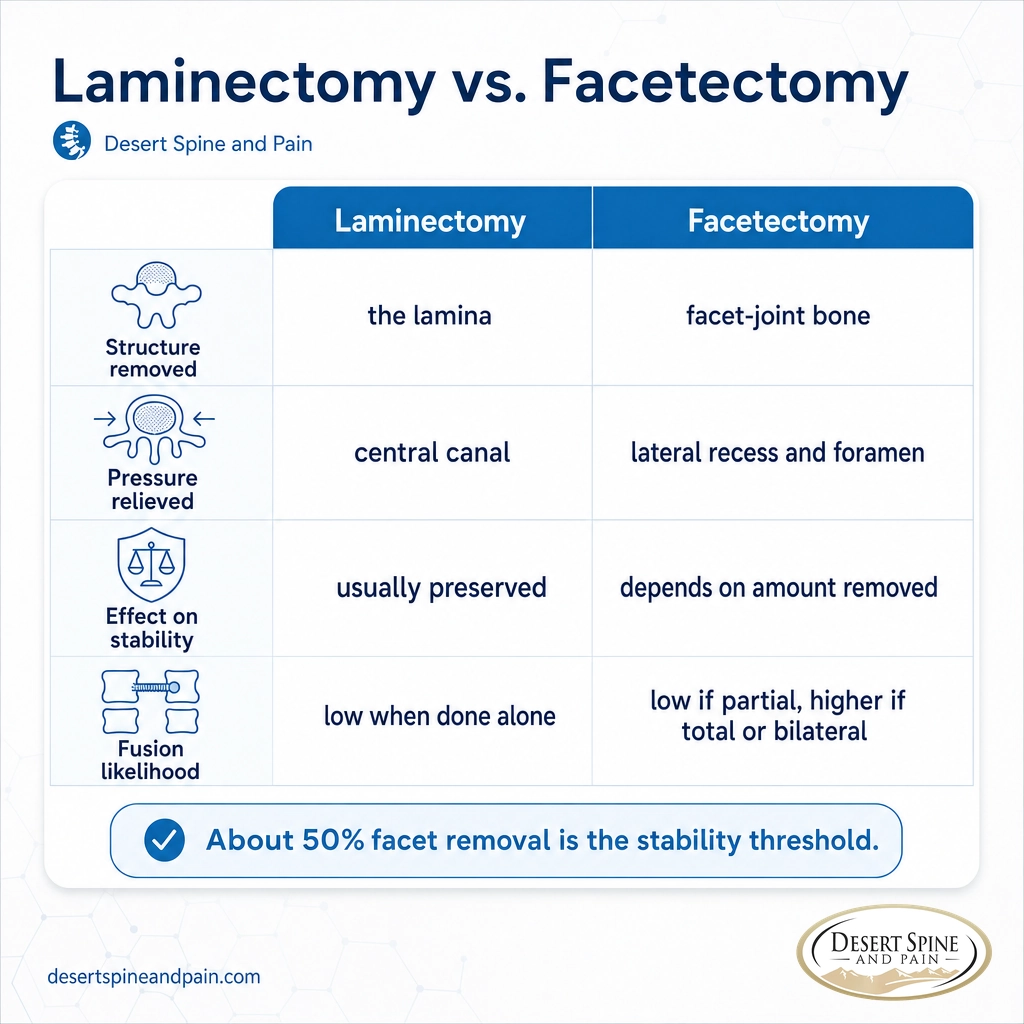
Biomechanical research has put numbers on this. In graded facetectomy studies, removing a small portion of a facet has little measurable effect on motion, but once resection passes roughly 50% of the joint, stability in axial rotation and lateral bending drops noticeably. Finite-element modeling suggests that beyond about 75% of a facet, or when both facets at a level are largely removed, fixation or fusion may be needed to keep the segment stable.
A common myth: "A facetectomy always means a fusion."
This is not true, and the fear of it keeps some patients from getting care they need. The great majority of facet removal done during a routine decompression is a small partial facetectomy that leaves the spine stable and needs no hardware. Fusion enters the conversation only when the compression requires removing a large share of a facet, or both facets at the same level. Your surgeon weighs exactly how much bone must come out before recommending whether a stabilizing fusion should be part of the plan.
A laminectomy can also reach a point of over-removal if too much bone and joint come out across several levels, so the same stability logic applies to any decompression. The guiding principle in modern spine surgery is the same for both procedures: relieve every point of pressure while preserving as much stabilizing structure as the anatomy allows. That balance is the whole art of a well-planned spinal decompression.
Source: Effect of Graded Facetectomy on Lumbar Biomechanics (PMC)

Recovery, Risks, and Results
Recovery depends far more on the scope of the operation than on which word is in its name. A focused, single-level laminectomy and a partial facetectomy sit in a similar range: a short hospital stay or same-day discharge for many patients, a few weeks of lifting and bending restrictions, and a gradual return to normal activity guided by the surgeon. Minimally invasive techniques, when appropriate, can shorten that curve further.
Recovery stretches longer when a facetectomy is extensive enough to require fusion, because fused bone needs months to knit solidly. That is one more reason the size of the facet removal, not the label, is what patients should ask about.
Do they actually work? For leg pain and the walking limitations of stenosis, decompression has strong evidence behind it. The Spine Patient Outcomes Research Trial (SPORT), a large multicenter study funded by the National Institutes of Health, found that patients who underwent surgical decompression for lumbar spinal stenosis reported greater improvement in pain and physical function than patients treated without surgery, and that advantage persisted through four years. Notably, a large share of patients who were initially assigned to non-surgical care eventually chose surgery because their symptoms pushed them toward it.
Risks to know. As with any spine surgery, both carry small risks of infection, bleeding, a dural (spinal fluid) leak, or incomplete relief of symptoms. The distinct risk tied specifically to facet removal is instability if too much joint is taken, which is precisely what careful surgical planning and, when needed, fusion are designed to prevent.
Source: Weinstein et al., SPORT lumbar spinal stenosis results (New England Journal of Medicine, 2008)
Side-by-Side Comparison
The table below lines up the two procedures across the factors patients ask about most. Remember that real cases often combine them.
| Factor | Laminectomy | Facetectomy | What it means for you |
|---|---|---|---|
| Structure removed | The lamina (bony roof of the canal) | Part or all of a facet joint | Different targets, matched to where the pressure is |
| Pressure it relieves | Central canal narrowing | Lateral recess and foraminal narrowing | Your MRI location decides, not a preference |
| Typical symptom pattern | Claudication: leg pain worse with walking | Root-specific sciatica or radiating leg pain | Both relieve leg symptoms more than back pain |
| Effect on stability | Usually preserved (facets left intact) | Depends on how much facet is removed | Facetectomy needs a closer stability check |
| Likelihood of fusion | Low when done alone | Low if partial; higher if total or bilateral | Ask how much facet must come out |
| Often combined with | Partial facetectomy, foraminotomy | Laminectomy, foraminotomy, fusion | Rarely a strict either/or decision |
| Recovery driver | Number of levels, open vs. minimally invasive | Extent of removal and whether fusion is added | Scope matters more than the name |
Who Should Consider a Laminectomy
A laminectomy tends to be the right fit when:
- Imaging shows narrowing in the central spinal canal, the classic picture of lumbar spinal stenosis.
- The main complaint is neurogenic claudication: leg heaviness, cramping, or pain that comes on with standing and walking and eases when you sit or bend forward.
- Conservative care, such as physical therapy and injections, has not given lasting relief.
- The facet joints are relatively healthy, so opening the roof is enough and the stabilizers can stay.
For many of these patients, a single-level decompression resolves years of walking limitation, and it can frequently be done through a muscle-sparing, stenosis-focused surgical approach.
Who Should Consider a Facetectomy
Facet removal (usually partial, as part of a decompression) tends to be indicated when:
- The pinch is in the lateral recess or foramen, off to the side, rather than dead center.
- An arthritic, enlarged facet joint or a bone spur off that joint is the structure compressing the nerve.
- Leg pain follows a specific nerve-root pattern (true sciatica) that maps to a side pathway on imaging.
- A foraminotomy alone cannot fully free the nerve without trimming some facet.
When the removal has to be extensive, the conversation naturally includes whether to add a fusion to protect stability, and a thorough surgeon will walk you through that trade-off before the day of surgery.
The Bottom Line: It Is Often Not Either/Or
Facetectomy and laminectomy are not rival surgeries so much as two instruments in the same decompression toolkit. A laminectomy lifts the roof over the central canal; a facetectomy clears a side joint pressing on a nerve. The best operation for you is the one that matches the exact location and size of the pressure on your imaging, removes it completely, and preserves as much stabilizing bone and joint as possible. In many spines, that means doing a measured amount of both in a single, carefully planned procedure.
That planning is where experience counts. Dr. David L. Greenwald is a dual board-certified spine surgeon and neurosurgeon who tailors each decompression to the patient's anatomy, favoring the least amount of removal that fully relieves the nerve, and recommending a fusion only when stability genuinely requires it. If you have been told you may need a laminectomy, a facetectomy, or a fusion, a focused review of your MRI can clarify which of these you actually need, and which you do not.
Frequently Asked Questions
Is a facetectomy the same as a laminectomy?
Does a facetectomy always require spinal fusion?
Which has a longer recovery, a laminectomy or a facetectomy?
Can a laminectomy and facetectomy be done at the same time?
Will a laminectomy or facetectomy relieve my sciatica and leg pain?
Methodology and Sources
This guide explains the clinical distinction between two decompression procedures in plain language for patients. Procedure definitions, indications, and stability principles reflect established spine-surgery practice. Prevalence figures, biomechanical thresholds, and outcome data are drawn from peer-reviewed research and a landmark National Institutes of Health trial, cited below. It is educational information, not a substitute for an individual evaluation; the right procedure for any patient is determined by imaging and an in-person surgical consultation.
Sources
- Prevalence of lumbar spinal stenosis in general and clinical populations: a systematic review and meta-analysis (41 studies)
- Population-based study of lumbar spinal stenosis prevalence by age group
- Zeng et al., Effect of Graded Facetectomy on Lumbar Biomechanics
- Weinstein et al., Surgical versus Nonsurgical Therapy for Lumbar Spinal Stenosis (SPORT), New England Journal of Medicine, 2008