
What Kind of Doctor Treats Sciatica? Who to See and When
What kind of doctor treats sciatica? Sciatica is treated by several types of doctors: primary care physicians, physiatrists (physical medicine and rehabilitation), pain management specialists, neurologists, and spine surgeons (orthopedic or neurosurgical). Most people start with conservative care and only see a surgeon if symptoms persist or become dangerous.
If your lower back pain shoots down one leg, you want relief, not a directory of medical specialties. The honest answer is that no single specialty "owns" sciatica. Several kinds of doctors treat it, and the right one depends on how severe your symptoms are and how long they have lasted. The good news: most people never need a surgeon. The American Academy of Orthopaedic Surgeons reports that roughly 80 to 90 percent of people with sciatica get better over time without surgery. This guide explains each doctor who treats sciatica, what each one actually does, and exactly when to move from one to the next.
Key Takeaways
- Start conservative. A primary care physician or a physiatrist is the right first stop for most people with new sciatica.
- Most cases resolve without surgery. About 80 to 90 percent of people with sciatica improve without an operation, often within a few weeks.
- Specialists escalate care. Pain management doctors add image-guided injections; neurologists sort out nerve symptoms; spine surgeons handle structural problems that will not settle.
- See a surgeon when pain persists. Disabling leg pain lasting about three or more months despite conservative care is the usual trigger for a surgical opinion.
- Know the emergencies. Loss of bladder or bowel control, groin numbness, or sudden leg weakness is a red flag that needs immediate care, not a routine appointment.
What's in This Guide
The Short Answer: Who Treats Sciatica
Sciatica is not a diagnosis on its own. It is a set of symptoms (pain, tingling, numbness, or weakness that travels from the lower back down the path of the sciatic nerve into the buttock and leg) caused by irritation or compression of a nerve root in the spine. Because the problem starts in the spine but shows up in the leg, it sits at the crossroads of several specialties.
In practice, six kinds of providers treat sciatica, and they work best as a sequence rather than as competitors:
- Primary care physician confirms the diagnosis and starts first-line treatment.
- Physiatrist (PM&R) leads nonsurgical rehabilitation and function recovery.
- Pain management specialist targets the nerve pain, often with injections.
- Neurologist evaluates and manages the nerve itself when the picture is unclear.
- Orthopedic spine surgeon operates on structural spine problems.
- Neurosurgeon operates on the spine and the nervous system, including complex cases.
Physical therapists and chiropractors also play important supporting roles, though they are not physicians. The central idea to hold onto: you almost always begin with the least invasive option and only escalate if you need to. If you are still learning the basics, our explainer on what sciatica is and the guide to what causes sciatica are useful companions to this page.
Source: AAOS OrthoInfo: Sciatica | Cleveland Clinic: Sciatica
How Sciatica Care Works: The Pathway
Understanding the care pathway tells you which doctor you need right now better than any single job title does. Sciatica care moves through three broad stages, and most patients never reach the last one.
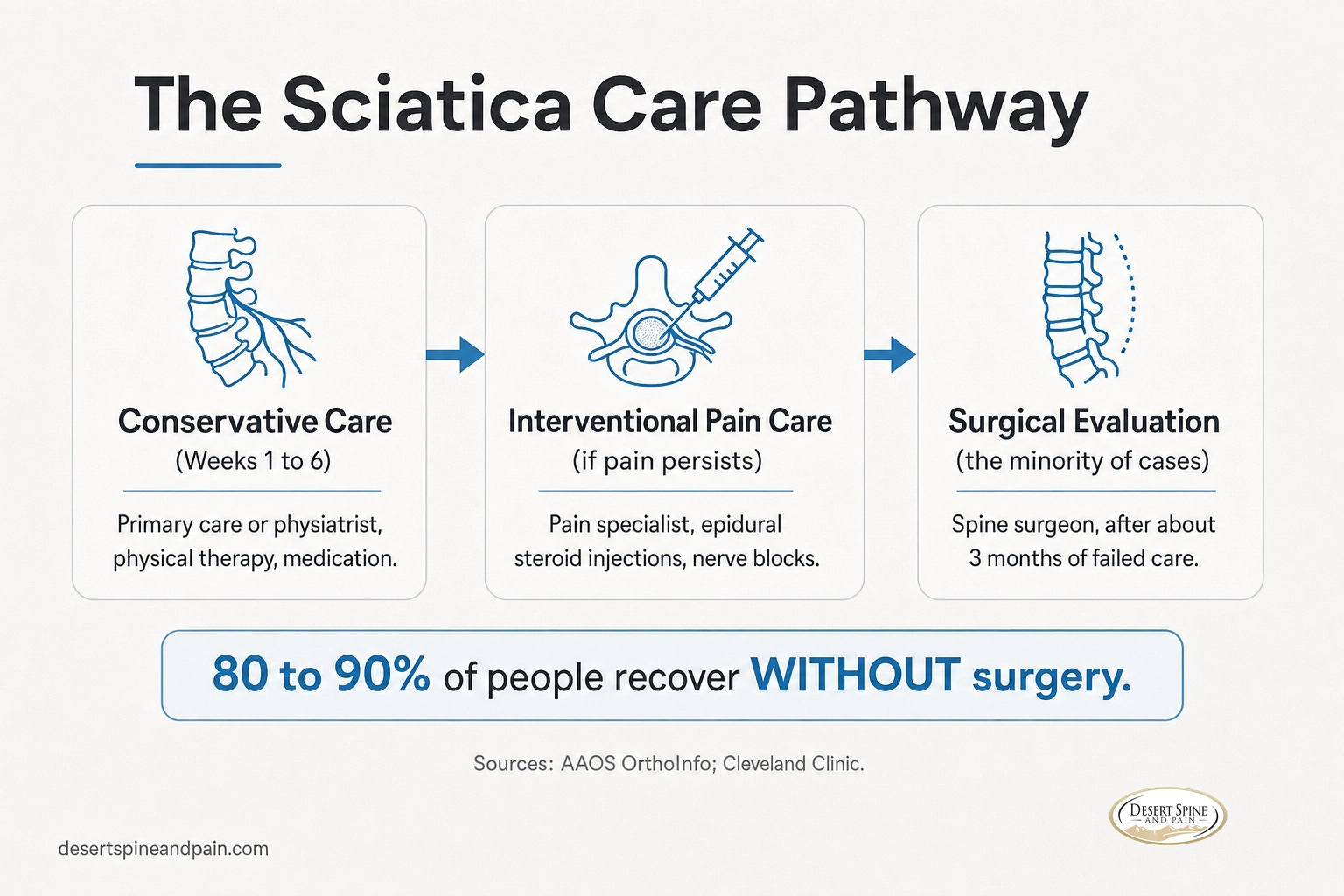
Stage 1: Conservative care (weeks 1 to 6)
This is where the large majority of sciatica is successfully treated. A primary care physician or physiatrist guides activity modification, physical therapy, anti-inflammatory medication, and time. Cleveland Clinic notes that many cases improve within four to six weeks without any procedure at all. At Desert Spine and Pain, this stage is handled through conservative, non-invasive care, and you can read more about how to treat sciatica during this window.
Stage 2: Interventional pain care (if pain persists)
When conservative measures are not enough, a pain management specialist can offer image-guided epidural steroid injections and nerve blocks that calm the inflamed nerve root. These are not surgery. They can break a pain cycle, confirm which nerve is the culprit, and help you tolerate the therapy that drives recovery.
Stage 3: Surgical evaluation (the minority of cases)
Only when disabling leg pain outlasts a reasonable trial of conservative and interventional care, or when there is clear nerve compression and warning signs, does a spine surgeon enter the picture. The procedures are often minimally invasive today, such as a microdiscectomy to remove the fragment of disc pressing on the nerve.
Source: AAOS OrthoInfo: Sciatica | Cleveland Clinic: Sciatica
The 6 Types of Doctors Who Treat Sciatica
Here is what each specialist actually does for sciatica, in the order you are most likely to meet them.

1. Primary Care Physician (Family Medicine or Internal Medicine)
Your family doctor is the natural starting point. They take a history, perform a physical exam, check your reflexes and strength, and screen for anything serious. Most new sciatica can be diagnosed clinically without immediate imaging. Your primary care physician prescribes first-line medication, refers you to physical therapy, and knows when to send you onward. If your symptoms are classic and recent, this is often the only doctor you will need.
2. Physiatrist (Physical Medicine and Rehabilitation, or PM&R)
A physiatrist is a nonsurgical musculoskeletal and nerve specialist whose entire focus is restoring function. For sciatica, a physiatrist designs a rehabilitation plan, fine-tunes medication, may order bracing or diagnostic nerve testing, and coordinates the rest of your care. Think of the physiatrist as the quarterback of nonsurgical spine care. If your primary care doctor is stretched thin or your case is more than routine, a physiatrist is an excellent next step.
3. Pain Management Specialist
Pain management physicians (often anesthesiologists or physiatrists with extra training) specialize in controlling pain, especially nerve pain. Their signature tools for sciatica are image-guided procedures: epidural steroid injections, selective nerve blocks, and related interventions. A well-placed injection can quiet an inflamed nerve root enough to let therapy work, and a diagnostic block can pinpoint exactly which level is causing your leg pain.
4. Neurologist
A neurologist specializes in the nervous system. In sciatica, the neurologist's value is diagnostic clarity. When the source of leg symptoms is uncertain, or when numbness and weakness need to be mapped, a neurologist can order and interpret electromyography (EMG) and nerve conduction studies to confirm which nerve is affected and how badly. Neurologists manage the medical side of nerve symptoms, but they do not perform spine surgery. If you are trying to understand whether your pain is truly sciatica or something that mimics it, such as piriformis syndrome, this is where a neurologist earns their keep.
5. Orthopedic Spine Surgeon
An orthopedic surgeon who sub-specializes in the spine treats the structural causes of sciatica: herniated discs, bone spurs, and spinal stenosis. Despite the title, a spine surgeon's first recommendation is frequently more conservative care, not an operation. When surgery is warranted, orthopedic spine surgeons perform procedures such as microdiscectomy and decompression to take pressure off the nerve.
6. Neurosurgeon
A neurosurgeon operates on the brain, spinal cord, and spine, including the nerves themselves. For sciatica, a neurosurgeon handles the same disc and nerve-compression problems a spine surgeon does, and is especially suited to complex cases involving the nervous system. The distinction between an orthopedic spine surgeon and a neurosurgeon matters less than finding a surgeon who focuses heavily on the spine and performs your specific procedure often. Dr. David L. Greenwald at Desert Spine and Pain is dual-trained as both a board-certified spine surgeon and neurosurgeon, which removes the either-or question entirely for Phoenix-area patients.
Source: Hospital for Special Surgery: Sciatica | AAOS OrthoInfo: Sciatica
Sciatica Specialists Compared
Use this side-by-side view to match your situation to the right provider.
| Provider | What they do for sciatica | Surgery? | Typically see them when |
|---|---|---|---|
| Primary care physician | Diagnosis, first-line medication, PT referral, screening for serious causes | No | New or recent sciatica; your first stop |
| Physiatrist (PM&R) | Nonsurgical rehab plan, medication, bracing, care coordination | No | Symptoms are more than routine or not improving |
| Pain management specialist | Image-guided epidural injections and nerve blocks | No | Pain persists despite therapy and medication |
| Neurologist | EMG and nerve testing, diagnosis of nerve symptoms | No | Diagnosis is unclear or weakness and numbness need mapping |
| Orthopedic spine surgeon | Surgery for discs, bone spurs, and stenosis | Yes | Disabling pain persists past about 3 months or imaging shows a clear cause |
| Neurosurgeon | Surgery on the spine and nervous system, including complex cases | Yes | Structural or nerve problems needing operative care |
Not a physician, but worth knowing: a physical therapist delivers the guided exercise that is the backbone of nonsurgical recovery, usually on referral. A chiropractor may provide manual therapy for some patients. Both work alongside, not instead of, the physicians above, and neither can prescribe medication or operate.
Knowing the full lineup raises the question every reader eventually asks, and it is the one that decides whether you need the bottom of this list at all: when does sciatica actually require a surgeon?

When Sciatica Needs a Surgeon
Because 80 to 90 percent of people recover without an operation, the question is not "do I have sciatica, so do I need surgery" but "is my sciatica the stubborn or dangerous minority." A surgical opinion is reasonable in three situations.
First, time. AAOS notes that surgery becomes a consideration when disabling leg pain persists after three or more months of nonsurgical treatment. A trial of conservative and interventional care comes first, and it usually works.
Second, a clear structural cause. When an MRI shows a herniated disc fragment or stenosis that lines up exactly with your symptoms, surgery to decompress the nerve tends to be very successful, especially when most of the pain is in the leg rather than the back.
Third, progressive nerve problems. Worsening weakness or numbness is a signal that the nerve is under real pressure, and waiting indefinitely is not wise.
A good surgeon is conservative by instinct. The right surgeon confirms you are genuinely a candidate, favors the least invasive effective option, and tells you when you do not need surgery. That is exactly the standard behind our minimally invasive spine surgery approach.
Source: AAOS OrthoInfo: Sciatica | Hospital for Special Surgery: Sciatica
Explore nonsurgical and pain treatments for sciaticaRed Flags: When Sciatica Is an Emergency
Most sciatica is miserable but not dangerous. A small set of symptoms is different, and they change the answer to "which doctor" completely. If any of these appear, the right doctor is the nearest emergency physician, today.
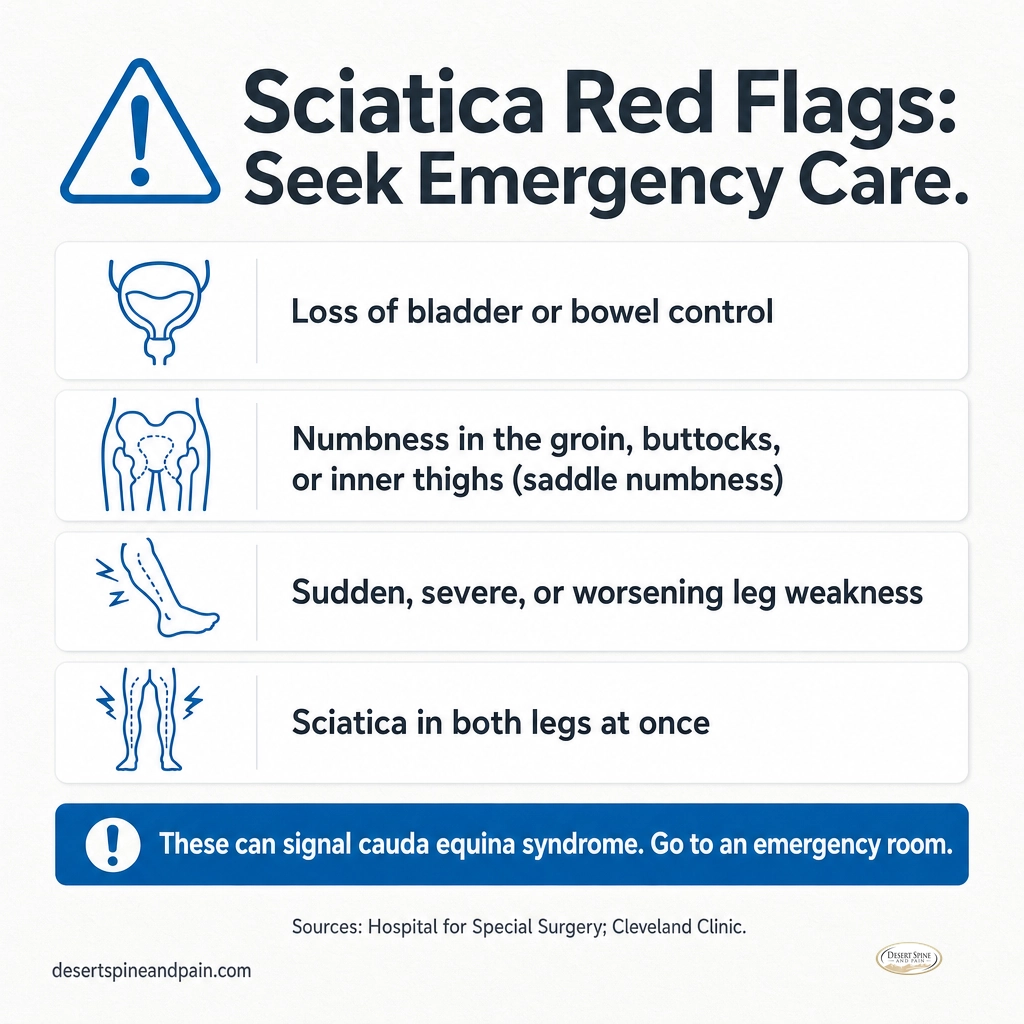
Seek immediate care if you have any of these
- Loss of bladder or bowel control (incontinence, or a new inability to go).
- Numbness in the groin, buttocks, or inner thighs (saddle numbness).
- Sudden, severe, or rapidly worsening weakness in one or both legs.
- Sciatica in both legs at once, especially with the symptoms above.
These can indicate cauda equina syndrome, a rare but serious compression of the nerve bundle at the base of the spine. As Hospital for Special Surgery notes, cauda equina symptoms may mean you should have surgery urgently to prevent permanent damage. Do not wait for a routine appointment. Go to an emergency room.
Short of a true emergency, Hospital for Special Surgery also advises seeing a physician as soon as possible for severe pain, genital numbness, urinary difficulty, or new incontinence, and consulting a physiatrist, spine surgeon, or your primary care doctor if self-care has not helped after a few days. For everything else, the stepwise pathway above is the safe and effective route, and knowing how long sciatica usually lasts helps set realistic expectations.
Source: Hospital for Special Surgery: Sciatica | Cleveland Clinic: Sciatica
How to Choose the Right Doctor for Sciatica
Once you know the pathway, choosing is straightforward. Use these practical steps.
- Match the doctor to your stage. New symptoms, start with primary care or a physiatrist. Pain that will not quit, add a pain management specialist. Disabling pain past a few months or a clear structural cause, get a spine surgeon's opinion.
- Favor a spine focus over a title. Whether the surgeon trained in orthopedics or neurosurgery matters less than how often they treat the spine and perform your exact procedure.
- Look for a conservative-first philosophy. The best spine practices treat surgery as the last resort, not the opening offer, and can deliver the nonsurgical options too.
- Ask about minimally invasive options. If surgery is on the table, ask whether a minimally invasive approach fits your case.
- Get a second opinion before any operation. A second opinion from a spine specialist is standard practice, never an insult.
A practice that offers the full spectrum, from conservative care and injections through minimally invasive and complex surgery under one roof, spares you the handoffs between unconnected offices. At Desert Spine and Pain in Phoenix, Dr. Greenwald's dual training as a spine surgeon and neurosurgeon means the same expert oversees your care whether it ends with physical therapy or with surgery.
Meet Dr. David L. Greenwald, MD, FAANS, FACSFrequently Asked Questions
What kind of doctor should I see first for sciatica?
Do I need a surgeon to treat sciatica?
What is the difference between a physiatrist and a pain management doctor for sciatica?
Can a neurologist treat sciatica?
When is sciatica a medical emergency?
Related Reading
- What Is Sciatica? A plain-English definition of the condition and its nerve anatomy.
- What Causes Sciatica? Herniated discs, stenosis, and the other common triggers.
- What Does Sciatica Feel Like? The symptoms that set it apart from ordinary back pain.
- How to Treat Sciatica The conservative-care playbook for the first several weeks.
- Piriformis Syndrome vs. Sciatica A common mimic worth ruling out.
Methodology and sources
This guide describes the types of doctors who diagnose and treat sciatica and the standard conservative-to-surgical care pathway. Recovery figures, timeframes, and surgical thresholds are drawn from Tier 1 clinical sources and reflect populations, not any individual patient. The provider roles described are general; scope of practice varies by physician and state.
Primary sources referenced:
- American Academy of Orthopaedic Surgeons, OrthoInfo: Sciatica (recovery without surgery, age range, surgical threshold)
- Cleveland Clinic: Sciatica (recovery timeframe, surgery as last option, warning symptoms)
- Hospital for Special Surgery: Sciatica (care pathway, when to see a specialist, cauda equina urgency)
This article is educational and is not individual medical advice. For guidance specific to your spine condition, consult a qualified physician. If you have red-flag symptoms, seek emergency care immediately.