
Spine Surgery
Discectomy Procedures
Minimally Invasive Discectomy Surgical Procedures in Phoenix, AZ — Treat a Herniated Disc at the Source
When a herniated or damaged disc presses on a nerve, a discectomy removes the problem fragment to relieve sciatica, arm or leg pain, and numbness. Dr. David L. Greenwald, MD, FAANS, FACS, a dual board-certified spine surgeon and neurosurgeon, performs minimally invasive and motion-preserving disc procedures in Phoenix.

Over 100 5-Star Reviews!
















Over 30 Years Experience in Orthopedic & Neuro Spine Surgeries.
A discectomy removes the portion of a herniated or damaged disc that's compressing a spinal nerve — the most direct way to relieve the sciatica, arm pain, or leg pain a bad disc causes. Depending on the disc and your goals, it can be paired with fusion or with a motion-preserving disc replacement.
Book a Consultation — (602) 566-9500What Is a Discectomy?
A discectomy is a surgical procedure that removes the piece of a damaged or herniated disc that is pressing on a spinal nerve or the spinal cord. When the soft center of a disc pushes through its outer wall, the fragment can crowd a nearby nerve root and send pain, numbness, or weakness down an arm or leg. Taking the pressure off that nerve is the whole point of the operation — and once it's gone, the radiating pain often eases dramatically.
In the lower back, the most common version is a microdiscectomy — a minimally invasive procedure that removes the offending fragment through a small incision. In the neck, a discectomy is usually combined with either a fusion (ACDF) or an artificial disc replacement to keep the spine stable. A discectomy is almost always considered only after conservative care and interventional pain procedures have been given a fair chance to work.
Our Discectomy Procedures
Which discectomy is right for you depends on the location of the disc and whether the segment needs added support afterward. These are the main procedures Dr. Greenwald performs, each matched to a specific problem:
Lumbar Microdiscectomy
A minimally invasive procedure that removes a herniated lumbar disc fragment to relieve sciatica.
Lumbar microdiscectomy →ACDF
Anterior cervical discectomy and fusion — removes a damaged neck disc and fuses the level for stability.
ACDF →Cervical Discectomy with Disc Replacement
Removes a damaged neck disc and replaces it with an artificial disc to preserve natural motion.
Discectomy with disc replacement →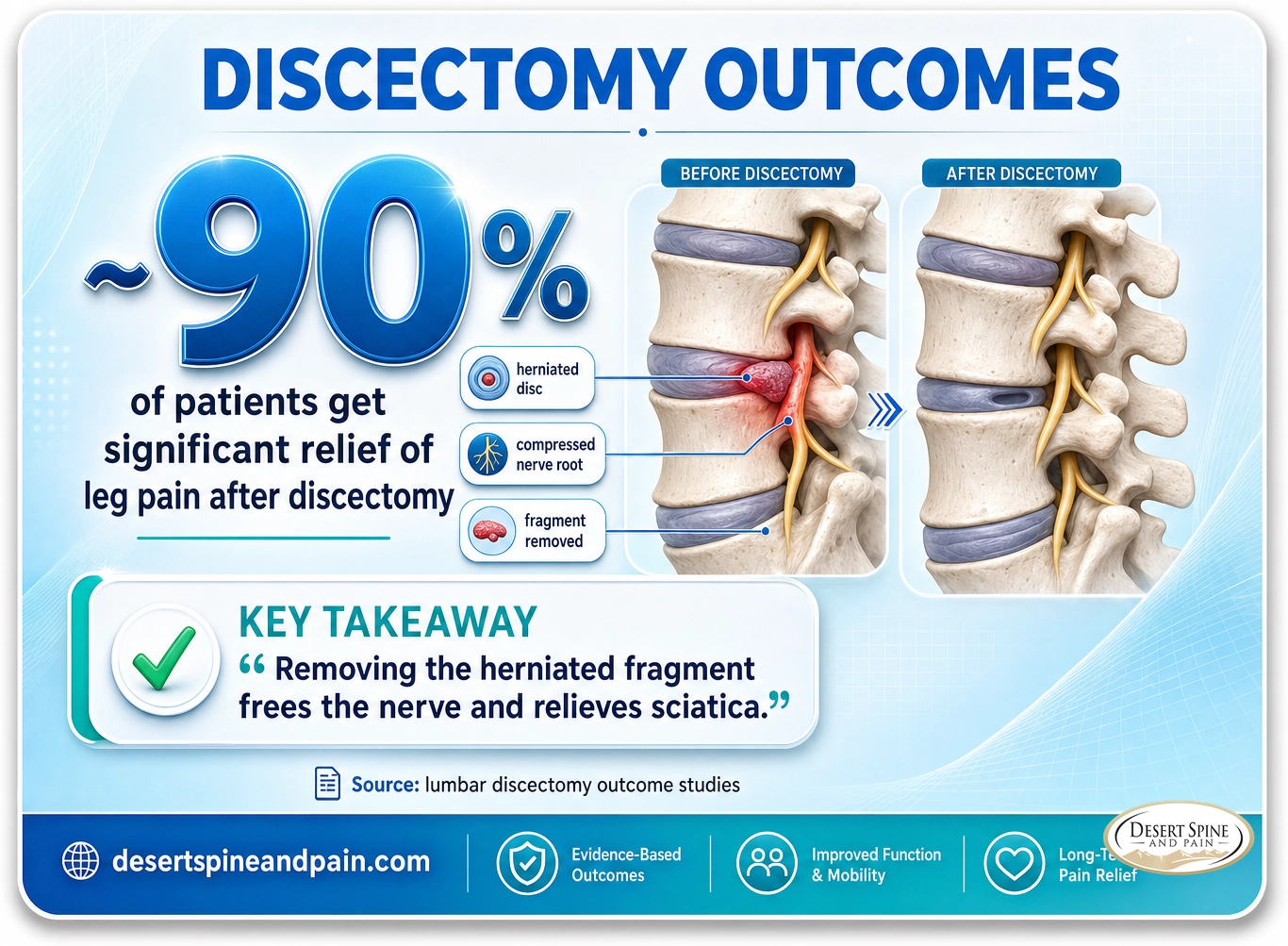
When Is a Discectomy Needed?
Most herniated discs settle down on their own and never require surgery. A discectomy becomes the right choice in a minority of cases — but in those cases, it can end nerve pain that nothing else has touched. You should be evaluated for a discectomy when:
- A herniated disc is pressing on a nerve. Imaging shows a herniated disc or disc extrusion compressing a nerve root, and your symptoms match that level.
- You have sciatica or radiculopathy. Pain, numbness, or tingling that radiates down a leg (sciatica) or an arm (radiculopathy) — especially when it's the dominant symptom.
- Conservative care hasn't worked. Leg or arm pain that persists despite roughly six or more weeks of physical therapy, medication, and image-guided injections.
- You have progressive weakness or numbness. A nerve that is losing strength or sensation over time is a reason to act sooner rather than later, because waiting can cost you function.
Seek care urgently if you develop sudden severe leg weakness, numbness in the groin or inner thighs, or loss of bladder or bowel control — these can signal cauda equina syndrome, a surgical emergency that needs immediate decompression.
Remove the Problem, Preserve What's Healthy
A discectomy should take out only the disc material causing trouble and protect everything that's still working. The large majority of back and neck problems improve without surgery, so we exhaust conservative care and interventional pain options first — and recommend a discectomy only when a nerve is genuinely compressed and other measures have run their course. When surgery is the right answer, a minimally invasive microdiscectomy relieves sciatica through a small incision in the lower back. In the neck, Dr. Greenwald offers both fusion (ACDF) and motion-preserving disc replacement — and, as a surgeon who performs both, he can recommend the one that's genuinely best for you rather than the only one he offers. All surgical procedures are performed at an accredited affiliated surgical facility.
The Minimally Invasive Advantage
Whenever it's safe and appropriate, a lumbar discectomy is done as a microdiscectomy — through a small incision, using an operating microscope and a tubular retractor that gently spreads the muscle instead of cutting through it. Compared with traditional open surgery, a minimally invasive approach generally means less blood loss, less post-operative pain, and a faster return to activity. Most microdiscectomies are performed on an outpatient basis, so you go home the same day, and many patients are up and walking within hours. Not every disc problem can be solved this way — a neck disc, for example, is reached from the front and usually stabilized with a fusion or artificial disc — but when a microdiscectomy will fully address the problem, it's our first choice.
What to Expect — From Consultation to Recovery
Deciding on surgery should never feel rushed or one-sided. Here's how the process works at Desert Spine and Pain:
- Consultation & imaging. Dr. Greenwald reviews your history, examines you, and studies your MRI to confirm which disc and which nerve are causing your symptoms.
- An honest recommendation. You'll hear whether a discectomy is truly warranted — and if conservative care or an injection could work first, we'll tell you.
- The procedure. Your discectomy is performed by Dr. Greenwald at an accredited affiliated surgical facility, using the least-invasive technique that will fully relieve the nerve — a lumbar microdiscectomy typically takes about 30 to 60 minutes.
- Recovery & follow-up. You're given a clear, personalized recovery plan and seen in follow-up to make sure the nerve is settling and you're getting back to the activities you love.
Recovery & Getting Back to Life
Recovery from a microdiscectomy is often quick. Because it's usually an outpatient procedure, most patients go home the same day and are encouraged to walk right away. Leg or arm pain from the pinched nerve frequently eases soon after the fragment is removed, while any lingering numbness or weakness can keep improving over the following weeks to months as the nerve heals. Most people limit heavy lifting, bending, and twisting for the first couple of weeks; desk workers often return to work within a week or two, while physically demanding jobs may need longer. A cervical discectomy with fusion or disc replacement follows a somewhat different timeline. Whatever the procedure, you'll leave with specific instructions and a recovery plan built around your life and your goals.
Insurance, Out-of-Network & Cost
We welcome out-of-network patients of every kind and you don't need a referral to be seen. Our team verifies your coverage and explains any out-of-pocket costs before anything is scheduled, so there are no surprises. Because many of our patients come to us after a car accident or injury, we also coordinate closely with personal-injury attorneys and offer 24/7 concierge support for accident-related spine care.
Proudly Serving the Greater Phoenix, Arizona Area
Desert Spine and Pain provides expert discectomy and disc surgery for patients across Phoenix and the Valley — and for out-of-area patients who travel for this caliber of surgeon.
…and the greater Phoenix metro. Out-of-area and out-of-network patients are always welcome.
Why Choose Our Disc Surgeon in Phoenix
Your discectomy is performed by a dual board-certified spine surgeon and neurosurgeon who offers the full range of disc procedures — minimally invasive, fusion, and motion-preserving — so your plan fits your anatomy, not a single technique. We welcome out-of-network patients, require no referral, and coordinate with personal-injury attorneys.
Schedule Your Consultation
Discectomy: Frequently Asked Questions
What's the difference between a discectomy and a microdiscectomy?
A microdiscectomy is a minimally invasive discectomy performed through a small incision using magnification. It removes the herniated fragment with less disruption to surrounding muscle and tissue, which generally means less pain and a faster recovery.
How soon will my leg or arm pain improve?
Nerve pain from the disc often improves quickly after the fragment is removed. Numbness and weakness can take longer to recover as the nerve heals — sometimes over weeks to months.
Is a discectomy done as an outpatient procedure?
A lumbar microdiscectomy is usually outpatient, so most patients go home the same day and are encouraged to walk within hours. A cervical discectomy with fusion or disc replacement may follow a different plan, which Dr. Greenwald reviews with you.
How long is recovery after a discectomy?
After a microdiscectomy, many patients limit heavy lifting and bending for the first couple of weeks and return to desk work within one to two weeks; physically demanding jobs take longer. You'll get a personalized recovery timeline built around your goals.
Will I need a fusion after my disc is removed?
In the lower back, often not — a microdiscectomy alone relieves most sciatica. In the neck, the removed disc is replaced with either a fusion (ACDF) or an artificial disc to keep the spine stable.
Do I need a referral, and do you accept out-of-network patients?
No referral is needed — you can schedule a consultation directly, and we welcome out-of-network patients of any kind. Our team verifies your coverage and explains any out-of-pocket costs before anything is scheduled.
Who performs the discectomy, and where?
Your discectomy is performed by Dr. David L. Greenwald, MD, FAANS, FACS — one of the few Phoenix surgeons who is both a board-certified spine surgeon and a neurosurgeon. Consultations and non-surgical care take place at our Phoenix office; surgery is performed at an accredited affiliated surgical facility.
Treat a herniated disc at the source.
See a dual board-certified spine surgeon and neurosurgeon in Phoenix to find out whether a minimally invasive discectomy is right for you.
Book a Consultation — (602) 566-9500
Dr. David L. Greenwald, MD, FAANS, FACS
Neurosurgeon | Spine Surgeon | Regenerative Medicine
Dr. David L. Greenwald, MD, FAANS, FACS, is a board-certified spine surgeon and neurosurgeon with extensive experience performing discectomy surgery. He plans and guides care with advanced imaging and builds a personalized, least-invasive-first plan — recommending a procedure only when it is genuinely the best option. His skill and patient-centered approach help patients throughout the greater Phoenix, Arizona area experience meaningful pain relief, reduced recovery time, and restored mobility.
Book your Spine Care Consultation Today!

Desert Spine and Pain
Patient Centered & Partner Focused
Quick Links
Resources
Connect With Us
21001 N Tatum Blvd SUITE 78 1640, Phoenix, AZ 85050
© Desert Spine and Pain. 2026. All Rights Reserved. Sitemap