
What Is Sciatica? Causes, Symptoms, and Treatment
Sciatica, in plain terms: Sciatica is pain that radiates along the sciatic nerve, from the lower back through the hip and down the back of the leg. It is a symptom of an underlying problem, most often a herniated lumbar disc pressing on a nerve root, not a diagnosis on its own. Most cases improve without surgery.
If pain shoots from your lower back into one leg, you have probably heard the word sciatica. It is one of the most common nerve-related conditions, with a lifetime incidence reported as high as 40%. The key thing to understand early is that sciatica is a symptom, not a disease: it describes pain traveling along the path of the sciatic nerve, and the real question is what is irritating that nerve. This guide explains exactly what sciatica is, how it happens, what it feels like, what causes it, how it is diagnosed, and how it is treated, from primary medical sources.
- Sciatica is radiating pain along the sciatic nerve, from the lower back down the leg, and it is a symptom rather than a diagnosis.
- The sciatic nerve is formed by nerve roots from L4 to S3 and, at up to 2 cm wide, is the largest nerve in the body.
- The most common cause is a herniated lumbar disc pressing on a nerve root; stenosis and spondylolisthesis are other causes.
- Symptoms usually affect one side and worsen with sitting, bending, twisting, or coughing.
- An estimated 80% to 90% of cases improve without surgery, and only about 5% to 15% ultimately need an operation.
- Loss of bladder or bowel control is a red flag that needs emergency care, not a wait-and-see approach.

What's in This Guide
How Sciatica Happens
The sciatic nerve is the body's largest nerve. It is formed by nerve roots that exit the spine from L4 to S3 in the lower back, then merge and run through the buttock and down the back of each leg to the foot. At up to 2 cm in diameter, it is thicker than a pencil. Because it carries signals for both movement and sensation along the whole leg, anything that irritates it near its origin in the spine can send pain all the way down that leg.
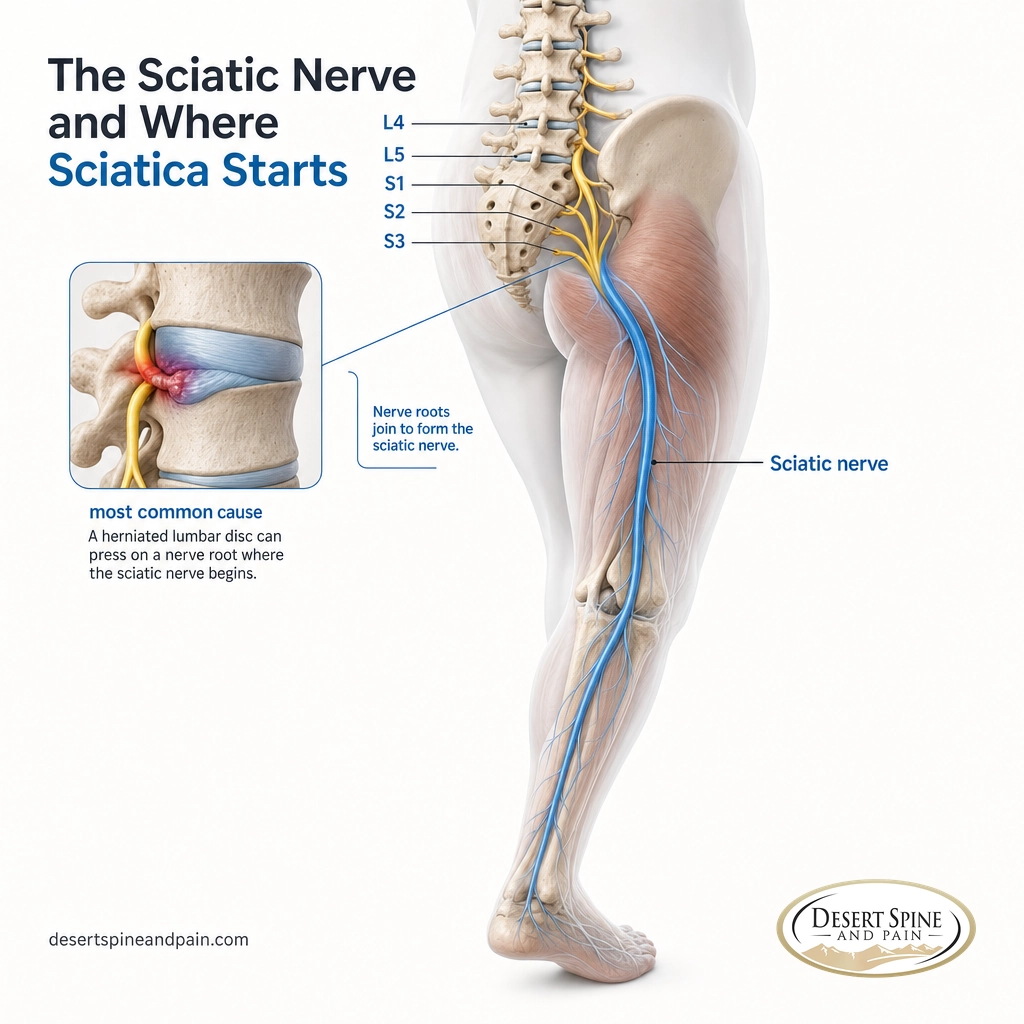
True sciatica is what clinicians call radicular pain, meaning pain that originates at a spinal nerve root. The sequence usually looks like this:
- Something presses on a nerve root. Most often a lumbar disc bulges or herniates and pushes against one of the roots that feed the sciatic nerve.
- Compression plus inflammation. Research indicates it is not pressure alone: a combination of mechanical compression and chemical inflammation around the nerve root is what actually produces the symptoms.
- The pain travels. The irritated root refers pain, numbness, or tingling along its map, so a problem in the lower back is felt in the buttock, thigh, calf, or foot.
- One side, one pathway. Because a single root is usually involved, sciatica typically follows one leg along a specific band rather than affecting both legs evenly.
A useful way to picture it: the sciatic nerve is like a long cable plugged into the base of the spine. Pinch or inflame the cable where it plugs in, and the whole downstream length can misfire, even though the leg itself is healthy. This is why treatment targets the source in the spine, not the leg where the pain is felt. It is one of the structural nerve conditions in the broader family of radiculopathy.
Source: StatPearls: Sciatica | Pain Research and Management (2022)
What Sciatica Feels Like: Symptoms
Sciatica has a recognizable pattern. The hallmark is pain that radiates from the lower back or buttock down the leg, following the path of the nerve. People describe it in different ways, but the common threads are consistent.
- Radiating pain that is often sharp, burning, or electric, running from the back or buttock into the thigh, calf, or foot.
- Usually one-sided. Sciatica typically affects a single leg rather than both.
- Numbness, tingling, or a pins-and-needles feeling along the same path as the pain.
- Leg or foot weakness in some cases, such as difficulty lifting the foot or rising onto the toes.
- Worse with certain movements. Sitting for long periods, bending, twisting, coughing, or sneezing commonly aggravate it, because they raise pressure on the nerve root.
The pain can range from a mild ache to a debilitating jolt, and it may come and go. Numbness or weakness points to the nerve being involved, not just muscle or soft tissue, which is part of what distinguishes sciatica from ordinary back strain.
Red flags: when sciatica is an emergency
Most sciatica is not dangerous, but a few symptoms need urgent evaluation and should never be watched at home. Seek emergency care right away if you develop loss of bladder or bowel control, numbness in the groin or inner thighs (saddle numbness), or rapidly progressing weakness in one or both legs. These can signal cauda equina syndrome, a rare compression of the lower spinal nerves that is a surgical emergency. Also see a doctor promptly if sciatica follows a serious injury, comes with fever, or is accompanied by unexplained weight loss.
Source: StatPearls: Sciatica
What Causes Sciatica
Because sciatica is a symptom, the useful question is always what is compressing or irritating the nerve root. One cause dominates, but several others are common, and a handful of risk factors raise the odds.
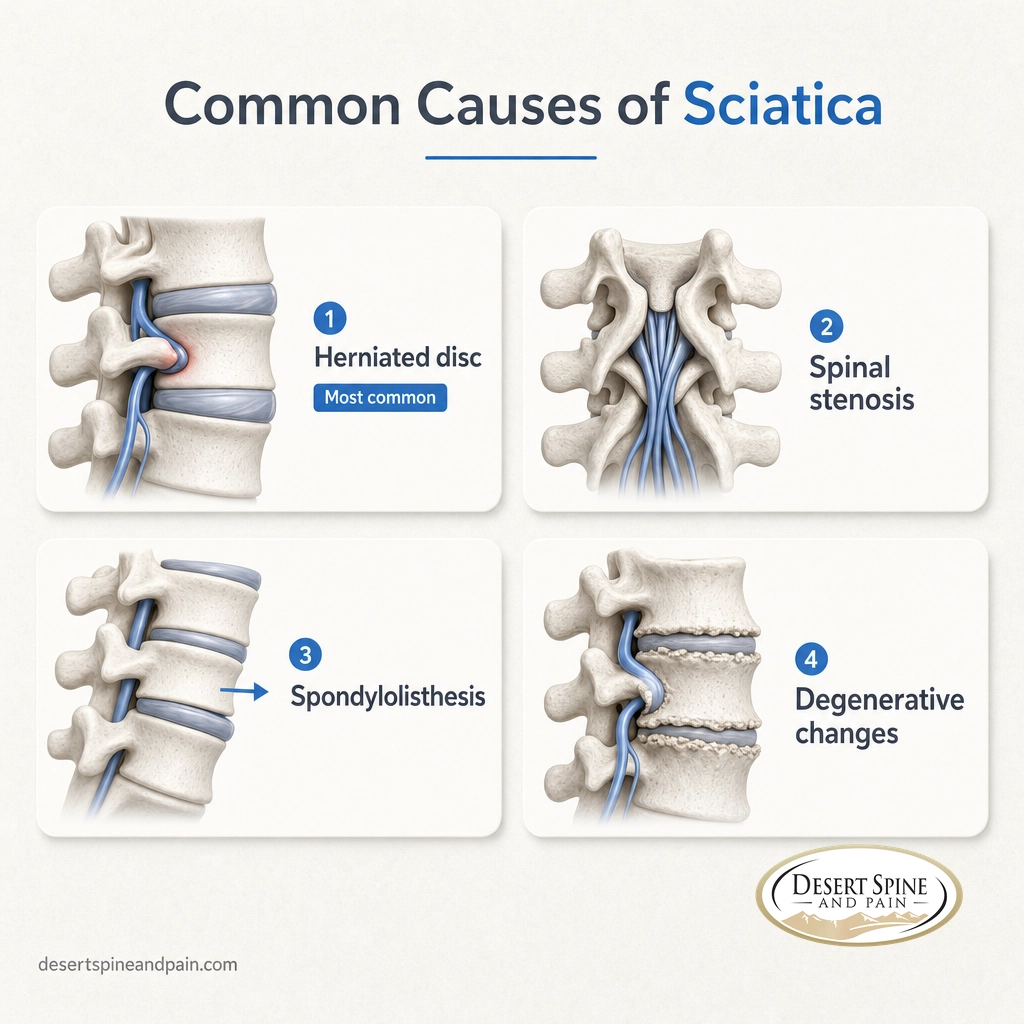
The leading causes of sciatica include:
- Herniated or bulging lumbar disc. When the soft center of a disc pushes out and contacts a nerve root, it is the single most common trigger. See our data on the leading cause in our herniated disc statistics.
- Spinal stenosis. Narrowing of the spinal canal from age-related changes crowds the nerve roots, more common in older adults.
- Spondylolisthesis. One vertebra slipping forward over another can pinch a root.
- Degenerative disc disease. Wear and bone spurs that narrow the space where nerve roots exit.
- Less often, a muscle spasm near the nerve, a traumatic injury, pregnancy, or, rarely, a tumor or infection.
Symptoms depend on both compression and inflammation, which is why two people with similar scans can feel very different. Risk factors that appear repeatedly in the research include obesity, smoking, arthritis, physically demanding or sedentary work, and a family history of the condition, alongside the strong role of age.
Source: Pain Research and Management (2022) | Scientific Reports (2025)
Sciatica vs. General Back Pain
The most common point of confusion is calling any back or leg pain sciatica. True sciatica is specifically nerve-root pain that travels along the sciatic nerve, and that distinction changes both the diagnosis and the treatment.
| Feature | Sciatica (radicular pain) | General low back pain |
|---|---|---|
| Where it hurts | Radiates from the back down one leg, past the knee | Stays mostly in the lower back or spreads only to the buttock |
| Source | A compressed or inflamed spinal nerve root | Muscles, ligaments, joints, or discs without nerve-root involvement |
| Nerve symptoms | Numbness, tingling, or weakness along the leg are common | Usually absent |
| Pattern | Typically one leg, following a specific band | Often central or across the low back |
A simple rule of thumb: if the pain is mainly in your back, it is probably not sciatica; if it shoots down your leg with numbness or tingling, it likely is. This matters because the two are managed differently, and an accurate diagnosis is the starting point. For the full picture of where back pain shows up, see our data on the most common back pain locations.
Source: StatPearls: Sciatica

How Common Sciatica Is
Sciatica is widespread, though exactly how widespread depends on how strictly it is defined. The reassuring headline is that most cases get better, but a meaningful minority persist, and that shapes how it is treated.
Sciatica has a lifetime incidence reported between 10% and 40% and an annual incidence of an episode of about 1% to 5%. It makes up roughly 5% to 10% of all low back pain cases. Most episodes resolve on their own, but about 30% of patients still report bothersome symptoms at one year, and sciatica becomes less responsive to treatment once it passes 12 weeks. That window after onset is when appropriate care does the most good. For the full numbers on prevalence, recovery, and surgery rates, see our detailed sciatica statistics.
Source: StatPearls: Sciatica | NIHR systematic review (sciatica management)
Explore the spine conditions we treatHow Sciatica Is Diagnosed
Diagnosing sciatica starts with a conversation and a physical exam, not a scan. The goal is to confirm that the pain is coming from a nerve root and to identify which one, then to decide whether imaging is needed at all.
- History and symptom pattern. Where the pain travels, what makes it worse, and whether there is numbness or weakness all point to the involved nerve.
- Physical and neurological exam. The clinician checks strength, reflexes, and sensation along the leg to map the affected root.
- Straight leg raise test. Lifting the straightened leg while lying down reproduces the radiating pain when a lower lumbar root is irritated, a classic bedside sign of nerve-root involvement.
- Imaging when it will change the plan. An MRI can show a herniated disc or stenosis, but it is usually reserved for severe, persistent, or progressive cases, or when surgery is being considered.
Why scans are not the whole story: Disc bulges and wear-and-tear changes show up on the imaging of many people who have no pain at all. That is why the diagnosis rests on your symptoms, your exam, and your images read together, never on a scan alone. Treating the picture instead of the patient leads to the wrong care.
Source: StatPearls: Sciatica
Learn about diagnostic nerve testingHow Sciatica Is Treated
Treatment for sciatica follows a least-invasive-first ladder. Because the large majority of cases improve without surgery, care starts conservatively and escalates only if symptoms persist or worsen.
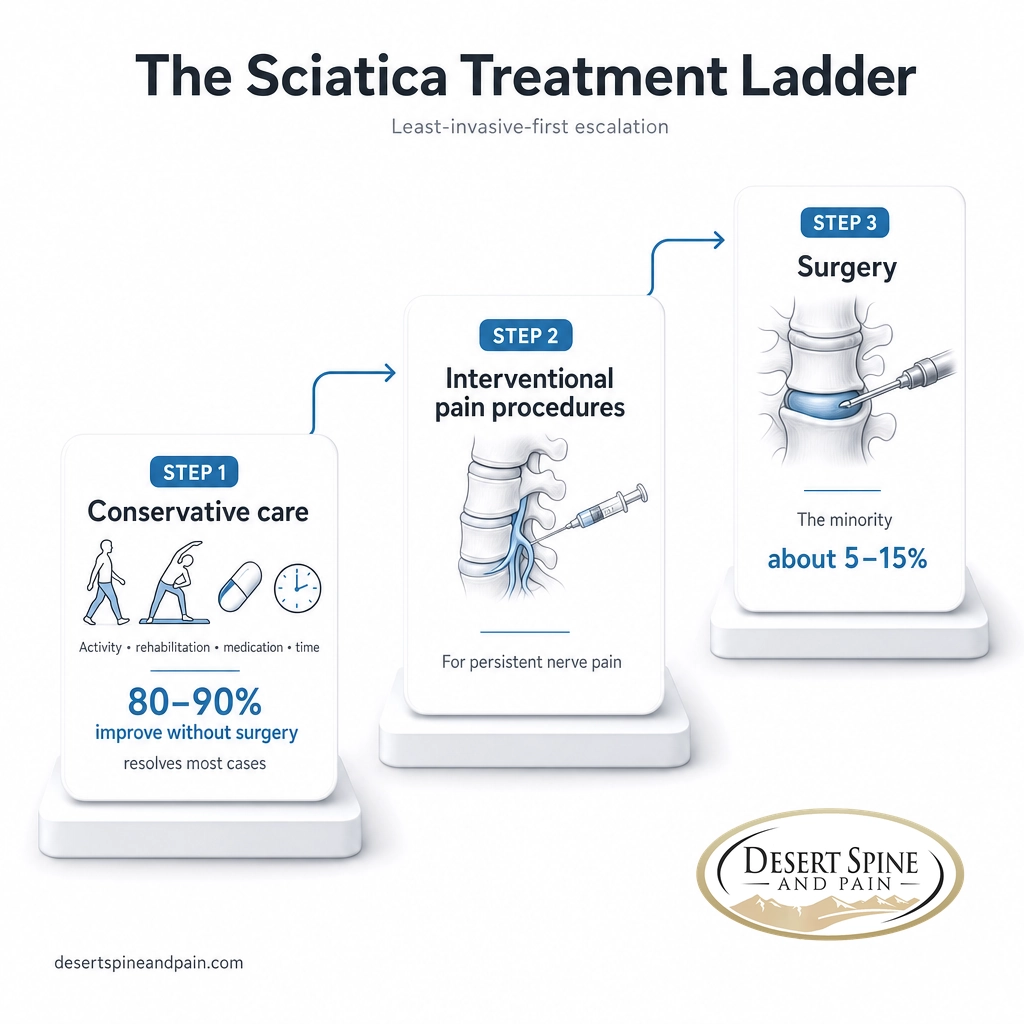
| Step | What it involves | Who it is for |
|---|---|---|
| Conservative care | Staying active, targeted exercise and rehabilitation, anti-inflammatory and other medication, time | First line for nearly everyone; resolves most cases |
| Interventional pain procedures | Epidural steroid injections to calm nerve-root inflammation | Persistent nerve pain that has not settled with conservative care |
| Surgery | Relieving the compression at its source, for example a microdiscectomy | The minority with severe, persistent, or progressive symptoms |
An estimated 80% to 90% of sciatica cases improve without surgery, managed with activity, rehabilitation arranged through referral, analgesia, and time. When pain persists, epidural steroid injections can reduce inflammation around the nerve root before any surgical step. Only the minority with ongoing severe, progressive, or neurologically concerning symptoms, roughly 5% to 15%, ultimately proceed to surgery, usually to take pressure off the nerve at its source with a procedure such as a microdiscectomy.
Myth: "Sciatica means I will need surgery."
For most people, it does not. The large majority of sciatica improves with conservative care, and surgery is reserved for a small share of cases that do not respond or that involve progressive weakness. The real priority is an accurate diagnosis and timely, appropriate care, not rushing to the operating room. A surgeon who is also trained as a neurosurgeon can guide the full ladder of care and recommend surgery only when it is genuinely the best option.
Source: BJA Education: sciatica review | NIHR systematic review
Explore interventional pain managementHow to Get Started
If pain is radiating down your leg, the most useful next step is a focused evaluation that confirms the source of the problem and matches it to the least-invasive effective treatment. A thorough consult reviews your symptoms, your neurological exam, and, if needed, your imaging together, and it is the right time to ask what is driving the pain and which options fit your case.
Desert Spine and Pain is a Phoenix, Arizona practice led by Dr. David L. Greenwald, MD, FAANS, FACS, a dual board-certified spine surgeon and neurosurgeon who sees patients from across the Greater Phoenix area and beyond. Care always starts with the least invasive effective option and escalates to a procedure only when it is genuinely the best path. When a procedure is appropriate, it is performed by Dr. Greenwald at affiliated surgical facilities.
See our conservative, non-invasive treatment options
Meet Dr. Greenwald, spine surgeon and neurosurgeon
Book a consultation: (602) 566-9500
Common Questions About Sciatica
What is sciatica?
What does sciatica feel like?
What causes sciatica?
Does sciatica go away on its own?
When should I see a doctor for sciatica?
Related Spine Terms
- Sciatic nerve: the body's largest nerve, formed by the L4 to S3 nerve roots and running from the lower back down each leg.
- Radiculopathy: the broader term for pain and symptoms caused by a compressed spinal nerve root; sciatica is lumbar radiculopathy.
- Herniated disc: when a disc's soft center pushes out and presses on a nerve, the leading cause of sciatica.
- Spinal stenosis: narrowing of the spinal canal that can crowd the nerve roots, a common cause in older adults.
- Spondylolisthesis: one vertebra slipping forward over another, which can pinch a nerve root.
- Cauda equina syndrome: a rare, urgent compression of the lower spinal nerves causing bladder or bowel changes and saddle numbness.
- Microdiscectomy: a minimally invasive surgery that removes the disc fragment pressing on the nerve, used for the minority who need an operation.
Sources
Sources and Methodology
This guide summarizes established clinical references and peer-reviewed data on sciatica. Prevalence and outcome figures are population estimates that vary by how sciatica is defined, and ranges are reported to reflect that. This is educational information, not medical advice, and it describes populations rather than any one person. If you have leg pain with progressive weakness, numbness, or loss of bladder or bowel control, seek prompt medical evaluation.
- StatPearls (NCBI Bookshelf): Sciatica, definition, anatomy, symptoms, causes, and demographics
- NIHR Systematic Review (NCBI Bookshelf): natural history, persistence, and surgery rates for sciatica
- BJA Education: Sciatica, epidemiology, pathogenesis, and management
- Pain Research and Management (2022): incidence and cause characteristics of sciatica
- Scientific Reports (2025): prevalence and risk factors of sciatica