

What Causes Sciatica? Common Triggers and Risk Factors
What causes sciatica, in plain terms: Sciatica is not a disease of its own. It is a set of symptoms, usually radiating leg pain, caused by pressure or irritation on the sciatic nerve or the nerve roots that feed it. The most common source is a herniated disc in the lower back, but stenosis, bone spurs, and other spine changes can do the same thing.
If sharp, shooting pain runs from your lower back into one leg, the real question is not just how to stop it, but what is causing it in the first place. Sciatica is a warning sign, not a diagnosis. Something is pressing on or irritating the sciatic nerve, and the lasting fix depends entirely on finding what that something is. This guide walks through the common causes of sciatica, the everyday triggers behind a sudden flare-up, the risk factors that make it more likely, and the red flags that mean you should be seen right away.
- Sciatica is a symptom, not a condition. It means a nerve feeding the sciatic nerve is being pinched or irritated somewhere along its path.
- A herniated disc in the lower spine is the single most common cause, followed by spinal stenosis, bone spurs, and spondylolisthesis.
- A cause is the underlying problem, such as a disc pressing on a nerve. A trigger is the daily movement that makes the pain spike, like prolonged sitting or lifting.
- Age, heavy lifting, long hours seated, extra body weight, smoking, and diabetes all raise your risk.
- Most sciatica eases within four to six weeks, but leg pain with loss of bladder or bowel control is a medical emergency.

What's in This Guide
- What Sciatica Actually Is
- What Causes Sciatica: The Common Sources
- Sciatica Risk Factors: Who Is Most Likely to Get It
- What Triggers a Sciatica Flare-Up
- Sciatica vs. Other Causes of Back and Leg Pain
- When Sciatica Is a Medical Emergency
- How the Cause Is Diagnosed and Treated
- Related Spine Terms
- Frequently Asked Questions
What Sciatica Actually Is
The word sciatica describes pain that travels along the path of the sciatic nerve, the longest and widest nerve in the body. It forms from nerve roots in the lower spine, roughly the L4 through S3 levels, then runs through the buttock and down the back of each leg toward the foot. When one of those roots, or the nerve itself, is compressed or inflamed, the brain reads it as pain, tingling, numbness, or weakness anywhere along that line, most often in just one leg.
This is the key point many people miss: sciatica is a symptom, not the root problem. Saying you have sciatica is like saying you have a cough. It tells you where it hurts and how, but not why. Two people can have identical leg pain from completely different causes, and the right treatment depends on which one it is. For a deeper look at the sensations themselves, see our companion guide on what sciatica feels like, and for the basics, what sciatica is.
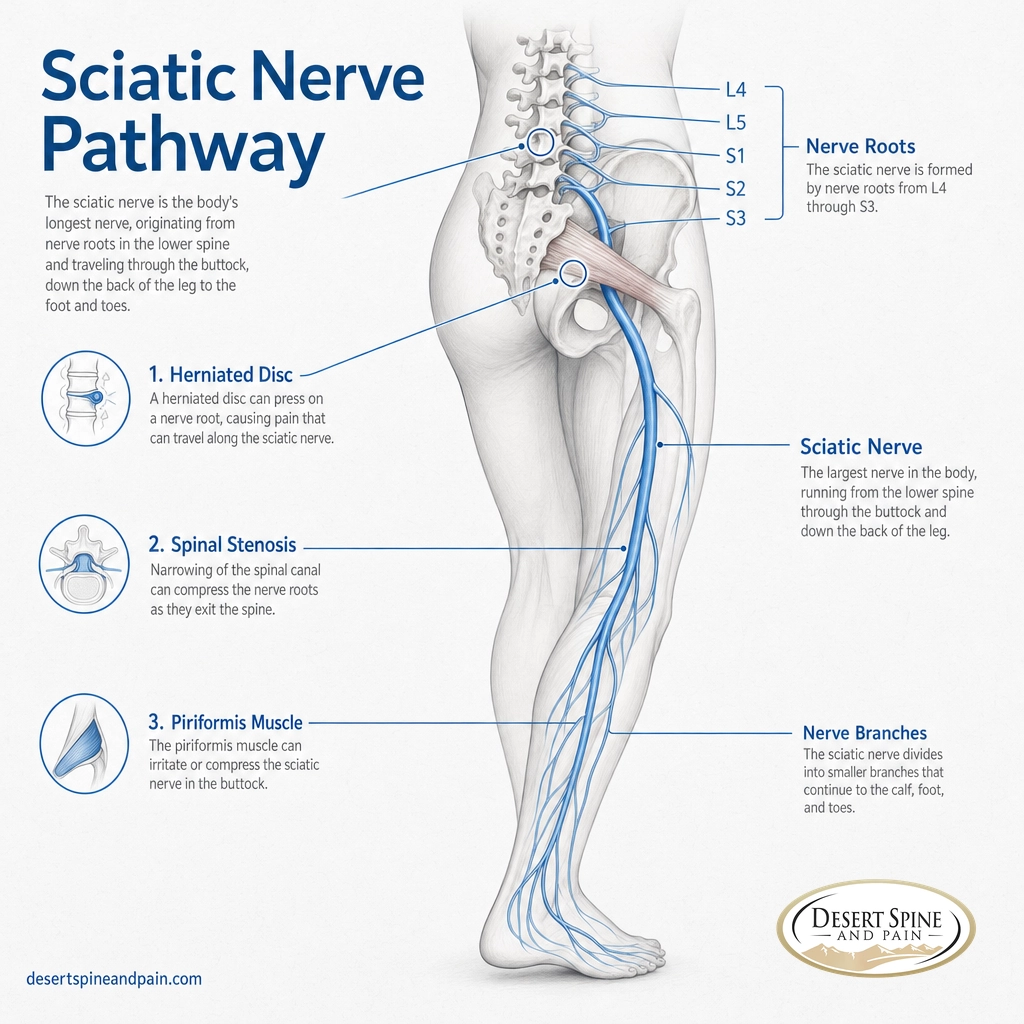
Sciatica is also part of a much larger picture. Low back problems, the setting in which most sciatica develops, are the leading cause of disability worldwide, affecting an estimated 619 million people in 2020. That scale is exactly why understanding the specific cause of your pain, rather than treating it generically, matters so much.
Source: StatPearls clinical reference on sciatica (NCBI Bookshelf) | World Health Organization: low back pain fact sheet
What Causes Sciatica: The Common Sources
Almost every case of sciatica traces back to a nerve root in the lower spine being pinched, irritated, or inflamed. What differs is the structure doing the pinching. Here are the causes a spine specialist sees most often, roughly in order of how common they are.
Herniated or slipped disc
This is the single most common cause. Spinal discs are cushions between the vertebrae, with a tough outer ring and a soft gel center. When the outer ring weakens, the center can push out and press directly on a passing nerve root. The result is classic one-sided leg pain. When a herniation is the culprit and conservative care has not helped, a targeted procedure such as a microdiscectomy can relieve the pressure through a very small incision.
Spinal stenosis
Stenosis is a narrowing of the spaces inside the spine, which squeezes the nerves that run through them. It is more common with age and often produces leg pain that worsens with standing or walking and eases when you sit or lean forward. Depending on severity, this may be treated conservatively or with a decompression procedure for lumbar stenosis.
Degenerative disc disease
As discs lose height and water content with age, they can bulge, crack, or shift, and the vertebrae can settle closer together. Any of these changes can crowd a nerve root. Degeneration is a normal part of aging and does not always cause pain, but when it narrows a nerve's exit it can set off sciatica.
Spondylolisthesis
Here one vertebra slips forward over the one below it, which can pinch the nerve as it exits the spine. It may follow a stress fracture in younger people or develop from wear and arthritis later in life.
Bone spurs and arthritis
Osteoarthritis in the spine can produce bone spurs, small bony overgrowths that take up space meant for the nerves. Over time these can press on a nerve root and refer pain down the leg.
Piriformis syndrome
Less often, the sciatic nerve is irritated not in the spine at all, but in the buttock, where the piriformis muscle can tighten or spasm against it. Because the symptoms overlap, this is frequently confused with disc-related sciatica. We break down the difference in our guide to piriformis syndrome versus sciatica.
Injury, pregnancy, and rarer causes
A fall, car accident, or sports injury can herniate a disc or fracture a vertebra and trigger sciatica. Pregnancy can bring it on as the growing uterus and shifting posture add pressure on the lower spine, usually easing after delivery. Rarely, a spinal tumor or infection presses on the nerves and must be ruled out, which is one reason unexplained or persistent sciatica deserves a professional evaluation. You can see the full range of spine conditions we treat on our conditions overview.
Source: Mayo Clinic: sciatica causes overview | Cleveland Clinic: sciatica
Sciatica Risk Factors: Who Is Most Likely to Get It
A cause is the structural problem. A risk factor is anything that makes developing that problem, and the sciatica that follows, more likely. Several of these are within your control.
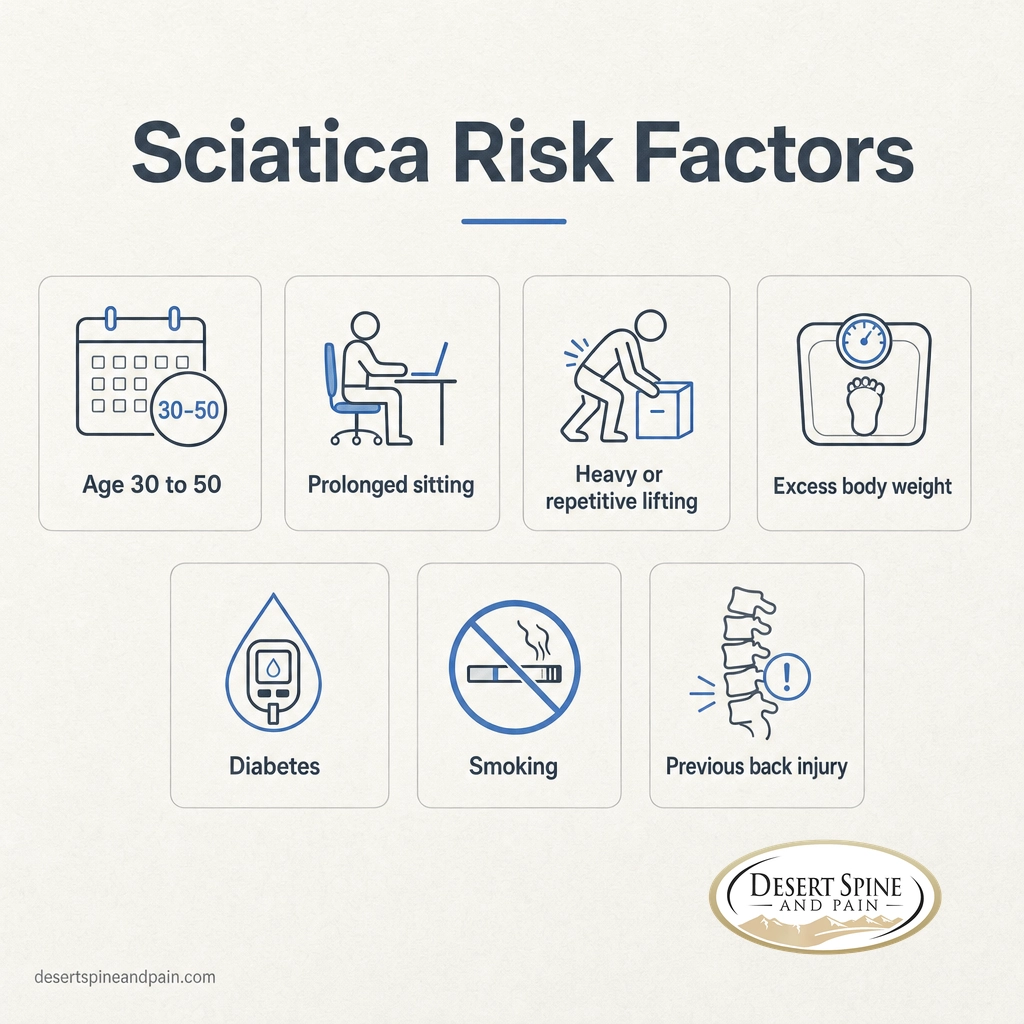
- Age. Disc and bone changes accumulate over time, making herniation, stenosis, and bone spurs more likely from your 30s onward.
- Occupation and prolonged sitting. Jobs that involve heavy lifting, twisting, or long hours behind the wheel or at a desk load the lower spine and are consistently linked to sciatica.
- Excess body weight. Extra weight increases the mechanical load on spinal discs and can accelerate the changes that pinch a nerve.
- Sedentary lifestyle and weak core. Inactivity and under-conditioned back and abdominal muscles leave the spine less supported and more vulnerable.
- Diabetes. High blood sugar can damage nerves over time, which raises the risk of nerve-related pain.
- Smoking. Smoking reduces blood supply to the discs, speeding degeneration and making them more prone to injury.
- Previous back injury. A disc or vertebra that has been injured before is more likely to cause problems again.
The encouraging part is that staying active, keeping a healthy weight, lifting carefully, and not smoking all genuinely lower your risk. Conservative strategies for day-to-day management are covered in our non-surgical spine care options.
Source: Mayo Clinic: sciatica risk factors | StatPearls clinical reference on sciatica
What Triggers a Sciatica Flare-Up
Once a nerve is already irritated, certain everyday movements can make the pain spike. These are triggers, not causes. They do not create the underlying problem, they just provoke an angry nerve. Recognizing them helps you avoid the worst flare-ups while you address the real source.
- Prolonged sitting. Sitting raises pressure inside the lumbar discs and keeps the nerve compressed. Long drives and desk marathons are classic triggers. Our guide on how to sit with sciatica covers posture fixes that help.
- Sudden bending or twisting. Reaching awkwardly or rotating the spine under load can momentarily press a disc harder against the nerve.
- Lifting with poor form. Lifting from the back rather than the legs, especially something heavy, is a frequent flare trigger.
- Coughing or sneezing. A hard cough or sneeze briefly spikes spinal pressure and can send a jolt down the leg.
- Inactivity and deconditioning. Too much rest stiffens the back and weakens supporting muscles, which can make the next flare worse. Gentle movement usually beats bed rest.
Source: Cleveland Clinic: sciatica symptoms and triggers | NHS: sciatica self-care guidance
Sciatica vs. Other Causes of Back and Leg Pain
Not all lower-body pain is sciatica, and treating the wrong problem wastes time. True sciatica follows the nerve down the leg. Other conditions can mimic it but behave differently. Here is how they compare.
| Condition | Where the pain is | Typical cause | Telltale sign |
|---|---|---|---|
| True sciatica | Lower back into one leg, often below the knee | Pinched nerve root in the spine, usually a herniated disc | Radiating, shooting pain with tingling or numbness along the nerve |
| Piriformis syndrome | Deep in the buttock, sometimes down the leg | Piriformis muscle irritating the sciatic nerve in the buttock | Tenderness in the buttock, worse with sitting, no clear disc finding |
| Mechanical low back pain | Lower back, may spread to the hips but rarely past the knee | Muscle, ligament, or joint strain | Aching and stiffness that does not travel far down the leg |
| Hip or sacroiliac joint pain | Groin, outer hip, or over the buttock | Arthritis or joint dysfunction, not a spinal nerve | Pain with specific hip movements, not a shooting nerve pattern |
Because these overlap, a careful diagnosis is what separates an educated guess from an effective plan. If you are unsure which type of specialist to start with, see what kind of doctor treats sciatica.
Source: StatPearls clinical reference on sciatica and differential diagnosis
When Sciatica Is a Medical Emergency
Most sciatica is not dangerous, but a few symptoms are red flags. Get emergency care right away if leg or back pain comes with any of these:
- Loss of control of your bladder or bowels, or new difficulty urinating.
- Numbness in the groin, buttocks, or inner thighs, sometimes called saddle numbness.
- Sudden, severe, or progressing weakness in one or both legs.
- Pain following a serious fall, accident, or direct blow to the back.
These can signal cauda equina syndrome, a rare but serious compression of the nerves at the base of the spine that needs urgent treatment to avoid permanent damage. Do not wait it out. When in doubt, be evaluated.
Source: Mayo Clinic: sciatica warning signs | NHS: when to get urgent help for sciatica
How the Cause Is Diagnosed and Treated
Finding the cause starts with a history and physical exam, including a straight-leg raise test that reproduces nerve pain. If the pain is persistent, severe, or paired with weakness, imaging such as an MRI shows exactly which disc, joint, or narrowing is involved. The goal is always to match the treatment to the specific cause.
Treatment usually follows a ladder, starting with the least invasive step that works. Conservative care includes staying active, physical therapy referral, and anti-inflammatory measures. When that is not enough, targeted epidural steroid injections can calm nerve inflammation. Surgery is reserved for cases with a clear structural cause and symptoms that do not respond, or for the red-flag situations above. For the full range of relief options, see our guide on how to treat sciatica and our pain management services. How long symptoms last varies, as we explain in how long sciatica lasts.
Explore pain relief options for sciatica
Source: NHS: sciatica treatment | Cleveland Clinic: sciatica diagnosis and treatment
Related Spine Terms
- Sciatic nerve: the longest nerve in the body, formed from the L4 to S3 roots, that carries sciatica pain down the leg.
- Herniated disc: a disc whose soft center pushes out and can press on a nerve root, the top cause of sciatica.
- Spinal stenosis: narrowing of the spinal canal or nerve openings that crowds the nerves.
- Radiculopathy: the clinical term for pain, numbness, or weakness from a pinched nerve root, which is what sciatica is.
- Spondylolisthesis: a vertebra slipping forward over the one below, sometimes pinching a nerve.
- Cauda equina syndrome: a rare emergency compression of the lowest spinal nerves that requires urgent care.
- Minimally invasive spine surgery: small-incision techniques used, when truly needed, to relieve nerve pressure.
Frequently Asked Questions
What is the most common cause of sciatica?
What triggers a sciatica flare-up?
Who is most at risk for sciatica?
Can sciatica go away on its own?
When is sciatica a medical emergency?
Find Out What Is Causing Your Sciatica
Because sciatica is a symptom with many possible causes, lasting relief starts with an accurate diagnosis. At Desert Spine and Pain, board-certified spine surgeon and neurosurgeon Dr. David L. Greenwald evaluates the real source of your leg pain and builds a plan that begins with the least invasive option that will work.
See the spine conditions we diagnose and treat
Book a consultation or second opinion
Sources
Sources and Methodology
This guide summarizes established clinical references and public-health data on the causes, triggers, and risk factors of sciatica. Figures are presented as general reference, not individual predictions. It is educational information, not medical advice. Decisions about diagnosis and treatment should be made with a qualified spine specialist after an in-person evaluation.