

What Causes Sciatica Buttock Pain?
The short answer: Sciatica buttock pain is caused by pressure on the sciatic nerve or the lower-back nerve roots (mainly L4, L5, and S1) that form it. A herniated disc is the most common culprit, followed by spinal stenosis, spondylolisthesis, arthritis bone spurs, and sacroiliac or piriformis muscle problems. The spot the pain starts, not just where it hurts, is what points to the real cause.
A deep, burning ache in one side of the buttock that travels down the back of the leg is the signature of sciatica, and it almost never starts where it hurts. The sciatic nerve is a thick cable built from nerve roots that leave your lower spine, pass through the buttock, and run down each leg to the foot. When something presses on one of those roots, or on the nerve as it crosses the buttock, the alarm fires all the way down its path. So the real question is not where the pain is, but what is pressing on the nerve and where. This guide walks through every common cause of sciatica buttock pain, shows how to tell true sciatica from the conditions that imitate it, and explains how a spine specialist tracks the pain back to its source.
- Sciatica is a symptom, not a diagnosis. It means the sciatic nerve or one of its roots (usually L4, L5, or S1) is being compressed or irritated somewhere along its path.
- A herniated or bulging lumbar disc is the most common cause. Spinal stenosis, spondylolisthesis, arthritis bone spurs, and degenerative disc disease are the other leading spinal causes.
- When the nerve is squeezed in the buttock itself by the piriformis muscle, it is called piriformis syndrome, which can feel identical to disc sciatica but is treated differently.
- Sacroiliac joint dysfunction, hip arthritis, and gluteal tendon problems all mimic sciatica, so pinpointing the cause changes the treatment.
- Most episodes ease within 4 to 6 weeks with conservative care, but saddle numbness or new bladder or bowel changes are a surgical emergency that needs immediate care.

What's in This Guide
- What Sciatica Buttock Pain Actually Is
- What Causes Sciatica Buttock Pain: The 9 Culprits
- Sciatica vs. Piriformis Syndrome
- What Else Gets Mistaken for Sciatica
- How Doctors Pinpoint the Cause
- How Sciatica Buttock Pain Is Treated
- When Buttock Pain Is an Emergency
- Why the Right Diagnosis Needs a Spine Expert
- Common Questions
- Related Spine Terms
- Sources
What Sciatica Buttock Pain Actually Is
Sciatica is the name for pain that follows the sciatic nerve, the longest and widest single nerve in the body. It is not one nerve from one spot. It forms where several nerve roots, mainly L4, L5, S1, and their neighbors, exit the lower spine and merge into one trunk. That trunk passes deep through the buttock, beneath or through the piriformis muscle, and then branches down the back of the thigh, the calf, and into the foot.
Because the nerve carries both feeling and movement signals, pressure on it produces a recognizable mix: a sharp or burning pain, often with pins-and-needles tingling, numbness, or weakness, that radiates from the buttock down one leg. It usually affects one side. The buttock is frequently where the pain is deepest, because that is the narrow, muscular corridor the nerve has to travel through after it leaves the spine.
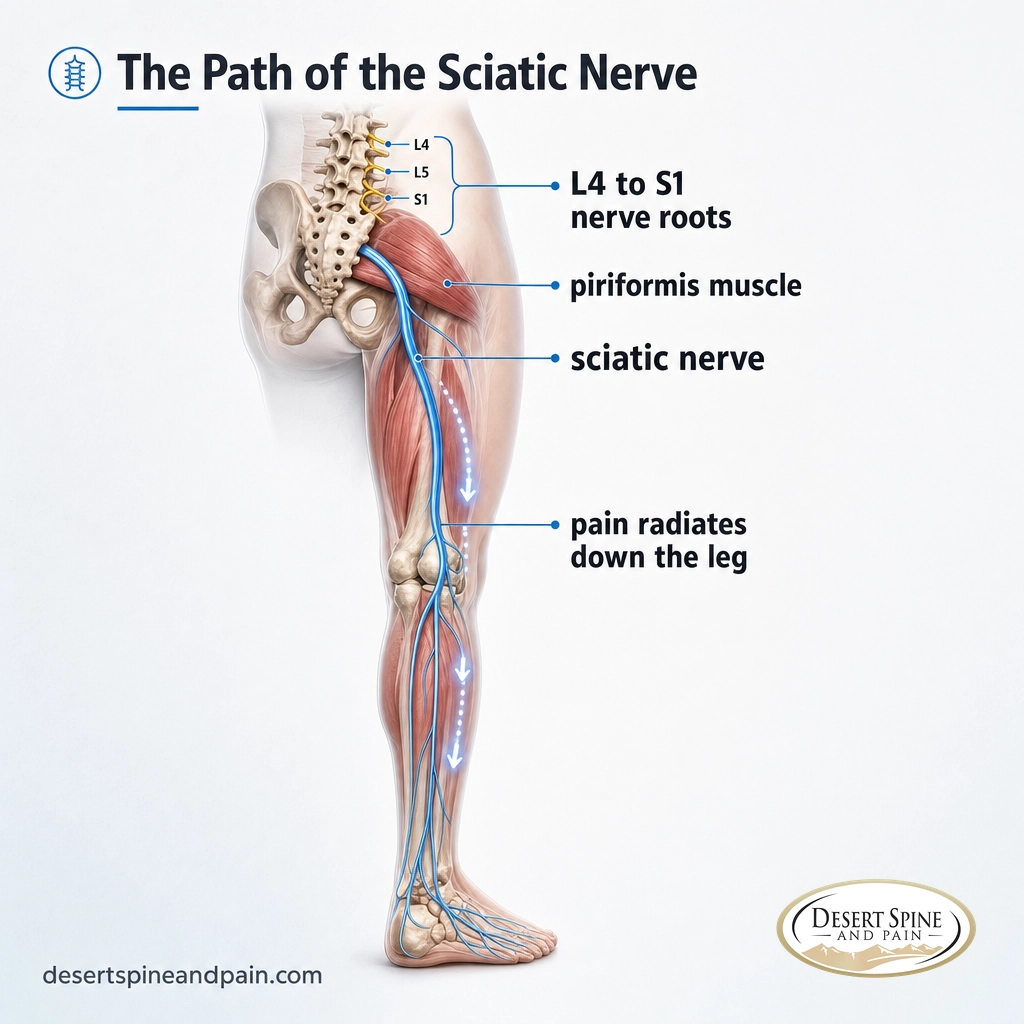
This is the key idea for understanding the causes below: the pain you feel in the buttock and leg is a return address. In most cases, the problem is back at the spine where the roots exit, and the buttock is simply downstream. In a smaller number of cases, the problem is in the buttock itself. Sorting out which one you have is the whole job of the diagnosis.
If you want the full map of which spinal level feeds which part of the leg and foot, our guide to which vertebrae affect which nerves breaks down the L5 and S1 patterns that drive most sciatica.
Source: American Association of Neurological Surgeons: Anatomy of the Spine | National Institute of Neurological Disorders and Stroke: Sciatica
What Causes Sciatica Buttock Pain: The 9 Culprits
Almost every cause of sciatica does the same thing, it narrows the space around a nerve root or the sciatic nerve, so the nerve gets pinched. What differs is what does the pinching. Here are the causes, roughly from most to least common.
1. Herniated or bulging disc (the most common cause)
Between each pair of vertebrae sits a disc with a soft center and a tough outer wall. When the wall weakens or tears, the center can bulge or push out and press on the nerve root right beside it. A lumbar disc herniation at L4 to L5 or L5 to S1 is the single most common reason for sciatica, because those are the roots that feed the sciatic nerve. The process often starts with a small tear in the disc wall before the full herniation; our explainer on how an annular tear differs from a herniated disc walks through that earlier stage.
2. Spinal stenosis
Stenosis means narrowing. Lumbar spinal stenosis is a tightening of the bony canal or the side openings (foramina) where the nerve roots exit, usually from age-related changes. The squeeze on the exiting roots produces sciatica, and a classic clue is pain that eases when you bend forward or sit, because that posture briefly opens the canal.
3. Spondylolisthesis
This is when one vertebra slips forward over the one below it. The slip narrows the opening where a nerve root exits and can tension or pinch it, sending pain into the buttock and leg. It is common in the lowest lumbar levels, where the sciatic roots live.
4. Bone spurs and spinal arthritis
Osteoarthritis of the spine (also called facet joint arthritis) can grow bone spurs, small bony overgrowths, that crowd the nerve root. The spurs plus the thickened ligaments and swollen joints around them reduce the room the nerve has, which is a frequent driver of sciatica in older adults.
5. Degenerative disc disease
As discs lose height and water content with age, the vertebrae settle closer together and the nerve openings shrink. A flatter, worn disc can also bulge more easily. Degenerative disc disease rarely acts alone, but it sets the stage for the pinching that the causes above finish.
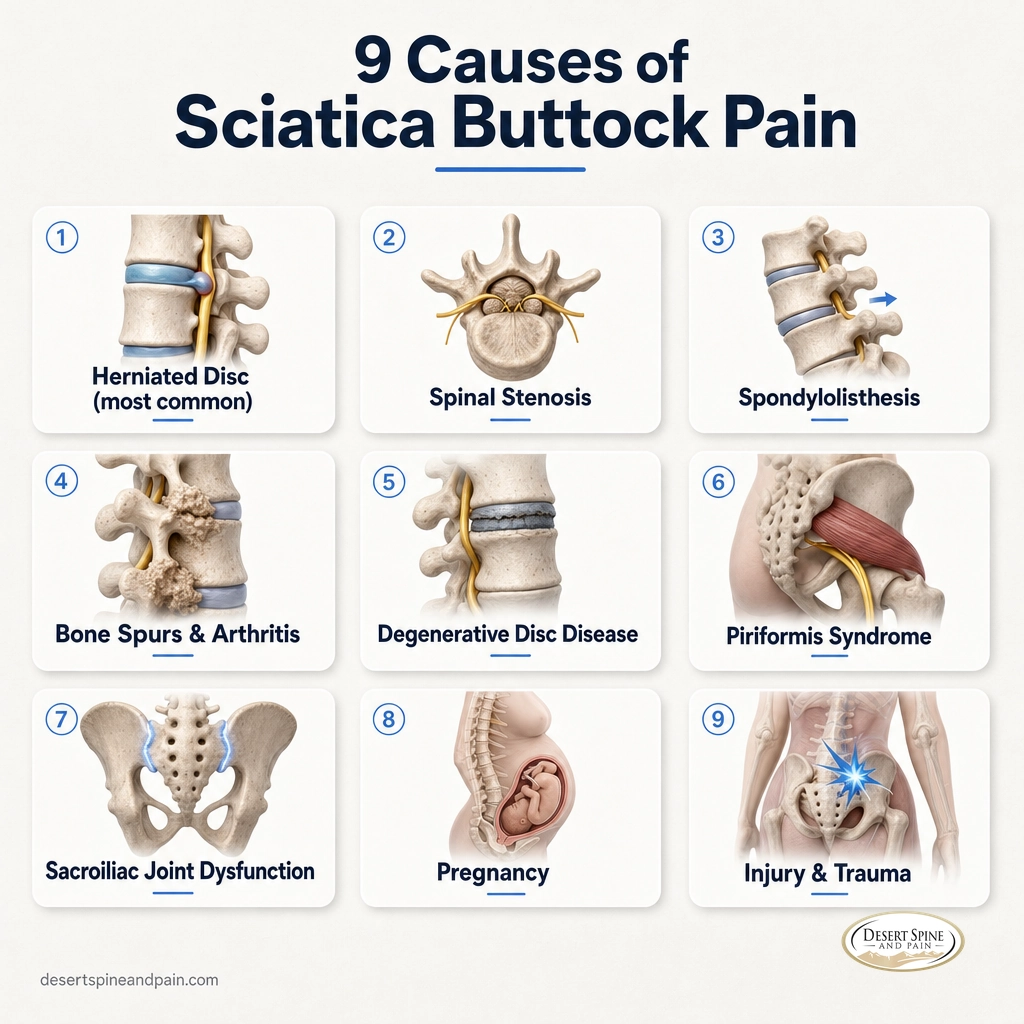
6. Piriformis syndrome
Here the problem is not at the spine at all. The piriformis is a small muscle deep in the buttock that the sciatic nerve passes directly beneath, and in some people through. When that muscle tightens, spasms, or swells, it can compress the nerve right there in the buttock. The result feels like sciatica but comes from the buttock itself, which is why it gets its own section below.
7. Sacroiliac (SI) joint dysfunction
The SI joints connect the base of the spine (the sacrum) to the pelvis, one on each side, low in the buttock. When an SI joint becomes inflamed or moves abnormally, it produces pain in the buttock that can refer down the leg and feel like sciatica, even though the sciatic nerve may not be directly involved.
8. Pregnancy
The added weight, the shift in posture, and the hormone-driven loosening of pelvic ligaments during pregnancy all increase pressure on the lower back and the sciatic nerve. Pregnancy-related sciatica is common and usually settles after delivery.
9. Injury, and rare serious causes
A fall, a car accident, or a direct blow can herniate a disc or injure the pelvis and trigger sciatica, which is why buttock and leg pain after a crash deserves a prompt spine evaluation. Rarely, a tumor, a cyst, or an infection in or near the spine can press on the nerve; these are uncommon but are part of why persistent or unexplained sciatica should be properly imaged rather than assumed.
Source: Mayo Clinic: Sciatica Symptoms and Causes | Cleveland Clinic: Sciatica
Sciatica vs. Piriformis Syndrome
This is the distinction the buttock-pain question really hinges on, and it is the one the general condition pages gloss over. Both send pain down the leg. The difference is where the nerve is being squeezed: at the spine (true, or spinal, sciatica) or in the buttock by the piriformis muscle (piriformis syndrome). Because the fix is different, telling them apart matters.
| Feature | Spinal sciatica (disc, stenosis, etc.) | Piriformis syndrome |
|---|---|---|
| Where the pinch is | At the nerve root in the lower spine | At the sciatic nerve in the buttock, under the piriformis muscle |
| Where pain is worst | Can start in the lower back, then runs through the buttock and down the leg | Deep in the buttock, often with less or no back pain |
| What makes it worse | Bending, coughing, sneezing, or sitting that loads the disc | Prolonged sitting (on a wallet or hard seat), climbing stairs, running, rotating the hip |
| Numbness and weakness | Often follows a specific nerve-root pattern (for example, L5 or S1) | Less likely to follow a clean root pattern; more a deep ache and tenderness |
| How it is confirmed | MRI showing the disc, stenosis, or slip pressing the root | Largely a clinical diagnosis after spinal causes are ruled out, aided by exam maneuvers |
In practice, spinal causes are far more common than piriformis syndrome, and the two can even coexist. That is why a careful exam that provokes the nerve in specific ways, paired with imaging of the spine, is how a specialist decides which one is driving your buttock pain, rather than guessing from symptoms alone.
Source: StatPearls (NCBI): Piriformis Syndrome | National Institute of Neurological Disorders and Stroke: Sciatica
What Else Gets Mistaken for Sciatica
Not every pain in the buttock is sciatica. Several conditions produce buttock or leg pain through a different mechanism, and treating them as sciatica wastes time. These are the usual imitators.
| Condition | How it differs from sciatica |
|---|---|
| Sacroiliac joint dysfunction | Pain centers low in the buttock near the dimple over the SI joint and rarely travels below the knee |
| Hip osteoarthritis | Pain sits in the groin and front or side of the hip and worsens with weight-bearing and hip rotation, not nerve tingling down the leg |
| Gluteal tendinopathy or trochanteric bursitis | Tenderness over the bony point on the outer side of the hip, worse lying on that side, not a radiating nerve pain |
| Facet joint pain | Referred ache into the buttock from arthritic spine joints, usually without the true leg-length radiation of sciatica |
| Vascular claudication | Leg pain from reduced blood flow that comes on with walking a set distance and eases with rest regardless of posture |
The SI joint is the trickiest of these because it sits so close to where sciatica is felt. If SI joint pain is the real problem, the answer is not a sciatica treatment at all; our overview of what sacroiliac joint fusion is and when it helps covers that lane. The practical takeaway is simple: buttock pain has several possible sources, and matching the treatment to the right one is exactly what a focused exam is for.
Source: Cleveland Clinic: Sciatica | Hospital for Special Surgery: Sciatica

How Doctors Pinpoint the Cause
Because so many things cause buttock pain, the diagnosis is where good care separates itself. A spine specialist is not just confirming sciatica, they are finding the specific structure that is pressing on the nerve, and at which level, so the treatment targets the real problem.
It starts with the story and the exam. Where the pain travels, what makes it better or worse, and the pattern of any numbness or weakness all point toward a level. The specialist tests reflexes, strength, and sensation, and uses provocation maneuvers (such as raising the straight leg) that stretch the nerve and reproduce the symptoms when a root is irritated.
Imaging then confirms the picture. An MRI is the workhorse, because it shows the discs, nerve roots, and soft tissue, so a herniation, stenosis, or slip is visible. X-rays show the bones and any spondylolisthesis, and nerve testing such as EMG can confirm which root is affected when the picture is mixed. The important nuance is that an MRI in an adult often shows age-related changes at several levels, and not every finding is the one causing the pain. Matching the images to the exam is how a specialist tells the guilty level from the innocent bystanders.
Source: National Institute of Neurological Disorders and Stroke: Sciatica | MedlinePlus: Sciatica
How Sciatica Buttock Pain Is Treated
The encouraging news is that most sciatica settles on its own. The large majority of people improve within a few weeks without surgery, so treatment follows a ladder that starts with the least invasive step and climbs only if the pain does not resolve.
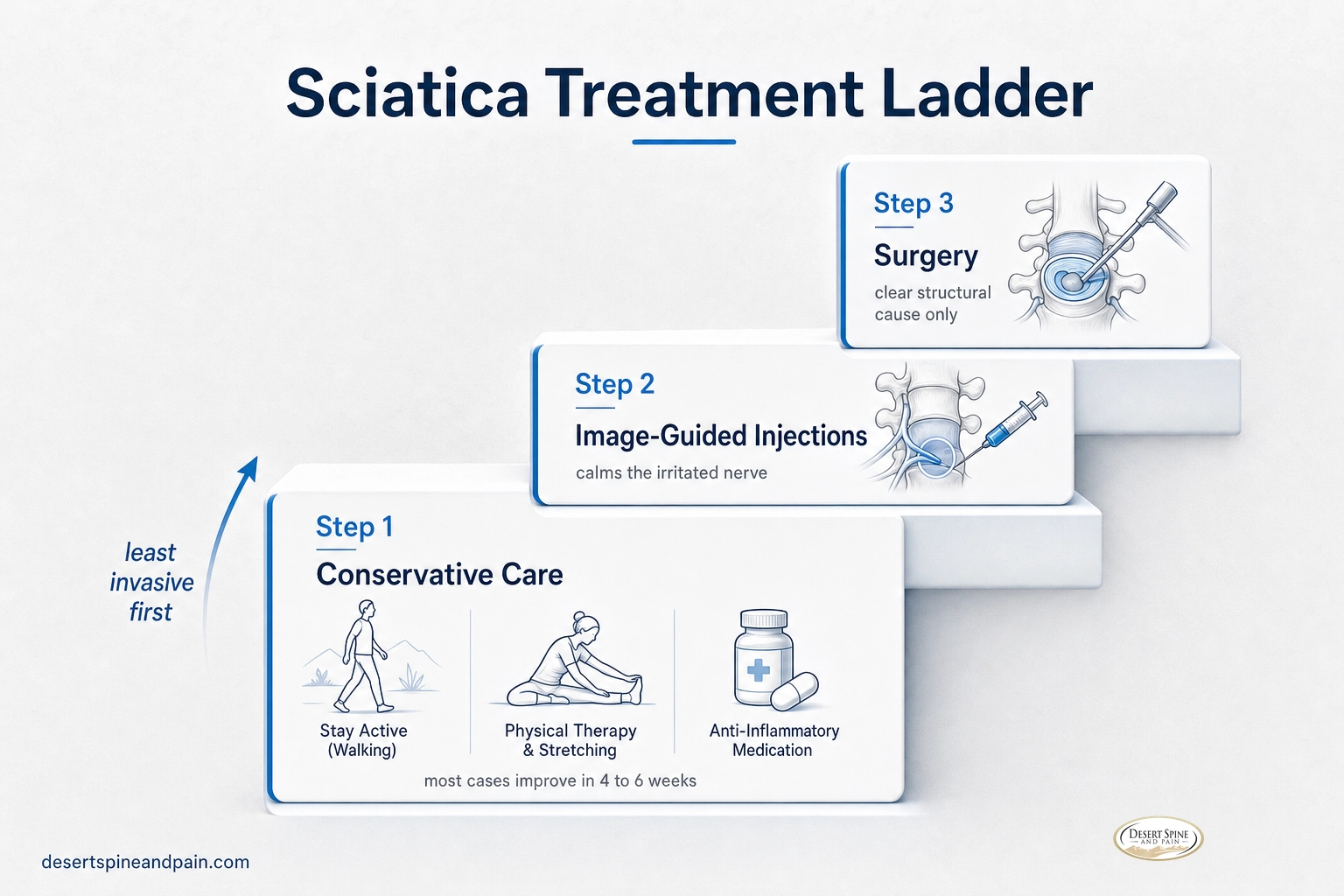
Step 1: Conservative care
Early on, staying gently active usually beats bed rest. Short-term anti-inflammatory medication, heat or ice, and a targeted physical therapy program for the lower back and hips address most cases. For pain driven by a tight piriformis, specific stretching and hip work can make a real difference. Our non-surgical and conservative care options page outlines what this stage looks like.
Step 2: Image-guided injections
When pain persists, an epidural steroid injection can calm the inflammation around an irritated nerve root and buy the relief needed to keep rehabbing. If the sacroiliac joint is the real source, a targeted sacroiliac joint injection both treats and helps confirm the diagnosis.
Step 3: Surgery, only when it is earned
Surgery is reserved for a clear structural cause with either disabling pain that has not responded to conservative care or progressive nerve weakness. When a herniated disc is pressing a root, a minimally invasive microdiscectomy removes the fragment pressing on the nerve. For stenosis, a decompression opens the space the nerve needs. The goal throughout is the least invasive option that genuinely solves the problem.
Source: Mayo Clinic: Sciatica Diagnosis and Treatment | Cleveland Clinic: Sciatica
When Buttock Pain Is an Emergency
Most sciatica is miserable but not dangerous. A small set of symptoms are the exception, because they signal that the lowest nerve roots are being crushed, and delay can cause permanent damage.
Seek immediate medical care if buttock or leg pain comes with any of these:
- Saddle numbness: loss of feeling in the inner thighs, groin, or buttocks.
- New loss of bladder or bowel control, including being unable to urinate or new incontinence.
- Weakness or numbness in both legs, especially if it is spreading or worsening.
- Sudden, severe weakness in one leg, such as a foot that drops or a leg that gives way.
The first three can signal cauda equina syndrome, in which a large disc herniation or other mass compresses the bundle of lower nerve roots. It is a surgical emergency, and relieving the pressure urgently offers the best chance of preserving bladder, bowel, and leg function. If any of these describe you, do not wait to stretch or ice it. Get emergency care.
Source: American Association of Neurological Surgeons: Cauda Equina Syndrome
Why the Right Diagnosis Needs a Spine Expert
By now the pattern is clear: sciatica buttock pain has many possible causes, several of its imitators look nearly identical, and the correct treatment depends entirely on which one you have. Guessing is how people end up chasing the wrong fix for months. The clinician who can sort it out is one who understands the nerve, the roots, and the bones around them, and who can carry you from the first exam through conservative care and, only if you ever need it, surgery.
At Desert Spine and Pain, that range sits with one surgeon. The practice is led by Dr. David L. Greenwald, MD, FACS, who is board certified as both a spine surgeon and a neurosurgeon. That dual training covers the whole chain in this guide, from the pinched nerve root to the disc, bone, or joint pressing on it, so a single expert can pinpoint the cause, explain it plainly, and choose the least invasive option that fits. The practice leads with non-surgical care and reserves surgery for when the evidence genuinely calls for it.
Desert Spine and Pain serves the Greater Phoenix, Arizona area, welcomes out-of-network patients, and partners with personal injury attorneys and their clients. If buttock and leg pain is tracing one of the patterns above, a focused consultation is the fastest way to find out what is causing it and what to do.
Meet Dr. David L. Greenwald, MD, FACS
Explore spine conditions we treat
Book a consultation or second opinion
Common Questions About Sciatica Buttock Pain
What causes sciatica buttock pain?
What can be mistaken for sciatica buttock pain?
How long does sciatica buttock pain last?
How do you relieve sciatica pain in the buttocks?
Why did I suddenly develop sciatica buttock pain?
Related Spine Terms
- Sciatic nerve: the longest, widest nerve in the body, formed from the L4 to S3 roots, running through the buttock and down each leg.
- Radiculopathy: the medical term for a pinched or irritated nerve root; lumbar radiculopathy is the formal name for most sciatica.
- Herniated disc: a disc whose soft center pushes through a tear in its outer wall and presses on a nearby nerve, the leading cause of sciatica.
- Spinal stenosis: narrowing of the spinal canal or nerve openings that crowds the nerve roots.
- Spondylolisthesis: a forward slip of one vertebra over another that can pinch an exiting nerve root.
- Piriformis syndrome: compression of the sciatic nerve in the buttock by the piriformis muscle rather than at the spine.
- Cauda equina syndrome: emergency compression of the lowest nerve roots, marked by saddle numbness and bladder or bowel changes.
Sources
Sources and Methodology
This guide summarizes established clinical information on the causes, diagnosis, and treatment of sciatica from peer-reviewed references and major medical institutions. Nerve territories and the typical course of sciatica overlap and vary from person to person, so the patterns here are presented for orientation, not as a diagnosis. This is educational information, not medical advice. Any new or worsening pain, numbness, or weakness should be evaluated by a qualified physician in person, and the emergency symptoms described above need immediate care.
- Mayo Clinic: Sciatica, Symptoms and Causes
- Mayo Clinic: Sciatica, Diagnosis and Treatment
- Cleveland Clinic: Sciatica
- National Institute of Neurological Disorders and Stroke (NINDS): Sciatica
- MedlinePlus Medical Encyclopedia: Sciatica
- American Association of Neurological Surgeons (AANS): Anatomy of the Spine and Peripheral Nervous System
- American Association of Neurological Surgeons (AANS): Cauda Equina Syndrome
- StatPearls (NCBI Bookshelf): Piriformis Syndrome
- Hospital for Special Surgery (HSS): Sciatica