
Can Sciatica Be Cured Permanently? What the Evidence Shows
If you have searched for how to cure sciatica permanently, here is the honest answer: sciatica is a symptom, not a disease, so it is not "cured" the way an infection is. What the evidence actually shows is encouraging. Most people reach lasting relief, and in a landmark New England Journal of Medicine trial, about 95% of patients had recovered within one year whether they had surgery or not. The key to relief that holds is finding what is pressing on the nerve and treating that cause, not just quieting the pain for a week.
Key Takeaways
- Sciatica is a symptom of a pinched nerve, most often from a herniated disc, spinal stenosis, or a slipped vertebra. Lasting relief comes from treating that cause.
- Most sciatica improves over weeks. Pooled trial data show about half of people improve within 10 days and about three-quarters within four weeks.
- Surgery is rarely the first step. It relieves leg pain faster, but one-year recovery is similar for surgical and conservative care in many patients.
- Relief lasts when the cause is corrected and backed by core and hip strength, good posture, safe lifting, and movement.
- A few symptoms are emergencies. Loss of bladder or bowel control, saddle numbness, or rapidly spreading leg weakness needs immediate care.

What's in This Guide
- What "Cured Permanently" Really Means for Sciatica
- What Is Actually Pressing on Your Sciatic Nerve
- The Evidence: Does Sciatica Go Away on Its Own?
- The Path to Lasting Relief, Step by Step
- Why Sciatica Comes Back, and How to Make Relief Stick
- Red Flags: When Sciatica Is an Emergency
- When to See a Spine Specialist
- Frequently Asked Questions
What "Cured Permanently" Really Means for Sciatica
Sciatica is the name for pain that travels along the sciatic nerve, the largest nerve in the body, running from the lower back through the hip and down each leg. The pain, tingling, or weakness you feel in your leg is a downstream signal. The real problem sits in your spine, where something is compressing or irritating a nerve root before it joins the sciatic nerve.
That distinction changes the whole question. You do not "cure" a symptom. You resolve the thing causing it. When a herniated disc shrinks back or is treated, when inflammation settles, or when narrowed space around the nerve is reopened, the signal stops and the leg pain goes with it. Relief becomes permanent when that cause stays corrected and the spine around it stays healthy. This is why two people with identical leg pain can have completely different outcomes: one had a cause that healed and stayed healed, the other had a cause that was never addressed.
So the useful goal is not a magic permanent cure. It is durable, lasting relief built on an accurate diagnosis. The sections below walk through what causes sciatica, what the research says about recovery, and the treatment path that gives relief the best chance of holding.
Source: National Institute of Neurological Disorders and Stroke
What Is Actually Pressing on Your Sciatic Nerve
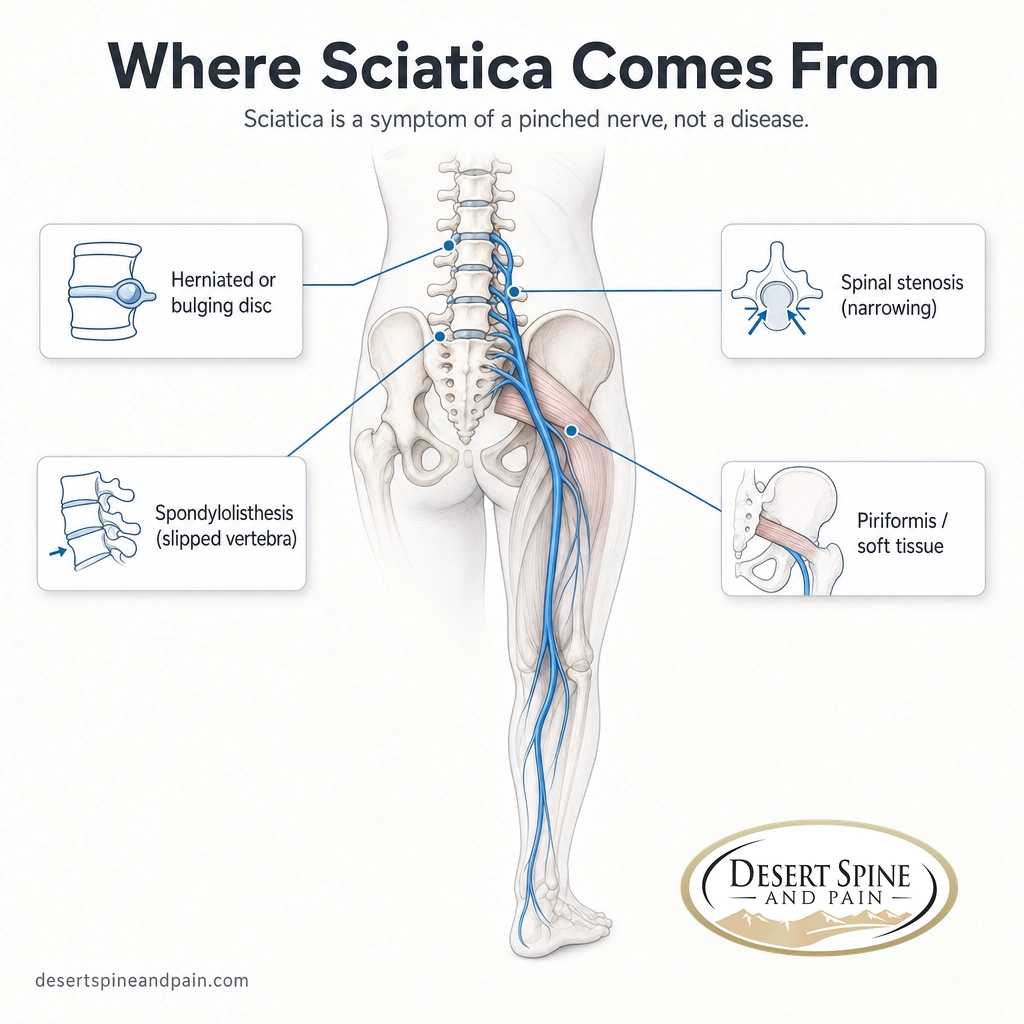
Because lasting relief depends on the cause, it helps to know the usual suspects. Sciatica almost always traces back to one of a handful of structural problems in the lower spine. A precise diagnosis, usually confirmed with an exam and imaging such as an MRI, is what separates a plan that works from months of guessing.
Herniated or bulging disc
The most common cause. The soft center of a spinal disc pushes through its outer wall and presses on a nearby nerve root. Many herniations improve as the disc material is reabsorbed by the body over weeks to months, which is a major reason so much sciatica resolves without surgery. You can read more about this on our overview of spine conditions that cause nerve pain.
Spinal stenosis
A narrowing of the spaces in the spine, often from age-related changes, that crowds the nerves. Stenosis-related sciatica tends to build gradually and is more likely to need ongoing management or, in some cases, a decompression procedure to reopen the space.
Spondylolisthesis
One vertebra slips forward over the one below it, pinching the nerve as it exits. This is a mechanical problem that sometimes needs stabilization to give permanent relief.
Piriformis and soft-tissue causes
Less commonly, a muscle deep in the buttock can irritate the sciatic nerve directly. These cases often respond well to targeted physical therapy and rarely need surgery.
The myth that keeps sciatica coming back
The most common mistake is treating the pain and ignoring the cause. Rest, heat, and a few days of medication can make a herniated-disc flare feel better, but if the disc is still pressing on the nerve, the pain returns. A "permanent cure" marketed without a diagnosis is a warning sign. Lasting relief starts with knowing exactly what is compressing the nerve.
Source: StatPearls clinical reference, NCBI Bookshelf
The Evidence: Does Sciatica Go Away on Its Own?
For most people, the answer is yes, and faster than they expect. Sciatica is common. Research places the lifetime chance of experiencing it somewhere between 10% and 40% of adults, with symptoms peaking in people in their 40s.
The natural history is favorable. In a 2007 clinical review in The BMJ by Koes and colleagues, about half of the patients with acute sciatica in the placebo groups of randomized non-surgical trials reported improvement within 10 days, and about three-quarters reported improvement after four weeks. That is why guidelines recommend active conservative care first for most cases rather than rushing to imaging or surgery.
How Fast Acute Sciatica Improves Without Surgery
Placebo-group improvement rates from randomized non-surgical trials, reported in Koes et al., BMJ 2007.
The most important study on whether you need surgery compared early surgery against prolonged conservative care in 283 patients who had already had severe sciatica for 6 to 12 weeks. The results are the quiet heart of this whole topic:
Early surgery relieved leg pain significantly faster, which matters a great deal when pain is severe. But by one year, both groups had reached roughly the same high recovery rate. Notably, 39% of the patients assigned to conservative care eventually chose surgery for faster relief, which tells you that conservative-first is a sensible default, not a guarantee that surgery will never help.
There is a real tail to be honest about. As that same BMJ review notes, a substantial minority, up to roughly 30% of patients, continue to have pain a year or longer after onset. For that group, a thorough specialist evaluation is exactly what prevents months of trial and error.
Source: New England Journal of Medicine, Peul et al. 2007 | The BMJ, Koes, van Tulder & Peul 2007 (sciatica clinical review) | StatPearls clinical reference
The Path to Lasting Relief, Step by Step
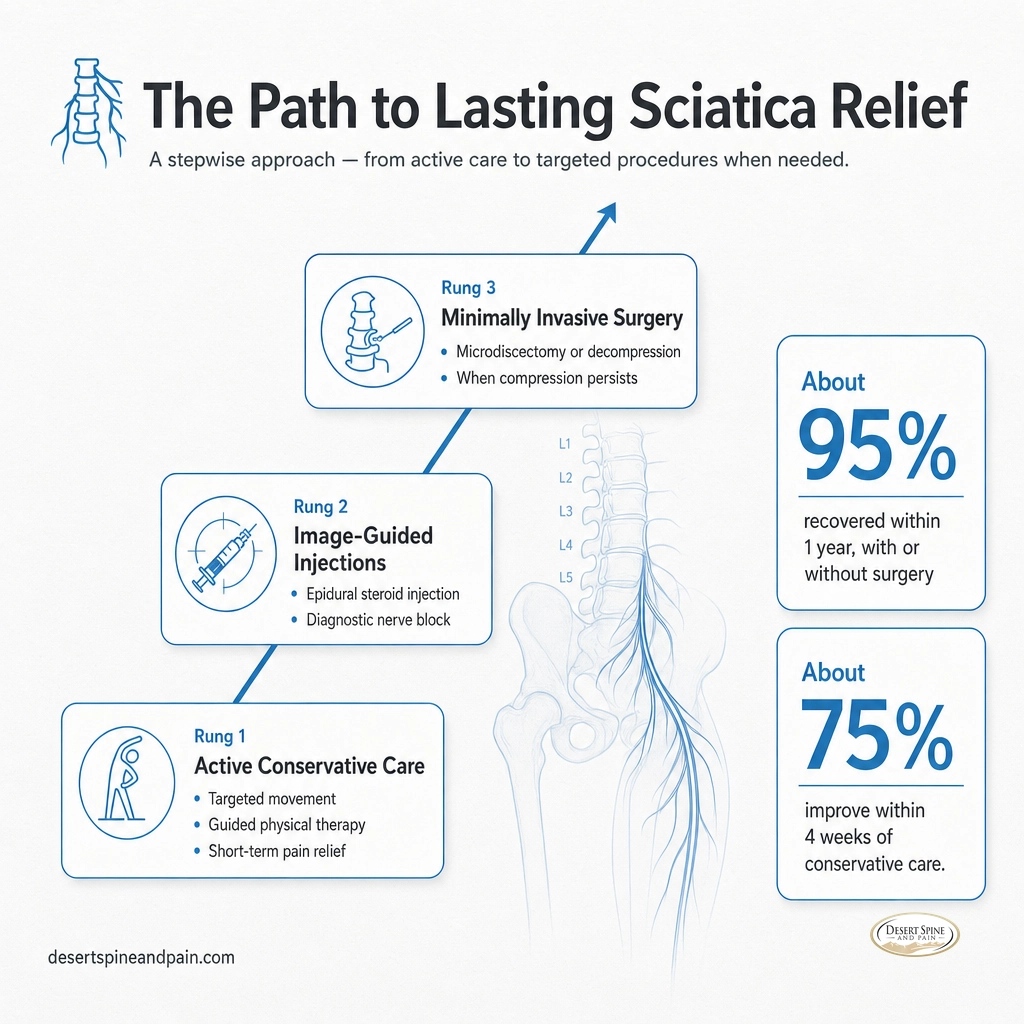
Sciatica care follows a ladder. You start with the least invasive approach that fits your cause and move up only if symptoms do not settle. The point of the ladder is to match the treatment to the problem, so relief holds instead of fading.
Step 1: Start With Active Conservative Care
For most people, this is where sciatica resolves. The modern evidence favors staying gently active over bed rest, which can actually slow recovery. A typical first phase includes targeted movement and stretching, short-term pain relief as advised by your doctor, and heat or ice for comfort. Structured guided physical therapy, which Desert Spine and Pain coordinates through trusted referral partners, builds the core and hip strength that takes pressure off the nerve. What success looks like: steadily shrinking leg pain over two to six weeks and a return to normal activity.
Step 2: Add Image-Guided Injections When Pain Persists
If pain is severe or has not settled with movement and time, targeted injections can calm the inflammation around the nerve so you can function and progress with therapy. An epidural steroid injection delivers anti-inflammatory medication directly to the irritated nerve root, and a diagnostic nerve block can both relieve pain and confirm which nerve is the true source. These are outpatient procedures, and for many people they are the bridge that avoids surgery. What success looks like: enough relief to move, sleep, and rehabilitate effectively.
Step 3: Consider Minimally Invasive Surgery When the Nerve Stays Compressed
Surgery enters the picture when severe pain or nerve-related weakness persists despite several weeks of appropriate care, or sooner if red-flag signs appear. For a herniated disc, a microdiscectomy removes the small fragment pressing on the nerve. For stenosis, a decompression procedure reopens the crowded space. Done by an experienced surgeon, these modern procedures are often minimally invasive, with small incisions and faster recovery. What success looks like: rapid, durable relief of leg pain once the mechanical cause is removed.
| Approach | Best suited for | Typical timeline | Goal |
|---|---|---|---|
| Active conservative care | New or mild to moderate sciatica | First choice, 2 to 6 weeks | Let the cause settle while staying active |
| Image-guided injections | Severe or persistent pain not settling with movement | Added after a few weeks if needed | Calm nerve inflammation, enable rehab |
| Minimally invasive surgery | Ongoing compression, weakness, or red flags | When conservative steps are exhausted, or urgently for red flags | Remove the mechanical cause for durable relief |
Explore conservative and non-invasive spine care
Source: New England Journal of Medicine, Peul et al. 2007

Why Sciatica Comes Back, and How to Make Relief Stick
Here is the part most quick-fix articles skip. Because sciatica reflects a structural issue, relief is only as durable as your spine's health going forward. A herniated disc can reherniate, stenosis can progress, and old habits that loaded the spine can reload it. The patients who keep their relief are the ones who treat recovery as the start of maintenance, not the finish line.
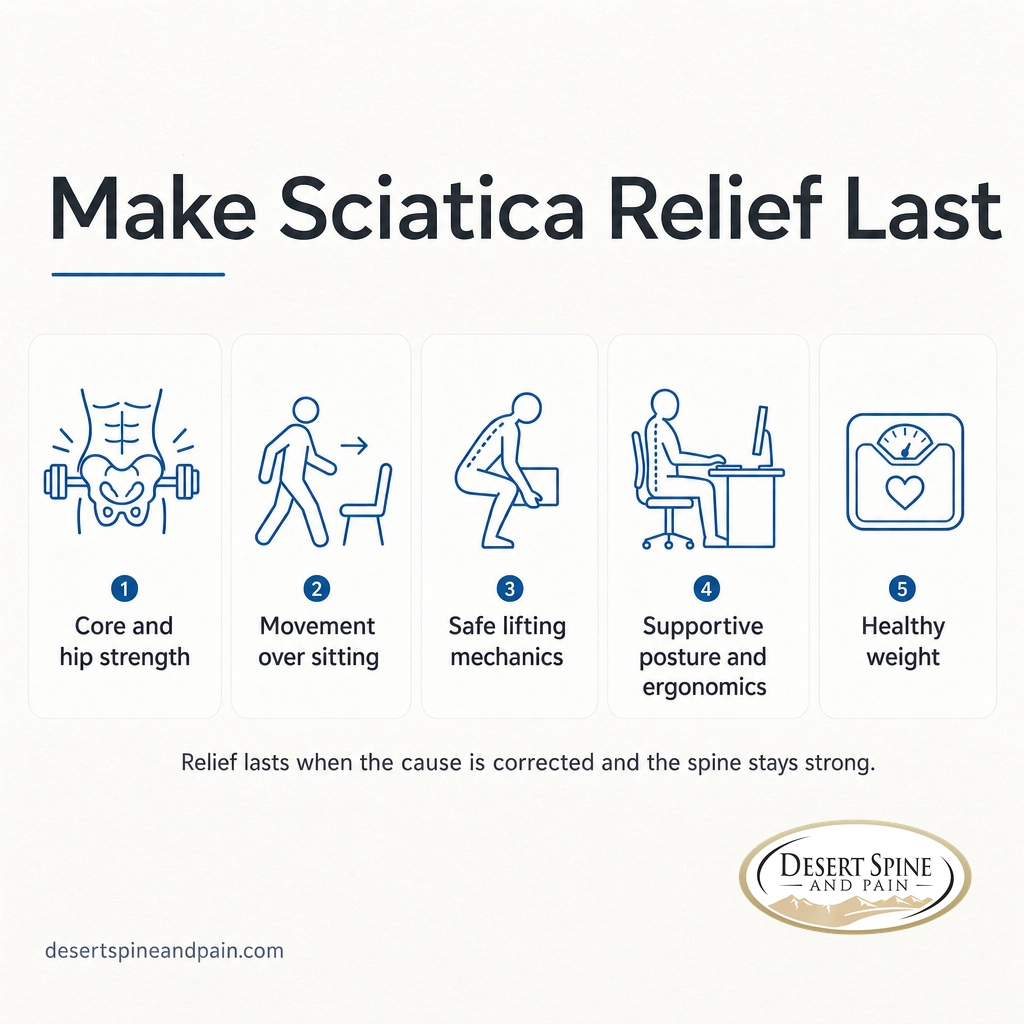
The factors most consistently linked to lasting relief are not exotic. They are strength, mechanics, and consistency:
- Core and hip strength. A strong trunk and strong glutes share the load the spine would otherwise carry alone.
- Movement over stillness. Regular low-impact activity keeps discs and nerves healthy. Prolonged sitting is a common relapse trigger.
- Safe lifting mechanics. Hinging at the hips and keeping loads close to the body protects the discs that cause most sciatica.
- Posture and ergonomics. A workstation that supports a neutral spine reduces the daily strain that re-irritates nerves.
- A healthy weight. Less load on the lumbar spine means less pressure on the discs and nerves.
Common Sciatica-Relief Mistakes and What to Do Instead
| Common mistake | What to do instead |
|---|---|
| Resting in bed until the pain stops | Stay gently active within comfort; prolonged bed rest tends to slow recovery |
| Chasing pain relief without a diagnosis | Get the cause identified so the right treatment is matched to it |
| Stopping exercises once the pain eases | Keep the core and hip program going to prevent recurrence |
| Ignoring leg weakness or numbness | Treat new or worsening weakness as a reason to be evaluated promptly |
| Delaying care for months of severe pain | See a spine specialist; options like injections or minimally invasive surgery may help |
Source: National Institute of Neurological Disorders and Stroke
Red Flags: When Sciatica Is an Emergency
The large majority of sciatica is not dangerous, just painful. But a small set of symptoms can signal cauda equina syndrome, a rare compression of the nerve bundle at the base of the spine that can cause permanent damage if it is not treated urgently.
Seek emergency care immediately if you have:
- New loss of bladder or bowel control, or difficulty passing urine
- Numbness in the "saddle" area, meaning the inner thighs, buttocks, or groin
- Weakness that is spreading or affecting both legs
- Sudden, severe worsening of symptoms
These are reasons to go to an emergency department right away, not to wait for a routine appointment. Prompt treatment is what protects long-term function.
Source: National Institute of Neurological Disorders and Stroke
When to See a Spine Specialist
If your sciatica is severe, is not improving after several weeks of conservative care, keeps returning, or comes with leg weakness, a spine specialist can find the exact cause and match it to the right treatment. That is the step that turns temporary relief into lasting relief, because the plan is built on a precise diagnosis rather than a guess.
At Desert Spine and Pain in Phoenix, care is led by Dr. David L. Greenwald, a dual board-certified spine surgeon and neurosurgeon who treats the full range of sciatica, from conservative and interventional pain care to minimally invasive spine surgery when it is truly needed. The goal is always the least invasive path that gives you durable relief.
Book a consultation for your sciatica
Meet Dr. Greenwald, board-certified spine and brain surgeon
Frequently Asked Questions
Can sciatica be cured permanently?
How long does sciatica take to go away?
Can sciatica come back after it heals?
Do I need surgery for sciatica?
What is the fastest way to relieve sciatica pain?
About This Article
This guide draws on peer-reviewed and government sources, including the StatPearls clinical reference, the National Institute of Neurological Disorders and Stroke, the 2007 New England Journal of Medicine sciatica trial by Peul and colleagues, and the 2007 BMJ clinical review of sciatica by Koes, van Tulder, and Peul. It is educational and does not replace a personal evaluation. Sciatica causes and treatment vary by individual, so talk with a qualified spine specialist about your situation.