
How to Sleep With Lower Back Pain and Sciatica: Positions That Help
The fastest way to sleep with lower back pain and sciatica is to keep your spine in a straight, neutral line and give the gaps support: sleep on your side with a pillow between your knees, or on your back with a pillow under your knees, on a medium-firm mattress, and stay off your stomach. That simple setup takes pressure off the sciatic nerve so it stops firing every time you shift. Poor sleep is not a minor side effect of back pain either. An estimated 58.9% of people with low back pain report disturbed sleep, and sleep loss and pain feed each other, so fixing your nights is part of the treatment, not separate from it.
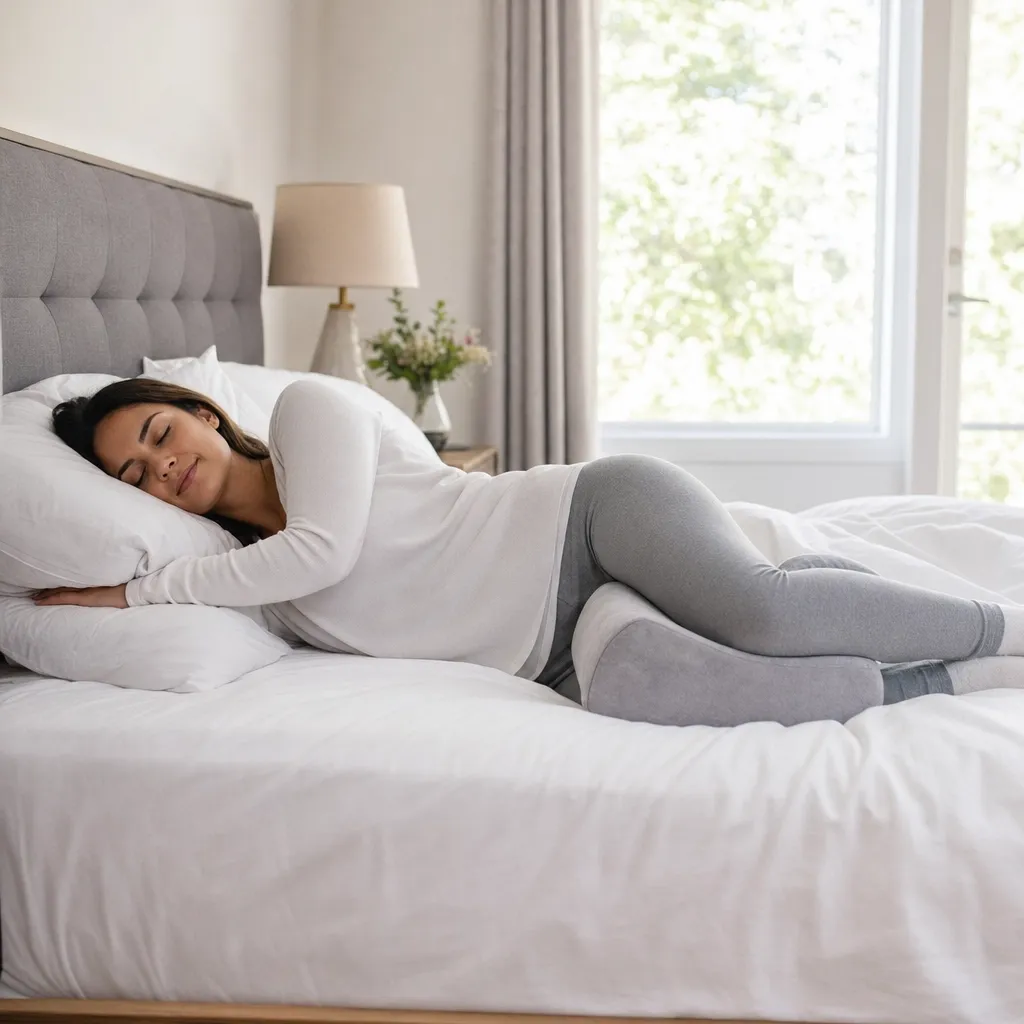
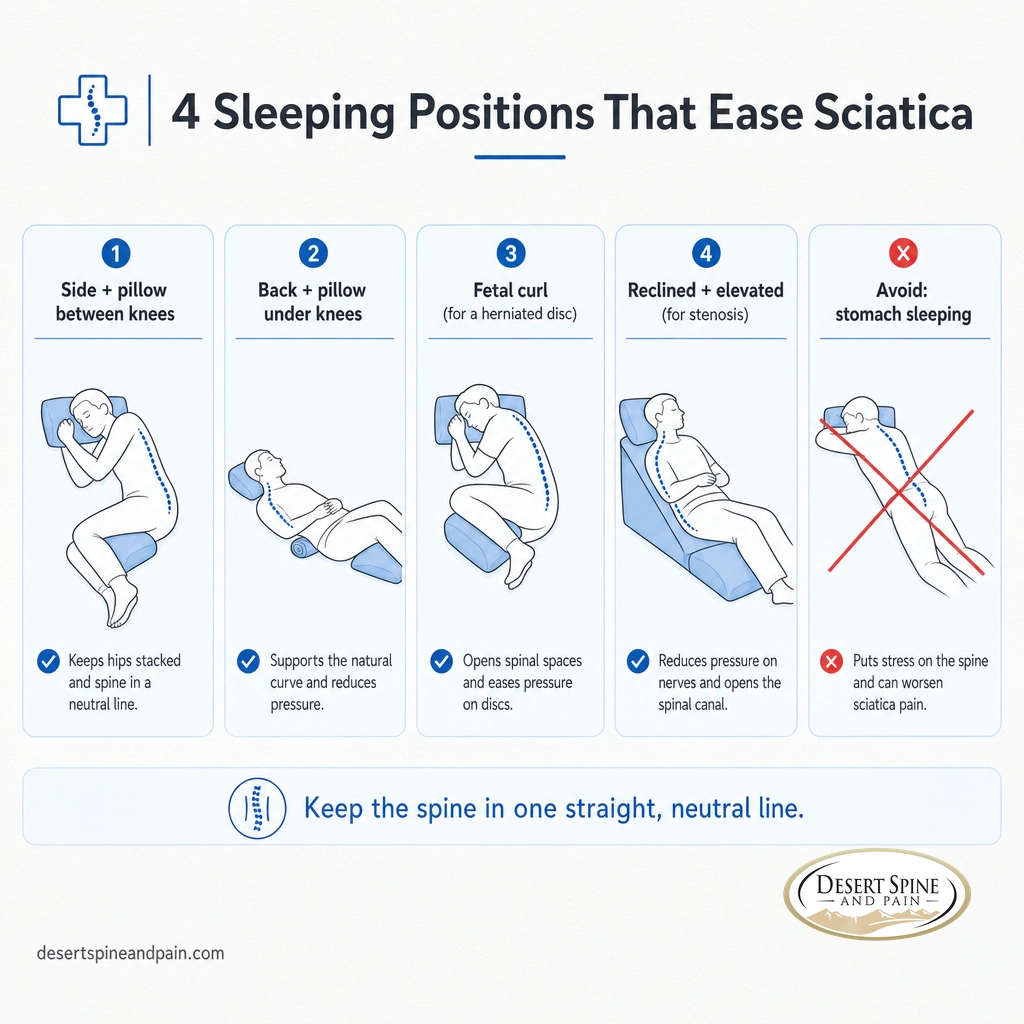
- Side sleeping with a pillow between the knees is the default position. It keeps the hips stacked and the lumbar spine neutral.
- Back sleeping with a pillow under the knees is the next-best option and relaxes the muscles that tug on the nerve.
- The fetal curl can help when a herniated disc is the cause, by opening space between the vertebrae.
- Avoid stomach sleeping. It flattens the lumbar curve and twists the neck, the position most likely to flare sciatica.
- A medium-firm mattress wins. In a randomized trial it beat a firm mattress for both pain and disability.
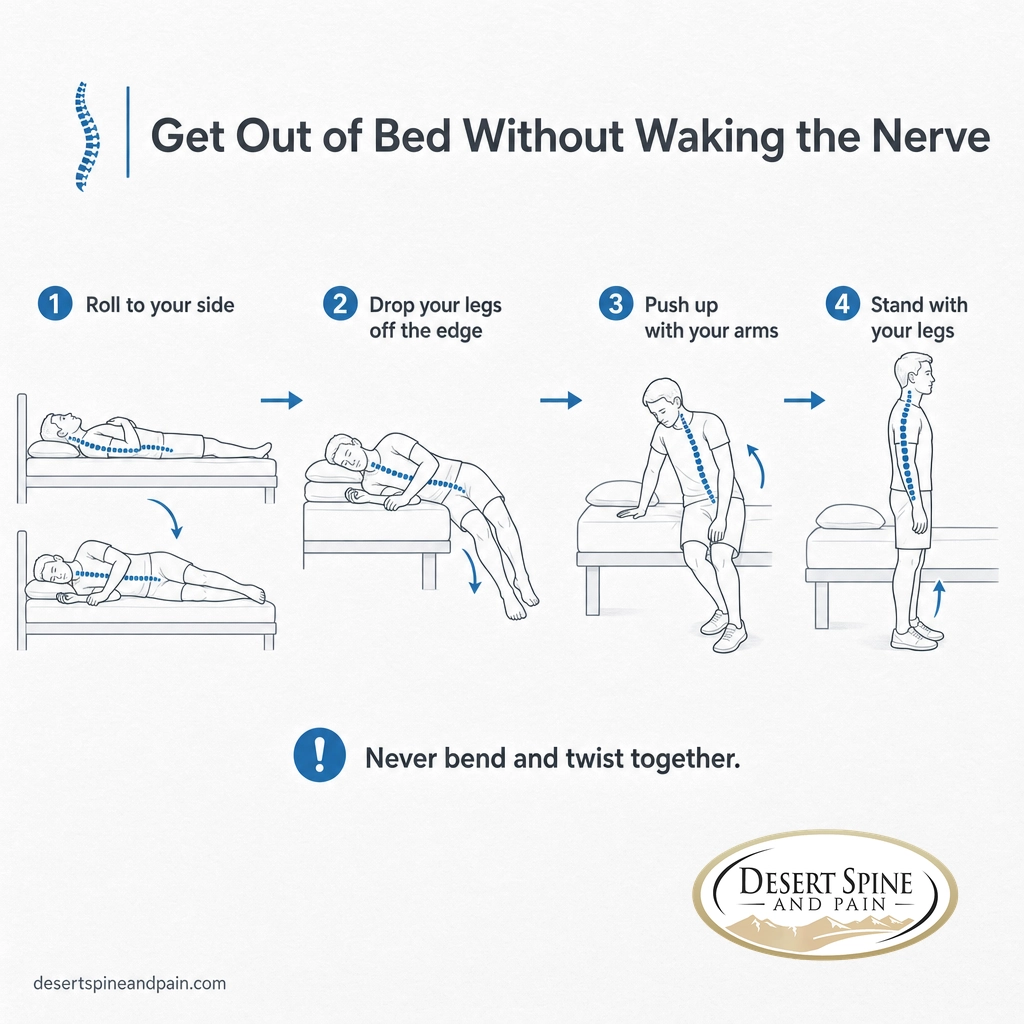
- Log-roll in and out of bed so you never twist or fold the painful back while half asleep.
- See a specialist for leg pain that worsens, lasts weeks, or comes with new weakness, numbness, or bladder or bowel changes.

What's in This Guide
- Why Sciatica Feels Worse the Moment You Lie Down
- Before You Begin: What You Need
- Position 1: Side Sleeping With a Pillow Between the Knees
- Position 2: Back Sleeping With a Pillow Under the Knees
- Position 3: The Fetal Curl for a Herniated Disc
- Position 4: Reclined and Elevated for Stenosis
- The One Position to Avoid
- Dial In Your Mattress and Pillows
- Getting In and Out of Bed Without a Flare
- A Wind-Down That Calms the Nerve
- When to See a Spine Specialist
- Troubleshooting Common Problems
- Frequently Asked Questions
- Methodology and Sources
Why Sciatica Feels Worse the Moment You Lie Down
Sciatica is pain that travels along the sciatic nerve, from the lower back through the buttock and down the leg, usually because a herniated disc, bone spur, or narrowed canal is pressing on a nerve root. During the day, standing and walking keep the spine lengthened and the muscles engaged. The moment you lie down, the spine settles, the discs rehydrate and swell slightly, and any position that bends, twists, or compresses that irritated nerve root gets held there for hours. That is why a leg can feel fine at dinner and be screaming at 2 a.m.
Sleep and pain are tangled together, and the relationship runs both ways. Researchers reviewing the evidence have found that a bad night does not just follow a painful day, it helps cause the next one: sleep loss is one of the more reliable predictors of future pain. So when sciatica wrecks your sleep, the resulting sleep debt lowers your pain threshold and makes the nerve feel louder the next night. Breaking that loop is exactly why getting your position right matters so much. It is not about comfort alone, it is about turning down the volume on the nerve while your body repairs. For a plain-language look at the symptom itself, see what sciatica feels like and what actually causes it.
Source: World Health Organization, Low Back Pain fact sheet | European Spine Journal, sleep disturbance in low back pain | The Journal of Pain, sleep and pain association
Explore the spine conditions we treatBefore You Begin: What You Need
The quick setup
- Pillows: one firm pillow for between or under your knees, plus your head pillow. A second thin pillow or rolled towel is handy for lumbar support.
- Mattress: ideally medium-firm. If replacing it is not an option tonight, there are workarounds below.
- Time: about 10 to 15 minutes the first night to test positions and find what quiets the leg. After that it becomes automatic.
- Mindset: the goal is a straight, neutral spine with every gap supported. If a position makes the leg symptoms louder, it is the wrong position, not something to push through.
One rule guides everything that follows: support the natural curve, never fight it. Your lumbar spine has a gentle inward curve, and the positions that help are the ones that keep that curve intact while removing the pull on the nerve. The positions that hurt are the ones that flatten it, exaggerate it, or twist it. Keep that single idea in mind and the rest is detail.
1 Position 1: Side Sleeping With a Pillow Between the Knees
What to do: Lie on your side with your knees slightly bent and a firm pillow between them, from the knees down toward the ankles. Keep your hips stacked directly on top of each other so the pelvis stays level. Your head pillow should fill the space between your ear and the mattress so your neck stays in line with your spine.
Why this step matters: Without the knee pillow, the top leg slides forward and down, which rotates the pelvis and twists the lower spine toward the mattress all night. The pillow keeps the pelvis neutral and takes the stretch off the sciatic nerve. This is the position most clinicians reach for first, and for good reason.
What success looks like: Your spine, from neck to tailbone, forms one straight horizontal line, and the leg pain quiets rather than builds over the first few minutes. If the leg still tingles, make the knee pillow a little taller so the hips sit perfectly level.
Common mistake: letting the top hip roll forward
The most frequent error with side sleeping is a thin or missing knee pillow, which lets the upper hip drop and the spine corkscrew. A too-small pillow is barely better than none. Use one firm enough that your top knee sits level with your hip, not sagging toward the bed. Hugging a second pillow to your chest can also keep the upper shoulder from collapsing forward.
Source: Michigan Medicine, sleeping with back pain
See conservative, non-invasive care options2 Position 2: Back Sleeping With a Pillow Under the Knees
What to do: Lie flat on your back and slide a pillow under your knees so they rest in a slight bend. If your lower back still feels like it is arching away from the mattress, add a small rolled towel in that gap for lumbar support. One modest head pillow keeps the neck neutral.
Why this step matters: Lying flat with straight legs tilts the pelvis forward and tightens the hip flexors, which pulls on the lumbar spine. Supporting the knees lets the pelvis settle back and relaxes the muscles that tug the nerve root. The rolled towel fills the natural lumbar gap so the lower back is supported rather than suspended.
What success looks like: Your lower back feels supported along its whole length, with no hollow space you can slide a hand into, and your legs feel loose rather than stretched.
Back sleeping is the easiest position to keep truly symmetrical, which is a real advantage when one leg is affected. If you tend to drift onto your stomach overnight, place a pillow on each side of your torso as a gentle barrier. For the daytime equivalent of all this, the same neutral-spine idea applies to how you sit with sciatica.
Source: Michigan Medicine, sleeping with back pain
Explore interventional pain management3 Position 3: The Fetal Curl for a Herniated Disc
What to do: Lie on your side and gently draw your knees up toward your chest so your body makes a loose C-shape. Keep it comfortable, not a tight ball. A pillow between the knees still helps here to keep the hips level.
Why this step matters: Curling forward slightly opens the space between the vertebrae at the back of the spine, which can relieve the pinch when a herniated or bulging disc is pressing on the nerve root. Many people with disc-related sciatica instinctively find this position and should not fight the instinct.
What success looks like: The leg symptoms ease as you curl, and you can hold the position without your neck or shoulders tensing. If curling forward makes the leg worse rather than better, your sciatica may not be disc-driven, and the flatter back or side positions above will likely serve you better.
Match the position to the cause
Not all sciatica is the same, and the position that helps depends on what is compressing the nerve. Disc-related sciatica often eases with a gentle forward curl, while sciatica from a narrowed canal (stenosis) usually prefers a slightly reclined, flexed posture. This is one reason a precise diagnosis is worth getting: it tells you which direction relieves your nerve instead of leaving you to guess. Dr. David L. Greenwald, MD, FAANS, FACS, a dual board-certified spine surgeon and neurosurgeon, evaluates exactly which structure is involved before recommending anything.
Source: Michigan Medicine, sleeping with back pain
Meet Dr. Greenwald: spine surgeon and neurosurgeon4 Position 4: Reclined and Elevated for Stenosis
What to do: If lying flat makes your legs ache or go numb, sleep slightly propped up instead. An adjustable bed raised at the head and knees works best, but a stable wedge pillow or a few firm cushions under the upper back and knees can approximate it. The aim is a gentle reclined posture with the knees supported.
Why this step matters: Lumbar spinal stenosis is a narrowing of the canal that carries the nerves, and it tends to improve when the spine is slightly flexed forward, which opens that canal. A flat-back position extends the spine and can close the space down, which is why stenosis sufferers often feel better leaning on a cart or sitting than standing. A reclined sleep setup borrows that same relief.
What success looks like: The heaviness, cramping, or numbness in the legs settles once you are propped, and you can stay in the position comfortably rather than sliding down.
Source: Michigan Medicine, sleeping with back pain
Learn about diagnostic nerve testingThe One Position to Avoid
Stomach sleeping is the position most likely to flare sciatica
Sleeping face-down flattens the natural inward curve of the lower back and forces your head to turn to one side for hours, straining both the lumbar spine and the neck. It is the single position clinicians most often advise against for lower back pain and sciatica. If you are a lifelong stomach sleeper and cannot switch overnight, slide a thin pillow under your pelvis and lower abdomen to reduce the arch, and start training yourself toward your side by hugging a body pillow. Most people can transition within a couple of weeks.
Source: Michigan Medicine, sleeping with back pain
Dial In Your Mattress and Pillows
The best position in the world cannot do its job on the wrong surface. A mattress that is too soft lets your hips and shoulders sink so the spine bows into a hammock shape. One that is too hard leaves the natural curves unsupported, creating pressure points at the hips and shoulders. The target is the middle.
In a double-blind randomized trial published in The Lancet, 313 adults with chronic low back pain slept on either a firm or a medium-firm mattress for 90 days. The medium-firm group came out ahead on pain while lying in bed, pain on rising, and disability. Medium-firm does not mean a specific brand or a high price, it means a surface that supports the curves of your spine without letting them sag. If a new mattress is not realistic right now, you can soften a too-firm bed with a mattress topper, or firm up a too-soft one with a board underneath as a temporary fix.

Pillows matter too. Your head pillow should keep your neck in line with the rest of your spine: thicker for side sleeping to fill the shoulder gap, thinner for back sleeping so your chin is not pushed toward your chest. The knee pillow is the one most people skip, and it is the one doing the real work for your sciatica. For a deeper comparison of surfaces, see our guide to the best mattress for sciatica.
Source: The Lancet, firmness of mattress and chronic low back pain (Kovacs et al.)
Review all our treatment optionsGetting In and Out of Bed Without a Flare
Many of the nighttime pain spikes people describe do not happen while sleeping, they happen in the clumsy, half-asleep moments of lying down and getting up. Twisting the spine or folding at the waist while the muscles are cold is a reliable way to set off the nerve. Use the log roll instead, every time.
The log roll, step by step
- Lying down: sit on the edge of the bed, then lower yourself onto your side using your arms while bringing your legs up together, keeping your spine straight the whole way.
- Rolling over: move your shoulders, hips, and knees together as one unit, like a log, rather than twisting your upper body ahead of your hips.
- Getting up: roll onto your side first, drop your lower legs off the edge of the bed, and use your arms to push your torso upright as your feet swing down. Let your legs counterbalance your trunk.
- Standing: scoot to the edge, plant both feet, and stand by pushing up with your legs, not by bending and hauling up with your back.
A Wind-Down That Calms the Nerve
Because sleep loss and pain amplify each other, a calm, consistent pre-bed routine is doing double duty. A few minutes of gentle positional stretching can release the muscles that crowd the sciatic nerve, and a steady schedule trains your body to settle faster. Keep the stretches easy and never push into sharp leg pain. A knee-to-chest hold, a gentle lying trunk rotation kept within comfort, and a reclined figure-four for the piriformis are common choices, but ease off anything that makes the leg symptoms travel further down.
Pair that with the basics that help anyone sleep: a cool, dark room, screens off well before bed, and caffeine kept to the morning. The point is to walk into bed already relaxed so the nerve is not competing with a racing mind. For specific movements, see our roundup of the best stretches for sciatica, and if daytime pain is the bigger problem, our guide on how to help sciatica pain covers more ground.

When to See a Spine Specialist
Good positioning and conservative care resolve most sciatica, and world health guidance now emphasizes staying active and self-managing rather than reaching for bed rest or a back brace. But sleep is also an early warning system. If your symptoms are not responding, your body is telling you something.
Book an evaluation if:
- Leg pain has lasted more than a few weeks despite good sleep positioning and conservative measures.
- The pain is getting worse over time rather than better, or steadily robbing you of sleep.
- You notice new weakness in the leg or foot, such as a foot that catches or drags.
- Numbness or tingling is spreading or becoming constant.
Seek emergency care immediately if you lose control of your bladder or bowels, or develop numbness in the groin or inner thighs. These can signal cauda equina syndrome, a rare but true surgical emergency.
At Desert Spine and Pain in Phoenix, the approach is least-invasive-first: identify exactly what is compressing the nerve, then match the right conservative, interventional, or, only when genuinely needed, surgical option to you. Many patients never need surgery at all. The goal of a visit is a precise answer and a plan, not a push toward the operating room.
Source: World Health Organization, Low Back Pain fact sheet and guideline
Book a consultation: (602) 566-9500Troubleshooting Common Problems
| Problem | Likely cause | What to try |
|---|---|---|
| Leg pain worse after lying on your side | Top hip rolling forward, twisting the spine | Use a taller, firmer knee pillow and stack the hips directly; hug a chest pillow |
| Lower back aches flat on your back | Pelvis tilting and lumbar gap unsupported | Add a pillow under the knees plus a small rolled towel in the lumbar curve |
| Numbness or heaviness in the legs lying flat | Possible spinal stenosis narrowing the canal | Sleep slightly reclined and flexed on a wedge or adjustable base |
| Waking with a sharp jolt when you move | Twisting while getting in or out of bed | Use the log roll every time; never bend and twist together |
| Comfortable at first, then pain builds | Mattress too soft or too firm for your spine | Add a topper or support board as a test; aim for medium-firm |
If you have worked through this table and the leg still wins most nights, that is a signal to stop troubleshooting on your own and get the nerve looked at. Persistent, position-resistant sciatica usually has a structural cause worth identifying. Our overview of how long sciatica lasts explains what a normal recovery timeline looks like, so you know when yours has run long.
Learn about spinal cord stimulation for persistent nerve painKeep Sleep on Track as You Recover
Once you find the position that quiets your leg, protect it. Keep the knee pillow on the bed so you reach for it automatically, hold a consistent sleep and wake time even on weekends, and stay gently active during the day, since movement, not bed rest, is what keeps the spine healthy. Flares can still happen, especially early in recovery, so treat a rough night as information rather than a setback: note what changed and return to the neutral-spine basics.
As the underlying sciatica improves with the right care, your nights usually improve with it. That is the loop working in your favor for once, with better sleep lowering your pain sensitivity and less pain letting you sleep. If progress stalls, that is exactly what a spine specialist is for.
Learn about minimally invasive spine surgeryFrequently Asked Questions
What is the best sleeping position for lower back pain and sciatica?
Should I sleep on the side with sciatica or the other side?
Is it bad to sleep on my stomach with sciatica?
What kind of mattress is best for sciatica?
When should I see a doctor about sciatica that keeps me awake?
Methodology and Sources
Every statistic in this guide is drawn from a primary source: a government or global health agency, a peer-reviewed study, or an academic medical center. Sleeping-position guidance reflects clinical consensus from academic medical centers; the numeric claims are tied to the studies named below. Where findings vary, the article says so rather than overstating certainty.
Primary sources:
- World Health Organization: Low Back Pain fact sheet and 2023 chronic low back pain guideline (global burden of 619 million in 2020; emphasis on staying active and self-management).
- European Spine Journal (Alsaadi et al., pooled analysis of 1,941 patients): prevalence of sleep disturbance in low back pain, 58.9%, and the link between pain intensity and disturbed sleep.
- The Lancet (Kovacs et al., double-blind randomized trial, 313 adults): medium-firm versus firm mattress outcomes for chronic low back pain.
- The Journal of Pain (Finan, Goodin, and Smith): the bidirectional relationship between sleep and pain, and sleep loss as a predictor of future pain.
- Michigan Medicine (University of Michigan Health): patient guidance on sleeping positions for back pain, including side and back positioning with pillow support.
This article is for general educational purposes and is not individual medical advice. If your sciatica is severe, worsening, or comes with new weakness, numbness, or any change in bladder or bowel control, seek evaluation promptly. Loss of bladder or bowel control is a medical emergency.
Media and press: Journalists are welcome to cite these statistics with attribution to the original primary source named alongside each figure, and a link to this page as the compiled reference. For commentary from a dual board-certified spine surgeon and neurosurgeon, contact Desert Spine and Pain in Phoenix, Arizona at (602) 566-9500.