
How to Relieve Sciatica Pain: A Step-by-Step Guide
The short answer: relieve sciatica by calming the irritated nerve while your body heals the cause. Stay gently active instead of resting in bed, use a cold pack for the first couple of days and then heat, take a short course of an over-the-counter anti-inflammatory if it is safe for you, add gentle lower-back and hip stretches, and fix how you sit and sleep. Most sciatica eases with this kind of conservative care, but a small set of warning signs means you should be seen right away.
Sciatica is the sharp, burning, or electric pain that travels from your lower back or buttock down the back or side of one leg, and when it flares it can make sitting, standing, and sleeping miserable. The good news is that most sciatica settles with simple steps you can start at home, and research is clear that staying gently active beats lying in bed. This guide walks through exactly how to relieve sciatica pain step by step, what to avoid, how long it usually takes, and the specific red flags that mean it is time to stop self-treating and see a spine specialist.
Before You Begin
This guide is for the common, mechanical sciatica that comes from an irritated nerve root in the lower back, usually from a herniated or bulging disc or a narrowed nerve opening. Before you start, make sure none of the emergency symptoms below apply, and have a few simple things on hand.
- What you need: a cold pack and a heat source (both wrapped in a towel), comfortable clothes, a firm surface or mat for gentle stretches, and a supportive chair.
- Time: relief measures take minutes a day; most episodes ease over a few weeks of consistent, gentle care.
- Skill level: beginner. Every step here is low-intensity and stops the moment pain travels further down the leg.
- Stop and seek urgent care first if you have new loss of bladder or bowel control, numbness in the saddle area (inner thighs, groin, buttocks), or weakness in both legs. These are covered in the red-flags section below.
- Stay gently active. Advice to keep moving eases acute low back pain and sciatica slightly better than advice to rest in bed, and prolonged bed rest can slow recovery.
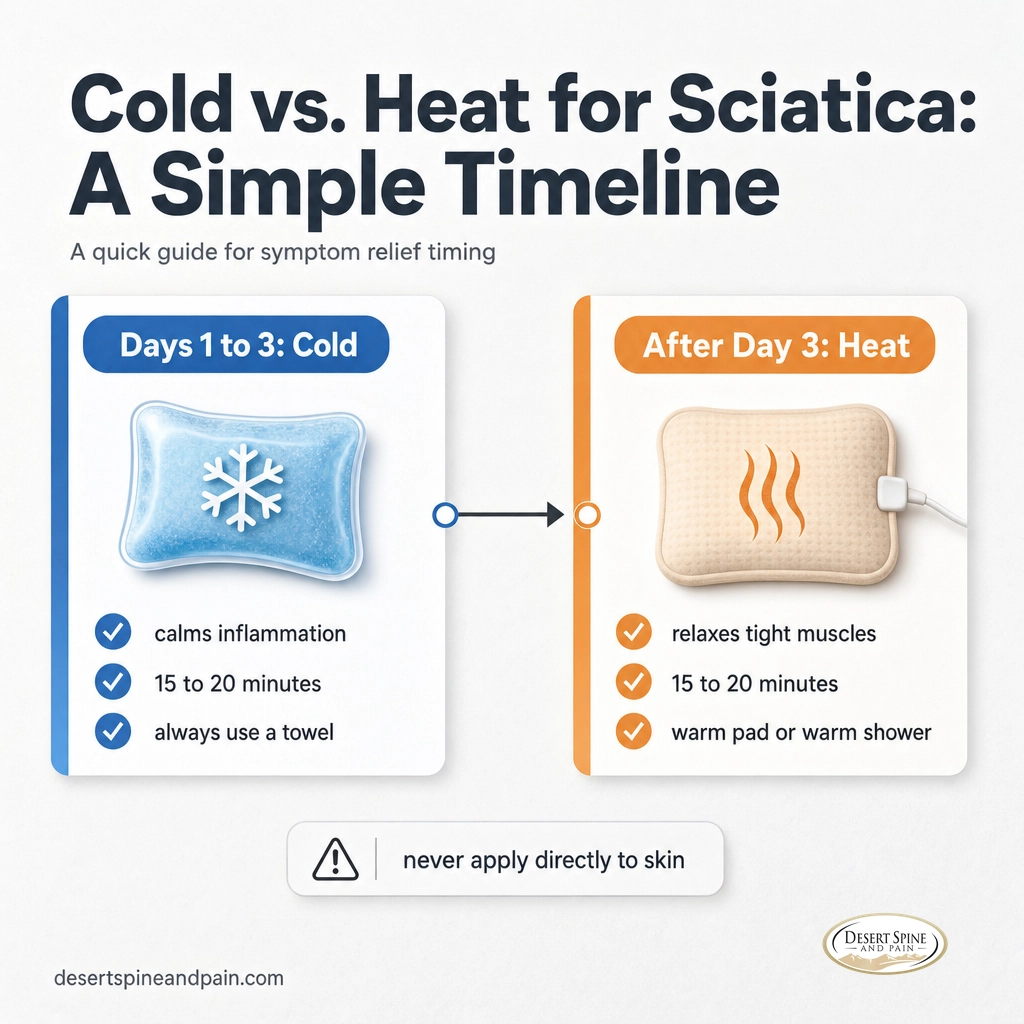
- Use cold for the first two to three days to calm inflammation, then switch to heat to relax tight muscles, always with a towel between the pack and your skin.
- A short course of an over-the-counter anti-inflammatory can help; use the lowest effective dose for the shortest time, and check your health history with a clinician first.
- Gentle lower-back, hip, and glute stretches take pressure off the nerve. Stop any stretch that sends pain further down the leg.
- Most sciatica improves with conservative care, but new bladder or bowel changes, saddle numbness, or spreading weakness are emergencies that need care right away.

What's in This Guide
- What Sciatica Is and Why It Travels Down the Leg
- Step 1: Keep Moving and Skip the Bed Rest
- Step 2: Use Cold First, Then Switch to Heat
- Step 3: Take the Right Over-the-Counter Medication, Short Term
- Step 4: Stretch the Lower Back, Hips, and Glutes
- Step 5: Fix How You Sit, Stand, and Sleep
- Step 6: Know When to Call a Spine Specialist
- Troubleshooting Common Sciatica Relief Problems
- Maintain and Monitor: Keeping It From Coming Back
- Why One Spine Expert for the Whole Picture Matters
- Common Questions About Relieving Sciatica
- Sources
What Sciatica Is and Why It Travels Down the Leg
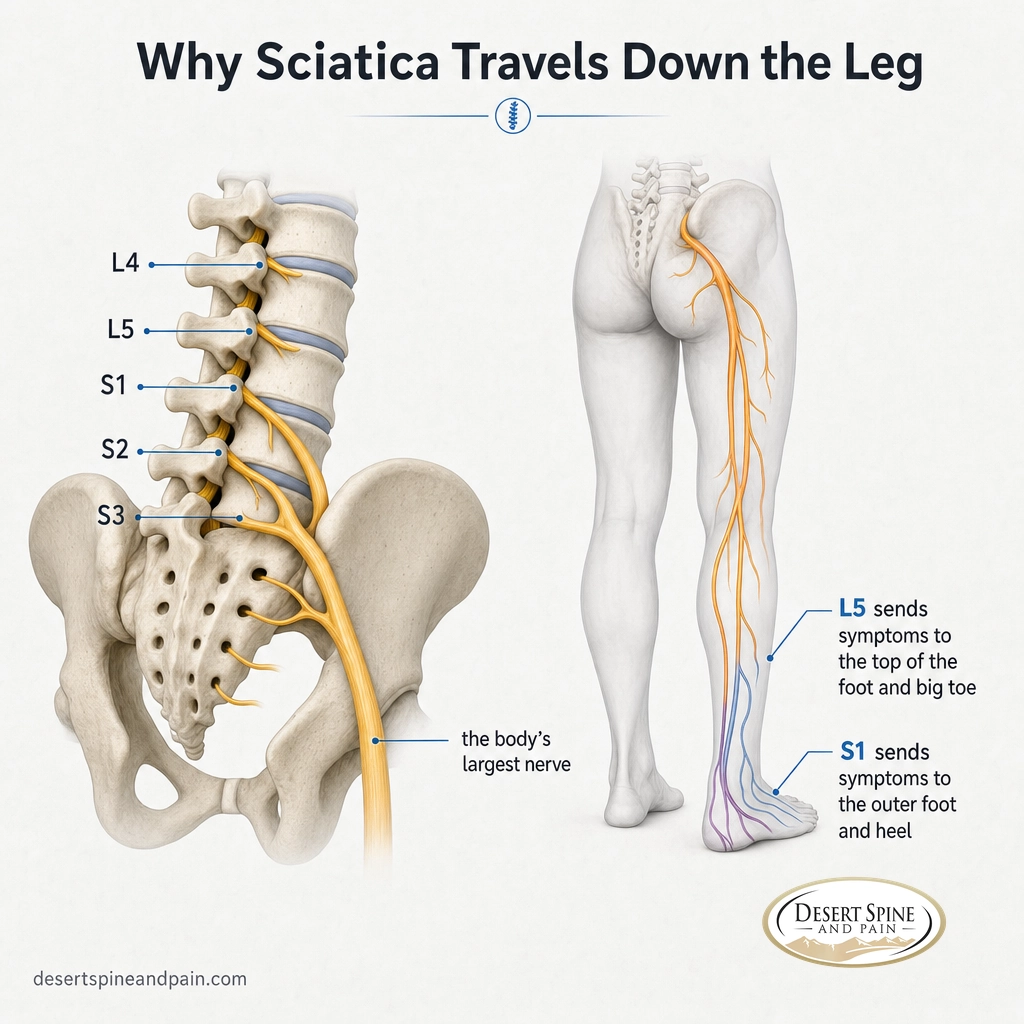
Sciatica is not a diagnosis on its own; it is a set of symptoms caused by irritation or compression of the sciatic nerve or the nerve roots that feed it. That nerve is the largest in the body, formed from nerve roots in the lower spine (the L4 through S3 levels) that join and run deep through the buttock and down the back of each leg to the foot. When a disc bulges or herniates, or a bone spur crowds the opening where a root exits, the root gets irritated, and the pain, tingling, or weakness shows up along the path that nerve serves rather than at the spot of the problem.
That is why sciatica is usually felt in one leg, often as a line of pain running from the buttock down the back or outer leg. The two most common culprits are the L5 and S1 roots: an L5 problem tends to send symptoms toward the top of the foot and big toe, while an S1 problem travels to the outer foot and heel. Knowing the pain is coming from a nerve, not a pulled muscle, is what makes the relief steps below work, because the goal is to calm the nerve and reduce what is pressing on it.
For a fuller explainer on the causes and what the pain pattern tells you, see our guides to what causes sciatica and what sciatica actually feels like. This article focuses on the part you can act on today: relieving the pain.
Source: StatPearls (NCBI Bookshelf): Sciatica | American Association of Neurological Surgeons: Anatomy of the Spine
Step 1: Keep Moving and Skip the Bed Rest
What to do: resist the urge to lie flat for days. Take short, frequent walks, change positions often, and return to normal light activity as your comfort allows. During a flare, avoid heavy lifting, deep bending, and twisting, but keep the body gently in motion the rest of the time.
Why this step matters: movement keeps the lower back from stiffening, maintains blood flow to the healing tissue, and sends the nervous system a safer signal than guarding and bracing. A Cochrane review comparing advice to rest in bed with advice to stay active for acute low back pain and sciatica found small improvements in pain and function in favor of staying active.
What success looks like: you are up and moving in short bursts through the day, your back feels looser after a gentle walk rather than worse, and you are not spending hours lying still.
Common mistake to avoid: treating bed rest as the cure. A day of relative rest during a severe flare is fine, but days of lying down tend to stiffen the back, weaken the muscles that support the spine, and prolong the episode. If walking a few minutes genuinely increases leg pain each time, ease the distance rather than stopping movement altogether, and move the conversation to a clinician.
Step 2: Use Cold First, Then Switch to Heat
What to do: in the first two to three days of a fresh flare, apply a cold pack wrapped in a thin towel to the lower back or buttock for 15 to 20 minutes at a time, several times a day, to calm inflammation. After those first days, switch to heat, a warm pad or a warm shower, to relax tight muscles and improve comfort and mobility. Always keep a towel between the pack and your skin, and limit each session to about 20 minutes.
Why this step matters: cold narrows blood vessels and dulls the pain signal in the irritated area early on, while heat later loosens the protective muscle tension that often piles on top of nerve pain. Neither one fixes the disc or the nerve, but both make it easier to stay active and sleep, which is what actually drives recovery.
What success looks like: a cold or warm session takes the edge off enough to walk, stretch, or settle to sleep. If one feels better than the other for you, use the one that helps; the two to three day guideline is a starting point, not a rule.
Source: AAOS OrthoInfo: Sciatica
Step 3: Take the Right Over-the-Counter Medication, Short Term
What to do: a short course of an over-the-counter nonsteroidal anti-inflammatory drug (NSAID) such as ibuprofen or naproxen can reduce the inflammation irritating the nerve and take the edge off the pain. Use the lowest dose that helps, for the shortest time, and take it with food. Acetaminophen is an alternative for pain if NSAIDs are not right for you.
Why this step matters: spine-surgery consensus guidance notes that NSAIDs may significantly improve acute low back and sciatic pain caused by a disc herniation. Controlling the pain enough to keep moving and sleeping is the point; the medication supports the other steps rather than replacing them.
Common mistake to avoid: treating NSAIDs as a long-term fix. Taken for too long or at high doses they carry real risks to the stomach, kidneys, and heart, so they are a short-term tool, not a daily habit. Check with a clinician or pharmacist first if you have kidney disease, stomach ulcers, heart disease, high blood pressure, or take blood thinners, and do not stack multiple NSAIDs. National guidance also advises against relying on gabapentinoids, opioids, or oral steroids for sciatica, so skip the leftover prescriptions and ask a professional instead.
Source: World Neurosurgery: X, WFNS Spine Committee Recommendations on Conservative Management of Lumbar Disc Herniation | NICE Guideline NG59: Low Back Pain and Sciatica in Over 16s
Step 4: Stretch the Lower Back, Hips, and Glutes
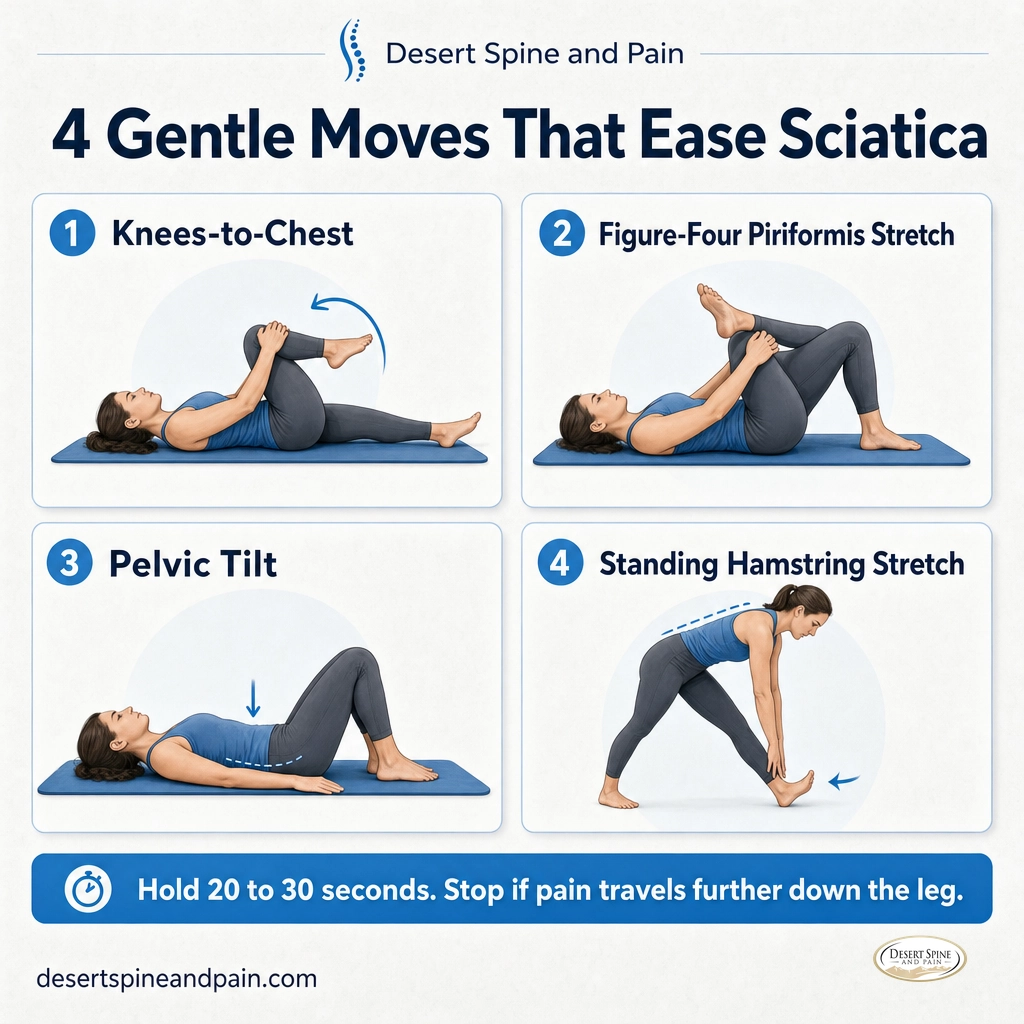
What to do: add a few gentle stretches that open the lower back, hips, and buttock muscles, where tightness often compounds nerve pain. Move slowly, breathe, hold each stretch for about 20 to 30 seconds, and never force it. A simple starting set:
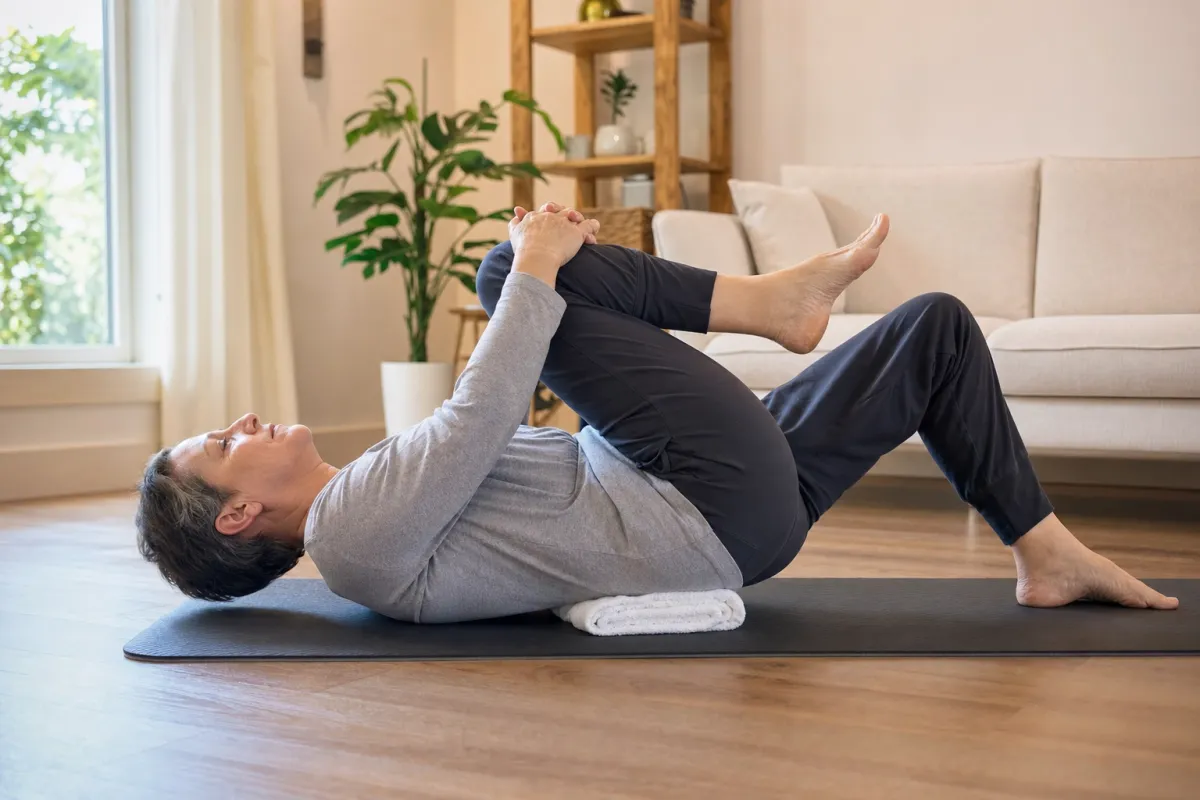
- Knees-to-chest: lie on your back and gently draw one knee, then both, toward your chest to ease the lower back.
- Figure-four (piriformis) stretch: lying on your back, cross one ankle over the opposite knee and draw that thigh toward you to release the deep buttock muscle that sits over the sciatic nerve.
- Gentle pelvic tilt: lying with knees bent, flatten your lower back into the floor and release, to wake up the core muscles that support the spine.
- Standing hamstring stretch: with a long spine, hinge gently forward to lengthen the back of the leg, stopping well before any pulling in the back.
Why this step matters: relaxing the muscles around the lower back and hips reduces the mechanical load crowding the nerve and restores comfortable movement. Done daily and gently, stretching is one of the most reliable self-care tools for sciatica.
What success looks like: the stretches feel like a mild, pleasant lengthening and leave you looser, not sorer. The golden rule: if a stretch sends pain, tingling, or numbness further down the leg, back off immediately. That direction of travel means the nerve is being provoked, not soothed.
For a full routine with form cues, see our dedicated guide to the best stretches for sciatica.
Source: AAOS OrthoInfo: Sciatica
Step 5: Fix How You Sit, Stand, and Sleep
What to do: change the positions you hold for hours, because they can keep a nerve irritated no matter how well the other steps go. Break up sitting every 30 to 45 minutes with a short stand or walk, support your lower back in your chair, and keep your hips level with or slightly above your knees. At night, sleep on your back with a pillow under your knees, or on your side with a pillow between your knees, to keep the spine neutral. Avoid sleeping on your stomach, which arches the lower back.
Why this step matters: sustained flexion, slumped sitting, and awkward sleep postures increase pressure on the lumbar discs and the exiting nerve roots. Small, consistent adjustments remove a source of constant low-grade irritation so the earlier steps can do their work.
What success looks like: you can sit and sleep through a stretch of time without the leg pain ramping up, and you notice fewer flares tied to long drives or desk days.
Both of these deserve their own attention when sciatica is interfering with your day and your rest. See our guides to how to sit with sciatica and how to sleep with sciatica for setup details.

Step 6: Know When to Call a Spine Specialist
Self-care relieves most sciatica, but part of relieving it well is knowing when steps 1 through 5 are not enough. Call a spine specialist if your sciatica is severe from the start, has not meaningfully improved after a few weeks of consistent self-care, keeps coming back, or is interfering with work and sleep despite your best efforts. There is no prize for waiting out pain that is not getting better, and an evaluation can pinpoint the level and cause so the right treatment is matched to it.
Some symptoms are not a matter of watchful waiting at all. They point to pressure on the lowest nerve roots or the spinal cord and need urgent care.
Seek emergency care right away if you have any of these:
- New loss of bladder or bowel control, including being unable to urinate or leaking.
- Numbness in the saddle area (the inner thighs, groin, and buttocks).
- Weakness or numbness in both legs, or weakness that is spreading or quickly worsening.
- A foot that drops or a leg that is giving out, especially if it came on suddenly.
The first three can signal cauda equina syndrome, a surgical emergency in which the bundle of lower nerve roots is compressed. Do not wait for a routine appointment; get care immediately.
When sciatica needs more than self-care, treatment is a ladder, not a leap to surgery. It usually starts with guided conservative and non-invasive care, including a tailored physical therapy program. If pain persists, an epidural steroid injection can calm inflammation directly around the irritated nerve root. Surgery such as a minimally invasive microdiscectomy is reserved for the smaller number of cases that do not respond or that involve significant nerve compression. Consensus guidance supports this order: conservative treatment first in the absence of serious neurologic deficits.
Book a consultation for persistent sciatica
Source: American Association of Neurological Surgeons: Cauda Equina Syndrome | World Neurosurgery: X, WFNS Spine Committee Recommendations
Troubleshooting Common Sciatica Relief Problems
If you are doing the steps and still struggling, use this table to adjust before you give up on a measure or assume the worst.
| Problem | What to try |
|---|---|
| Stretching makes the leg pain worse | Stop that stretch. Pain traveling further down the leg means the nerve is being provoked. Switch to gentle walking and position changes, and ask a clinician which movements suit your specific level. |
| Pain is worst first thing in the morning | Discs are more swollen after lying all night. Avoid deep bending for the first hour, do a few gentle pelvic tilts in bed before standing, and review your sleep position. |
| Sitting at work sets it off every day | Stand or walk every 30 to 45 minutes, add lumbar support, raise your screen to eye level, and alternate sitting with brief standing. Consider that the position, not just the sciatica, is the trigger. |
| NSAIDs are not helping or upset your stomach | Do not increase the dose. Take them with food, or ask a pharmacist about alternatives. If pain is not responding at all after a short trial, that is a reason to be evaluated rather than medicate harder. |
| It eases, then keeps coming back | Recurrent sciatica suggests an underlying mechanical cause that self-care alone is not resolving. A specialist can identify it and build a plan to address the root cause for lasting relief. |
Source: NICE Guideline NG59: Low Back Pain and Sciatica in Over 16s
Maintain and Monitor: Keeping It From Coming Back
Once a flare settles, the aim shifts from relief to prevention, because sciatica that came once can return if the underlying habits do not change. Keep the gains from the steps above by building them into normal life rather than saving them for the next flare.
- Keep moving regularly: ongoing walking and low-impact activity keep the back resilient. Motion is maintenance.
- Build core and hip strength: a continued program, often guided by physical therapy, supports the spine and reduces the load on the discs.
- Protect your lifting and posture: hinge at the hips, keep loads close, and avoid the twist-and-lift that strains the lower back.
- Mind the long sits: the desk and the car are the most common quiet triggers; keep breaking them up even when you feel fine.
- Track the pattern: note what sets it off and how long episodes last. If they are getting longer, more frequent, or harder to calm, that trend is worth a specialist's eyes. See how long sciatica usually lasts for what is typical.
Ongoing management is exactly where a spine practice adds value beyond a single visit: matching the right evaluation of the condition behind the pain to a plan that keeps you out of the next flare.
Why One Spine Expert for the Whole Picture Matters
Relieving a flare is the part you can do at home. Understanding why it keeps happening, and choosing the least invasive fix if it does not settle, is where experience counts. The same leg pain can come from a disc, a bone spur, a narrowed canal, or a problem that is not in the spine at all, and sorting that out takes a clinician who understands both the nerves and the bones around them.
At Desert Spine and Pain, that range sits with one surgeon. The practice is led by Dr. David L. Greenwald, MD, FAANS, FACS, who is board certified as both a spine surgeon and a neurosurgeon. That dual training covers the whole picture behind sciatica, from the irritated nerve root to the disc and vertebrae pressing on it, so a single expert can pinpoint the cause, start with conservative care, and reserve surgery for when the evidence genuinely calls for it.
Desert Spine and Pain serves the Greater Phoenix, Arizona area, welcomes out-of-network patients, and partners with personal injury attorneys and their clients. If sciatica is not easing with self-care, or it keeps returning, a focused consultation is the fastest way to learn what is driving it and what to do next.
Meet Dr. David L. Greenwald, MD, FAANS, FACS
Explore treatments for sciatica and nerve pain
Common Questions About Relieving Sciatica
What is the fastest way to relieve sciatica pain?
Should I rest in bed or keep moving with sciatica?
How long does sciatica usually last?
When should I see a doctor for sciatica?
Can sciatica be relieved without surgery?
Sources
Sources and Methodology
This guide summarizes established clinical guidance on conservative, non-surgical relief of sciatica from peer-reviewed references, surgical-society consensus, and national clinical guidelines. Self-care measures are presented as general comfort and recovery steps, not as a diagnosis or a treatment plan for your specific case. This is educational information, not medical advice. New or worsening pain, numbness, or weakness should be evaluated by a qualified physician in person, and the emergency symptoms described above need immediate care. Always confirm that any medication is appropriate for your health history with a clinician or pharmacist.
- StatPearls (NCBI Bookshelf): Sciatica (epidemiology and overview)
- Cochrane Database of Systematic Reviews: Advice to Rest in Bed Versus Advice to Stay Active for Acute Low-Back Pain and Sciatica
- World Neurosurgery: X: WFNS Spine Committee Recommendations on Conservative Management of Lumbar Disc Herniation
- NICE Guideline NG59: Low Back Pain and Sciatica in Over 16s
- AAOS OrthoInfo: Sciatica
- American Association of Neurological Surgeons: Cauda Equina Syndrome