
Best Mattress for Sciatica: How to Choose for Pain Relief
The short answer: For most people with sciatica, the best mattress is medium-firm, with enough support to keep the lower spine aligned and enough give to relieve pressure at the hips and shoulders. A hybrid or a quality memory-foam or latex bed usually fits that brief. Then match the firmness to your body weight and sleep position, pair it with a sciatica-friendly sleep posture, and use the trial period to confirm it before you commit. A better mattress eases symptoms, but it will not fix the pinched nerve underneath, so persistent sciatica still needs a real diagnosis.
If sciatica has you dreading bedtime, your mattress is doing more than you think. You spend roughly a third of your life lying on it, and for eight of those hours your spine is either supported in a neutral line or slowly sagging into a position that keeps pressure on the exact nerve root that is already inflamed. The wrong mattress will not create sciatica, but it can keep flaring it, which is why so many people wake up stiffer than they went to bed. This guide walks you through how to choose a mattress for sciatica the way a spine specialist would think about it: what the research actually shows about firmness, how to weigh support against pressure relief, how your sleep position changes the answer, and the point at which a better bed is no longer the fix you need.
- Medium-firm is the evidence-backed starting point. A Lancet trial and a 2021 systematic review both favor medium-firm over firm for low back pain and spinal alignment.
- Support keeps the spine aligned; pressure relief offloads the hip and shoulder. Sciatica relief needs both, which is why hybrids and quality foam or latex beds tend to win.
- Your ideal firmness shifts with body weight and sleep position: side sleepers and lighter bodies lean softer, heavier bodies and back sleepers lean firmer.
- Sleep position matters as much as the mattress. Side sleeping with a pillow between the knees, or back sleeping with a pillow under the knees, protects the nerve; stomach sleeping is the one to avoid.
- A mattress eases symptoms but does not treat the pinched nerve. Sciatica that lasts beyond about six weeks, or that comes with saddle numbness or bladder or bowel changes, needs a spine specialist, and red flags need emergency care.

What's in This Guide
- How Your Mattress Affects Sciatica
- What the Research Says About Firmness
- How to Choose the Right Mattress for Sciatica
- Mattress Materials Compared
- The Best Sleep Positions for Sciatica
- If You Cannot Replace the Mattress Yet
- When a Better Mattress Isn't Enough
- Where Desert Spine and Pain Fits In
- Common Questions
- Sources
How Your Mattress Affects Sciatica
Sciatica is nerve pain. It starts when a nerve root in the lower spine, most often at the L4, L5, or S1 level, gets pinched or irritated, usually by a herniated disc, a bone spur, or narrowing of the canal, and it radiates down the buttock and leg along the path of the sciatic nerve. The mattress does not cause that compression. What it does is decide, for eight hours a night, whether your spine rests in a neutral line or in a position that adds to the pressure the nerve is already under.
Two things have to happen at once for a mattress to help. First, support: the surface has to hold your heavier regions, the pelvis and lower back, up in line with the rest of the spine. When a mattress sags or is too soft, the hips sink deeper than the shoulders and the lower back bows, a hammock effect that twists the lumbar spine and crowds the nerve roots. Second, pressure relief: the surface has to yield enough at the shoulder and hip that you are not resting your body weight on a few bony points, which is what a too-hard mattress does. Sciatica relief lives in the overlap of those two jobs, which is exactly why one extreme or the other tends to disappoint.
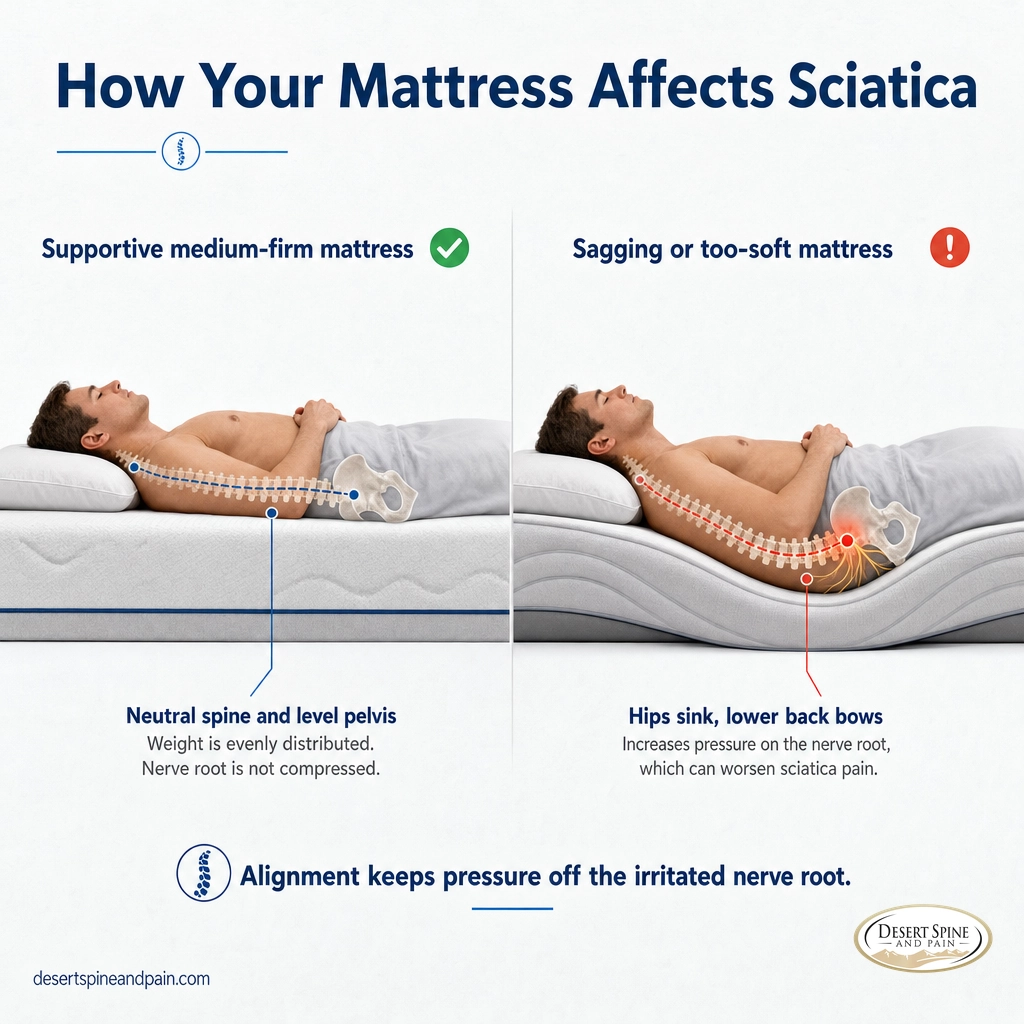
This is also why a mattress that felt fine for years can start to bother you once sciatica arrives. The bed did not necessarily change; your tolerance did. An irritated nerve root turns a small amount of nightly misalignment into a morning of pain, so a surface that was good enough before an injury may no longer be good enough after one. If you want the anatomy behind which level drives your leg symptoms, our guide to which spinal nerves control which parts of the body maps L5 and S1, the two classic sciatica levels, to the exact paths pain tends to follow.
Source: NIH NINDS: Back Pain overview | Cleveland Clinic: Sciatica
What the Research Says About Firmness
The single most common question is also the one with the clearest answer: how firm should it be? For decades the folk wisdom was that a rock-hard mattress is best for a bad back. The evidence says otherwise, and it points consistently to the middle of the range.
The landmark study is a double-blind, randomized trial published in The Lancet in 2003. Researchers assigned adults with chronic non-specific low back pain to either a firm mattress or a medium-firm one and followed them for 90 days. The medium-firm group reported better outcomes on pain while lying in bed, pain on getting up, and day-to-day disability. A firm surface, in other words, was not the winner the old advice assumed it would be.
More recent work agrees. A 2021 systematic review in the Journal of Orthopaedics and Traumatology pulled together the available studies and concluded that medium-firm mattresses are the best choice for promoting comfort, sleep quality, and spinal alignment in people with back pain. The certainty of this body of evidence is modest, and individual preference genuinely varies, but the direction is steady across studies: not too soft, not too hard.
Myth: a firmer mattress is always better for a bad back. It is one of the most durable pieces of bad advice in all of back care. A mattress that is too firm forces your body weight onto the bony prominences of the pelvis, shoulders, and spine instead of distributing it, which creates pressure points and can leave the lumbar curve unsupported. The research favors medium-firm precisely because it balances support and relief. Firmer is not safer; it is just firmer.
One practical caution about the "best mattress for sciatica" lists you will find online: most are affiliate-driven roundups that earn a commission on the specific beds they rank, and their picks change from year to year. The firmness and support principles below are stable and are the part worth trusting. The brand names are not.
Source: The Lancet (Kovacs et al., 2003): mattress firmness and low back pain | Journal of Orthopaedics and Traumatology (2021): mattress review
How to Choose the Right Mattress for Sciatica
Firmness is the starting point, not the whole decision. Use these steps in order, because each one adjusts the answer the step before it gave you.
Step 1: Start at medium-firm, then adjust for your body weight
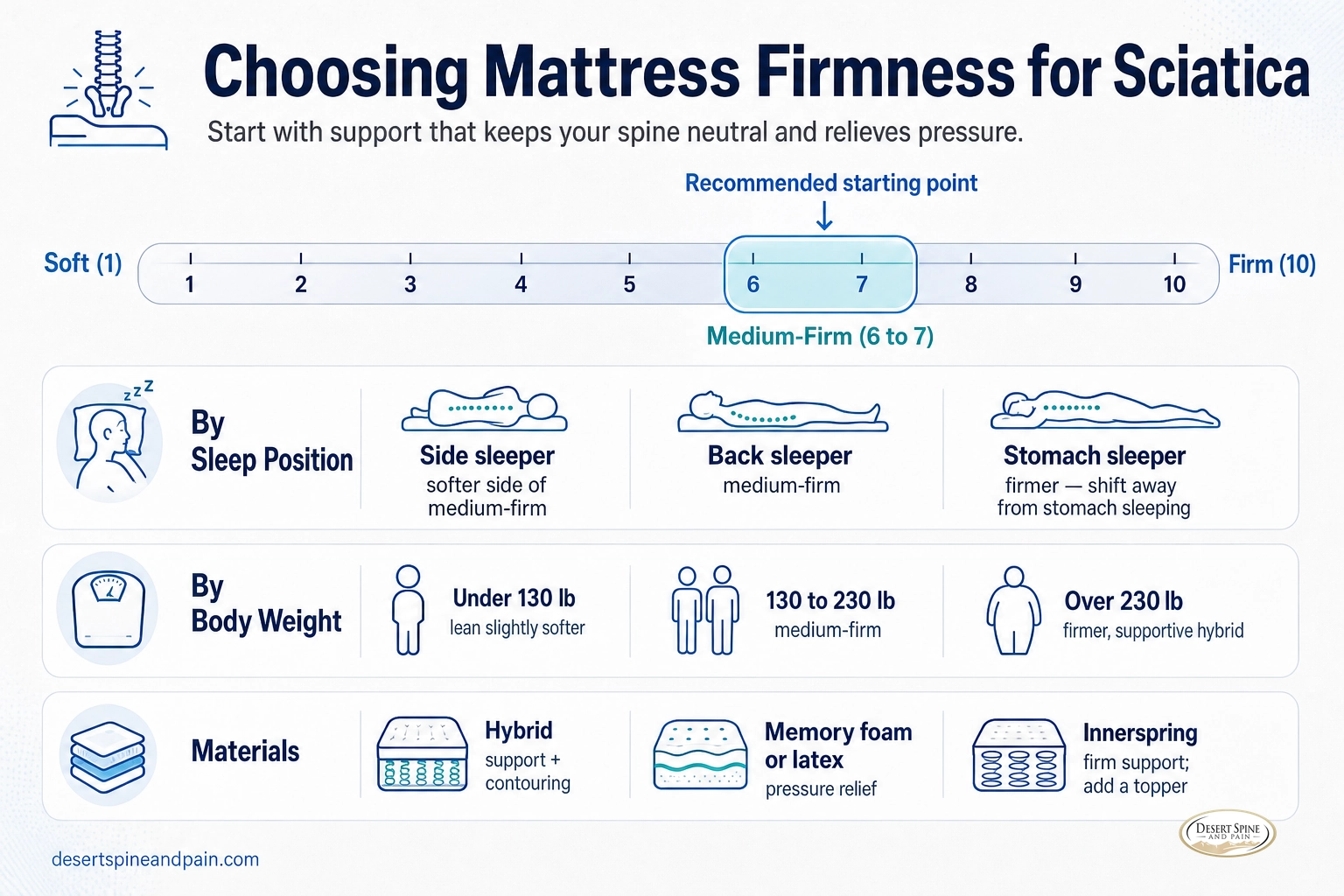
What to do: Treat medium-firm, often labeled around a 6 to 7 on a 10-point scale, as your default, then nudge it based on body weight. Lighter sleepers, under roughly 130 pounds, do not sink in as much, so a surface feels firmer to them and they can lean slightly softer. Heavier sleepers, over roughly 230 pounds, sink in more and need a firmer, more supportive build to avoid the sag that twists the spine.
Why it matters: Firmness ratings are set for an average body. The same mattress feels different under different weights, so your weight, not just the label, decides where you land. What success looks like: lying on your back, you can slide a flat hand into the curve of your lower back with light resistance, not a wide gap and not no space at all.
Step 2: Match the firmness to how you sleep
What to do: Factor in your main sleep position. Side sleepers need a touch more give so the shoulder and hip can settle and the spine stays straight from head to tailbone; lean toward the softer end of medium-firm. Back sleepers are well served by true medium-firm. Stomach sleepers need firmer support to stop the midsection from sinking, though stomach sleeping is the position to move away from for sciatica, as explained below.
Why it matters: Alignment is the goal, and each position puts different parts of the body in contact with the mattress. What success looks like: whatever position you wake in, your spine holds a neutral line rather than a sag or an arch.
Step 3: Prioritize support and alignment over plushness
What to do: Separate the two things a showroom mattress is selling you. The plush, cushioned feel of the top comfort layer is not the same as the support of the core underneath. For sciatica, the support core is what matters most; the comfort layer should relieve pressure without letting you bottom out or sink.
Why it matters: A deeply pillowed top can feel wonderful for ten minutes and leave your spine unsupported all night. What success looks like: the mattress cradles your hip and shoulder but still pushes back enough to hold your pelvis level.
Common mistake: buying for the five-minute showroom test. A few minutes lying on a floor-model mattress tells you almost nothing about how your back will feel after eight hours on it. The plushest bed usually wins the showroom and loses the night. Judge support and alignment, not first-touch softness, and lean on a real home trial instead (Step 6).
Step 4: Choose a material that balances support and pressure relief
What to do: Pick a construction that does both jobs. Memory foam and latex contour well for pressure relief; innersprings give strong support but little cushioning; hybrids combine a coil support core with a foam or latex comfort layer and are the most broadly recommended for sciatica. The table in the next section breaks down the trade-offs. Why it matters: material determines whether you get support and relief together or have to compromise on one. What success looks like: you are not choosing between a supported spine and a comfortable hip; a good hybrid or a well-built foam or latex bed gives you both.
Step 5: Consider an adjustable base
What to do: If budget allows, think about an adjustable bed frame that lets you raise the head and, more importantly for sciatica, elevate the knees. Gently bending the hips and knees flattens the lower back and can take tension off an irritated nerve root, the same reason the knees-up positions below help. Why it matters: for some people, being able to offload the lower back at the push of a button does more than firmness alone. What success looks like: a slight knee elevation noticeably eases the pull down the leg.
Step 6: Use the trial period, and actually sleep on it
What to do: Buy only from a retailer with a genuine sleep trial, ideally 90 nights or more, and give the mattress at least two to four weeks. Your body needs time to adjust, and so does the mattress. Track how your sciatica feels on waking across those weeks, not on night one. Why it matters: the only test that counts is your own spine over real sleep, not a review or a label. What success looks like: by the end of the trial you are waking with less leg pain and less morning stiffness, not more.
Mattress Materials Compared
Here is how the common constructions stack up for sciatica, judged on the two things that matter: support to keep the spine aligned, and pressure relief to offload the hip and shoulder.
| Material | Support | Pressure relief | Best for sciatica if... |
|---|---|---|---|
| Hybrid (coils + foam or latex) | High | High | you want both support and contouring in one bed; the most broadly recommended starting point, and the safest pick for heavier sleepers |
| Memory foam | Moderate | High | you are a side sleeper or need strong pressure relief; choose a denser, more supportive foam so you do not sink too far |
| Latex | High | Moderate to high | you want responsive support with some cushioning and prefer a cooler, bouncier feel than memory foam |
| Innerspring (traditional) | High (often too firm) | Low | you need firm support and are a back sleeper; usually needs a topper to add the pressure relief sciatica wants |
| Airbed (adjustable firmness) | Adjustable | Varies | you are unsure of your ideal firmness, your needs fluctuate, or two sleepers need different sides |
If you take one thing from the table: a hybrid is the most forgiving choice because it is the least likely to force a trade-off, and a traditional innerspring is the one most likely to need help from a topper. Everything else comes down to feel preference within the medium-firm range.
Source: Journal of Orthopaedics and Traumatology (2021): mattress review
The Best Sleep Positions for Sciatica
The best mattress in the world cannot fully protect a nerve if you spend the night in a position that strains it. Sleep posture is the free half of this equation, and for sciatica it can matter as much as firmness.
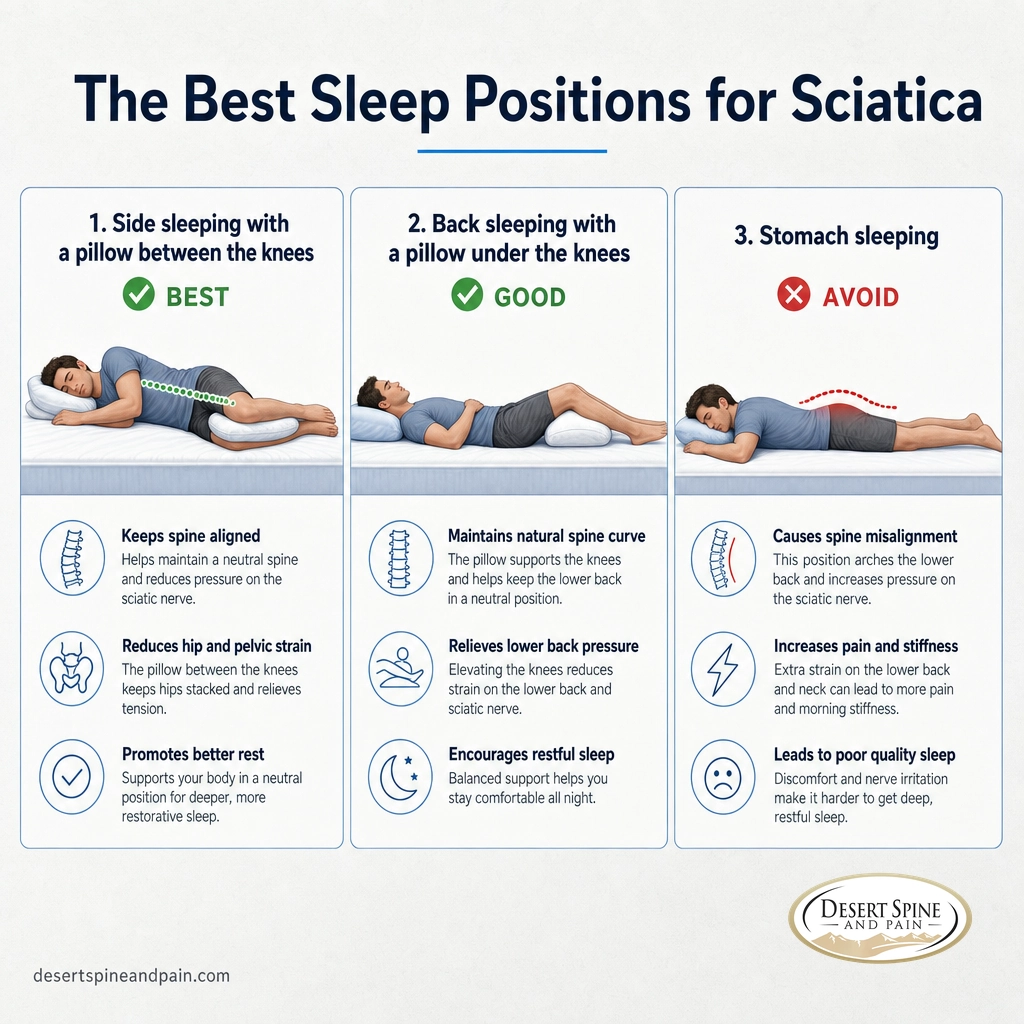
Side sleeping with a pillow between the knees (best for most)
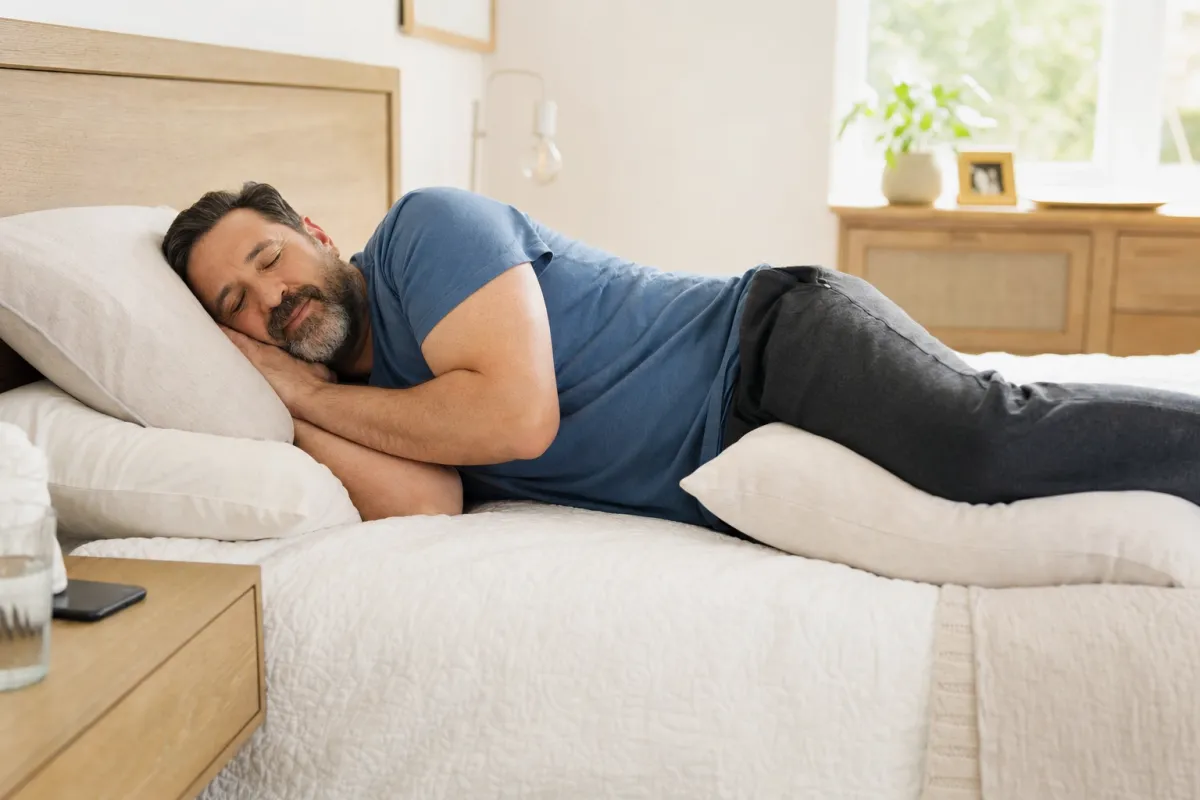
Lie on the less painful side and place a firm pillow between your knees. Without it, the top leg drops forward and rotates the pelvis and lower spine, twisting the nerve roots; the pillow keeps the hips, pelvis, and spine stacked in a straight line. Some people find brief relief curling into a loose fetal position, which opens the space between vertebrae, though it is not a position to hold all night.
Back sleeping with a pillow under the knees (strong alternative)
Lie flat on your back and slide a pillow under your knees so the hips and knees bend slightly. That small bend flattens the lower back against the mattress and relieves the pull on the sciatic nerve. A rolled towel under the natural curve of the lower back can add support.
Stomach sleeping (the one to change)
Sleeping face down flattens the natural inward curve of the lower back and pushes the spine out of alignment, which tends to aggravate sciatica. If you cannot break the habit overnight, place a thin pillow under your pelvis and lower abdomen to reduce the arch, and work toward side or back sleeping over time.
These positions pair with the same conservative basics a clinician would suggest for a recent flare: gentle movement rather than extended bed rest, short-term ice then heat, and over-the-counter anti-inflammatories if appropriate for you. Our overview of how we evaluate sciatica and related spine conditions explains how these first steps fit into a larger plan.
Source: Cleveland Clinic: Sciatica self-care | NIH NINDS: Back Pain
If You Cannot Replace the Mattress Yet
A new mattress is a real expense, and you do not have to buy one tonight to get relief. A few lower-cost moves can bridge the gap while you decide.
- Add a mattress topper. A firm topper can shore up a mattress that has started to sag, and a plush memory-foam or latex topper can add pressure relief to a mattress that is too hard. It is the cheapest way to shift your current bed toward medium-firm.
- Put a board under a sagging mattress. A plywood board between the mattress and the box spring is a short-term fix for a mattress that dips in the middle, buying time until you can replace it.
- Fix your pillow and position first. The knee pillow and sleep positions above cost nothing and often help immediately, independent of the mattress.
- Rotate or flip the mattress. If yours allows it, rotating head to foot can even out wear and reduce a sag you have sunk into over time.
Think of these as symptom management, not a cure. They can make the nights more bearable, which matters, but they do not change what is happening at the nerve root.
When a Better Mattress Isn't Enough
Here is the honest limit of everything above: a mattress is a comfort and alignment tool, not a treatment. Sciatica comes from a compressed nerve, and no sleep surface removes a herniated disc or a bone spur. The large majority of sciatica does settle on its own, usually within a few weeks to a few months of conservative care, so a better bed and smarter sleep posture are sensible first steps for mild, recent symptoms. The problem is assuming the mattress is the answer when the symptoms are telling you otherwise.
It is time to see a spine specialist if your sciatica lasts longer than about six weeks, keeps coming back, is getting worse, or is disrupting your sleep and daily life despite the changes above. An evaluation can pinpoint which nerve root is involved and why, and the options at that stage range from guided physical therapy and conservative care to a targeted epidural steroid injection that calms inflammation around the root, and, only when it is truly warranted, a minimally invasive procedure such as a lumbar microdiscectomy to relieve the pressure directly.
Seek emergency care immediately if you have any of these:
- Numbness in the saddle area (the inner thighs, groin, or buttocks).
- New loss of bladder or bowel control, including being unable to urinate or new incontinence.
- Rapidly worsening weakness in one or both legs.
These can signal cauda equina syndrome, in which the bundle of lower nerve roots is compressed. It is a surgical emergency, and prompt treatment protects against permanent loss of leg, bladder, and bowel function. Do not wait to adjust your mattress; get care now.
Source: American Association of Neurological Surgeons: Cauda Equina Syndrome | Cleveland Clinic: Sciatica
Where Desert Spine and Pain Fits In
If a better mattress and better sleep posture have not settled your sciatica, the next step is finding out exactly what is pinching the nerve, and that is a question for someone who treats the whole spine, not just the part that hurts tonight.
Desert Spine and Pain is led by Dr. David L. Greenwald, MD, FAANS, FACS, who is board certified as both a spine surgeon and a neurosurgeon. That dual training covers the full picture behind sciatica, from the nerve root and the disc pressing on it to the bones around them, so one expert can pinpoint the level, explain what is driving your leg pain, and build a plan that starts with the least invasive option that fits. The practice leads with conservative and non-surgical care and reserves surgery for the cases that genuinely need it.
Serving the Greater Phoenix, Arizona area, Desert Spine and Pain welcomes out-of-network patients and partners with personal injury attorneys and their clients. If your sciatica has outlasted the easy fixes, a focused consultation is the fastest way to learn which nerve is involved and what to do about it.
Meet Dr. David L. Greenwald, MD, FAANS, FACS
Explore treatments for sciatica and nerve pain
Book a consultation or second opinion
Common Questions About Mattresses and Sciatica
What is the best mattress firmness for sciatica?
Is memory foam or a hybrid mattress better for sciatica?
What is the best sleeping position for sciatica?
Can the wrong mattress cause or worsen sciatica?
When should I see a doctor for sciatica instead of just changing my mattress?
Sources
Sources and Methodology
This guide summarizes peer-reviewed research and guidance from major medical institutions on mattress selection, sleep posture, and sciatica. Firmness recommendations reflect the balance of the evidence, which favors medium-firm, while acknowledging that certainty is modest and individual preference and body type genuinely vary; the guidance is presented for orientation, not as a prescription. This is educational information, not medical advice. Any new, severe, or worsening pain, numbness, or weakness should be evaluated by a qualified physician in person, and the emergency symptoms described above need immediate care.
- Kovacs FM, et al. Effect of firmness of mattress on chronic non-specific low-back pain: randomised, double-blind, controlled, multicentre trial. The Lancet, 2003.
- Caggiari G, et al. What type of mattress should be chosen to avoid back pain and improve sleep quality? Journal of Orthopaedics and Traumatology, 2021.
- NIH National Institute of Neurological Disorders and Stroke (NINDS): Back Pain.
- Cleveland Clinic: Sciatica.
- American Association of Neurological Surgeons (AANS): Cauda Equina Syndrome.