

How Long Does Sciatica Last? The Real Recovery Timeline
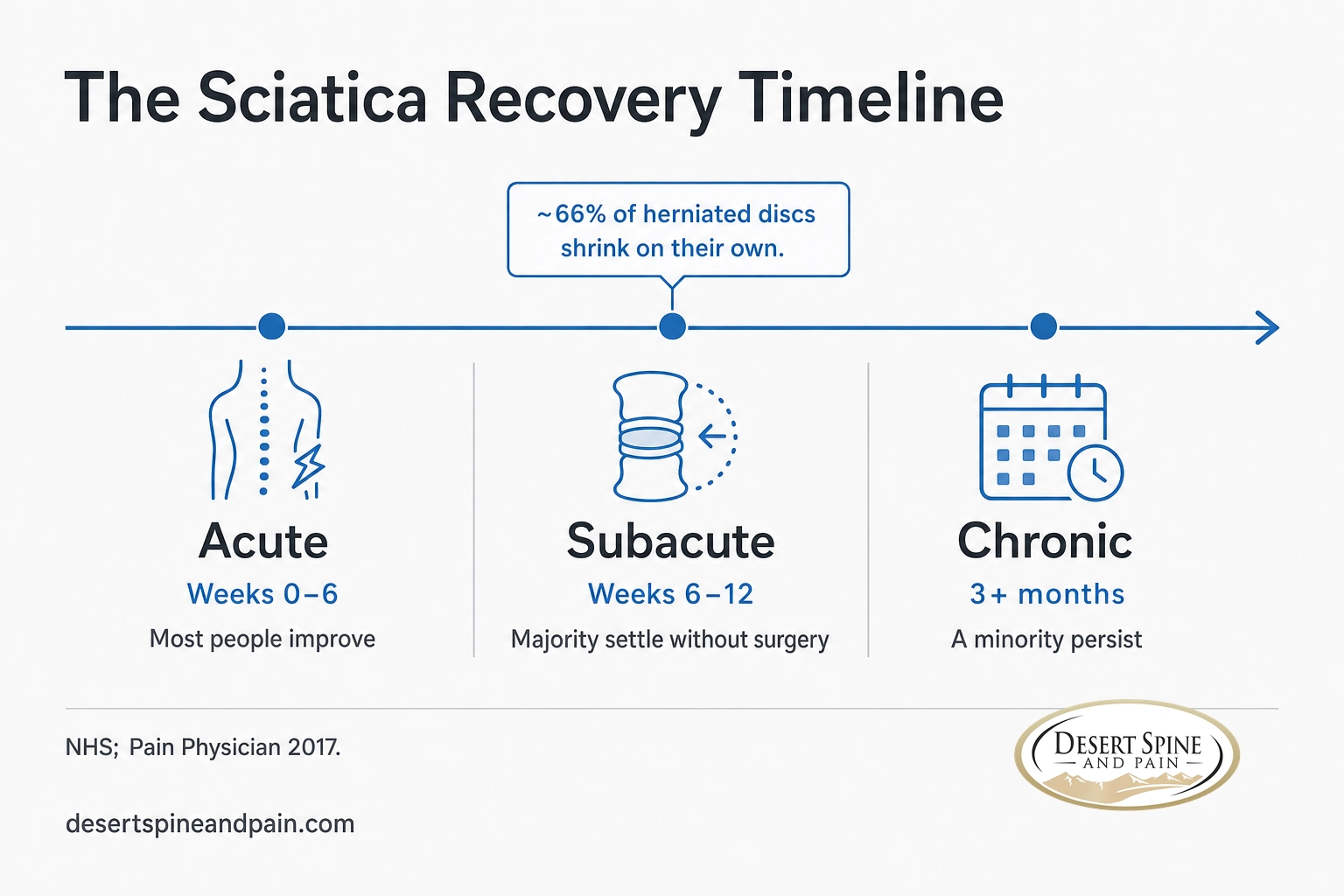
Most sciatica improves faster than people fear. The majority of cases ease within 4 to 6 weeks, and most settle inside 6 to 12 weeks without surgery, largely because a herniated disc tends to shrink on its own over time. But the timeline is not the same for everyone: in one large primary-care study, 55% of patients had clearly improved by 12 months, which means a real minority deal with sciatica for longer. Here is the evidence-based recovery timeline, what shortens it, and the warning signs that mean you should not wait at all.
- Acute sciatica (0-6 weeks) is where most people start, and most improve substantially in this window.
- The majority of cases settle within 6 to 12 weeks with conservative care, no surgery required.
- About two-thirds of herniated discs spontaneously shrink, which is why sciatica so often resolves on its own.
- In a 609-patient cohort, 55% had clearly improved by 12 months, so some symptoms can linger past three months.
- At five years in a surgical-trial follow-up, about 21% still had an unsatisfactory recovery, and roughly 8% never fully recovered.
- Early surgery speeds relief but does not beat conservative care on one-year outcomes for most people.
- A few symptoms are a medical emergency: loss of bladder or bowel control, or numbness around the groin.

What's in This Guide
- The Short Answer: How Long Sciatica Lasts
- Phase 1: Acute Sciatica (Weeks 0-6)
- Phase 2: The Subacute Turning Point (Weeks 6-12)
- Phase 3: Persistent and Chronic Sciatica (3+ Months)
- Why Your Timeline Depends on the Cause
- What Speeds Recovery, and What Slows It
- When Sciatica Is an Emergency
- The Treatment Timeline: Patience vs. Procedures
- The Full Recovery Timeline at a Glance
- Frequently Asked Questions
- Methodology and Sources
1 The Short Answer: How Long Sciatica Lasts
Sciatica is the leg pain, tingling, numbness, or weakness that travels along the path of the sciatic nerve, usually from the lower back down through the buttock and leg. It is a symptom of nerve irritation, most often from a herniated disc pressing on a nerve root, not a diagnosis on its own. That distinction matters for the timeline, because what is irritating the nerve is what determines how long the pain lasts.
The reassuring headline, backed by the NHS, is that sciatica usually gets better on its own over a few weeks to a few months, though it can sometimes last longer and can come back. In clinical terms, most acute episodes improve meaningfully within 4 to 6 weeks, and the majority settle within 6 to 12 weeks without surgery.
The honest caveat is that averages hide a wide spread. Some people turn the corner in a week; others carry symptoms for months. The rest of this guide walks through each phase of that spread so you can see where you are, what is normal, and when it is worth getting evaluated rather than waiting. For the wider picture on how common this condition is, see our sciatica statistics roundup.
Source: NHS: Sciatica
Explore the spine conditions we treat2 Phase 1: Acute Sciatica (Weeks 0-6)
The acute phase is the first six weeks, and it is where almost everyone starts. The pain can be intense, sometimes sharp or electric down the leg, and it often feels worse than a simple backache because a nerve is involved. Despite how it feels, this is also the phase with the best odds of natural improvement.
What is happening biologically is that the inflamed, compressed nerve root begins to calm down. Inflammation around the nerve settles, and if a disc is involved, the body starts to break down and reabsorb the displaced disc material. During these weeks, the goals are to control pain, stay as active as the pain allows, and avoid prolonged bed rest, which tends to slow recovery rather than speed it.
Myth: "I should rest in bed until the pain is gone."
Extended bed rest is one of the most common mistakes in early sciatica. Current guidance favors staying gently active, with modified activity rather than complete immobility. Movement helps maintain mobility, reduces the risk of deconditioning, and does not damage a healing nerve. Rest when you need to, but the goal in the acute phase is to keep moving within comfortable limits, not to wait motionless for the pain to pass.
If your pain is manageable and slowly trending down over these first weeks, that is the expected course. If it is not budging, or it is getting worse, that is a reason to be evaluated sooner rather than later, especially so the cause can be identified early. Conservative, non-surgical care is almost always the right starting point in this phase.
Source: NHS: Sciatica
See conservative, non-invasive care options3 Phase 2: The Subacute Turning Point (Weeks 6-12)
Weeks six through twelve are the subacute phase, and they are a genuine turning point. For most people, this is when sciatica that was going to resolve on its own has largely done so. The reason is one of the most encouraging findings in spine research: herniated discs tend to shrink without any intervention.
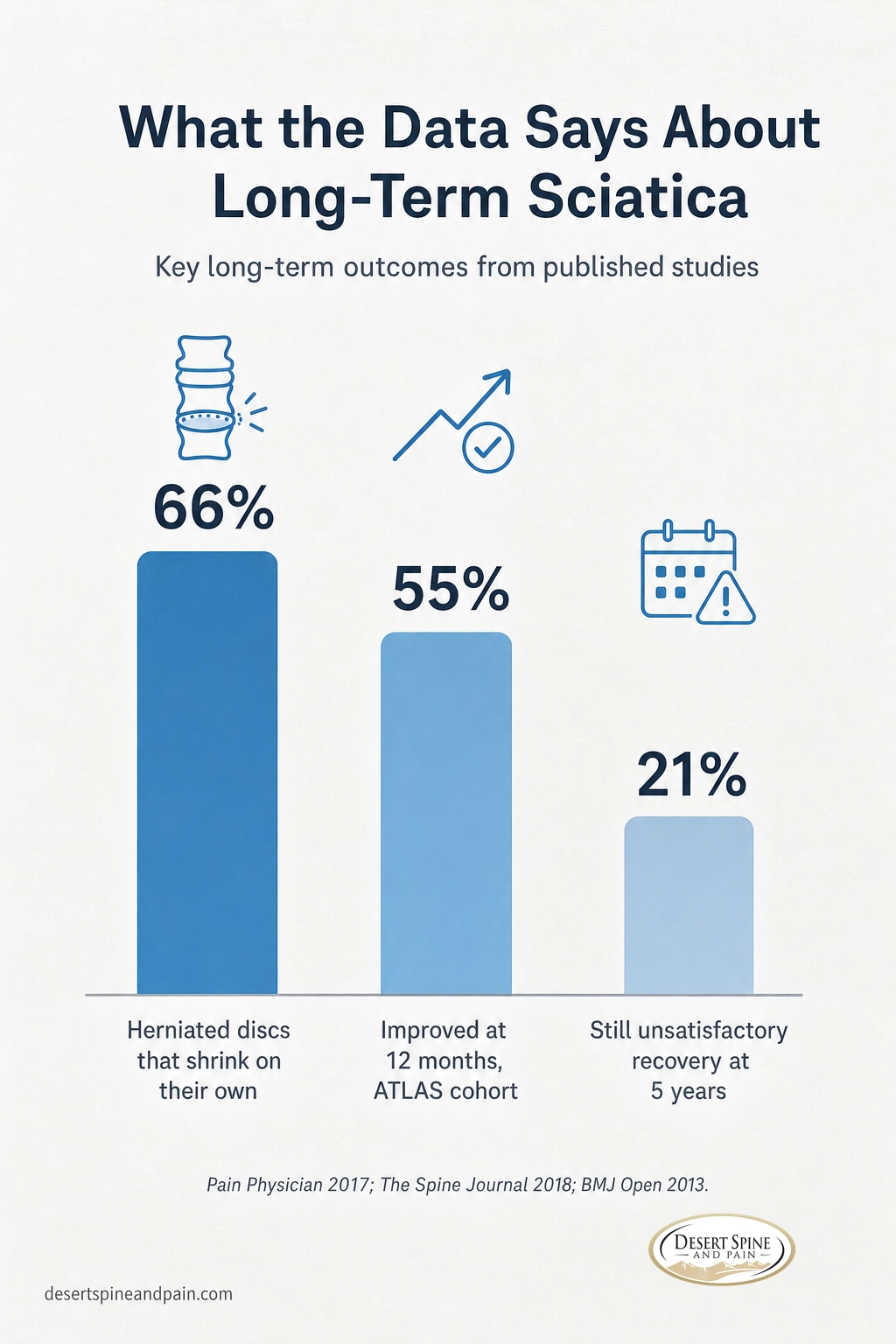
A meta-analysis published in Pain Physician in 2017 pooled the imaging data from multiple cohort studies and found that roughly two-thirds of lumbar disc herniations spontaneously resorb, meaning the herniated material physically shrinks or disappears on follow-up scans. Larger, more displaced herniations actually tend to resorb more reliably than small bulges. As the disc shrinks, the pressure and inflammation on the nerve ease, and the leg pain follows. This is the biology behind why patience and conservative care work so often, and why reaching for surgery first is usually unnecessary.
If you are in this window and clearly improving, the plan is to keep going: stay active, continue any prescribed exercises, and let the process finish. If you are at the eight-to-twelve-week mark and have seen little or no improvement, that is the standard point at which a specialist evaluation and imaging become worthwhile, to confirm the cause and discuss whether an interventional step could help.
Source: Zhong et al., Pain Physician (2017), spontaneous resorption meta-analysis
Explore interventional pain management4 Phase 3: Persistent and Chronic Sciatica (3+ Months)
When leg pain lasts beyond three months, it is considered chronic sciatica. This is the phase people worry about most, and the data here is best understood with honesty rather than false comfort: a meaningful minority of people do carry symptoms past a year, but reaching this phase does not mean the situation is hopeless.
The ATLAS cohort, published in The Spine Journal in 2018, followed 609 adults who saw their primary-care clinician with back-related leg pain. At 12 months, 55% had a good outcome, defined as at least a 30% reduction in disability, and the figure was the same in the confirmed-sciatica subgroup. Read plainly, that means roughly four to five in ten still had meaningful symptoms at a year, which is why persistent sciatica deserves a real plan rather than indefinite waiting.
The longer view comes from the five-year follow-up of the Dutch Sciatica Trial, published in BMJ Open in 2013, which tracked 231 of the original 283 patients. About 21% still had an unsatisfactory recovery at five years, and the authors concluded that roughly 8% never showed any recovery while at least 23% had ongoing complaints that fluctuated over time. These are the patients for whom a thorough specialist evaluation, and sometimes a targeted procedure, makes the biggest difference.
If your sciatica has passed the three-month mark
Chronic does not mean untreatable. Persistent sciatica is often driven by factors that can still be addressed, from the specific structure compressing the nerve to how pain and movement have been managed along the way. A board-certified spine surgeon and neurosurgeon can identify exactly what is irritating the nerve and match the least-invasive effective option to it, whether that is a targeted injection, an interventional pain procedure, or, in the cases that truly need it, minimally invasive surgery.
Source: Konstantinou et al., The Spine Journal (2018), ATLAS cohort | Lequin et al., BMJ Open (2013), 5-year Dutch Sciatica Trial follow-up
Meet Dr. Greenwald: spine surgeon and neurosurgeon5 Why Your Timeline Depends on the Cause
Sciatica is a symptom, and the single biggest factor in how long it lasts is what is causing it. The same leg pain can trace back to very different problems, and each one behaves differently over time. This is why two people with "sciatica" can have completely different recovery curves.
| Underlying cause | What it is | Typical course |
|---|---|---|
| Herniated or bulging disc | Disc material presses on a nerve root | Often favorable; the disc tends to resorb over weeks to a few months |
| Piriformis-related irritation | A buttock muscle irritates the sciatic nerve | Frequently responds to activity modification and targeted therapy |
| Lumbar spinal stenosis | Age-related narrowing of the spinal canal | Tends to be more persistent and may wax and wane long-term |
| Spondylolisthesis | One vertebra slips forward over another | Variable; depends on the degree of slip and nerve involvement |
Disc-related sciatica, the most common form, has the favorable natural course described earlier, because the herniation usually shrinks on its own. Sciatica from lumbar spinal stenosis, by contrast, comes from a narrowing of the canal that does not resorb on its own, so it tends to be more persistent and is more likely to need an active treatment plan rather than time alone. Piriformis-related symptoms often improve with movement and therapy. The practical takeaway is that a precise diagnosis is what turns a vague "wait and see" into a real timeline, because it tells you which curve you are actually on. For help telling these apart, see our comparison of piriformis syndrome vs. sciatica.
Source: NHS: Sciatica | Zhong et al., Pain Physician (2017)
Learn about diagnostic nerve testing
6 What Speeds Recovery, and What Slows It
Beyond the cause, research has identified factors that consistently push sciatica toward a faster or slower recovery. Some are outside your control, but several are not, and that is where you can make a difference.
The ATLAS cohort found that a longer duration of leg pain before seeking help, and the belief that the problem would last a long time, were both linked to a poorer chance of improvement. The five-year Dutch trial follow-up found that age over 40, severe leg pain at the outset, and a higher emotional pain score predicted a less satisfactory recovery. The common thread is that waiting longer and more severe baseline pain tend to lengthen the timeline, which is a strong argument for getting evaluated early rather than toughing it out indefinitely.
What tends to help the timeline
- Staying gently active instead of prolonged bed rest, which maintains mobility and does not harm the nerve.
- Getting an accurate diagnosis early, so the plan fits the actual cause instead of a guess.
- Managing pain enough to keep moving, including, where appropriate, interventional options like targeted injections.
- Addressing the whole picture, since fear of movement and low mood can entrench pain, a pattern well documented in chronic spinal pain.
None of these are guarantees, and no responsible clinician can promise a cure on a fixed date. But the evidence is clear that early, accurate, active management tilts the odds toward the faster end of the range. If you want practical, day-to-day steps while you recover, our guides on how to treat sciatica and the best stretches for sciatica cover the conservative basics.
Source: Konstantinou et al., The Spine Journal (2018) | Lequin et al., BMJ Open (2013)
7 When Sciatica Is an Emergency
Almost all sciatica is not dangerous, just painful and slow. But a small set of symptoms turn it from a wait-and-watch problem into a same-day emergency, because they can signal cauda equina syndrome, a rare compression of the lowest nerve roots that requires urgent treatment to avoid permanent damage.
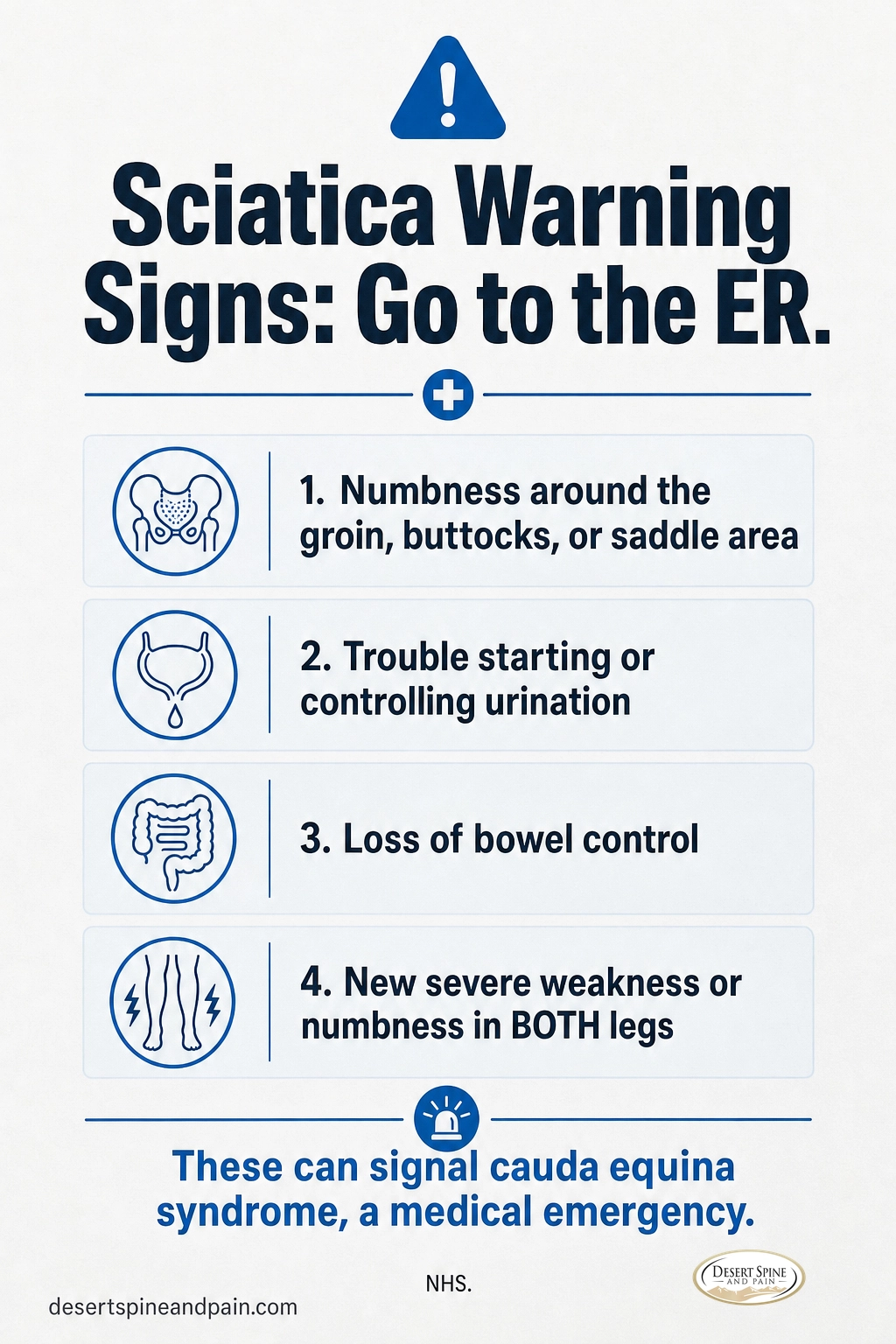
Go to the emergency room now if you have:
- Numbness around your genitals, buttocks, or the area you would sit on (saddle numbness).
- Trouble starting to urinate, being unable to urinate, or losing control of urination.
- Loss of control of your bowels, or not noticing when you need to go.
- New, severe, or worsening weakness or numbness in both legs.
The NHS advises going to an emergency department or calling emergency services for these symptoms. Do not drive yourself; have someone drive you or call an ambulance. These signs are uncommon, but when they appear, time matters.
Short of a true emergency, you should also book a specialist evaluation if your sciatica has not improved after six to twelve weeks, if the pain is severe and not controlled, or if you notice progressive weakness in a foot or leg (for example, a foot that is starting to drag). These are not emergencies, but they are signals that time alone may not be enough.
Source: NHS: Sciatica
Book a consultation: (602) 566-95008 The Treatment Timeline: Patience vs. Procedures
Because most sciatica resolves on its own, the standard approach is a stepwise one: start with the least invasive effective care, and escalate only if time and conservative measures are not working. Understanding how that ladder maps onto the calendar helps set expectations.
The clearest evidence on timing comes from the Dutch Sciatica Trial, published in the New England Journal of Medicine in 2007, which randomized 283 patients with severe sciatica of six to twelve weeks to either early surgery or prolonged conservative care with surgery only if needed. Patients who had early surgery got relief of their leg pain faster. But by one year, outcomes were similar between the two groups, and notably, a large share of the conservative group recovered without ever needing an operation.
In plain terms: surgery is a tool for speed and for the cases that need it, not a requirement for everyone. For many people, conservative care over the first weeks is both the standard and the successful path. When conservative care has had a fair trial and symptoms persist, a minimally invasive procedure such as a microdiscectomy can relieve the nerve compression directly, and modern techniques are far less disruptive than older open surgery. The right answer depends entirely on your cause, your timeline, and how the first phases have gone, which is exactly the judgment a dual board-certified neuro-spine surgeon brings.
Source: Dutch Sciatica Trial, 5-year follow-up, BMJ Open (2013)
Explore minimally invasive spine surgery9 The Full Recovery Timeline at a Glance
| Stage or finding | Figure / timing | Source | Year |
|---|---|---|---|
| Acute sciatica phase | Weeks 0-6 | Clinical consensus / NHS | 2025 |
| Most acute cases improve substantially | Within 4-6 weeks | Clinical consensus / NHS | 2025 |
| Subacute phase | Weeks 6-12 | Clinical consensus | 2025 |
| Majority settle without surgery | By 6-12 weeks | NHS | 2025 |
| Chronic threshold | 3+ months | Clinical consensus | 2025 |
| Lumbar disc herniations that spontaneously shrink | ~66% | Pain Physician meta-analysis | 2017 |
| Improved (good outcome) at 12 months | 55% | The Spine Journal (ATLAS) | 2018 |
| ATLAS cohort size | 609 patients | The Spine Journal (ATLAS) | 2018 |
| Good-outcome definition | ≥30% disability reduction | The Spine Journal (ATLAS) | 2018 |
| Dutch Sciatica Trial cohort | 283 patients | NEJM | 2007 |
| Early surgery vs. conservative at 1 year | Similar outcomes; surgery faster relief | NEJM | 2007 |
| Conservative arm eventually operated (5 yr) | 46% | BMJ Open follow-up | 2013 |
| Unsatisfactory recovery at 5 years | 21% | BMJ Open follow-up | 2013 |
| Never showed full recovery (5 yr follow-up) | ~8% | BMJ Open follow-up | 2013 |
| Ongoing fluctuating complaints | At least 23% | BMJ Open follow-up | 2013 |
| Predictors of slower recovery | Age >40, severe baseline leg pain, long symptom duration | ATLAS / BMJ Open | 2013-2018 |
| Cauda equina red flags | Bladder/bowel loss, saddle numbness | NHS | 2025 |
Frequently Asked Questions
How long does sciatica usually last?
Can sciatica go away on its own?
When is sciatica considered chronic?
Does surgery make sciatica heal faster?
What are the warning signs that sciatica is an emergency?
Methodology and Sources
Every figure in this article is drawn from a Tier 1 primary source: a national health service, a peer-reviewed cohort or randomized trial, or a published meta-analysis. No blog-to-blog citations are used. Where estimates vary by study or definition, the timeline is described as a range rather than a single number, and clinical-consensus phase boundaries (acute, subacute, chronic) are labeled as such.
Primary sources:
- NHS (National Health Service): natural course of sciatica (improves over a few weeks to a few months) and emergency red-flag symptoms.
- Konstantinou et al., The Spine Journal (2018): the ATLAS prospective cohort of 609 primary-care patients with back-related leg pain; 55% good outcome at 12 months, defined as at least a 30% reduction in disability, with the same figure in the sciatica subgroup.
- Peul et al., New England Journal of Medicine (2007): the Dutch Sciatica Trial randomizing 283 patients with 6-12 week severe sciatica to early surgery versus conservative care; early surgery sped relief, one-year outcomes were similar.
- Lequin et al., BMJ Open (2013): five-year follow-up of the Dutch Sciatica Trial; about 21% unsatisfactory recovery at five years, roughly 8% never recovered, at least 23% with ongoing fluctuating complaints, and 46% of the conservative arm eventually operated.
- Zhong et al., Pain Physician (2017): meta-analysis reporting spontaneous resorption of lumbar disc herniation in roughly two-thirds (about 66%) of cases.
This article is for general educational purposes and is not individual medical advice. Statistics describe populations, not any one person. Your timeline depends on the specific cause of your sciatica. If your pain is severe, not improving, or accompanied by any of the red-flag symptoms above, see a qualified provider for evaluation.
Media and press: Journalists and researchers are welcome to cite these figures with attribution to the original primary source named alongside each number, and a link to this page as the compiled reference. For commentary from a dual board-certified spine surgeon and neurosurgeon, contact Desert Spine and Pain in Phoenix, Arizona at (602) 566-9500.