
How to Treat Sciatica at Home: Self-Care and Remedies
How to treat sciatica at home, in short: Keep moving with gentle activity, use cold packs for the first 48 to 72 hours and heat after that, do slow pain-free stretches, adjust how you sit and sleep, and use a short course of an over-the-counter anti-inflammatory if it is safe for you. Most sciatica settles within weeks. See a specialist if pain is severe, is not improving after a few weeks, or comes with leg weakness or bladder or bowel changes.
If a sharp, radiating pain is traveling from your lower back down through your buttock and leg, the good news is that most sciatica improves on its own, and the right home care can ease the pain while it does. Sciatica is a symptom, usually caused by a herniated disc or another spine problem pressing on the sciatic nerve, and the large majority of cases get better without surgery. This guide walks through seven practical, doctor-informed steps you can start today, explains how to use cold and heat correctly, shows which stretches help, and makes clear which warning signs mean it is time to stop self-treating and call a spine specialist.
- Most sciatica improves substantially within about 4 to 6 weeks and the majority of people recover within a few months without surgery.
- Stay active within comfort. Prolonged bed rest does not speed recovery and can slow it down.
- Use cold packs for the first 48 to 72 hours to calm inflammation, then switch to heat to relax tight muscles.
- Gentle, pain-free stretches and small changes to how you sit and sleep take pressure off the irritated nerve.
- Red flags like new leg weakness, groin numbness, or loss of bladder or bowel control need emergency care, not home treatment.

What's in This Guide
- What Sciatica Is, and Why Home Care Usually Works
- Before You Begin
- Step 1: Keep Moving (Gentle Activity Beats Bed Rest)
- Step 2: Use Cold First, Then Heat
- Step 3: Do Gentle Sciatica Stretches
- Step 4: Fix How You Sit
- Step 5: Sleep in a Position That Unloads the Nerve
- Step 6: Use Over-the-Counter Relievers Wisely
- Step 7: Pace Activity and Track Your Progress
- When to Call a Professional
- Troubleshooting Common Problems
- How to Keep Sciatica From Coming Back
- How to Get Started
- Common Questions
- Sources
What Sciatica Is, and Why Home Care Usually Works
Sciatica is not a diagnosis on its own. It is the name for the pain, tingling, numbness, or weakness that travels along the path of the sciatic nerve, the largest nerve in the body, which runs from the lower spine through the buttock and down the back of each leg. The pain comes from something irritating or compressing that nerve or one of its roots, and in most people the cause is a herniated disc in the lower back pressing on a nerve root.
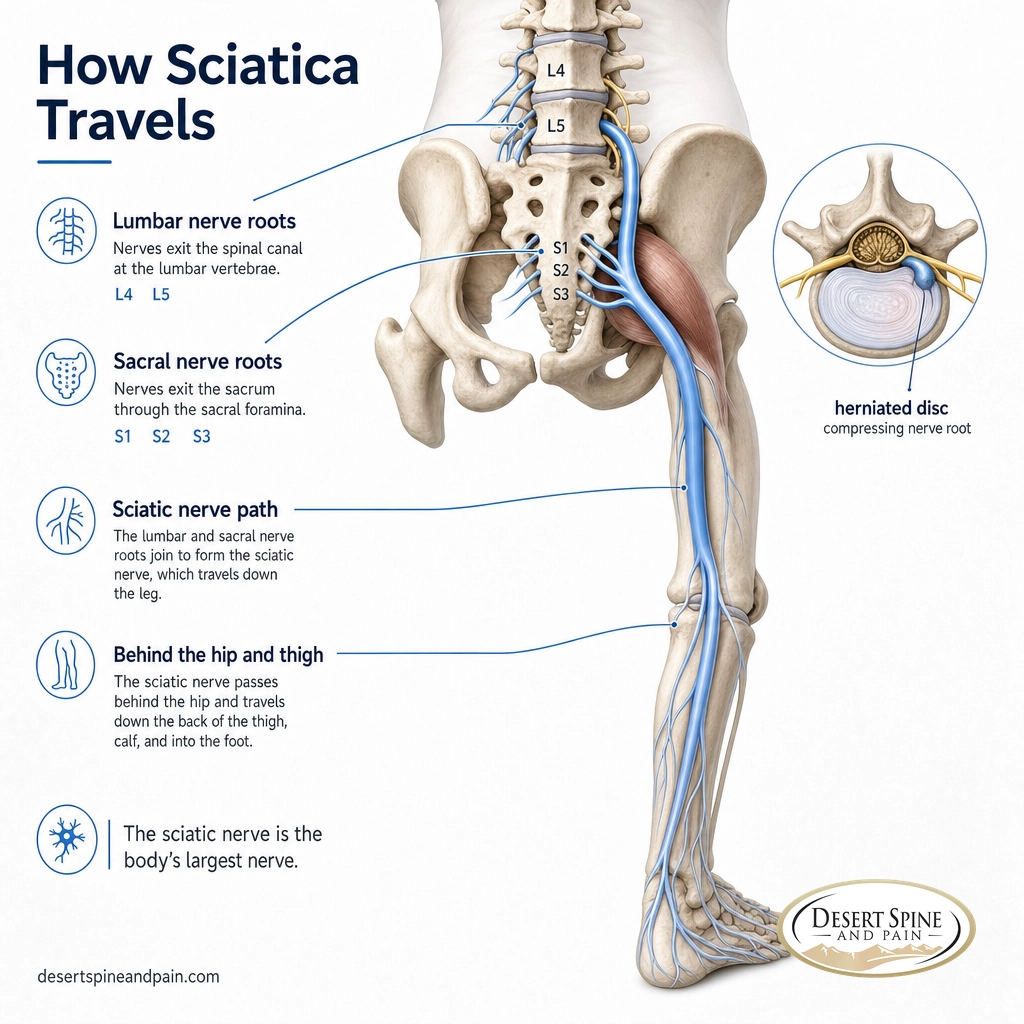
That underlying cause matters because it explains why home care is the right first step. Nerve roots irritated by a disc problem tend to calm down over time as the inflammation settles and the disc material is gradually reabsorbed, so most sciatica is self-limiting. Clinical reviews describe the typical pattern clearly: the majority of people improve within weeks to a few months, even though a minority continue to have pain longer.
The point of treating sciatica at home is to control pain and protect the nerve while your body does the healing, and to recognize the uncommon situations where waiting is the wrong choice. The steps below are ordered the way most clinicians recommend starting: least invasive first.
Source: Ropper & Zafonte, Sciatica, New England Journal of Medicine (2015) | Mayo Clinic: Sciatica symptoms and causes
Before You Begin
What you need: a flexible ice pack or a bag of frozen peas, a few thin towels, a warm shower or a heating pad, a firm floor or exercise mat for stretches, and an over-the-counter anti-inflammatory you have used safely before.
Time and effort: most of these measures take only a few minutes at a time, several times a day. Plan on a 4 to 6 week window to judge progress, since that is how long typical sciatica takes to improve substantially.
Skill level: beginner. Nothing here requires special equipment or fitness.
When NOT to self-treat: skip straight to the When to Call a Professional section first if you have any red-flag symptoms. Home care is for ordinary sciatica, not for the emergency warning signs described there.
1 Keep Moving (Gentle Activity Beats Bed Rest)
What to do: within the limits of your pain, keep moving. Take short, frequent walks, change positions often, and continue light daily activities. A day or two of easing off the movements that clearly aggravate your leg pain is reasonable, but do not retreat to bed for days at a time.
Why this step matters: the instinct to lie still is understandable, but the evidence points the other way. A Cochrane review of acute low back pain and sciatica found that people advised to rest in bed did a little worse on pain and recovery than those advised to stay active, and concluded it is reasonable to advise staying active given the harms of prolonged bed rest.
What success looks like: you are up and moving in small amounts throughout the day, and gentle activity does not spike your leg pain. Walking should feel neutral or mildly better, not sharply worse.
Common mistake: "resting until it is completely gone." Waiting out sciatica flat on your back usually backfires. Muscles deconditioned, joints stiffen, and the nerve does not heal faster. Motion, not immobility, is what the current evidence supports.
Source: Cochrane Review: Advice to rest in bed versus advice to stay active for acute low-back pain and sciatica | Mayfield Clinic: Leg pain and sciatica patient guide
2 Use Cold First, Then Heat
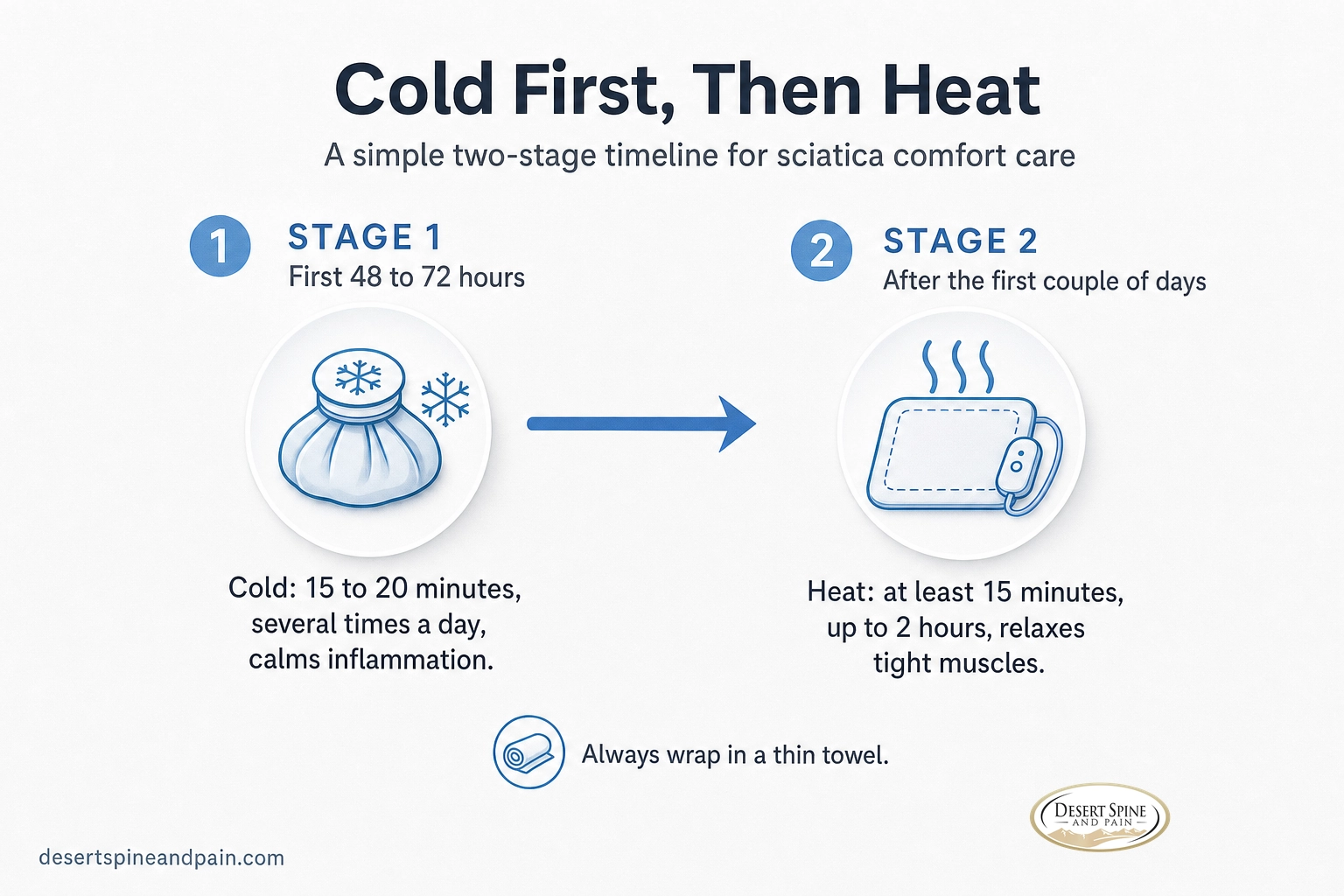
What to do: for the first 48 to 72 hours, apply an ice pack wrapped in a thin towel to the painful area of your lower back for about 15 to 20 minutes at a time, several times a day. After those first couple of days, switch to heat: a warm shower or a heating pad on a low setting helps relax the muscles that tense up around an irritated nerve. Keep heat sessions to at least 15 minutes but no more than about two hours, and always put a cloth barrier between any hot or cold source and your skin.
Why this step matters: cold narrows blood vessels and helps blunt the early inflammation and sharp pain in the first days, while heat later on improves blood flow and loosens tight, guarding muscles. Using them in the right order gives you the benefit of each.
What success looks like: the cold pack takes the edge off the sharpest pain in the early days, and the heat later feels soothing rather than irritating.
| Cold (ice) | Heat | |
|---|---|---|
| When | First 48 to 72 hours | After the first couple of days |
| Why | Calms inflammation and numbs sharp pain | Relaxes tight, guarding muscles and improves blood flow |
| How long | 15 to 20 minutes, several times a day | At least 15 minutes, up to about 2 hours |
| Always | Wrap in a thin towel, never apply ice directly to skin | Use a cloth barrier and a low setting to avoid burns |
Source: Mayfield Clinic: Leg pain and sciatica patient guide | Harvard Health Publishing: Sciatica
3 Do Gentle Sciatica Stretches
What to do: once the sharpest early pain has eased, add slow, controlled stretches that ease tension around the lower back and hips. Three gentle options most people tolerate well:
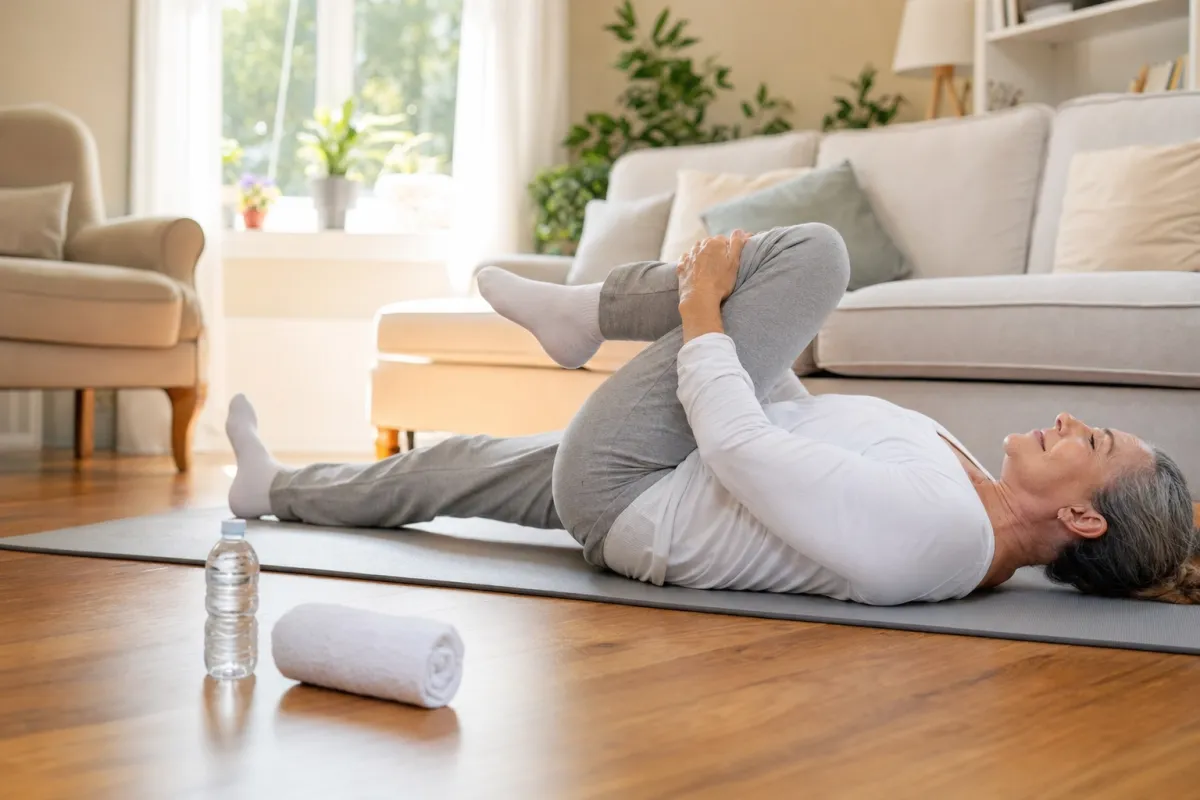
- Knee-to-chest. Lie on your back and draw one knee up toward your chest with both hands, hold for 20 to 30 seconds, then switch legs. This gently opens the lower back.
- Figure-4 (piriformis) stretch. Lying on your back, cross one ankle over the opposite knee to make a figure-4, then gently pull the lower thigh toward you. This targets the deep buttock muscle that can aggravate the sciatic nerve.
- Pelvic tilt. Lying with knees bent, flatten your lower back into the floor by gently tightening your abdominals, hold a few seconds, and release. This builds light core support without strain.
Why this step matters: gentle stretching reduces tension in the muscles surrounding the nerve and keeps the lower back mobile, which supports recovery. A structured program through a physical therapist (which Desert Spine and Pain coordinates through trusted non-surgical care referral partners) can tailor these further.
What success looks like: the stretch feels like a mild, comfortable pull in the muscle, and your leg symptoms stay the same or ease afterward.
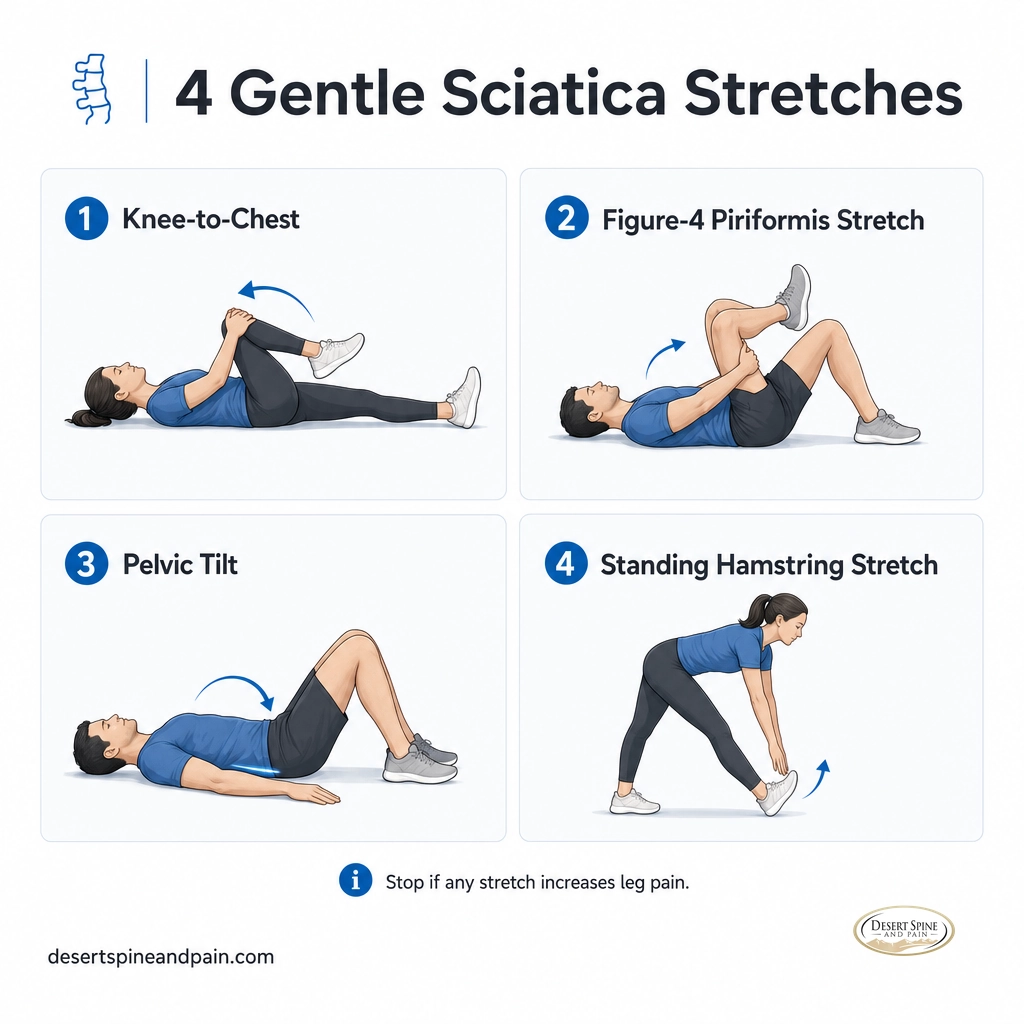
The rule for every stretch: it should never increase your leg pain. A gentle pull in the muscle is fine. Sharp, shooting, or radiating pain down the leg means stop that movement. Never force a stretch or bounce into it. For a fuller routine, see our guide to the best stretches for sciatica.
Source: Mayo Clinic: Sciatica diagnosis and treatment | AAOS OrthoInfo: Sciatica
4 Fix How You Sit
What to do: long stretches of sitting raise pressure inside the lumbar discs and are one of the most common triggers for a sciatica flare. Break up sitting time: stand and move for a minute or two every 30 to 45 minutes. When you do sit, keep your hips level with or slightly above your knees, support the curve of your lower back with a small cushion or rolled towel, and keep both feet flat on the floor. Avoid slouching, deep soft couches, and sitting on a wallet.
Why this step matters: reducing the load on an already irritated disc and nerve gives the inflammation a chance to settle instead of being re-provoked all day.
What success looks like: you can sit for reasonable stretches without your leg pain building, and getting up is easier. For a deeper look at posture and setup, see our guide on how to sit with sciatica.
Source: Mayfield Clinic: Leg pain and sciatica patient guide | Mayo Clinic: Sciatica

5 Sleep in a Position That Unloads the Nerve
What to do: poor sleep positions can keep the nerve provoked overnight. Two positions tend to help most. If you sleep on your side, place a firm pillow between your knees to keep your hips and spine aligned. If you sleep on your back, put a pillow under your knees to take tension off the lower spine. A medium-firm mattress generally supports the back better than a very soft one.
Why this step matters: you spend hours in one position overnight, so a setup that keeps the lower spine in a neutral, unloaded position protects your progress while you rest.
What success looks like: you wake with less stiffness and your morning leg pain is no worse than the night before. For more detail, see our full guide to how to sleep with sciatica.
Source: Harvard Health Publishing: Sciatica | Mayo Clinic: Sciatica diagnosis and treatment
6 Use Over-the-Counter Relievers Wisely
What to do: a short course of an over-the-counter nonsteroidal anti-inflammatory drug (NSAID) such as ibuprofen or naproxen can reduce both inflammation and pain. Acetaminophen can ease pain but does not reduce inflammation. Follow the dosing on the label and do not exceed it.
Why this step matters: calming the inflammation around the nerve root can make it far easier to stay active and keep up with the other steps, which is where most of the real recovery happens.
What success looks like: pain is manageable enough that you can walk, stretch, and sleep, using the medication as a short-term aid rather than a long-term crutch.
Check with a clinician first if NSAIDs may not be safe for you. People with high blood pressure, stomach ulcers or reflux, or kidney or heart disease should talk to a doctor or pharmacist before using NSAIDs. Do not combine multiple NSAIDs, and do not use them for weeks on end without medical guidance.
Source: Harvard Health Publishing: Sciatica | Mayo Clinic: Sciatica diagnosis and treatment
7 Pace Activity and Track Your Progress
What to do: rebuild activity gradually rather than all at once. Add a little more walking or gentle movement every few days, and keep a simple note of your pain level and how far the leg symptoms travel. The goal is a steady downward trend, not a pain-free day followed by a hard relapse from overdoing it.
Why this step matters: tracking turns vague worry into useful information. If your leg pain is slowly shrinking and climbing back up the leg toward the back (a pattern clinicians call centralization), that is usually a good sign. If it is spreading further down or getting stronger, that tells you it is time for professional help.
What success looks like: week over week, your pain is less intense, less frequent, or covers less of the leg. Wondering about the timeline? See our guide on how long sciatica lasts.
Source: Ropper & Zafonte, Sciatica, New England Journal of Medicine (2015) | AAOS OrthoInfo: Sciatica
When to Call a Professional
Home care handles most sciatica, but some situations need a specialist, and a few need emergency care. Reach out to a spine specialist if your sciatica is severe, keeps returning, or is not improving after a few weeks of consistent home care. An evaluation can confirm the cause, rule out anything serious, and open up options like an image-guided epidural steroid injection or, in the uncommon cases that need it, a minimally invasive microdiscectomy.
Seek emergency care immediately for these red flags. New or worsening weakness in a leg or foot, numbness around the groin, buttocks, or inner thighs (saddle numbness), or any loss of bladder or bowel control can signal serious nerve compression such as cauda equina syndrome. These are uncommon, but they are medical emergencies and should never be watched at home. The same goes for sciatica that follows a significant fall or accident, or that comes with fever or unexplained weight loss.
Source: National Institute of Neurological Disorders and Stroke: Back Pain | Mayo Clinic: Sciatica, when to see a doctor
Troubleshooting Common Problems
| Problem | What it may mean | What to do |
|---|---|---|
| Stretching makes my leg pain worse | You are stretching too far or too soon, or that movement provokes the nerve | Stop that stretch, ease back to gentle movement only, and reintroduce stretching slowly once the sharp pain settles |
| Pain is no better after 2 to 3 weeks | Ordinary sciatica that is slow to settle, or a cause that needs assessment | Keep up home care but book a spine evaluation to confirm the cause and discuss next options |
| Pain is spreading further down the leg | The nerve irritation may be worsening rather than improving | See a specialist soon; worsening or spreading symptoms are a reason not to keep waiting |
| Numbness, tingling, or weakness is new | Possible increasing nerve compression | Get evaluated promptly; sudden or severe weakness is a red flag for urgent care |
| NSAIDs upset my stomach | A common side effect of anti-inflammatories | Stop and ask a pharmacist or clinician about safer options for your situation |
How to Keep Sciatica From Coming Back
Once the pain settles, a few habits lower the odds of a repeat episode. Keep up gentle core and hip strengthening so your spine has muscular support, lift with your legs and keep loads close to your body, and avoid long unbroken stretches of sitting. Stay generally active, keep a healthy weight to reduce load on the lower spine, and if you smoke, know that smoking reduces the limited blood supply discs rely on to stay healthy. These are the same foundations that support recovery, carried forward as prevention.
If sciatica keeps returning, that pattern itself is worth a conversation with a spine specialist, since a recurring problem may point to an underlying disc or nerve issue that is better managed proactively than ridden out each time.
Source: Mayo Clinic: Sciatica prevention | AAOS OrthoInfo: Sciatica
How to Get Started
Start with Steps 1 and 2 today: keep gentle movement going and begin the cold-then-heat routine. Layer in the stretches and the sitting and sleeping adjustments over the next few days, use an over-the-counter anti-inflammatory if it is safe for you, and track whether your leg pain is trending down week to week. Give it a fair 4 to 6 weeks, while watching for the red flags above.
If your sciatica is severe, keeps coming back, or is not improving, a focused evaluation is the right next move. Desert Spine and Pain is a Phoenix, Arizona practice led by Dr. David L. Greenwald, MD, FACS, a board-certified surgeon who is both a spine surgeon and a neurosurgeon. Care always starts with the least invasive effective option and moves toward a procedure only when it is genuinely the best path, and a second opinion is always welcome before any surgery is considered.
Explore non-surgical sciatica and spine care
See interventional pain treatment options
Book a consultation or second opinion
Common Questions About Treating Sciatica at Home
How can I relieve sciatica pain fast at home?
Should I use ice or heat for sciatica?
Is it better to rest or stay active with sciatica?
How long does sciatica take to go away?
When should I see a doctor for sciatica?
Sources
Sources and Methodology
This guide summarizes established clinical references and peer-reviewed data on sciatica and its conservative, at-home management. Epidemiology figures (the share of cases caused by disc herniation and the annual incidence) are drawn from a major medical-journal review and a peer-reviewed epidemiology review and are presented as general reference, not individual predictions. Self-care guidance reflects patient-education materials and systematic-review evidence from the sources listed below. This is educational information, not medical advice. Decisions about diagnosis and treatment should be made with a qualified spine specialist after an in-person evaluation, and any red-flag symptoms warrant immediate medical care.
- Ropper AH, Zafonte RD. Sciatica. New England Journal of Medicine (2015)
- Peer-reviewed review of sciatica epidemiology and pathophysiology, Frontiers in Neuroscience (2023)
- Cochrane Review: Advice to rest in bed versus advice to stay active for acute low-back pain and sciatica
- Mayo Clinic: Sciatica (symptoms, causes, when to see a doctor)
- Mayo Clinic: Sciatica (diagnosis and treatment)
- Mayfield Clinic: Leg pain and sciatica patient guide
- Harvard Health Publishing: Sciatica
- American Academy of Orthopaedic Surgeons OrthoInfo: Sciatica
- National Institute of Neurological Disorders and Stroke: Back Pain