

Cervical Myelopathy vs. Radiculopathy: Key Differences
The difference in one line: Cervical radiculopathy is a pinched nerve root in the neck, so it usually sends pain or numbness down one arm. Cervical myelopathy is pressure on the spinal cord itself, so it shows up as clumsy hands and an unsteady walk, often with little or no pain. The first is uncomfortable and usually improves; the second can damage the cord over time and is treated with more urgency.
If a doctor or an MRI report has used the words myelopathy and radiculopathy, it is easy to assume they are two names for the same neck problem. They are not. Both start with the same kind of wear in the cervical spine, but they compress very different structures, and that single distinction changes the symptoms you feel, the signs a specialist looks for, how urgent the problem is, and how it is treated. This guide explains cervical radiculopathy and cervical myelopathy side by side, how to tell them apart, how common each one is, and when each needs to be seen.
- Radiculopathy = a pinched nerve root. It typically causes pain, tingling, or weakness that travels down one arm in a pattern matching a single nerve.
- Myelopathy = compression of the spinal cord. It typically causes clumsy hands, trouble with fine tasks, and an unsteady, wide-based walk, often with little neck pain.
- The exam separates them. Radiculopathy tends to reduce reflexes in the affected arm, while myelopathy produces overactive reflexes and signs like a positive Hoffmann or Babinski that point to the spinal cord.
- Urgency differs. Most radiculopathy improves with non-surgical care, while myelopathy can progress and cause lasting damage, so it is evaluated and treated with more urgency.
- They can overlap. The same degenerative changes can pinch a nerve and press on the cord at once, a mix called myeloradiculopathy.
What's in This Guide
- The Core Difference: Nerve Root vs. Spinal Cord
- Understanding Cervical Radiculopathy
- Understanding Cervical Myelopathy
- Symptoms Side by Side
- How a Specialist Tells Them Apart
- How Common Is Each One?
- How Each Is Treated
- Myelopathy vs. Radiculopathy at a Glance
- Which One Is More Likely in Your Case?
- How to Get Started
- Common Questions
- Sources
The Core Difference: Nerve Root vs. Spinal Cord
Everything about telling these two conditions apart comes down to what is being squeezed. The cervical spine protects two very different things. Running down the center is the spinal cord, the thick bundle of nervous tissue that carries signals between the brain and the entire body below the neck. Branching off the cord at each level are the nerve roots, individual nerves that exit through small openings and travel out to a specific patch of skin and set of muscles, mostly in the shoulder, arm, and hand.
Cervical radiculopathy is compression or irritation of one of those exiting nerve roots. Cervical myelopathy is compression of the spinal cord itself. A helpful way to picture it: the spinal cord is the main cable, and the nerve roots are the individual wires branching off it. Radiculopathy is a problem with one branch wire, so the trouble shows up in that wire's specific territory. Myelopathy is pressure on the main cable, so the effects are broader and can involve both arms, the hands, and the legs.
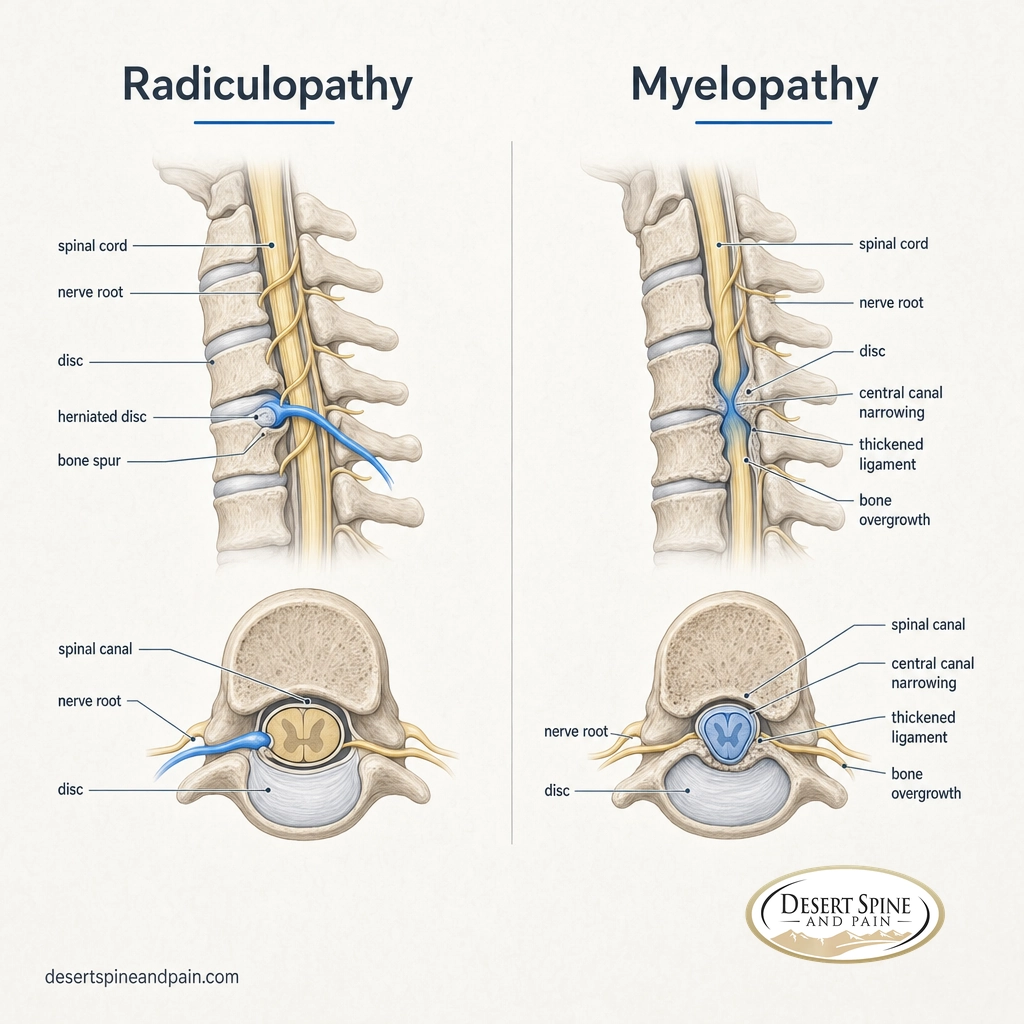
Both usually come from the same underlying process: age-related wear in the neck. A disc that bulges or herniates, bone spurs from arthritis, thickened ligaments, and narrowing of the spinal canal (stenosis) can all crowd these structures. Whether you end up with radiculopathy, myelopathy, or both depends mostly on where that crowding lands: out at a nerve root opening, or centrally against the cord.
Source: Kane et al., Degenerative Cervical Myelopathy, American Family Physician (2020) | American Academy of Orthopaedic Surgeons: Cervical Radiculopathy (Pinched Nerve)
Understanding Cervical Radiculopathy
Cervical radiculopathy is what most people mean when they say they have a "pinched nerve in the neck." A nerve root gets compressed or inflamed where it exits the spine, usually by a herniated disc or by bone spurs narrowing the opening the nerve travels through. Because each root serves a defined area, the symptoms follow a map.
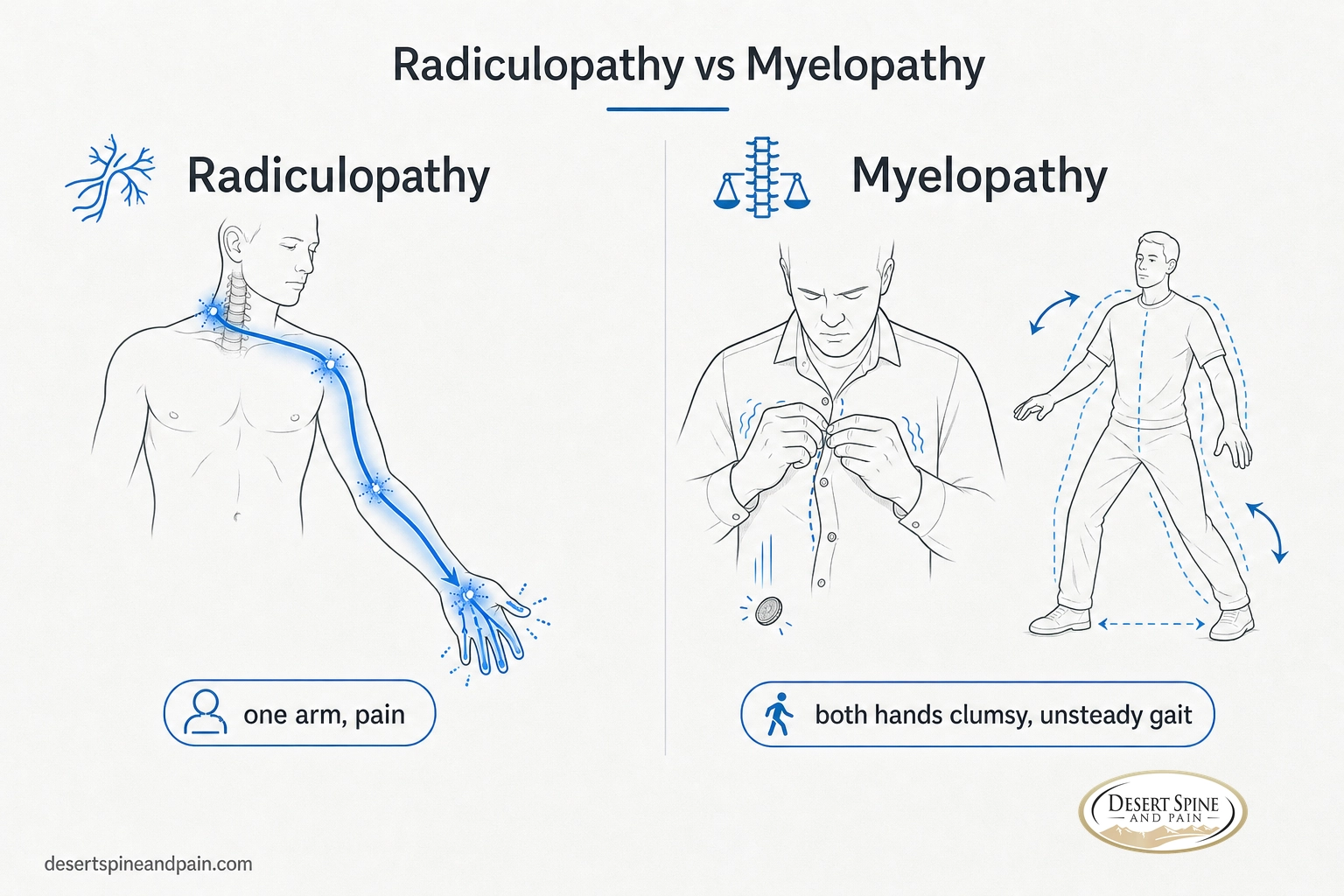
The hallmark is arm pain. It often starts in the neck or shoulder blade and shoots down one arm, sometimes into specific fingers, following the path of the affected nerve. Along with the pain, people frequently notice tingling, numbness, or weakness in the same arm, and the problem is usually on one side only. Certain neck positions, especially tilting the head back or toward the painful side, can make it worse, while supporting the arm overhead sometimes eases it.
The reassuring part is the natural history. Cervical radiculopathy tends to calm down. Many cases settle over weeks to a few months with conservative care, and surgery is the exception rather than the rule. That favorable outlook is one of the clearest practical differences from myelopathy, and it shapes how aggressively each is treated.
Source: AAOS OrthoInfo: Cervical Radiculopathy | Radhakrishnan et al., Epidemiology of cervical radiculopathy, Brain (1994), PubMed
Understanding Cervical Myelopathy
Cervical myelopathy is compression of the spinal cord in the neck. The most common cause is degenerative: years of disc, bone, and ligament changes gradually narrow the central canal and press on the cord, a condition called degenerative cervical myelopathy. Because the cord carries signals to everything below the neck, the symptoms are broader and, importantly, often painless in the early stages.
Instead of one-arm pain, myelopathy tends to announce itself through loss of fine control and balance. People describe hands that have become clumsy, dropping objects, fumbling with buttons, zippers, coins, or keys, and handwriting that has changed. Walking can feel unsteady, stiff, or wide-based, as if balance is harder than it used to be. Numbness or tingling may affect both hands rather than one, and some people notice heaviness or weakness in the legs. Neck pain can be present, but it is not the main event, and its absence is exactly why myelopathy is so often missed early.
Myelopathy also behaves differently over time. Rather than steadily improving the way most radiculopathy does, it often progresses, sometimes in a stepwise pattern of plateaus and declines. Because the nervous tissue of the cord does not recover as readily as an irritated nerve root, delays in diagnosis can mean function that does not fully return. That is the core reason specialists treat suspected myelopathy as more urgent.
Source: Kane et al., Degenerative Cervical Myelopathy, American Family Physician (2020) | National Institute of Neurological Disorders and Stroke
Symptoms Side by Side
When you line the two up, the pattern of symptoms is usually the fastest clue to which is which. Radiculopathy is focal, one-sided, and painful. Myelopathy is diffuse, often two-sided, and defined by loss of coordination more than by pain.
| Symptom pattern | Cervical Radiculopathy | Cervical Myelopathy |
|---|---|---|
| Main complaint | Pain shooting down one arm | Clumsy hands and unsteady walking |
| Side affected | Usually one arm only | Often both hands or arms, sometimes legs |
| Pain | Prominent, a leading symptom | Often mild or absent early on |
| Fine motor skills | Usually preserved | Buttons, coins, handwriting become difficult |
| Balance and gait | Normal | Unsteady, stiff, or wide-based |
| Bladder or bowel | Not affected | Can be affected in advanced cases |
Myth: "No neck pain means nothing serious is going on." With myelopathy, the opposite can be true. Pain is not the hallmark of spinal cord compression, and some of the most important early signs, like dropping objects or an unsteady walk, are painless. Judging the seriousness of a neck problem by how much it hurts can let myelopathy slip by until it is advanced. The symptoms to watch are about function, not just pain.
How a Specialist Tells Them Apart
Symptoms point the way, but the physical exam is where the two conditions genuinely separate, because they affect different parts of the nervous system in opposite directions. Radiculopathy is a problem with a peripheral nerve root, so it tends to reduce function in that nerve's territory: a weaker specific muscle, a diminished reflex, numbness in a defined patch of skin. These are called lower motor neuron findings.
Myelopathy involves the spinal cord, which produces the opposite pattern below the level of compression: reflexes become overactive, muscles can feel stiff or spastic, and specific signs appear that healthy nerves do not show. A specialist checks for a few of these cord signs directly.
- Hyperreflexia. Overactive deep tendon reflexes are a key finding in myelopathy, whereas radiculopathy usually blunts the reflex of the affected nerve.
- Hoffmann sign. Flicking the middle fingernail causes the thumb and index finger to twitch. It is a classic upper motor neuron clue, with a specificity around 81 percent for myelopathy.
- Babinski sign and clonus. An abnormal upward toe response or rhythmic ankle beats point strongly to cord involvement.
- Gait testing. A wide-based or unsteady walk, or trouble with heel-to-toe walking, supports a cord problem rather than a single pinched nerve.
Imaging then confirms the picture. An MRI shows whether the pressure sits out at a nerve root opening, centrally against the cord, or both, and whether the cord shows signal changes from being compressed. As with any spine imaging, the scan is read alongside your symptoms and exam, never on its own.
Source: Kane et al., American Family Physician (2020) | StatPearls: Cervical Myelopathy (NCBI Bookshelf)
How Common Is Each One?
Radiculopathy is the far more common of the two. The most cited population study, a long-term survey in Rochester, Minnesota, put the age-adjusted annual incidence of cervical radiculopathy at about 83 per 100,000 people, with the peak between ages 50 and 54. Degenerative cervical myelopathy is diagnosed much less often, with an estimated prevalence of 605 per 1 million people in North America, though experts note that inconsistent terminology makes it hard to count precisely and that it is frequently diagnosed late.
Put on the same scale, the gap is striking. Converting radiculopathy's incidence to the same per-million units used for myelopathy (83.2 per 100,000 equals about 832 per million per year) shows that new cervical radiculopathy is diagnosed roughly twenty times as often as degenerative cervical myelopathy.
New diagnoses per 1 million people each year (United States / North America)
Desert Spine and Pain analysis: radiculopathy incidence of 83.2 per 100,000 (Radhakrishnan et al., Brain 1994) converted to 832 per million for comparison with the 41 per million annual incidence of degenerative cervical myelopathy (Kane et al., AFP 2020). Figures come from different studies and methods and are shown for scale.The point is not that myelopathy is rare enough to ignore. It is that the much more common pinched-nerve pattern is what most people and even many clinicians think of first, which is one more reason the quieter, function-based signs of myelopathy get overlooked.
Source: Radhakrishnan et al., Brain (1994), PubMed | Kane et al., American Family Physician (2020)

How Each Is Treated
Treatment follows the same logic as the urgency. Because most radiculopathy improves on its own, it is managed conservatively first. Because myelopathy reflects cord compression that can progress, the conversation turns to surgery sooner.
Treating cervical radiculopathy
Care usually starts with the least invasive effective steps, in keeping with a least-invasive-first philosophy, and most people never need an operation. A typical path can include:
- Activity changes and time. Short-term adjustment of aggravating movements while the inflamed nerve settles.
- Guided physical therapy. A structured program, coordinated through trusted referral partners, to restore neck mechanics and relieve pressure on the nerve, part of non-surgical spine care.
- Medication. Anti-inflammatory and nerve-calming options to control symptoms during recovery.
- Targeted injections. When arm pain persists, an image-guided epidural steroid injection can reduce inflammation around the irritated root.
- Surgery, only if needed. Reserved mainly for radiculopathy that does not improve or that causes meaningful weakness, often through a focused procedure such as an anterior cervical discectomy and fusion or a motion-preserving cervical disc replacement.
Treating cervical myelopathy
Myelopathy is handled differently. Mild, stable cases may be watched closely, but for moderate or progressive myelopathy, surgical decompression of the cord is commonly recommended, because the goal is to stop the condition from worsening and to protect the function that remains. Options depend on where and how the cord is compressed, and can include anterior approaches, posterior decompression for cervical stenosis, or a cervical fusion to stabilize the segment. Where appropriate, these can be done with minimally invasive techniques. The emphasis on timing is deliberate: operating before significant cord damage sets in gives the best chance of preserving hand function and walking.
This difference in treatment thresholds is the practical payoff of getting the diagnosis right. Treating cord compression like a routine pinched nerve, or chasing arm pain that is actually part of a broader myelopathy, both lead to the wrong plan.
Source: Kane et al., American Family Physician (2020) | Radhakrishnan et al., Brain (1994)
Myelopathy vs. Radiculopathy at a Glance
Here is the full comparison in one place. No single row diagnoses anything on its own, but together they capture how differently these two conditions behave.
| Feature | Cervical Radiculopathy | Cervical Myelopathy | What it tells you |
|---|---|---|---|
| What is compressed | A single nerve root | The spinal cord | The root cause of every other difference |
| Where symptoms appear | One arm, in a defined pattern | Both hands, and often the legs | Focal vs. widespread |
| Pain | Prominent arm pain | Often mild or absent | Myelopathy can be painless |
| Reflexes on exam | Reduced (lower motor neuron) | Overactive (upper motor neuron) | The clearest exam divider |
| Hand and walking function | Usually preserved | Clumsy hands, unsteady gait | Function loss points to the cord |
| Natural history | Often improves over time | Tends to progress | Drives urgency |
| Typical first-line care | Conservative, non-surgical | Surgical decompression considered earlier | Different treatment thresholds |
| How common | About 83 per 100,000 per year | About 605 per 1 million (prevalence) | Radiculopathy is far more common |
Which One Is More Likely in Your Case?
These profiles are not a substitute for an exam, but they capture the typical picture each condition presents.
It is more likely radiculopathy when
- Your main problem is pain, tingling, or weakness traveling down one arm.
- The symptoms follow a line into specific fingers rather than spreading everywhere.
- Your hands still handle buttons, coins, and writing normally.
- Your balance and walking are unchanged.
- Certain neck positions clearly trigger or relieve the arm symptoms.
It is more likely myelopathy when
- Your hands have become clumsy, or you are dropping things or fumbling with fine tasks.
- Numbness or tingling affects both hands rather than one.
- Walking feels unsteady, stiff, or wide-based.
- Symptoms have crept in with little or no neck pain.
- There are any changes in bladder or bowel control, which warrants prompt evaluation.
Seek urgent care for red flags. Rapidly worsening weakness, a fast decline in hand function or balance, or any new loss of bladder or bowel control can signal serious spinal cord compression and should be evaluated immediately, not watched at home. These situations are uncommon, but they are the ones where timing matters most.
How to Get Started
If neck-related arm pain, clumsy hands, or an unsteady walk has shown up, the most useful next step is a focused evaluation that connects your symptoms and exam to an MRI and sorts out whether a nerve root, the spinal cord, or both are involved. That answer determines whether the right plan is watchful conservative care or earlier surgical decompression, and it is the right time to ask about least-invasive options and to get a second opinion before any surgery.
Desert Spine and Pain is a Phoenix, Arizona practice led by Dr. David L. Greenwald, MD, FACS, a board-certified surgeon who is both a spine surgeon and a neurosurgeon, dual expertise that is especially relevant when the spinal cord itself is involved. The practice draws patients from across the Greater Phoenix area and beyond, and care always starts with the least invasive effective option and moves toward a procedure only when it is genuinely the best path.
Explore neck and spine conditions we treat
See non-surgical spine care options
Book a consultation or second opinion
Common Questions About Myelopathy and Radiculopathy
What is the difference between cervical myelopathy and radiculopathy?
Is cervical myelopathy more serious than radiculopathy?
Can you have cervical myelopathy and radiculopathy at the same time?
What are the early warning signs of cervical myelopathy?
Does cervical radiculopathy or myelopathy require surgery?
Sources
Sources and Methodology
This guide summarizes established clinical references and peer-reviewed data on cervical radiculopathy and degenerative cervical myelopathy. Incidence and prevalence figures come from a long-term population study and a current clinical review and are presented as general reference, not individual predictions. The per-million comparison converts radiculopathy's reported incidence of 83.2 per 100,000 to 832 per million so it can be shown on the same scale as myelopathy's 41 per million annual incidence; the two figures come from separate studies and methods and are shown for scale only. This is educational information, not medical advice. Decisions about diagnosis and treatment should be made with a qualified spine specialist after an in-person evaluation.
- Kane, Flanigan, et al. (2020): Degenerative Cervical Myelopathy, American Family Physician 102(12):740-750
- Radhakrishnan et al. (1994): Epidemiology of cervical radiculopathy, Rochester, Minnesota, 1976-1990, Brain (PubMed)
- American Academy of Orthopaedic Surgeons: Cervical Radiculopathy (Pinched Nerve)
- National Institute of Neurological Disorders and Stroke: Cervical Spondylotic Myelopathy
- StatPearls: Cervical Myelopathy (NCBI Bookshelf)