

Spine Surgery Cost Statistics (2026): What Procedures Really Cost
The mean inpatient cost of a lumbar fusion reached $45,458 in 2023, nearly double what it was two decades earlier, and all-in fusion costs including hardware commonly run from $50,000 to more than $150,000. For the same procedure, prices can vary by tens of thousands of dollars depending on the facility.
- Mean inpatient lumbar fusion cost rose from $25,849 (2002) to $45,458 (2023), per a 2026 JAMA Network Open study of 5 million admissions.
- All-in spinal fusion costs, including hardware, commonly run $50,000 to $150,000+; facility fees alone for a posterior lumbar interbody fusion have a median near $9,740.
- Total U.S. inpatient spending on lumbar fusion climbed from $3.86 billion (2002) to $14.1 billion (2023).
- Complexity drives price: a one-level fusion averaged $33,610 vs. $55,034 for a multilevel anterior-posterior fusion in 2023.
- Procedures are shifting to outpatient settings, rising from 2.1% of fusions in 2016 to 9.8% in 2023, which can lower costs.
- Hospital markups on spinal implants can reach 200% to 500%, and Medicare introduced mandatory price limits on some spine procedures in 2026.
What's in This Report
1What Spine Surgery Costs in 2026
Spine surgery is among the most expensive common procedures in the United States, and the price tag depends enormously on which operation is involved. Lumbar fusion sits at the higher end. A 2026 JAMA Network Open study analyzing more than 5 million admissions found the mean inpatient hospital cost of a lumbar fusion was $45,458 in 2023. Hospital price-transparency data put facility fees alone for a posterior lumbar interbody fusion at a median of about $9,740, but the all-in total, once hardware, surgeon, anesthesia, and hospital stay are added, commonly ranges from $50,000 to more than $150,000.
Not every spine operation carries a fusion-sized bill. Decompression procedures such as a microdiscectomy, laminectomy, or foraminotomy are generally far less costly, because they involve no implants and often a shorter stay. That difference is a big reason the least-invasive-effective option matters not just clinically but financially.
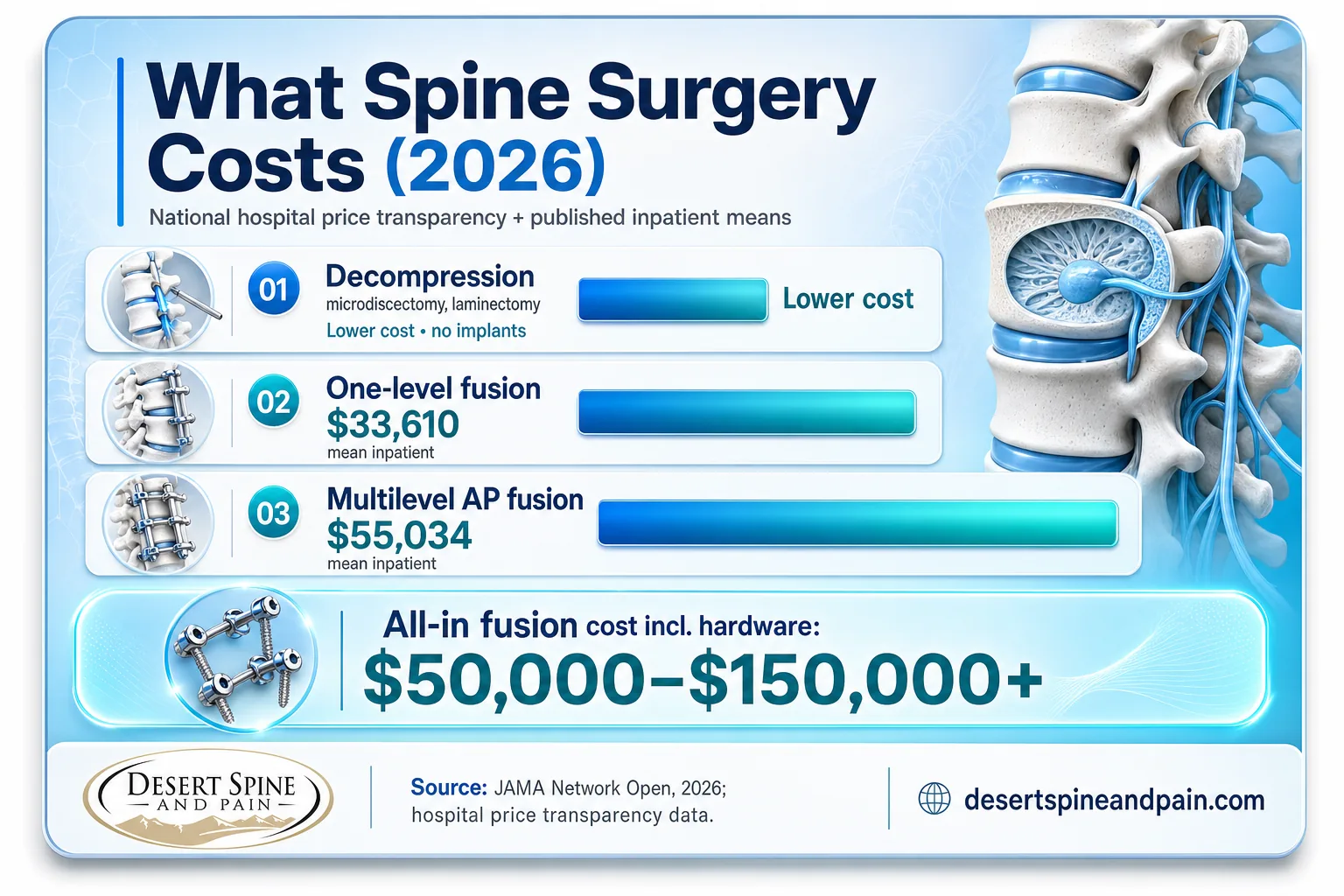
Source: JAMA Network Open (Martin et al., 2026) | Hospital price transparency data
See conservative, non-surgical options first2What Drives the Price
The wide range in spine surgery costs is not random. Peer-reviewed cost analyses consistently point to the same drivers: surgical approach, implants and hardware, operating-room time, and length of hospital stay. Complexity compounds all of them. In the 2026 JAMA data, a one-level single-column fusion averaged $33,610 in 2023, while a multilevel anterior-posterior fusion averaged $55,034, a difference of more than $21,000 for procedures that share a name but not a scope.
Mean Inpatient Cost by Fusion Complexity (2023)
Source: Martin et al., JAMA Network Open, 2026. Inpatient hospital costs, inflation-adjusted.Anterior approaches also tend to cost more than posterior ones. One multi-hospital analysis found the mean cost difference based on approach was about $6,901. The takeaway for patients is that the specific technique, not just the diagnosis, shapes the bill.
Source: JAMA Network Open, 2026 | The Spine Journal (cost by approach)
Learn about minimally invasive spine surgery3Facility and Regional Variation
Perhaps the most actionable statistic for patients is how much the same procedure can cost at different facilities. Hospital price-transparency data covering 1,760 hospitals found that facility fees for a posterior lumbar interbody fusion ranged from about $1,296 to more than $27,187, with most falling between $3,647 and $17,335. That is a price difference of more than 20 times between the cheapest and most expensive facilities for the same billing code.
Geographic variation is just as striking, and long-documented. A classic study of the Medicare population found up to a 20-fold variation in lumbar fusion rates between the highest and lowest regions of the country, a spread many researchers attribute to differing surgical practice patterns rather than differing patient needs.
The data says otherwise. The same fusion can cost 20 times more at one facility than another, and specialty centers sometimes offer bundled pricing 30 to 50 percent below academic hospitals. Asking for an itemized estimate, an all-inclusive bundled price, and a breakdown of implant charges can meaningfully change what you pay. Price transparency rules exist precisely so patients can compare.
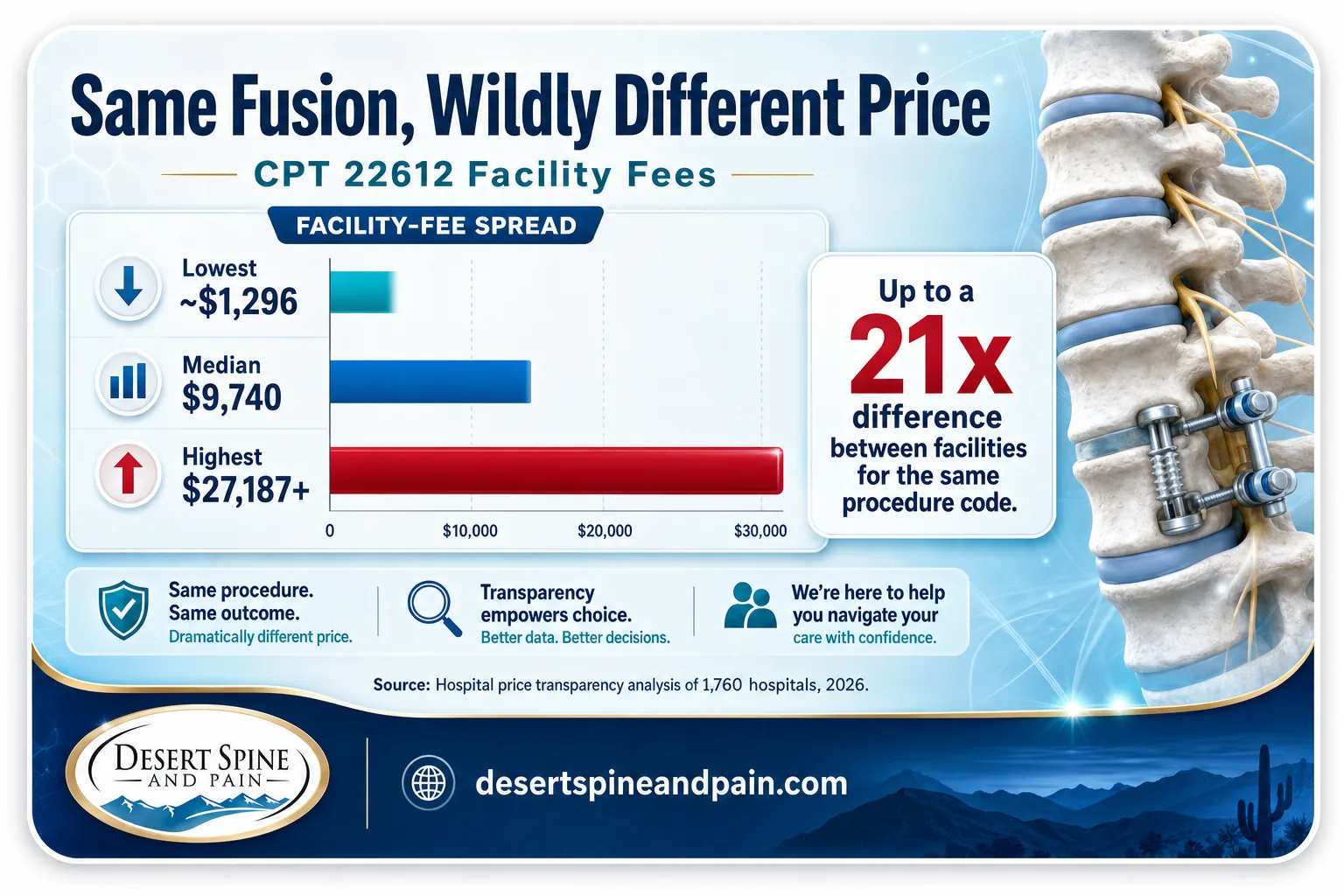
Source: Hospital price transparency data (1,760 hospitals) | Cost Analysis of Single-Level Lumbar Fusions (PMC)
Understand out-of-network cost estimates4The 20-Year Cost Trend
Spine surgery costs have not just been high, they have been climbing. The 2026 JAMA Network Open analysis tracked lumbar fusion from 2002 to 2023 and found that inflation-adjusted national inpatient spending on the procedure rose from $3.86 billion to $14.1 billion, even as the number of procedures and the population changed. Mean per-procedure inpatient cost climbed from $25,849 to $45,458 over the same period.
Two structural shifts explain much of the rising cost. First, procedures grew more complex: combined anterior-posterior fusions rose from 19.6% of procedures in 2016 to 41.1% in 2023, and multilevel fusions rose from 44.8% to 50.1%, while simpler single-level single-column fusions fell from 43.7% to 25.1%. Second, indications shifted, with fusion rates for scoliosis rising 271.2% over the study period. The move toward outpatient surgery is one countertrend that can reduce cost per case.
Combining two figures from the 2026 JAMA data isolates the cost of complexity. A one-level single-column fusion averaged $33,610 in 2023, while a multilevel anterior-posterior fusion averaged $55,034. That is a $21,424 difference, or roughly 64% more, for greater surgical scope. As the mix has shifted toward those more complex procedures (AP fusions more than doubling as a share since 2016), average costs have risen even where per-unit prices held. It reinforces why confirming that the least-invasive-effective procedure is being recommended matters both clinically and financially. Calculation and interpretation original to Desert Spine and Pain, based on JAMA Network Open (2026) data.
Source: JAMA Network Open (Martin et al., 2026) | Study summary
Explore our spine surgery options5Cost, Overuse, and Getting Value
The cost conversation is inseparable from a clinical one. Lumbar fusion has drawn scrutiny for years over geographic variation, complication risk, and questions about effectiveness for some common conditions. Fusion added to a simple decompression, when there is no instability, remains debated in the literature. That is why many specialists, and most insurers, favor documented conservative care and an independent second opinion before fusion.
This is where a least-invasive-first practice adds value. Desert Spine and Pain is led by Dr. David L. Greenwald, MD, FACS, who is both a spine surgeon and a neurosurgeon, and the practice's philosophy is to pursue the least invasive effective treatment first, from conservative care and interventional pain procedures through minimally invasive surgery, and to reserve complex surgery for when it is genuinely warranted. For patients who were told fusion was their only option, an independent second opinion can sometimes reveal a less invasive, less costly path.
On the financial side, the practice works with patients across the network spectrum, including out-of-network patients and those referred by personal injury attorneys. The administrative team verifies benefits, explains costs up front, and assists with reimbursement paperwork, and for attorneys, coordinates documentation directly with legal teams. For how often insurers deny claims in the first place, see our report on health insurance claim denial statistics.
Has conservative care been fully tried? Is this the least invasive effective option? What is the all-in, bundled price including implants? What will my out-of-pocket cost be after insurance, and what is covered out-of-network? Is an independent second opinion available? Getting clear answers protects both your health and your finances. This article is general information, not medical or financial advice; consult a qualified provider about your specific situation.
Source: Hospital price transparency analysis | JAMA Network Open, 2026
Get a consultation: (602) 566-9500Spine Surgery Cost Statistics: Summary Table (2026)
| Statistic | Figure | Source | Year |
|---|---|---|---|
| Mean inpatient lumbar fusion cost | $45,458 | JAMA Network Open | 2023 |
| Mean inpatient lumbar fusion cost (2002) | $25,849 | JAMA Network Open | 2002 |
| One-level single-column fusion (mean) | $33,610 | JAMA Network Open | 2023 |
| Multilevel anterior-posterior fusion (mean) | $55,034 | JAMA Network Open | 2023 |
| All-in fusion cost incl. hardware | $50,000-$150,000+ | Price transparency analysis | 2026 |
| Median facility fee, posterior lumbar interbody fusion | $9,740 | Price transparency (1,760 hospitals) | 2026 |
| Facility fee range (same fusion code) | $1,296-$27,187+ | Price transparency analysis | 2026 |
| Typical facility fee middle range | $3,647-$17,335 | Price transparency analysis | 2026 |
| Hospital implant markup range | 200%-500% | Price transparency analysis | 2026 |
| Bundled-price savings vs. academic centers | 30%-50% | Price transparency analysis | 2026 |
| Total U.S. inpatient lumbar fusion spending | $14.1 billion | JAMA Network Open | 2023 |
| Total U.S. inpatient lumbar fusion spending (2002) | $3.86 billion | JAMA Network Open | 2002 |
| Inpatient lumbar fusion procedures | 274,750 | JAMA Network Open | 2023 |
| Annual spinal fusions (all settings) | ~500,000 | Price transparency analysis | 2026 |
| Outpatient share of lumbar fusions | 9.8% | JAMA Network Open | 2023 |
| Combined AP fusion share | 41.1% | JAMA Network Open | 2023 |
| Fusion rate increase for scoliosis (2002-2023) | 271.2% | JAMA Network Open | 2023 |
| Cost difference, anterior vs. posterior approach | ~$6,901 | The Spine Journal | 2021 |
| Regional variation in fusion rates (Medicare) | Up to 20-fold | PMC / Medicare analysis | Historical |
| Mean patient age, lumbar fusion | ~63 years | JAMA Network Open | 2023 |
Frequently Asked Questions
How much does spine surgery cost in 2026?
Why does spine surgery cost so much?
Is spinal fusion overused?
Does insurance cover spine surgery?
How can I reduce the cost of spine surgery?
Methodology & Sources
How we compiled this report
All figures are drawn from Tier 1 primary sources: peer-reviewed research and hospital price-transparency data. National cost and utilization trends come from Martin BI, Mirza SK, Karamian BA, et al., "Cost and Utilization Trends of Lumbar Fusion," JAMA Network Open, 2026;9(3):e260452, a cross-sectional analysis of more than 5 million lumbar fusion admissions using the National Inpatient Sample (2002-2023) and Nationwide Ambulatory Surgical Sample (2016-2022). Facility-fee and transparency figures reflect analyses of negotiated-rate data reported by hospitals under federal price-transparency rules (CPT 22612, posterior lumbar interbody fusion). Cost-by-approach data come from peer-reviewed spine journals. Regional-variation figures reference Medicare-population analyses.
Inpatient cost figures are inflation-adjusted hospital costs, which differ from charges and from patient out-of-pocket amounts. All-in cost ranges include hardware, surgeon, anesthesia, and facility fees and vary by case. Figures are rounded. Costs vary by procedure, facility, region, implant, and insurance; individual costs may differ substantially.
- Martin BI, Mirza SK, Karamian BA, et al. "Cost and Utilization Trends of Lumbar Fusion." JAMA Network Open. 2026;9(3):e260452
- Hospital price-transparency analyses of negotiated rates (CPT 22612), 1,760 hospitals (2026)
- Crawford AM, et al. Cost variability by surgical approach, The Spine Journal (2021)
- Cost Analysis of Single-Level Lumbar Fusions, PMC (peer-reviewed)
- Centers for Medicare & Medicaid Services (CMS), price transparency and TEAM payment model
You are welcome to cite these statistics with attribution to the original primary sources named above (JAMA Network Open, the cited spine journals, and CMS). When referencing the Desert Spine and Pain Analysis, please attribute the calculation to Desert Spine and Pain. This article is general information and not medical or financial advice.