

Discectomy Statistics (2026): Success Rates, Reherniation, and Reoperation
Discectomy is one of the most effective spine operations for leg pain from a herniated disc, with good or excellent outcomes in about 79 percent of patients across 39,048 cases and leg-pain relief as high as 80 to 95 percent. The main long-term consideration is reherniation, which drives most reoperations and is one reason technique and timing matter.
- A review of 39,048 patients found 78.9 percent reported good or excellent outcomes at an average 6.1-year follow-up.
- Leg pain relief success runs 80 to 95 percent, the symptom that most often drives patients to surgery.
- Microdiscectomy outperformed open discectomy in one comparison: 86.8 percent versus 77.8 percent success, with lower complication rates.
- Reherniation occurs in about 5 to 21 percent of patients and is the leading cause of reoperation.
- In the largest nationwide cohort (308,979 patients), the 5-year reoperation rate was 14.4 percent, rising to 18.2 percent after revision discectomy.
- Outcomes are best when surgery occurs within about 6 to 12 months of symptom onset for appropriate candidates.
- Technique, timing, and patient selection all shape results, which is why an experienced surgeon's evaluation matters.
What's in This Guide
1Discectomy Types and How Common They Are
A discectomy removes part or all of a herniated disc to relieve pressure on spinal nerves. It is one of the most common spine procedures, and it comes in several forms that differ mainly in how the disc is accessed.
The main techniques are open discectomy, microdiscectomy (using a microscope and a smaller incision), and endoscopic discectomy (using a small camera and the least invasive access). Microdiscectomy is the most common minimally invasive form and is often considered the reference standard for single-level herniation.
Our Phoenix practice, led by board-certified neurosurgeon and spine surgeon Dr. David L. Greenwald, MD, FACS, offers the full range of discectomy techniques and matches the approach to the specific herniation and patient.
Explore discectomy options in PhoenixSource: Herniated disc surgery outcomes review | Nationwide discectomy cohort, Spine 2025
2Success Rates by Technique
Discectomy success is usually measured by relief of leg pain (sciatica), the symptom most patients want resolved. Across techniques, the results are consistently strong.
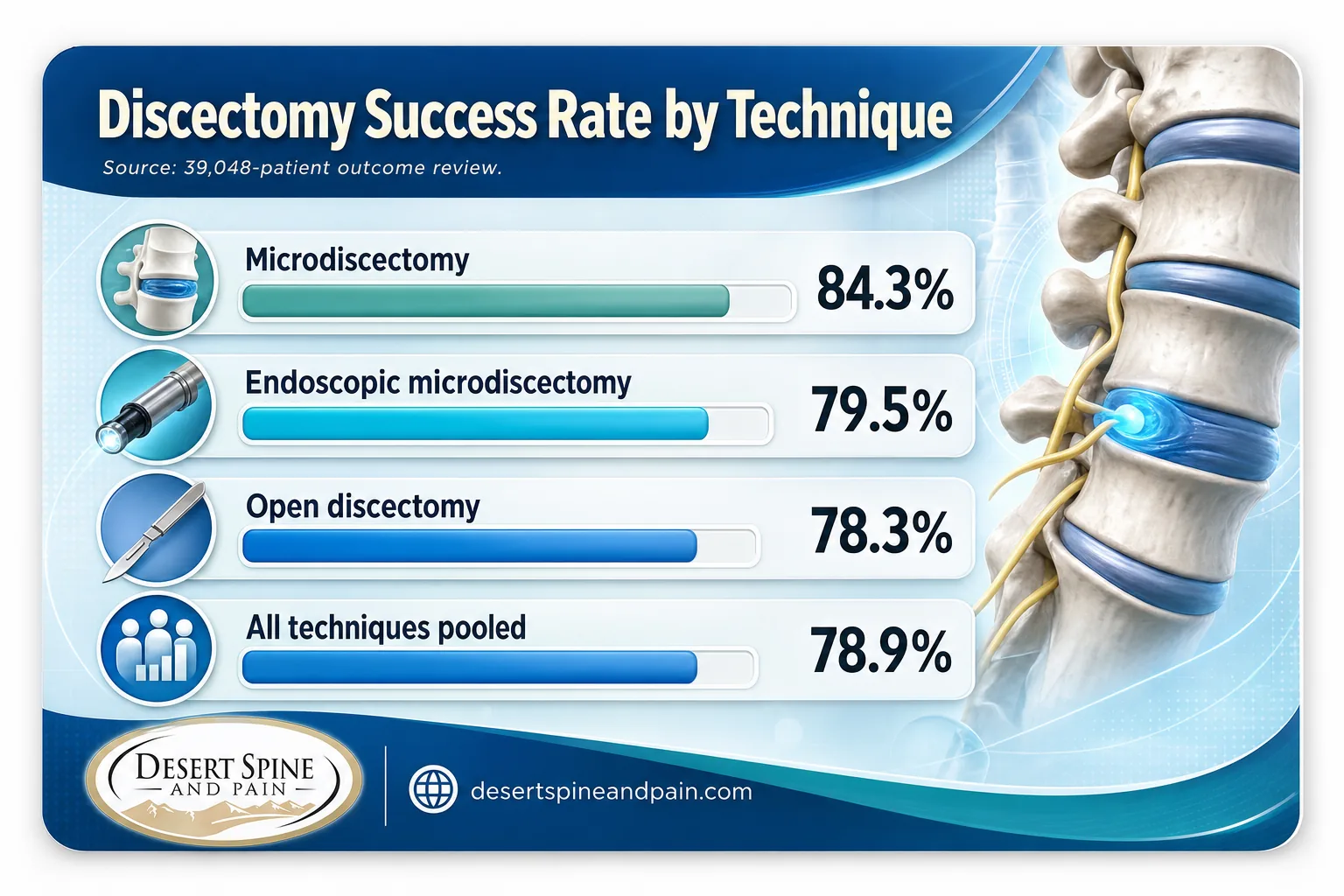
The pattern favors minimally invasive technique modestly: microdiscectomy showed the highest success and lowest complication rate in head-to-head data, with discitis occurring in 0.4 percent of microdiscectomy patients versus 2.6 percent of open discectomy patients. Still, all techniques deliver strong relief for well-selected patients, so the choice is tailored to the herniation.
Learn about minimally invasive discectomySource: Herniated disc surgery outcomes review | Microdiscectomy vs open discectomy, PMC
3Reherniation Rates
The most important long-term risk after discectomy is reherniation, when a new fragment of disc herniates at the same level. It is the leading cause of needing another operation.
Reherniation risk is influenced by identifiable factors including age, body mass index, diabetes, herniation type, and the level operated on. Because it is the main driver of reoperation, counseling patients about it, and addressing modifiable risk factors before surgery, is an important part of good surgical planning.
The data says otherwise. While reherniation is the most common reason for reoperation, the large majority of discectomy patients, roughly 80 to 95 percent, do not reherniate and enjoy lasting relief. The 5 to 21 percent who do reherniate are a minority, and their risk is partly tied to factors that can be identified in advance. Framing discectomy as inevitably temporary misrepresents strong long-term outcomes.
Source: Recurrent herniation study, Spine Surgery and Related Research 2025 | Long-term discectomy outcomes
4Reoperation and Revision Data
Reoperation rates after discectomy have long been debated, but recent large-scale data has clarified the picture. The numbers are moderate and rise with follow-up time and after revision surgery.
The nationwide cohort of 308,979 patients found a 5-year reoperation rate of 14.4 percent after primary discectomy and 6.1 percent going on to fusion. After a revision discectomy, those figures rose to 18.2 percent and 12.4 percent, again showing that each additional operation carries higher risk. Obesity and greater overall comorbidity were identified as significant risk factors for needing further surgery.
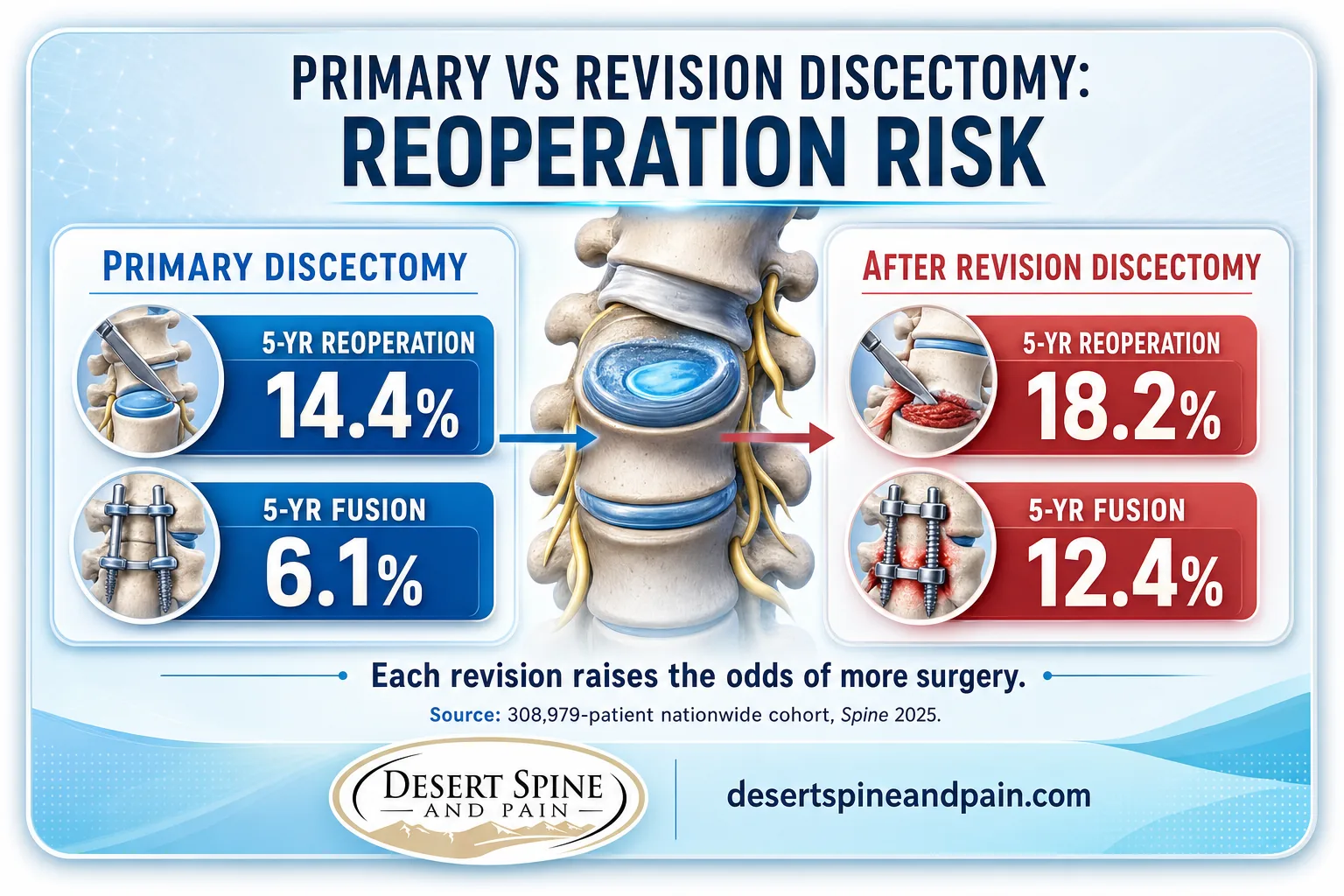
Comparing the primary discectomy 5-year reoperation rate (14.4 percent) with the revision discectomy rate (18.2 percent), and the jump in subsequent fusion from 6.1 to 12.4 percent, shows the same pattern seen across spine surgery: outcomes are best the first time, and each revision raises the odds of yet more surgery. Careful selection, technique, and addressing modifiable risks like obesity at the outset protect against that escalating cascade. Interpretation original to Desert Spine and Pain.
Source: Nationwide discectomy cohort, Spine 2025 | 10-year microendoscopic reoperation study, PubMed
5Timing and Patient Factors
When a discectomy is performed, and on whom, affects how well it works. The evidence points to a window where surgery tends to help most.
The research supports a balanced approach: conservative care first, then surgery within a reasonable window if symptoms persist and a clear surgical target exists. Operating too late can reduce benefit, while operating too early may mean treating a disc that would have recovered on its own. This is exactly the kind of judgment a least-invasive-first philosophy is built to handle.
Desert Spine and Pain works with out-of-network patients of every kind and partners closely with personal injury attorneys, offering 24/7 concierge response and documentation coordination for injured clients with herniated discs from accidents.
See conservative care options firstSource: Long-term discectomy outcomes | Recurrent herniation study, PMC 2025
Summary Table: Discectomy Statistics 2026
| Statistic | Figure | Source | Year |
|---|---|---|---|
| Good/excellent outcomes (39,048 patients) | 78.9% | Outcome review | 2025 |
| Leg pain relief success | 80 to 95% | Long-term outcomes lit. | 2026 |
| Microdiscectomy success | 84.3% | Outcome review | 2025 |
| Endoscopic microdiscectomy success | 79.5% | Outcome review | 2025 |
| Open discectomy success | 78.3% | Outcome review | 2025 |
| Micro vs open success (head-to-head) | 86.8% vs 77.8% | PMC comparison | 2025 |
| Discitis, micro vs open | 0.4% vs 2.6% | PMC comparison | 2025 |
| Reherniation rate (primary) | 5 to 21% | Spine Surgery & Related Research | 2025 |
| Reherniation within 10 years | 5 to 15% | Long-term outcomes lit. | 2026 |
| 5-year reoperation (primary) | 14.4% | Spine (PearlDiver cohort) | 2025 |
| 5-year fusion after primary | 6.1% | Spine (PearlDiver cohort) | 2025 |
| 5-year reoperation (after revision) | 18.2% | Spine (PearlDiver cohort) | 2025 |
| 5-year fusion (after revision) | 12.4% | Spine (PearlDiver cohort) | 2025 |
| 10-year reoperation (microendoscopic) | 22.1% | PubMed follow-up study | 2021 |
| Best surgery window from onset | 6 to 12 months | Long-term outcomes lit. | 2026 |
| Nationwide cohort size | 308,979 | Spine (PearlDiver cohort) | 2025 |
Frequently Asked Questions
What is the success rate of a discectomy?
How common is reherniation after discectomy?
What is the reoperation rate after lumbar discectomy?
Is microdiscectomy better than open discectomy?
When is the best time to have a discectomy?
Methodology & Sources
How we compiled these statistics
Every figure traces to a Tier 1 primary source: large nationwide cohort studies, systematic reviews, meta-analyses, and comparative studies. Success rates reflect appropriately selected patients and describe populations, not any individual. Reherniation and reoperation ranges reflect differences in follow-up length, patient factors, and technique. All statistics describe averages, not guarantees.
Primary sources referenced:
- Long-term reoperation rates after single-level lumbar discectomy (308,979 patients), Spine, PearlDiver cohort, 2025
- Herniated disc surgery outcomes review (39,048 patients), technique-specific success rates
- Microdiscectomy versus open discectomy comparison, PMC, 2025
- Patient factors associated with recurrent herniation and revision, Spine Surgery and Related Research, 2025
- Risk factors and reoperation rate in revision lumbar disc herniation surgery meta-analysis (1,031,348 patients), 2026
- Long-term reoperation rates after microendoscopic discectomy (10-year follow-up), PubMed
This article is educational and is not individual medical advice. For guidance specific to your spine condition, consult a qualified spine surgeon. No outcome can be guaranteed.
Journalists and researchers may cite these statistics with attribution to Desert Spine and Pain and a link to this page. Please attribute the underlying figures to their original Tier 1 sources as listed above. For expert commentary on discectomy data from a board-certified neurosurgeon and spine surgeon, contact Desert Spine and Pain at (602) 566-9500.