

Microdiscectomy Statistics (2026): Success Rates, Recovery, and Recurrence
Microdiscectomy is the reference-standard minimally invasive surgery for a herniated disc, relieving leg pain in roughly 80 to 90 percent of patients as a same-day outpatient procedure. Its benefits are durable, one 10-year study found success fell only from 91 to 83 percent, with recurrence being the main long-term consideration.
- Microdiscectomy success rates are reported at roughly 80 to 90 percent, with rigorous prospective studies more conservative at 73 to 79 percent.
- It is usually an outpatient procedure, with most patients home the same day and about 80 percent back to work within 12 weeks.
- A 10-year follow-up found success declined only from 91 percent at 6 months to 83 percent at 10 years, showing durable benefit.
- Recurrence occurs in about 5 to 15 percent of cases in most studies, with a wider 3 to 24 percent range and up to 21 percent in some series.
- Infection is rare at under 1 percent, and dural tear occurs in about 1 to 3 percent.
- Real-world outcomes are modestly lower than trial outcomes (66 vs 79 percent), largely due to stricter patient selection in trials.
- Recurrence risk is tied to modifiable factors and to surgeon skill, which is why technique and selection matter.
What's in This Guide
1Microdiscectomy Success Rates
Microdiscectomy uses a microscope and a small incision to remove the portion of a herniated disc pressing on a nerve root. It is one of the most reliable spine operations for relieving sciatica, the leg pain that most often drives patients to surgery.
The spread in reported success, from the low 70s to the 90s, comes down to study design and how success is defined. Retrospective reports tend to be higher, prospective trials more conservative. When measured by pain relief and return to daily activities, most studies converge on the 80 to 90 percent range for well-selected patients.
Our Phoenix practice, led by board-certified neurosurgeon and spine surgeon Dr. David L. Greenwald, MD, FACS, performs microdiscectomy with microsurgical precision as part of a least-invasive-first approach to herniated discs.
Explore microdiscectomy in PhoenixSource: Recurrent herniation study, Spine Surgery and Related Research 2025
2Recovery and Return to Work
One of the biggest advantages of microdiscectomy over open surgery is a faster, easier recovery. Because tissue disruption is minimal, most patients recover quickly.
The rapid recovery has practical value beyond convenience. For working-age patients, and for personal injury clients whose recovery timeline affects both their health and their case, a faster return to function matters. Compared with open discectomy, microdiscectomy delivers similar pain relief with less postoperative pain and quicker recovery.
Learn about minimally invasive spine surgerySource: Microdiscectomy procedure overview
3Recurrence Rates
The main long-term risk after microdiscectomy is recurrent disc herniation, a new herniation at the same level. Understanding the true rate helps patients weigh the procedure realistically.
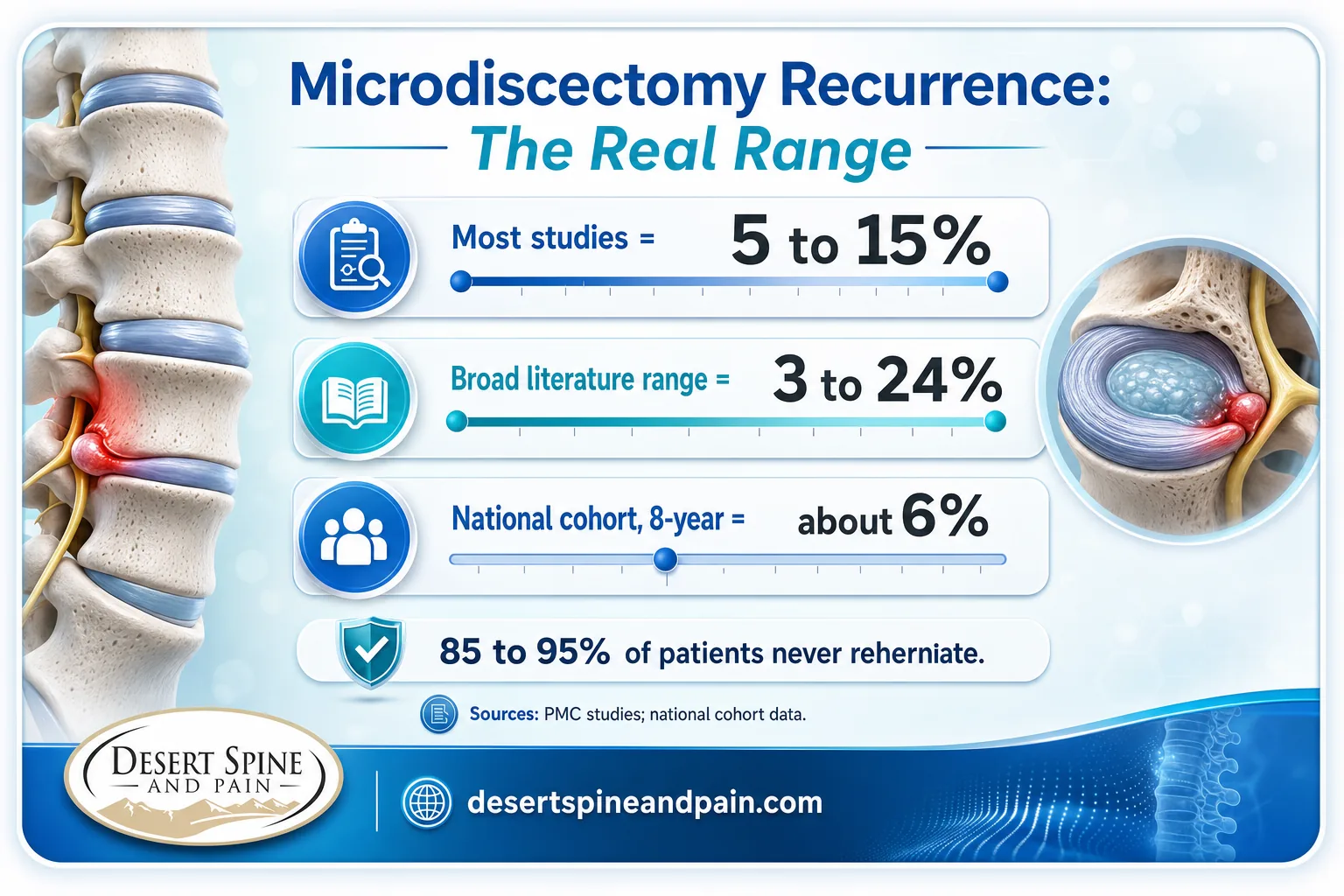
Recurrence risk is not random. Studies consistently link it to age, obesity, smoking, diabetes, larger herniations, disc height, disc location, and the amount of disc material removed. Surgeon technique also plays a significant role. Because several of these factors are modifiable or assessable before surgery, careful preoperative planning can lower the odds.
Not true. In most studies, 85 to 95 percent of patients do not experience a recurrence, and long-term satisfaction stays high. Recurrence is the most common reason a minority need further treatment, but it is a minority. The larger story is durable relief for the great majority, especially when modifiable risk factors are addressed and patient selection is careful.
Source: Recurrence factors study (130 patients), PMC | Recurrent herniation study, PMC 2025
4Long-Term Durability
A fair question about any surgery is whether the relief lasts. For microdiscectomy, long-term data is reassuring: the benefits hold up well over years.
The gap between real-world cohorts (about 66 percent) and randomized trials (about 79 percent) is instructive. It largely reflects that trials use stricter patient selection, which is itself a lesson: careful selection of the right candidate is a major driver of a good long-term result. That is a decision made before surgery, by the surgeon and patient together.

When trial outcomes (about 79 percent) exceed real-world outcomes (about 66 percent) largely because of stricter patient selection, the message is clear: who is chosen for surgery matters as much as the surgery itself. A careful evaluation that selects genuinely appropriate candidates effectively moves a patient closer to the higher, trial-level odds. That selection is exactly what an experienced surgeon's judgment provides. Interpretation original to Desert Spine and Pain.
Source: Long-term revision microdiscectomy outcomes, European Spine Journal 2024
5Revision Microdiscectomy Outcomes
When a disc reherniates and conservative care fails again, a revision microdiscectomy may be considered. The outcomes here are more modest, reinforcing why the first surgery matters most.
Revision surgery is a viable option for a confirmed recurrent herniation, but its outcomes are less predictable than a first, well-planned microdiscectomy. This is the same theme seen across spine surgery: the first operation, done right, offers the best odds, which is why accurate diagnosis and surgical experience are so valuable at the outset.
Desert Spine and Pain works with out-of-network patients of every kind and partners closely with personal injury attorneys, offering 24/7 concierge response and documentation coordination for injured clients with herniated discs.
See conservative care options firstSource: Long-term revision microdiscectomy outcomes, European Spine Journal 2024
Summary Table: Microdiscectomy Statistics 2026
| Statistic | Figure | Source | Year |
|---|---|---|---|
| Microdiscectomy success rate | 80 to 90% | Spine Surgery & Related Research | 2025 |
| Prospective study success range | 73 to 79% | Prospective outcome lit. | 2025 |
| Short-term pain relief | 80 to 90% | Microdiscectomy outcome lit. | 2025 |
| Typical discharge | Same day | Procedure literature | 2025 |
| Return to work | 2 to 6 weeks | Procedure literature | 2025 |
| Back to work within 12 weeks | ~80% | Long-term outcome lit. | 2025 |
| Recurrence rate (typical) | 5 to 15% | Recurrence literature | 2026 |
| Recurrence range (broad) | 3 to 24% | PMC retrospective study | 2024 |
| Reherniation (national cohort, 8 yr) | ~6% | National cohort | 2025 |
| Recurrence in some series | Up to 21% | PMC recurrent herniation | 2025 |
| Infection rate | <1% | Procedure literature | 2024 |
| Dural tear rate | 1 to 3% | Procedure literature | 2024 |
| Success at 6 mo vs 10 yr | 91% vs 83% | 10-year follow-up | 2025 |
| Real-world vs trial long-term success | 66% vs 79% | European Spine Journal | 2024 |
| Revision good outcome range | 69 to 86% | European Spine Journal | 2024 |
| Revision favorable recovery at 10 yr | 40% | European Spine Journal | 2024 |
Frequently Asked Questions
What is the success rate of microdiscectomy?
How long is recovery after microdiscectomy?
How common is recurrence after microdiscectomy?
Does microdiscectomy last long term?
What lowers the risk of recurrence after microdiscectomy?
Methodology & Sources
How we compiled these statistics
Every figure traces to a Tier 1 primary source: national surgical databases, cohort studies, randomized trials, and systematic reviews. Success and recurrence ranges reflect differences in study design, follow-up length, patient selection, and how outcomes are defined. Recovery and return-to-work figures are typical estimates and vary by individual and job demands. All statistics describe populations, not any individual patient.
Primary sources referenced:
- Patient factors associated with recurrent herniation and revision following lumbar microdiscectomy (ACS-NSQIP database), Spine Surgery and Related Research, 2025
- Long-term outcome of revision microdiscectomy for recurrent sciatica (216 patients), European Spine Journal, 2024
- Factors influencing recurrence rates and surgical outcomes in lumbar microdiscectomy (130 patients), PMC
- 10-year and long-term microdiscectomy follow-up outcome literature
- Microdiscectomy procedure and recovery clinical literature
This article is educational and is not individual medical advice. For guidance specific to your spine condition, consult a qualified spine surgeon. No outcome can be guaranteed.
Journalists and researchers may cite these statistics with attribution to Desert Spine and Pain and a link to this page. Please attribute the underlying figures to their original Tier 1 sources as listed above. For expert commentary on microdiscectomy data from a board-certified neurosurgeon and spine surgeon, contact Desert Spine and Pain at (602) 566-9500.