

Lumbosacral Spondylosis Without Myelopathy: What It Means
If a doctor or a radiology report handed you the phrase "lumbosacral spondylosis without myelopathy," the most important word in it is without. The diagnosis is describing ordinary age-related wear and arthritis in your lower spine, and it is specifically telling you that the one thing people worry about most, pressure on the spinal cord, is not happening. It sounds alarming because it is written in medical shorthand, but for the large majority of people it is a common, manageable finding rather than a warning of something dangerous.
Quick definition. Lumbosacral spondylosis without myelopathy is age-related wear and arthritis in the discs, joints, and bones of your lower spine (the lumbosacral region) that has not caused any compression or injury to the spinal cord. In plain terms: your low back shows normal aging changes, and the cord, the structure that matters most, is unaffected.
- Spondylosis = spinal arthritis. It is the catch-all term for the wear-and-tear changes (worn discs, bone spurs, arthritic facet joints) that build up in the spine with age.
- Lumbosacral = your lower back. It points to the bottom of the lumbar spine where it meets the sacrum, roughly the L4 to S1 levels that carry most of your body weight.
- "Without myelopathy" is the good news. It confirms the wear is not compressing or damaging the spinal cord.
- It is extremely common. By age 80, degenerative changes show up on the scans of nearly everyone, including people with no pain at all.
- Treatment is usually conservative. Staying active, exercise, and, when needed, targeted injections handle most cases. Surgery is rarely required for spondylosis by itself.

What's in This Guide
- Decoding the Full Phrase, Word by Word
- What Is Lumbosacral Spondylosis?
- What "Without Myelopathy" Really Means
- Your ICD-10 Code: M47.816 and M47.817
- How Common Is It, and Should You Worry?
- What Causes It
- Spondylosis vs. the Sound-Alikes
- Symptoms and How It Feels
- When It Is Not Just Spondylosis
- How It Is Diagnosed
- How It Is Treated
- Frequently Asked Questions
- Related Terms
- Methodology and Sources
Decoding the Full Phrase, Word by Word
Medical diagnoses are built from stacked words, and each one narrows down the meaning. Read the phrase one piece at a time and it stops being intimidating.
| The word | What it tells you |
|---|---|
| Spondylosis | Age-related wear and arthritis of the spine: worn discs, bone spurs (osteophytes), and arthritic facet joints. |
| Lumbosacral | The location, your lower back where the lumbar spine meets the sacrum, around the L4 to S1 levels. |
| Without myelopathy | The spinal cord is not being compressed or injured. This is the reassuring part of the diagnosis. |
| (Without radiculopathy) | If your code is M47.816 or M47.817, it also means no spinal nerve root is pinched, so no sciatica-type pain running down the leg. |
Put together, the phrase says: you have normal aging changes in your lower spine, and neither your spinal cord nor your nerve roots are being squeezed by them. That is a very different message from the one most people fear when they first read it.
What Is Lumbosacral Spondylosis?
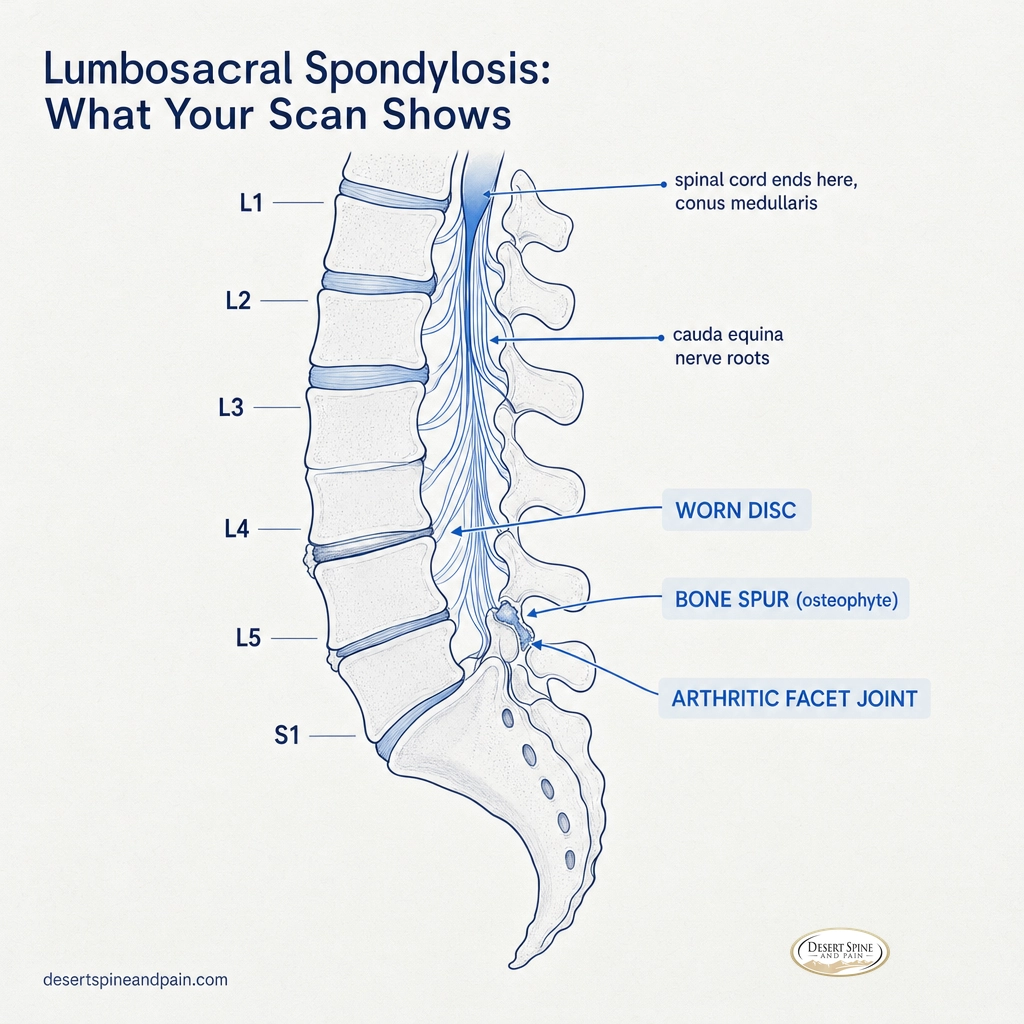
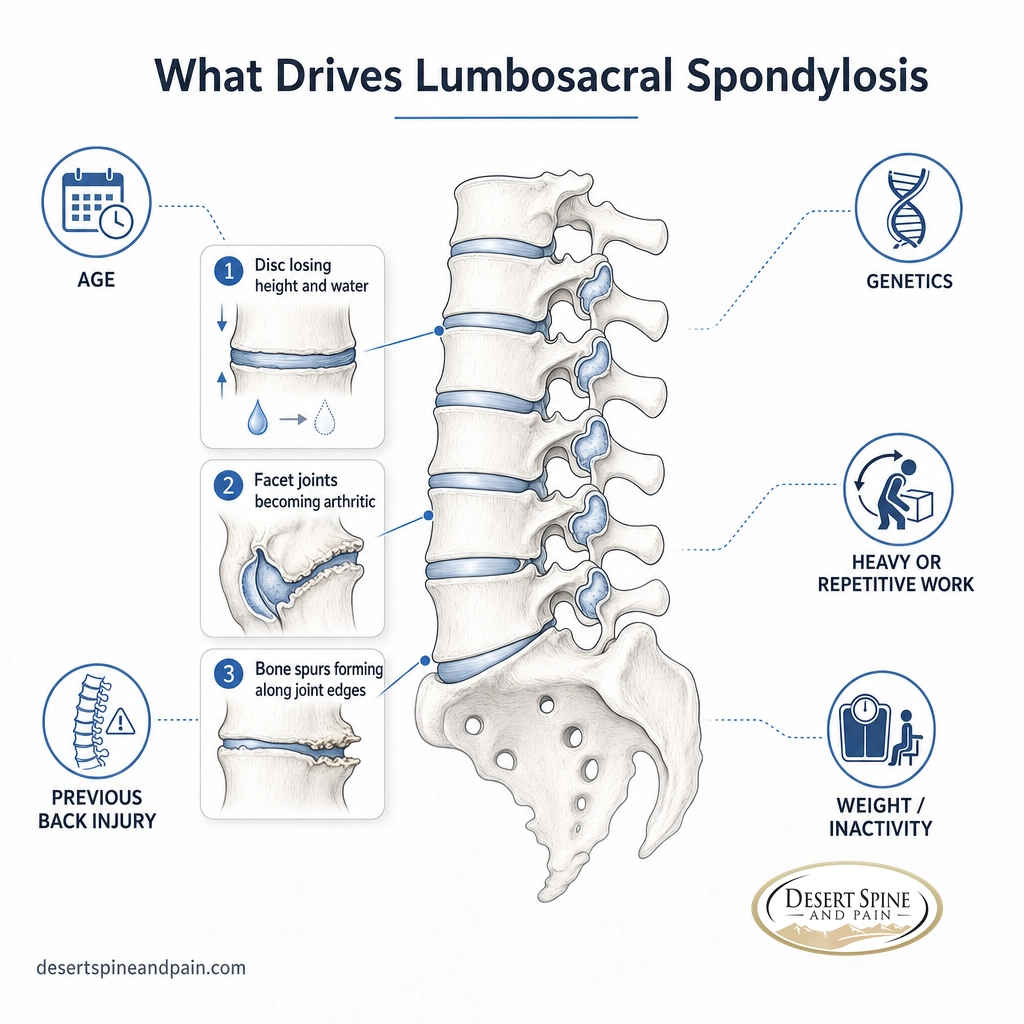
Spondylosis is the medical name for spinal arthritis, the slow wear and tear that affects nearly every spine over time. In the lumbosacral region it shows up as three main changes that tend to happen together: the cushioning discs between the vertebrae lose height and water content, the small facet joints at the back of the spine become arthritic, and the body lays down extra bone (bone spurs, or osteophytes) along the edges of worn joints. The lower back is a common place for this, because the L4 to S1 levels carry and pivot much of your body weight for a lifetime.
None of that is a disease you catch or a sign you did something wrong. It is the spine aging the same way knees and hips do. In fact, the United Kingdom's National Health Service describes this kind of spinal wear as "a normal part of ageing," noting that many people who have it never develop symptoms at all. The changes on your scan are the spine showing its mileage, not evidence of damage in progress.
Because spondylosis is a broad umbrella term, it often travels with more specific findings. The same wear can lead to a worn disc diagnosis like degenerative disc disease, and if the arthritic changes start to narrow the spinal canal, they can contribute to spinal stenosis. For a plain-language look at the term across all regions of the spine, our overview of spondylosis without myelopathy covers the general concept.
Source: NHS: Spondylosis (age-related spinal wear)
What "Without Myelopathy" Really Means
Myelopathy is any condition in which the spinal cord itself is compressed or injured. Because the cord is the central cable carrying signals between the brain and the body, pressure on it can cause serious, whole-body problems. "Without myelopathy" is your report's way of certifying that nothing like that is happening: the exam and the imaging show no sign of cord compression.
There is an extra layer of reassurance that is specific to the lower back. The spinal cord does not run the full length of your spine. In most adults it tapers and ends near the top of the lumbar spine, around the L1 vertebra, at a point called the conus medullaris. Below that, the spinal canal carries a bundle of loose nerve roots called the cauda equina rather than the cord itself. So in the lumbosacral region there is usually no spinal cord present to compress in the first place, which is one reason true myelopathy at this level is uncommon and the phrase "without myelopathy" is so often the honest finding.
The short version. "Without myelopathy" means the spinal cord is clear. In the lower spine that is doubly expected, because the cord has already ended higher up. What a surgeon watches for down here is pressure on the nerve roots instead, and if you have an M47.816 or M47.817 code, the "without radiculopathy" part says those roots are clear too.
If you want to understand the cord condition this phrase rules out, our explainer on what myelopathy is breaks it down in detail.
Your ICD-10 Code: M47.816 and M47.817
The phrase on your paperwork usually comes straight from the ICD-10-CM code system that doctors and insurers use to classify diagnoses. For lower-spine spondylosis with no cord or nerve-root involvement, there are three closely related codes, and the only difference between them is exactly where in the lower spine the changes were found.
| ICD-10-CM code | Official description |
|---|---|
| M47.816 | Spondylosis without myelopathy or radiculopathy, lumbar region |
| M47.817 | Spondylosis without myelopathy or radiculopathy, lumbosacral region |
| M47.818 | Spondylosis without myelopathy or radiculopathy, sacral and sacrococcygeal region |
"Lumbosacral" (M47.817) points to the junction where the lumbar spine meets the sacrum, the L5 to S1 area. "Lumbar" (M47.816) covers the lumbar levels more broadly. The practical takeaway is the same for all three: the code itself is built from the reassuring words. The system has a separate set of codes for spondylosis with myelopathy, and your code is deliberately not one of them.
Source: CMS ICD-10-CM official code set
How Common Is It, and Should You Worry?
This is the question most people really want answered, and the data is genuinely reassuring. Degenerative spine changes are so common with age that they are better thought of as normal than as abnormal. A landmark systematic review in the American Journal of Neuroradiology pooled imaging from more than 3,000 people with no back symptoms at all and tracked how often degeneration showed up by decade of life.
Facet joint arthritis, one of the core features of spondylosis, follows the same curve: in that same review, facet degeneration in symptom-free people rose from roughly 4 percent at age 20 to about 83 percent by age 80. In other words, if you scanned a random group of healthy, pain-free older adults, most of them would have spondylosis on the images and never know it.
That matters because it reframes your diagnosis. Finding spondylosis does not mean your pain is explained or your future is written. Globally, low back pain is the single leading cause of disability, affecting 619 million people in 2020 according to the World Health Organization, yet about 90 percent of low back pain is classed as "non-specific," meaning no single structural cause can be pinned down. The wear on your scan may or may not be the source of what you feel.
For a fuller picture of how widespread lower-back wear and pain really are, see our roundups of low back pain statistics and the most common causes of lower back pain.
Source: World Health Organization: Low Back Pain fact sheet | American Journal of Neuroradiology (2015): Imaging Features of Spinal Degeneration in Asymptomatic Populations
What Causes It
Lumbosacral spondylosis is driven mostly by time and load. As the discs lose water and height, the vertebrae settle closer together, which throws more stress onto the facet joints behind them. Those joints respond the way any weight-bearing joint does to decades of use: the cartilage thins, the joint becomes arthritic, and the body builds bone spurs around the edges. Several factors speed the process along:
- Age. The single biggest factor. The changes accumulate steadily from early adulthood onward.
- Genetics. A family history of early disc or joint degeneration raises your odds.
- Repetitive strain and heavy work. Years of lifting, bending, or impact loading add wear to the lower levels.
- Previous injury. An old back injury can accelerate degeneration at that level.
- Weight and inactivity. Extra load and weak supporting muscles increase stress on the lumbosacral joints.
Spondylosis vs. the Sound-Alikes
Part of why this diagnosis confuses people is that it sits in a family of nearly identical-sounding words, and they mean genuinely different things. Mixing them up is the single most common source of worry, so here is how they separate.
| Term | What it actually means |
|---|---|
| Spondylosis | General age-related wear and arthritis of the spine. This is your diagnosis. |
| Spondylolisthesis | One vertebra has slipped forward over the one beneath it. A position problem, not just wear. |
| Spondylolysis | A stress crack in a specific thin part of a vertebra (the pars), often from repetitive extension. |
| Ankylosing spondylitis | An inflammatory autoimmune arthritis of the spine, unrelated to simple wear and tear. |
These can overlap. Advanced spondylosis can contribute to a slip, which is why some people carry both a spondylosis and a spondylolisthesis note. But they are distinct findings, and your report uses the exact word that matches what your images showed. If your paperwork says spondylosis without myelopathy, it is describing wear, not a slip, a crack, or an autoimmune disease.
Symptoms and How It Feels
Here is the twist that surprises people: spondylosis often causes no symptoms at all. When it does, the complaints are usually mechanical and local to the lower back rather than dramatic. Typical patterns include:
- A dull, aching low back that is worse after activity and better with rest
- Stiffness, especially first thing in the morning or after sitting a long time
- Pain that eases when you keep moving gently and flares when you overdo it
- Occasional stiffness or soreness that comes and goes over months or years
Because the diagnosis is "without myelopathy" and, in the M47.816 and M47.817 codes, "without radiculopathy," what you should not have is nerve-driven symptoms: shooting pain down a leg, numbness, or weakness. If those appear, the picture has changed and it is worth a fresh evaluation, which is exactly what the next section covers.
When It Is Not Just Spondylosis
Spondylosis itself is benign wear. The reason to understand it clearly is so you can recognize the uncommon situations where the lower spine needs prompt attention, because a few symptoms signal pressure on the nerve roots rather than simple arthritis.
Myth: "Spondylosis on my scan means I am headed for back surgery or disability." Not true. These changes are a normal part of aging, most people who have them have no symptoms, and the words "without myelopathy" confirm the cord is clear. Spondylosis by itself is almost never a surgical problem. Surgery enters the conversation only if a specific, treatable issue such as significant nerve compression develops later, and even then most patients are managed without an operation.
That said, the lower spine does have one true emergency to know about. Below the point where the spinal cord ends, the cauda equina nerve roots can, rarely, be compressed by a large disc herniation or severe narrowing. The warning signs of cauda equina syndrome are not features of ordinary spondylosis and need emergency care, not a routine appointment.
Go to an emergency room if you develop any of these: new numbness in the "saddle" area (groin, buttocks, inner thighs), a new loss of bladder or bowel control, or sudden, significant weakness in both legs. These are red flags for cauda equina syndrome and should not wait. They are rare, and they are not caused by spondylosis alone, but every back patient deserves to know them.
Short of those emergencies, see a spine specialist for leg pain, numbness, or weakness that is new or worsening, or for back pain that is not improving after several weeks of sensible self-care. A proper evaluation can confirm the wear is still just wear.
Get Your Lower-Back Symptoms EvaluatedHow It Is Diagnosed
Spondylosis is usually identified on imaging, often as an incidental finding when you are scanned for something else. X-rays show the bone spurs, disc-space narrowing, and arthritic joints that define it. MRI adds detail on the soft tissues, the discs, ligaments, and nerves, and it is the test used to confirm whether anything is pressing on the nerve roots or the cord, which is how the "without myelopathy" and "without radiculopathy" parts get established.
The crucial point about diagnosis is the one the statistics already made: imaging findings are common even in people with no pain, so a scan showing spondylosis does not automatically explain your symptoms. A good spine evaluation weighs the images against your actual history and physical exam, rather than treating the scan as the whole story. Knowing which finding matters, and which is just background aging, is where an experienced spine surgeon earns their keep.
How It Is Treated
When spondylosis is present without cord or nerve-root compression, treatment is conservative and aimed at comfort and function, not at erasing the changes on the scan (which is neither possible nor necessary). The goal is to keep you active and comfortable.
First-line: keep moving and build support
The foundation is activity and exercise. Prolonged rest tends to make mechanical back pain worse, while staying active, strengthening the core and back muscles, stretching, and managing weight tends to improve it. Structured physical therapy, anti-inflammatory medication when appropriate, and simple ergonomic changes handle the majority of cases over time.
Explore Non-Surgical Pain TreatmentWhen arthritic joints are the pain source
When the arthritic facet joints are the main driver of pain, targeted procedures can help without surgery. Facet joint injections can calm an inflamed joint and help confirm it is the source, and if relief is short-lived, radiofrequency ablation can quiet the small nerves that carry pain from those joints for a longer stretch. These are in-office, minimally invasive options, not operations. Our roundup of facet joint injection statistics shows how often they help.
The right answer depends on the right diagnosis. Spondylosis without myelopathy is a reassuring finding, but "benign wear" and "a treatable nerve problem" can start with similar-sounding back complaints. That is why an evaluation by a surgeon who treats the entire spectrum, from conservative care to complex surgery, is worth more than any single scan. Dr. David L. Greenwald is a dual board-certified spine surgeon and neurosurgeon, so whether your lower back needs simple reassurance, a joint injection, or a closer look, the full range of expertise is in one place.
Frequently Asked Questions
Is lumbosacral spondylosis without myelopathy serious?
What does "without myelopathy" mean on my diagnosis?
What is the ICD-10 code for lumbosacral spondylosis without myelopathy?
What is the difference between spondylosis and spondylolisthesis?
How is lumbosacral spondylosis treated?
Related Terms
- Spondylosis without myelopathy: the same diagnosis described across all regions of the spine, not just the lower back.
- Myelopathy: compression or injury of the spinal cord, the condition your diagnosis specifically rules out.
- Degenerative disc disease: age-related drying and thinning of the spinal discs, a common partner to spondylosis.
- Spinal stenosis: narrowing of the spinal canal that arthritic changes can contribute to over time.
- Spondylolisthesis: forward slippage of one vertebra over another, a different finding that can coexist with wear.
- Osteophytes: the bone spurs the body forms along the edges of worn, arthritic spinal joints.
- Facet joints: the small paired joints at the back of the spine that become arthritic in spondylosis.
- Cauda equina: the bundle of nerve roots in the lower spinal canal, below where the cord ends.
Methodology and Sources
How we built this explainer
This guide explains a specific diagnostic phrase and its ICD-10-CM coding using official code references, a peer-reviewed systematic review of imaging in asymptomatic populations, and public-health and national-health-service descriptions of age-related spinal wear. Prevalence figures are cited at the point of use. The anatomical point that the spinal cord typically ends near the L1 level (the conus medullaris), above the lumbosacral region, reflects standard human anatomy. This content is general education, not individualized medical advice. Imaging findings are common even without symptoms, symptoms vary from person to person, and only a qualified evaluation can establish a diagnosis or treatment plan.
- CMS ICD-10-CM official code set (codes M47.816, M47.817, M47.818: Spondylosis without myelopathy or radiculopathy, lumbar / lumbosacral / sacral and sacrococcygeal region)
- Brinjikji W, et al. American Journal of Neuroradiology (2015): Systematic Literature Review of Imaging Features of Spinal Degeneration in Asymptomatic Populations (disc degeneration 37% at age 20 to 96% at age 80; facet degeneration roughly 4% to 83%)
- World Health Organization: Low Back Pain fact sheet (2023) (leading cause of disability worldwide; 619 million people in 2020; about 90% of low back pain is non-specific)
- NHS: Spondylosis (spinal spondylosis as a normal part of ageing, frequently without symptoms)